
lovethailand home >South Travel Attractions >Phatthalung Travel Attractions >Ta Mot >Ta Mot > Wat Tamot
TL;DR: Wat Tamot is located at Tambon Tamot, Tamot District, Phatthalung Province, open Daily, hours 08.00 – 17.00.
Wat Tamot
Open Days: Daily
Opening Hours: 08.00 – 17.00
Wat Tamot in Phatthalung Province is an important Buddhist temple in Tamot District, known not only as a place of worship but also as a center of education, local culture, community learning, and grassroots development. Its main highlights include the viharn of Phor Than Chuay Intasaro, the first legally appointed abbot of the temple, the beautifully decorated ordination hall and surrounding pavilions, the Princess Mother Commemorative Library, the Tamot cultural learning center, and the community forum known as Sapha Lan Wat Tamot. For travelers who want to understand Phatthalung beyond the usual sightseeing route, this temple offers a deeper look at faith, local history, southern Thai culture, and the strong relationship between temple, village, and public institutions.
Wat Tamot is located at 60 Moo 3, Tambon Tamot, Tamot District, Phatthalung Province 93160. It is a local Buddhist temple under the Mahanikaya order and has long served as the spiritual heart of Ban Tamot community. The temple is closely connected with the history of the old Tamot settlement, the foothills of the Banthat mountain range, and the local waterways that shape the identity of the district. This makes Wat Tamot more than a religious site; it is also a place where local knowledge, community memory, cultural traditions, and public participation have been passed down across generations.
The history of Wat Tamot is linked to an older temple known locally as Wat Nuea, or the northern temple, which once stood south of the present temple site near the upper part of the stream. Around 1907, Luang Pho Pia, a monk from Wat Don Khan in Sathing Phra District of Songkhla Province, arrived in the area and found the old cemetery site peaceful and suitable for meditation practice. With the support of local residents, he helped establish a monastic dwelling on the site of the present temple. The new site was later known as Wat Tai, or the southern temple, because of its position below the stream.
As the monastic community grew, local people became increasingly devoted to the temple and helped build a pavilion in the stream to support Buddhist ordination rites, as water-based ritual spaces were still important in that period. In 1910, the villagers invited Phra Chuay Intasaro from Wat Chang Thong to serve as a preceptor-related monk for ordination ceremonies. Later, Phra Chuay Intasaro was appointed as Phra Athikan Chuay Intasaro, the first legally recognized abbot of Wat Tamot. To this day, local people respectfully call him Phor Than Chuay and continue to pay homage to him as a revered spiritual figure of the Tamot community.
Phor Than Chuay gives Wat Tamot much of its living spiritual identity. For local Buddhists, he represents compassion, protection, and moral support. Many visitors come to the viharn dedicated to him to pay respect, pray for peace of mind, and ask for blessings. The devotion to Phor Than Chuay is not merely a matter of ritual; it is part of the collective memory of Tamot, connecting the founding period of the temple with the continuing faith of the community today.
The temple’s educational role became especially clear in 1921, when the government allowed the first school at Wat Tamot to open within the temple compound. The sermon hall was used as a learning space for local children. This history reflects the traditional role of Thai temples as centers of education, literacy, and public service. In the past, temples were often the first places where children learned to read, write, and take part in the moral life of the community. Wat Tamot is therefore a temple where religion and education have been closely connected for more than a century.
Inside the temple compound, the Princess Mother Commemorative Library and the Tamot cultural learning center add another layer of value. These spaces help preserve local history, traditional knowledge, community stories, and the cultural identity of Tamot. They make the temple suitable for students, cultural travelers, researchers, and visitors who want to learn how a southern Thai community uses a temple as a living archive. Instead of being only a place to stop briefly for photographs, Wat Tamot rewards travelers who take time to understand its social and cultural context.
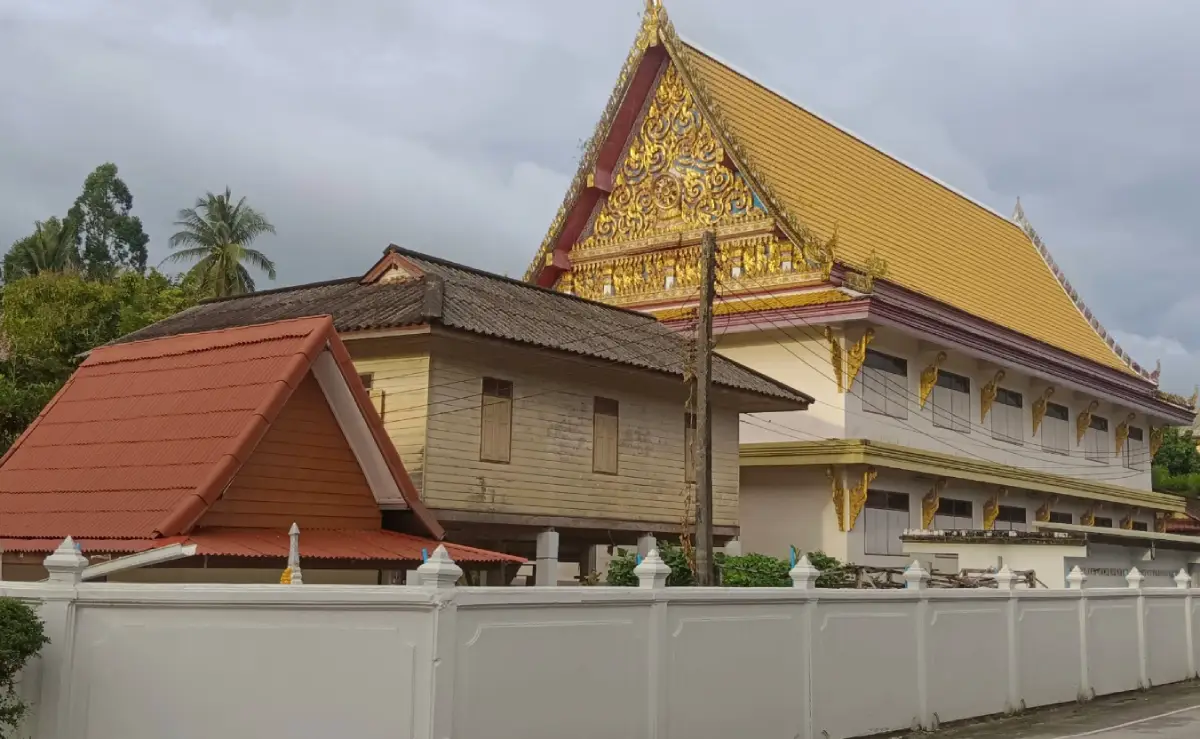
The ordination hall of Wat Tamot is one of the most visually striking parts of the temple. Its decorative details reflect the refinement of Thai religious craftsmanship, especially in the roof structure, gable design, entrance elements, and ornamental motifs. The surrounding pavilions also contribute to the temple’s architectural character and community function. They provide space for ceremonies, merit-making, local gatherings, cultural events, and community activities. For travelers interested in Thai temple architecture, Wat Tamot offers an example of a local temple where craftsmanship and community use remain closely connected.
One of the most distinctive features of Wat Tamot is its role as the birthplace of Sapha Lan Wat Tamot, a community forum formally established in 1995. This forum created a space where villagers, monks, local leaders, schools, public agencies, and community groups could come together to discuss problems and plan local development. Its work covers social welfare, the local economy, education, religion, culture, and environmental conservation. This makes Wat Tamot an important example of how a Buddhist temple can function as a civic center, not only a ritual space.
Sapha Lan Wat Tamot is significant because it shows how faith-based spaces can support practical community development. Through the temple, local people have worked together on issues such as children and youth, livelihoods, cultural preservation, environmental protection, health, and social harmony. The temple’s role in these activities has helped strengthen the identity of Tamot as a community that values participation, local wisdom, and shared responsibility. For travelers, this is one of the reasons Wat Tamot is more meaningful than a typical temple visit.
Ban Tamot is also known as a community where Buddhists and Muslims live side by side. Wat Tamot serves as an important Buddhist spiritual center while also forming part of a wider community culture based on mutual respect. One of the clearest expressions of this relationship is the two-religion tradition held on April 15 each year, when people from different backgrounds join activities that promote merit-making, goodwill, and harmony. This gives Wat Tamot special value for visitors interested in interfaith coexistence and local peace-building traditions in southern Thailand.
Traditional events held around the temple, especially retro-style community activities and Songkran celebrations, also make Wat Tamot a living cultural space. These events often include traditional dress, local performances, folk entertainment, retro dancing, and local food. They help younger generations experience their cultural roots and give travelers a chance to see southern Thai community life in a more authentic setting. Visiting during an event provides a richer experience, but travelers should check the current schedule with local authorities before making specific plans.
Environmental awareness is another important aspect of the Tamot community. The district is connected with forests, waterfalls, streams, and the natural resources of the Banthat mountain range. Wat Tamot and its community network have played a role in encouraging local people to value forest conservation, watershed protection, and responsible use of natural resources. This makes the temple part of a wider cultural landscape where religion, ecology, and community development are connected.
Visitors to Wat Tamot will find a calm atmosphere typical of a local southern Thai temple. It is not a crowded urban attraction, which makes it suitable for merit-making, quiet reflection, photography, and cultural learning. The main points of interest include the viharn of Phor Than Chuay, the ordination hall, the pavilions, the library, the cultural learning center, and the community activity area associated with Sapha Lan Wat Tamot. Travelers who are interested in local history should spend time learning about Phor Than Chuay and the community forum, as these are the features that make the temple unique.
Getting There is easiest by private car or rental car. From Phatthalung town, travelers can drive south toward Khao Chaison, Bang Kaeo, or Tamot District, then continue into Tambon Tamot through local roads. From Hat Yai in Songkhla Province, it is also possible to travel northward through the southern part of Phatthalung before entering Tamot District. Travelers without a private vehicle should plan local transport carefully, as onward transport within the district is more convenient when arranged in advance. A private vehicle is recommended because the temple can be combined with Lan Mom Chui Waterfall, Khlong Hua Chang Reservoir, Tamot community tourism homestay, and other nearby attractions.
The best time to visit Wat Tamot is from morning to early afternoon, when visitors have enough time to pay respect to Phor Than Chuay, walk around the temple compound, and continue to nearby natural attractions. During Songkran or local cultural events, the temple becomes livelier and offers a stronger sense of community life. Visitors should dress respectfully, speak quietly inside religious areas, and ask permission before photographing monks, rituals, or interior spaces. A visit to Wat Tamot is best approached slowly, with attention to both the sacred atmosphere and the community stories behind the temple.
For cultural travelers, Wat Tamot works well as the starting point of a Tamot route. After visiting the temple, travelers can continue to Tamot cultural sites, Lan Mom Chui Waterfall, Khlong Hua Chang Reservoir, and local homestay activities. This route reveals how religion, nature, food, local livelihoods, and community-based tourism are linked in one district. Wat Tamot is therefore not only a temple to visit, but a doorway into the wider identity of Tamot in Phatthalung Province.
Wat Tamot deserves a place in a Phatthalung travel plan for anyone interested in meaningful temples beyond the main tourist routes. It offers religious value, local history, architecture, education, traditions, community development, and interfaith harmony in one destination. A visit here helps travelers understand how one temple can become the heart of a community and how faith can support culture, learning, and sustainable local development.
| Name | Wat Tamot |
| Location | Tambon Tamot, Tamot District, Phatthalung Province |
| Address | 60 Moo 3, Tambon Tamot, Tamot District, Phatthalung Province 93160, Thailand |
| Highlights | Viharn of Phor Than Chuay, ornate ordination hall and pavilions, Princess Mother Commemorative Library, Tamot cultural learning center, and Sapha Lan Wat Tamot community forum |
| History | The temple developed from earlier monastic sites known locally as Wat Nuea and Wat Tai. Phra Chuay Intasaro was appointed as the first legally recognized abbot in 1910. |
| Name Origin | The temple is named after Ban Tamot and Tambon Tamot, an old community in Tamot District, Phatthalung Province. |
| Distinctive Features | A community temple combining Buddhist worship, education, local culture, public participation, and grassroots development |
| Travel Information | Best reached by private car or rental car through Tamot District. The temple can be combined with Lan Mom Chui Waterfall, Khlong Hua Chang Reservoir, and Tamot community tourism activities. |
| Current Status | Open as an active community temple and important religious site of Tamot District |
| Open Days | Daily |
| Opening Hours | 08.00 – 17.00 |
| Facilities | Princess Mother Commemorative Library, Tamot cultural learning center, pavilions, and community activity areas |
| Main Areas / Zones | Viharn of Phor Than Chuay, ordination hall, pavilions, Princess Mother Commemorative Library, Tamot cultural learning center, and Sapha Lan Wat Tamot area |
| Abbot / Caretaker | Phra Khru Sunthon Kitjanuyok |
| Main Contact Number | 081-599-9835 |
| Nearby Tourist Attractions | 1. Ban Tamot Cultural Center, about 1 km 2. Lan Mom Chui Waterfall / Tamot Waterfall, about 5 km 3. Tamot Community Tourism Homestay Enterprise, about 8 km 4. Khlong Hua Chang Reservoir, about 10 km 5. Khao Chaison Hot Spring and Cool Stream, about 27 km |
| Nearby Restaurants | 1. Baan Dream, about 14 km, Tel. 088-956-5292 2. Na Ruean Ton Cafe&Bistro Mae Khri, about 15 km, Tel. 095-265-1050 3. Cha Payom Mae Khri Market, about 15 km, Tel. 062-691-5642 4. Kuai Tiao Chon Daeng, about 15 km, Tel. 089-816-5542 5. Yob Mum, about 15 km, Tel. 090-953-0965 |
| Nearby Accommodations | 1. Tamot Community Tourism Homestay Enterprise, about 8 km, Tel. 087-298-8588 2. D.D. Resort, about 16 km, Tel. 089-876-8670 3. Mae Khri Apartment, about 15 km, Tel. 086-948-6723 4. Wang Chan Resort Hotel, about 15 km, Tel. 086-295-2176 5. Banana Tree Homestay & Cafe, about 16 km, Tel. 098-852-8658 |
Frequently Asked Questions (FAQ)
Q: Where is Wat Tamot located?
A: Wat Tamot is located at 60 Moo 3, Tambon Tamot, Tamot District, Phatthalung Province 93160, Thailand.
Q: What is Wat Tamot known for?
A: Wat Tamot is known for the viharn of Phor Than Chuay, its ornate ordination hall and pavilions, its cultural learning spaces, and its role as the birthplace of Sapha Lan Wat Tamot.
Q: Who is Phor Than Chuay at Wat Tamot?
A: Phor Than Chuay refers to Phra Chuay Intasaro, the first legally appointed abbot of Wat Tamot in 1910 and a deeply respected spiritual figure of the Tamot community.
Q: What are the opening days and hours of Wat Tamot?
A: Wat Tamot is open daily from 08.00 to 17.00.
Q: What is Sapha Lan Wat Tamot?
A: Sapha Lan Wat Tamot is a community forum established in 1995 to help villagers, monks, schools, and local agencies work together on community development, culture, education, social welfare, and environmental issues.
Q: What local traditions are connected with Wat Tamot?
A: The temple is connected with retro-style community events, Songkran activities, and the two-religion tradition held on April 15, reflecting harmony between Buddhist and Muslim residents in Tamot.
Q: What nearby places can travelers visit after Wat Tamot?
A: Nearby places include Ban Tamot Cultural Center, Lan Mom Chui Waterfall, Tamot Community Tourism Homestay Enterprise, Khlong Hua Chang Reservoir, and Khao Chaison Hot Spring and Cool Stream.
 Category: ●Places of Worship
 Group: ●Temple
Last Update : 2 MonthAgo
 Last Update : 2 MonthAgo

 Click to Access the Navigation Map GPS

 Art, Culture and Heritage
 Historical Sites and Monuments(1)
 Landmarks and Memorials(1)
 Art, Craft Centres, Tradition(6)
 Historic Homes and Cities(1)
 Educational Places
 Educational Gardens, Farm(1)
Temple(25)
 Other Sacred Sites(4)
 Research and Development
 Royal Project(2)
 Suburban Living
 Village, Community(3)
 Nature and Wildlife
 National Parks and Marine Reserves(3)
 Mountain (Doi)(4)
 Dam, Reservoir, Lake(7)
 Waterfalls(16)
 Hot Springs(2)
 Caves(12)
 River, Canal(5)
 Bays and Beaches(6)
 Islands(2)
 Other natural attractions(4)
 Entertainment and Agricultural
 Farms, Parks and Ecotourism(4)
 Travel Articles, Recipes
 Travel Review, Food Review(1)


