
lovethailand home >South Travel Attractions >Phatthalung Travel Attractions >Khao Chai Son >Chong Thanon > Wat Phra Borommathat Chedi Khian Bang Kaeo
TL;DR: Wat Phra Borommathat Chedi Khian Bang Kaeo is located at 42 Ban Bang Kaeo, Village No. 4, Chong Thanon Subdistrict, Khao Chaison District, Phatthalung Province 93130, open Daily, hours 08.00 - 17.00.

Wat Phra Borommathat Chedi Khian Bang Kaeo
Open Days: Daily
Opening Hours: 08.00 - 17.00
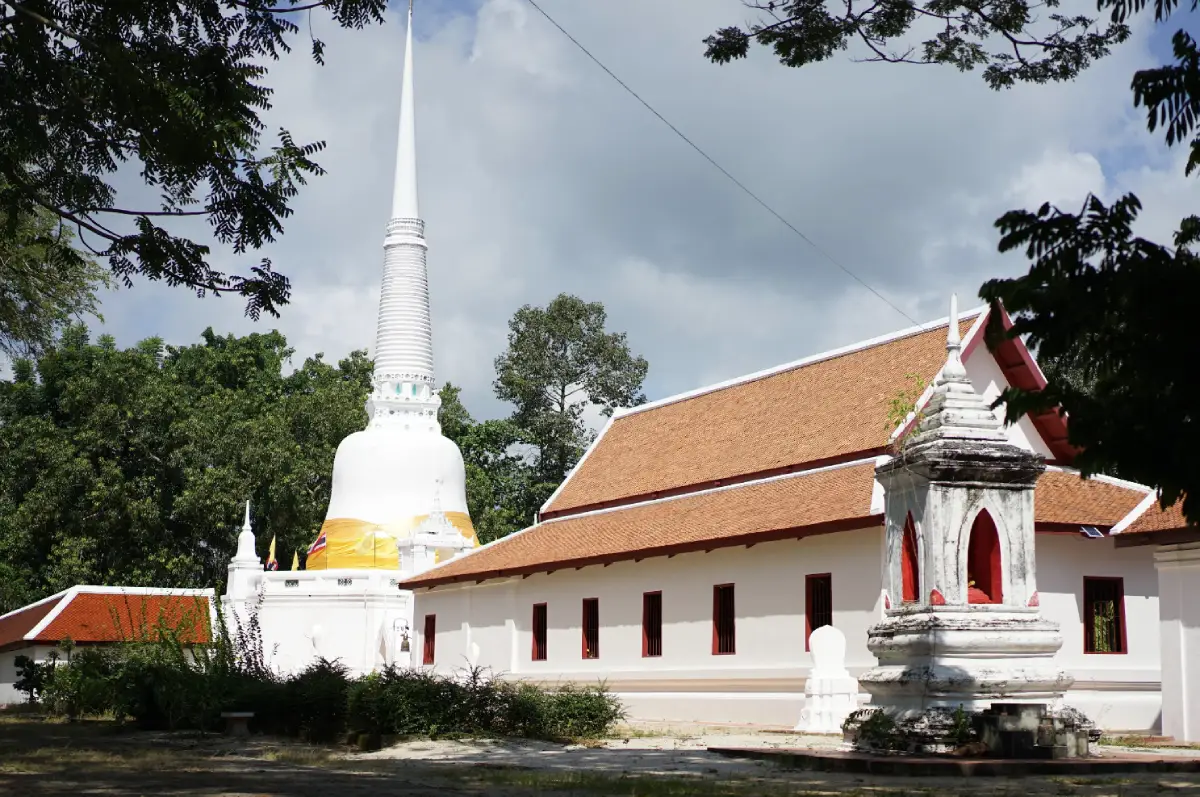
Wat Khian Bang Kaeo, officially known today as Wat Phra Borommathat Chedi Khian Bang Kaeo, is one of the most important historic Buddhist temples in Phatthalung Province. It is located at 42 Ban Bang Kaeo, Village No. 4, Chong Thanon Subdistrict, Khao Chaison District, Phatthalung Province. The temple was recognized as a model developed temple in 1990 and is best known for Phra Borommathat Chedi Bang Kaeo, an ancient sacred monument at the center of the temple. The site is significant for Buddhism, local history, archaeology, art history, and the cultural memory of communities around the Songkhla Lake Basin.
Wat Khian Bang Kaeo should be understood as one of Phatthalung’s most important historical temples. Various legends and academic records connect the temple with the Srivijaya period and the early Ayutthaya period. Although historical traditions differ in details, the main point is consistent: this temple has long been a major religious and cultural site in the Phatthalung area. Visitors are not simply entering an old temple; they are entering a landscape once linked with religious authority, ancient settlement, trade, and regional Buddhist networks.
The temple has been known by several names over time, including Wat Phra That Bang Kaeo, Wat Takhian Bang Kaeo, Wat Bang Kaeo, and Wat Khian Bang Kaeo. In 2018, the temple’s official name was changed to Wat Phra Borommathat Chedi Khian Bang Kaeo. However, the name Wat Khian Bang Kaeo remains widely used because it is deeply connected with local history, chronicles, tourism information, and community memory.
The most important highlight of the temple is Phra Borommathat Chedi Bang Kaeo. The chedi is an ancient brick monument with an octagonal base and a height of about 22 meters. Its architectural form was influenced by Phra Borommathat Chedi in Nakhon Si Thammarat, but it is smaller in scale. The structure includes Buddha niches, stucco elephant heads, directional stupas, a staircase, an octagonal base, and ceramic decoration. These features show layers of construction, restoration, and long-term religious use.
Phra Borommathat Chedi Bang Kaeo is not only an architectural monument. It is also a major focus of local faith. Local tradition says that relics of the Buddha were brought from Lanka and enshrined inside the chedi. Legends connect this event with Phraya Kuman and Nang Lueat Khao, making the chedi a sacred landmark of Phatthalung and a devotional center for worshippers.
The legend of Nang Lueat Khao is one of the most important cultural narratives associated with Wat Khian Bang Kaeo. According to local tradition, Nang Lueat Khao and Phraya Kuman were involved in the construction of the temple and the enshrinement of relics from Lanka. This story reflects southern Thai beliefs about city foundation, temple building, long-distance religious exchange, and the transmission of Buddhism into the Songkhla Lake Basin. Wat Khian Bang Kaeo is therefore a place where legend and archaeological evidence meet.
The area around Wat Khian Bang Kaeo is believed to have been an important ancient settlement and may have been connected with an earlier center of Phatthalung. Archaeological remains found in and around the temple include laterite ruins, Buddha images, lingams, yoni bases, Chinese ceramics, Khmer ceramics, Sangkhalok wares, and other objects. These finds suggest that the area was part of a complex religious and trading landscape with connections beyond the local community.
The archaeological value of the temple lies in the density and variety of evidence found in one area. Hindu objects such as lingams and yoni bases point to Brahmanical influence, while Buddha images and the chedi reflect Buddhist practice. Imported ceramics indicate contact with wider trade networks. Together, these materials help explain the development of ancient communities around the Songkhla Lake Basin and the early history of Phatthalung.
Inside the temple is a museum commonly known as the National Museum of Wat Khian Bang Kaeo or the Wat Khian Bang Kaeo Museum. It displays Buddha images, Chinese ceramics, Sangkhalok wares, lingams, yoni bases, local tools, and other archaeological objects found in the temple area and nearby communities. Visitors who wish to enter the museum must request the key from the abbot or temple caretaker in advance. This makes planning important for those who want to study the artifacts closely.
The museum gives Wat Khian Bang Kaeo a special role beyond ordinary worship. It allows visitors to learn from objects found in the same historical landscape. The artifacts are not detached exhibits; they help explain why this temple and the surrounding area were important to Phatthalung’s early development. A visit to the museum is therefore best combined with worship at the chedi and a walk around the ancient structures.
A cloister surrounds Phra Borommathat Chedi on 3 sides. Inside the cloister are 34 stucco Buddha images in the posture of subduing Mara. These Buddha images differ in facial expression and form, yet all face toward the chedi. This creates a powerful sacred space around the central monument and adds artistic and ritual depth to the temple.
In addition to the chedi, the temple has an ordination hall located in front of the chedi and parallel to Khlong Bang Kaeo. It is a brick-and-plaster structure with a wooden roof frame and tile roof. Inside are 5 stucco Buddha images in the posture of subduing Mara, and at the back is a room for a reclining stucco Buddha image. These structures show that Wat Khian Bang Kaeo has long been a complete religious space with a chedi, ordination hall, cloister, Buddha images, and ritual areas.
Other important structures and archaeological features include the Dharma hall, the base of a bell tower, the sermon hall, Khok Khaek Chi or the Brahman shrine area, the remains of the oath-water pavilion, and Khok Phra Tula. These features show that the temple once supported several kinds of religious and public ritual functions. The presence of Buddhist, Brahmanical, and oath-related remains makes the site especially important for understanding ritual history in southern Thailand.
The sacred well near the chedi is another important feature. It is traditionally regarded as a well paired with the chedi and is associated with oath-water rituals in the past. Nearby traces of the oath-water pavilion further suggest that the temple was once linked with official rituals and political authority. Wat Khian Bang Kaeo was therefore not only a religious site but also a place connected with public order and regional governance.
During the Ayutthaya period, Wat Khian Bang Kaeo had a major regional role. Historical records describe it as a center of the Pa Kaeo monastic network in Phatthalung, with many temples in Phatthalung, Nakhon Si Thammarat, Songkhla, and Trang connected to it. This indicates that Wat Khian Bang Kaeo once held religious authority at a regional level, not merely at the village level.
The temple’s history includes both prosperity and decline. During the middle Ayutthaya period, Phatthalung was affected by raids and destruction by Malay pirates. Houses and temples suffered severe damage, and Wat Khian Bang Kaeo became abandoned during some periods. The temple was later restored several times in the Ayutthaya and Rattanakosin periods, eventually returning to active religious and community use.
The Fine Arts Department registered Wat Khian Bang Kaeo as an ancient monument on 3 January 1937 and later announced its protected archaeological boundary on 22 April 1986. The protected area covers about 22 rai, 2 ngan, and 97 square wah. This official status confirms the temple’s national heritage value and means visitors should treat the site carefully, avoiding contact with artifacts, climbing on monuments, or damaging historic structures.
Geographically, Wat Khian Bang Kaeo stands on a sand ridge about 1 kilometer from the shore of Songkhla Lake. The surrounding area includes rice fields and traces of old waterways such as Khlong Bang Kaeo and Khlong Pak Phaniat. These waterways were important to settlement, agriculture, transport, and trade in the ancient Songkhla Lake Basin. The temple’s location helps explain why the area became a significant historical community.
A meaningful visit should begin with paying respect at Phra Borommathat Chedi Bang Kaeo, then walking around the cloister, ordination hall, Dharma hall, archaeological remains, sacred well, and museum. Visitors who want to see the museum should contact the temple caretaker first. This route allows visitors to understand the temple step by step, from its sacred center to its archaeological and historical evidence.
Wat Khian Bang Kaeo is suitable for visitors interested in ancient temples, archaeology, local museums, the legend of Nang Lueat Khao, Phatthalung history, and the cultural landscape of the Songkhla Lake Basin. A short worship visit may take about 45 minutes to 1 hour, while a deeper visit including the museum and ancient structures should allow at least 1.5 to 2 hours.
The temple is located in Khao Chaison District, an area with several natural and cultural attractions. Visitors can combine Wat Khian Bang Kaeo with Khao Chaison Hot Spring, Than Nam Yen Cave, Phatthong Beach, Ban Pak Phon Floating Market, and attractions around Songkhla Lake. This route combines an ancient temple, hot springs, caves, lake scenery, and local community tourism.
Visitors should dress modestly, speak quietly, avoid disturbing monks and worshippers, and never touch archaeological objects. The temple includes both active religious areas and protected ancient remains, so careful behavior is essential. Families visiting with children should supervise them closely, especially near the chedi, cloister, and museum areas.
Getting There is convenient from Phatthalung town or Khao Chaison District. The temple is located along Highway 4081, about 7 kilometers from Khao Chaison town, in Ban Bang Kaeo. Its approximate coordinates are 7.499536, 100.191932. When using online maps, search both “Wat Khian Bang Kaeo” and “Wat Phra Borommathat Chedi Khian Bang Kaeo,” as different map systems may use different names.
In summary, Wat Khian Bang Kaeo is one of Phatthalung’s most important historical temples. Its value comes from its status as a model developed temple in 1990, its registration as an ancient monument, Phra Borommathat Chedi Bang Kaeo, the legend of Nang Lueat Khao, its possible connection with ancient Phatthalung settlement, its museum, its cloister, its ordination hall, its sacred well, and its archaeological evidence. It is an essential destination for anyone who wants to understand Phatthalung through Buddhism, art, archaeology, local history, and the Songkhla Lake Basin cultural landscape.
| Name | Wat Khian Bang Kaeo, Officially Wat Phra Borommathat Chedi Khian Bang Kaeo |
| Location | 42 Ban Bang Kaeo, Village No. 4, Chong Thanon Subdistrict, Khao Chaison District, Phatthalung Province 93130 |
| Coordinates | 7.499536, 100.191932 |
| Highlights | Phra Borommathat Chedi Bang Kaeo, over 1,000-year-old temple history, temple museum, ancient artifacts, cloister, ordination hall, sacred well, and archaeological evidence of ancient Phatthalung settlement |
| Former / Other Names | Wat Phra That Bang Kaeo, Wat Takhian Bang Kaeo, Wat Bang Kaeo, and Wat Khian Bang Kaeo |
| Current Official Name | Wat Phra Borommathat Chedi Khian Bang Kaeo, renamed on 9 November 2018 |
| History / Period | An ancient temple of the Songkhla Lake Basin with traditions linked to Nang Lueat Khao and Phraya Kuman. Historical sources connect the temple with the Srivijaya and early Ayutthaya periods |
| Ancient Monument Status | Registered by the Fine Arts Department as an ancient monument on 3 January 1937, with protected boundary announced on 22 April 1986 |
| Protected Area | About 22 rai, 2 ngan, and 97 square wah |
| Landscape | Located on a sand ridge about 1 kilometer from Songkhla Lake, with Khlong Bang Kaeo and Khlong Pak Phaniat as important waterways in the surrounding area |
| Phra Borommathat Chedi Bang Kaeo | An octagonal brick chedi about 22 meters high, influenced by Phra Borommathat Chedi in Nakhon Si Thammarat, with Buddha niches, stucco elephant heads, directional stupas, and ceramic decoration |
| Important Structures / Archaeological Features | Phra Borommathat Chedi Bang Kaeo, ordination hall, cloister, Dharma hall, bell tower base, sermon hall, Khok Khaek Chi, remains of the oath-water pavilion, and Khok Phra Tula |
| Sacred Objects | Buddha relics enshrined in the chedi, stucco Buddha images in the posture of subduing Mara, Phra Kaeo Kula Sri Maha Bodhi, Phra Song Phi Nong, and 34 Buddha images in the cloister |
| Museum | Wat Khian Bang Kaeo Museum displays Buddha images, Chinese ceramics, Sangkhalok wares, lingams, yoni bases, archaeological objects, and local tools. Visitors must request the key from the abbot or temple caretaker before entering |
| Entrance Fee | No admission fee |
| Contact Number | 089-289-1656 |
| Ancient Monument Care | Wat Khian Bang Kaeo and the Fine Arts Department |
| Buddhist Order | Mahanikaya |
| Main Areas / Zones | 1. Phra Borommathat Chedi Bang Kaeo 2. Cloister and 34 Buddha Images 3. Ordination Hall 4. Wat Khian Bang Kaeo Museum 5. Sacred Well 6. Oath-Water Pavilion Remains 7. Khok Khaek Chi and Surrounding Archaeological Areas 8. Community Rest and Activity Areas |
| Community Role | A spiritual center of Ban Bang Kaeo, a learning site for Phatthalung history, an archaeological site, and a major cultural attraction of Khao Chaison District |
| Travel Information | Located along Highway 4081, about 7 kilometers from Khao Chaison town. Search for either Wat Khian Bang Kaeo or Wat Phra Borommathat Chedi Khian Bang Kaeo on online maps |
| Current Status | Open to visitors and remains a major Buddhist and cultural attraction of Khao Chaison District, Phatthalung Province |
| Open Days | Daily |
| Opening Hours | 08.00 - 17.00 |
| Visitor Etiquette | Dress modestly, do not touch artifacts, do not climb on ancient structures, keep the area clean, and contact the caretaker before entering the museum |
| Nearby Tourist Attractions | 1. Phatthong Beach, about 4 km 2. Wat Sathang / Sathang Community Area, about 5 km 3. Ban Pak Phon Floating Market, about 10 km 4. Khao Chaison Hot Spring, about 13 km 5. Than Nam Yen Cave, about 14 km 6. Kaeng Nam Hu Rae, about 18 km 7. Thale Noi Non-Hunting Area, about 32 km |
| Nearby Restaurants | 1. Local Lake Cafe' & Restaurant, about 3 km, Tel. 095-016-6401, 063-610-0447 2. Halal Islam House Restaurant and Souvenirs, about 8 km, Tel. 089-976-3768 3. Forest House Restaurant Khao Chaison, about 10 km, Tel. 097-217-0240 4. Im Aem Khao Chaison, about 11 km, Tel. 083-686-0704 5. NAYA CAFE, about 12 km, Tel. 065-553-3911 6. Nuea Mai Restaurant, about 12 km, Tel. 074-691-237 |
| Nearby Accommodations | 1. Sanfhan Resort, about 11 km, Tel. 085-914-5662 2. Ticket to Childhood Baan Yipun @ Phatthalung, about 14 km, Tel. 081-599-2006 3. Rabiang Lam Pam Resort, about 23 km 4. Dusit Princess Phatthalung, about 27 km, Tel. 074-880-777 5. City Park Hotel Phatthalung, about 28 km, Tel. 074-613-516 6. Merdelong Hotel, about 28 km, Tel. 074-615-888 |
Frequently Asked Questions (FAQ)
Q: Where is Wat Khian Bang Kaeo located?
A: Wat Khian Bang Kaeo is located at 42 Ban Bang Kaeo, Village No. 4, Chong Thanon Subdistrict, Khao Chaison District, Phatthalung Province 93130.
Q: What are the opening hours of Wat Khian Bang Kaeo?
A: Wat Khian Bang Kaeo is open daily from 08.00 to 17.00.
Q: What is the current official name of Wat Khian Bang Kaeo?
A: The current official name is Wat Phra Borommathat Chedi Khian Bang Kaeo. The name was changed on 9 November 2018.
Q: Why is Phra Borommathat Chedi Bang Kaeo important?
A: It is an ancient octagonal brick chedi about 22 meters high, influenced by Phra Borommathat Chedi in Nakhon Si Thammarat, and traditionally believed to enshrine relics brought from Lanka.
Q: How can visitors enter the Wat Khian Bang Kaeo Museum?
A: Visitors who wish to enter the museum must request the key from the abbot or temple caretaker before visiting the museum area.
Q: Is there an admission fee for Wat Khian Bang Kaeo?
A: No. There is no admission fee, but visitors should dress modestly and follow temple and heritage-site rules.
Q: How is Wat Khian Bang Kaeo connected with ancient Phatthalung?
A: The temple area is believed to have been connected with an ancient settlement or early center of Phatthalung because many laterite remains, Buddha images, ceramics, and archaeological objects have been found there.
Q: What nearby attractions can be visited with Wat Khian Bang Kaeo?
A: Nearby attractions include Phatthong Beach, Ban Pak Phon Floating Market, Khao Chaison Hot Spring, Than Nam Yen Cave, Kaeng Nam Hu Rae, and Thale Noi.
 Category: ●Places of Worship
 Group: ●Temple
Last Update : 2 MonthAgo
 Last Update : 2 MonthAgo

 Click to Access the Navigation Map GPS
Wat Phra Borommathat Chedi Khian Bang Kaeo Map
Recommend

 Art, Culture and Heritage
 Historical Sites and Monuments(1)
 Landmarks and Memorials(1)
 Art, Craft Centres, Tradition(6)
 Historic Homes and Cities(1)
 Educational Places
 Educational Gardens, Farm(1)
Temple(25)
 Other Sacred Sites(4)
 Research and Development
 Royal Project(2)
 Suburban Living
 Village, Community(3)
 Nature and Wildlife
 National Parks and Marine Reserves(3)
 Mountain (Doi)(4)
 Dam, Reservoir, Lake(7)
 Waterfalls(16)
 Hot Springs(2)
 Caves(12)
 River, Canal(5)
 Bays and Beaches(6)
 Islands(2)
 Other natural attractions(4)
 Entertainment and Agricultural
 Farms, Parks and Ecotourism(4)
 Travel Articles, Recipes
 Travel Review, Food Review(1)


