
lovethailand home >South Travel Attractions >Phatthalung Travel Attractions >Muang Phatthalung >Khuha Sawan > Wat Khuha Sawan
TL;DR: Wat Khuha Sawan is located at At The Foot Of Khuha Sawan Hill, Khuha Sawan Subdistrict, Mueang Phatthalung District, Phatthalung Province, open Daily, hours Daytime For Worship And Cave Visits.
Wat Khuha Sawan
Open Days: Daily
Opening Hours: Daytime For Worship And Cave Visits
Wat Khuha Sawan Royal Monastery in Phatthalung Province is one of the city’s oldest and most important Buddhist temples and historic sites. Located at 248 Rames Road, Khuha Sawan Subdistrict, Mueang Phatthalung District, near the foot of Khuha Sawan Hill and close to Phatthalung city market, the temple is a third-class royal monastery under the Mahanikaya order. It brings together Buddhism, local history, folk legend, archaeology, cave landscape, royal inscriptions, and the memory of old Phatthalung in one highly accessible place.
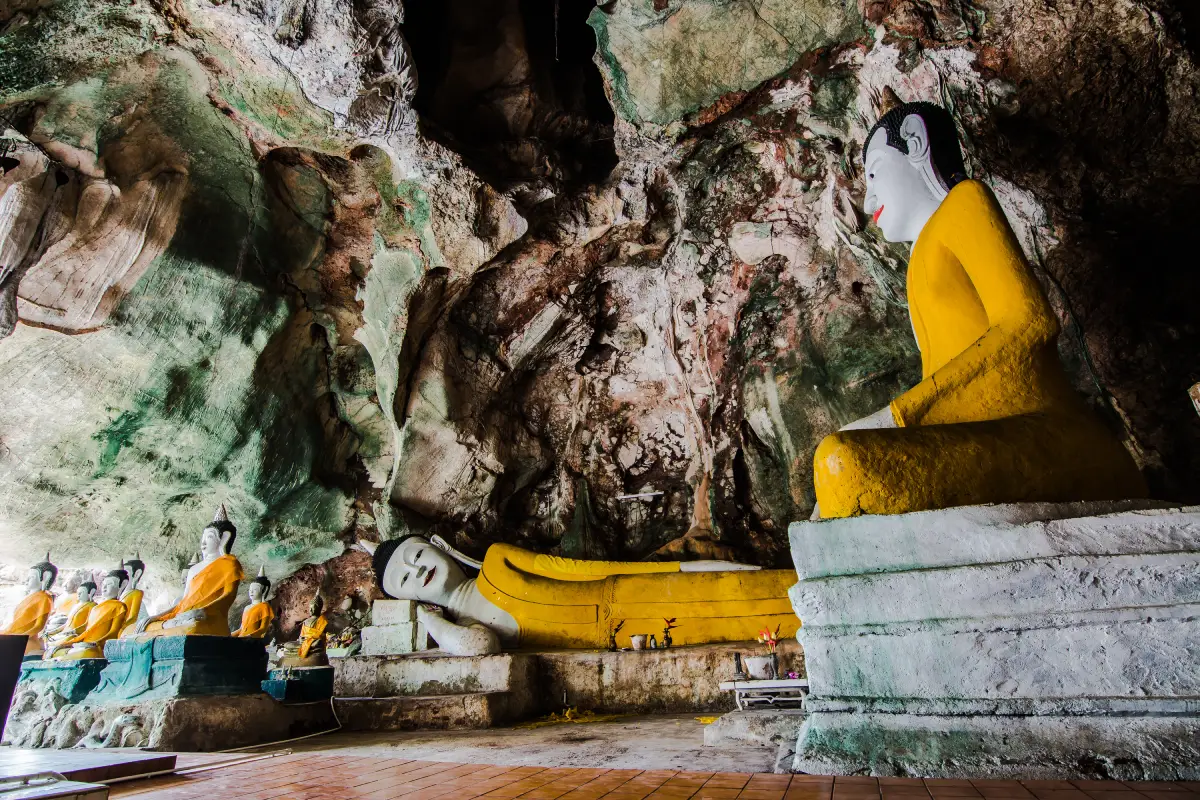
The central feature of the temple is Khuha Sawan Cave, located within the temple grounds. Local people also call the temple Wat Khuha Sung or Wat Sung, while the cave is traditionally known as Tham Nam Ngoen or Tham Phra. Inside the cave are a large reclining Buddha image, many stucco and clay Buddha images, a small chedi, Srivijaya-period clay votive tablets, and several sacred features that show the long religious use of this natural cave.
The exact date of the temple’s foundation is not clearly documented, but one temple directory of Phatthalung records the establishment year as B.E. 1924. The Nang Lueat Khao legend says that after Ta Sam Mo and Yai Phet passed away, Phra Kumar and Nang Lueat Khao placed their ashes inside Khuha Sawan Cave. This story gives the cave a meaning beyond its natural form. It is a place of memory, ancestry, devotion, and local identity.
Wat Khuha Sawan is also mentioned in old temple-endowment records of Phatthalung from the Ayutthaya period. These records connect the temple with the making of Buddha images, the dedication of property to support Buddhist activities, and the wider religious organization of old Phatthalung. This shows that the temple was not only a place of worship. It was also part of a social and economic system that supported Buddhism through land, labor, offerings, and local faith.
During the Ayutthaya period, Phatthalung experienced unrest and attacks. Temple-endowment records describe how Malay pirates attacked the city and burned houses and temples as far as the Khuha Sawan area. Wat Khuha Sawan was likely damaged during the reign of King Narai and was later restored. This history gives the temple a layered identity: it has passed through prosperity, destruction, abandonment, revival, and royal recognition.
In the Rattanakosin period, the temple underwent a major restoration in 1889 to prepare for the visit of King Chulalongkorn during his journey to the Malay Peninsula. During that visit, the royal initials Ch.P.R. 108 were carved at the rock shelter in front of the cave. This inscription remains one of the site’s most important historical marks because it links a local Phatthalung temple directly with the history of the Thai monarchy.
After the major restoration, the temple was abandoned for a period. In 1909, local people invited Phra Khru Charun Karani, also known as Luang Pho Tuk Kesaro, to become abbot. He restored the temple extensively, and Wat Khuha Sawan gradually flourished again. In 1924, the provincial center of Phatthalung moved from Lam Pam to Khuha Sawan, and Phraya Khanasai Sunthon, the governor at that time, also supported the restoration of the temple. This made Wat Khuha Sawan even more important as a city temple close to the new administrative center.
Wat Khuha Sawan has been visited by several Thai kings and members of the royal family. In addition to the Ch.P.R. 108 inscription of King Rama V, King Prajadhipok visited the temple in 1928 and left his royal initials P.P.R. at the cave-front rock shelter. In 1959, King Bhumibol Adulyadej and Queen Sirikit visited Khuha Sawan Cave and left the royal initials B.P.R. and S.K. at the same location. These inscriptions make the cave-front rock shelter a rare local historical record of multiple royal visits.
The cave wall also contains inscriptions connected with Somdet Phra Ariyavongsagatanana, the Supreme Patriarch, and Prince Paribatra Sukhumbandhu, Prince of Nakhon Sawan. These inscriptions show that Wat Khuha Sawan was significant not only to local Buddhists but also to the monarchy, high-ranking Buddhist leadership, and national history.
Khuha Sawan Cave is about 18 meters wide and 28 meters long, with a cone-shaped upper chamber. The cave has a calm, cool, and sacred atmosphere. A stalagmite formation near the upper part of the cave resembles an elephant and is locally called Chang Phut or Hin Lap Lae. The cave floor is paved with brick and mortar, and a small chedi stands inside. These features make the cave both a natural formation and a long-used sacred space.
Inside the cave are 37 stucco and clay Buddha images arranged in orderly rows along the north, south, and west sides. Historical accounts state that 20 of these images were created in the Ayutthaya period, while another 17 were restored or added in the Rattanakosin period. Their arrangement turns the cave into a natural sanctuary surrounded by Buddhist images, allowing visitors to see layers of devotion from different periods.
The large reclining Buddha image is the main sacred highlight inside the cave. Set within the limestone chamber, it creates a distinctive atmosphere where Buddhist art and the natural cave landscape merge. Worshipping the reclining Buddha here feels different from worshipping inside a conventional temple hall, because the rock walls, cave ceiling, and quiet interior add depth to the experience.
East of the reclining Buddha’s head, a large cache of votive tablets and Buddhist objects was found in the past. These included carved wooden objects, stucco Buddha images, bronze Buddha images, and unbaked clay votive tablets from the Srivijaya period. Local people called them Phra Phi Tham. Their discovery gives the cave strong archaeological value and shows that it has been used for Buddhist devotion over a long period.
At the cave mouth is a layered rock feature about 2 meters high, known locally as Hua Tharapi. Opposite it stands a stucco figure of the fiery-eyed hermit. According to local legend, Nang Lueat Khao and Chao Phraya Kumar created this figure in memory of Ta Sam Mo and Yai Phet and placed their ashes inside. This area shows how Buddhist devotion, ancestral memory, and local legend coexist within the same sacred landscape.
The ordination hall is another important area of the temple. It houses the principal Buddha image donated by Queen Saovabha Phongsri, Queen Mother Sri Bajrindra. The image is described as being made of 60 percent gold. The ordination hall is therefore meaningful not only as a ritual space but also as a place connected with royal devotion.
A replica Buddha footprint is located on the hillside above the cave, about 60 meters higher than the cave area. It was built by Nai Huad and Nang Khim Sae Sor in 1928. Visitors who walk up to this point can pay respect and see the relationship between the temple, the hill, and Phatthalung city from above. The path should be walked carefully, especially after rain or when the stone surface is slippery.
Nang Khlot Cave is another interesting area in the temple. It is associated with local stories and decorated with stucco scenes related to folk narratives. This gives the temple another layer of cultural value, beyond the main cave and Buddhist images. Visitors can learn how local stories, visual art, and sacred space are preserved together inside the temple compound.
The Fine Arts Department registered Wat Khuha Sawan as a historic site in the Government Gazette, Volume 52, Part 75, dated 8 March 1935. This confirms its national significance as a historic, artistic, and archaeological site. The protected features include the cave, Buddha images, inscriptions, chedi, and related religious structures. Visitors should treat the temple as both a sacred place and a protected heritage site.
Today, Wat Khuha Sawan remains an active royal monastery and a center of Buddhist faith in Phatthalung. People come to worship the reclining Buddha, visit the ordination hall, see the royal inscriptions, learn about history, and explore the cave. The current abbot is listed as Phra Pariyattiwachirodom (Phichit, Pali Studies 7), and the temple continues to serve religious, educational, cultural, and tourism roles for the province.
Visitors should see Wat Khuha Sawan as a learning site rather than only a quick photo stop. The ordination hall reflects royal and Buddhist devotion. Khuha Sawan Cave preserves Buddhist art and archaeology. The cave-front inscriptions record royal visits. The replica Buddha footprint expresses faith on the hillside. Nang Khlot Cave preserves local storytelling. Khuha Sawan Hill itself connects nature with the city. Together, these elements make the temple one of the most complete cultural sites in Phatthalung.
For travel planning, Wat Khuha Sawan is very convenient because it is close to Phatthalung city center, the railway station, and major city roads. It can easily be combined with nearby attractions such as Khao Ok Thalu, the Phraya Thukkharat Monument, Phatthalung City Pillar Shrine, the Governor’s Palace of Phatthalung, and Saen Suk Lam Pam Beach. A half-day city route can begin here before continuing to other historical and natural sites.
Getting There is easy because the temple is located within Phatthalung Municipality. Travelers can use Rames Road to reach Khuha Sawan Subdistrict directly. Those arriving by train can get off at Phatthalung Railway Station and continue by local transport to the temple. The temple is suitable as the first stop on a city-based Phatthalung cultural route.
The best time to visit is from morning to afternoon, when there is enough daylight for the cave and hillside areas. Visitors should wear comfortable walking shoes because some areas involve stone surfaces, steps, and uneven paths. Drinking water is useful, but food should not be eaten inside the cave or around monkeys. This helps maintain cleanliness and safety.
Visitors should dress modestly, behave respectfully, keep noise low inside the cave, avoid touching Buddha images and inscriptions, avoid writing on cave walls, avoid climbing on rock formations or historic structures, avoid feeding monkeys, and follow the guidance of monks or caretakers. Wat Khuha Sawan is both a sacred temple and a historic site, so respectful conduct is part of preserving the place.
Wat Khuha Sawan is an essential destination for anyone who wants to understand Phatthalung deeply. It brings together Buddhism, a natural cave, ancient Buddha images, Srivijaya-period votive tablets, royal inscriptions, the Nang Lueat Khao legend, and the city’s historical landscape. A visit here is not only a temple visit. It is a journey into the roots of Phatthalung through cave, hill, sacred art, and living memory.
| Name | Wat Khuha Sawan Royal Monastery |
| Local Names | Wat Khuha Sung, Wat Sung, Khuha Sawan Cave, Tham Nam Ngoen, Tham Phra |
| Location | At The Foot Of Khuha Sawan Hill, Khuha Sawan Subdistrict, Mueang Phatthalung District, Phatthalung Province |
| Address | 248 Rames Road, Khuha Sawan Subdistrict, Mueang Phatthalung District, Phatthalung 93000, Thailand |
| Coordinates | 7.6148637621, 100.089859758 |
| Type | Third-Class Royal Monastery / Historic Site / Important Buddhist Temple In Phatthalung |
| Sect | Mahanikaya |
| Temple Establishment | B.E. 1924 |
| Wisungkhamasima Granted | B.E. 2490 |
| Highlights | Khuha Sawan Cave, Large Reclining Buddha, 37 Stucco And Clay Buddha Images, Srivijaya-Period Clay Votive Tablets, Royal Initials, Ordination Hall, Replica Buddha Footprint, Nang Khlot Cave, And City View From The Hill |
| History / Importance | An old Phatthalung temple connected with the Nang Lueat Khao legend, Ayutthaya-period temple endowment records, Rattanakosin restoration, the revival by Phra Khru Charun Karani, and royal visits by several Thai monarchs |
| Khuha Sawan Cave Size | About 18 Meters Wide And 28 Meters Long, With A Cone-Shaped Upper Chamber |
| Important Features Inside The Cave | Reclining Buddha, 37 Buddha Images, Small Chedi, Chang Phut Or Hin Lap Lae Formation, Hua Tharapi, Fiery-Eyed Hermit Figure, And Votive Tablet Cache With Wooden Carvings, Stucco Buddha Images, Bronze Buddha Images, And Srivijaya-Period Clay Votive Tablets |
| Ordination Hall | Houses The Principal Buddha Image Donated By Queen Saovabha Phongsri, Queen Mother Sri Bajrindra, Described As Being Made Of 60 Percent Gold |
| Replica Buddha Footprint | Located On The Hillside Above The Cave, About 60 Meters Higher Than The Cave Area, Built By Nai Huad And Nang Khim Sae Sor In B.E. 2471 |
| Historic Registration | Registered By The Fine Arts Department In The Government Gazette, Volume 52, Part 75, Dated 8 March 1935 |
| Important Inscriptions | Royal Initials Of King Rama V, King Rama VII, King Rama IX, And Queen Sirikit, As Well As Inscriptions Of High-Ranking Royal And Buddhist Figures |
| Current Abbot | Phra Pariyattiwachirodom (Phichit, Pali Studies 7) |
| Open Days | Daily |
| Opening Hours | Daytime For Worship And Cave Visits |
| Admission Fee | No Admission Fee |
| Facilities | Parking, Toilets, Shops, Food, Ramp, Areas For Children, Older Visitors, And Guardians |
| Main Zones / Areas | Ordination Hall, Khuha Sawan Cave, Cave-Front Rock Shelter And Inscriptions, Reclining Buddha, 37 Buddha Images, Luang Pu Thuat Shrine, Former Abbots’ Shrine, Replica Buddha Footprint, Nang Khlot Cave, Viewpoint, And Khuha Sawan Hill Area |
| Contact Number | 08-1279-7944, Phra Maha Preecha, Assistant Abbot |
| Travel Information | Travel To Phatthalung City And Follow Rames Road To Khuha Sawan Subdistrict. The Temple Is Near The City Market And Phatthalung Railway Station, With Access By Private Car, Rental Car, Or Local Transport |
| Nearby Tourist Attractions | 1. Replica Buddha Footprint At Wat Khuha Sawan, About 0.1 Km 2. Khuha Sawan Public Park, About 1 Km 3. Khao Ok Thalu, About 2 Km 4. Phraya Thukkharat (Chuai) Monument, About 2 Km 5. Phatthalung City Pillar Shrine, About 5 Km 6. Governor’s Palace Of Phatthalung, About 7 Km 7. Saen Suk Lam Pam Beach, About 8 Km |
| Nearby Restaurants | 1. Aunt Nui’s Restaurant, About 1 Km, Tel. 087-477-7472 2. Baan Chaokuay Made-To-Order Food, About 1 Km, Tel. 083-655-0910, 095-025-5885 3. Bang & Go Tea And Roti, About 1 Km 4. Khrua Baan Suan DO-D, About 2 Km, Tel. 090-674-2280 5. Khrua Phi May, About 2 Km, Tel. 084-466-9441, 090-624-9663 6. Tha Mi Ram Khanom Pang, About 3 Km, Tel. 084-266-1157 |
| Nearby Accommodations | 1. Ho Fah Hotel, About 0.5 Km, Tel. 074-611-645 2. Merdelong Hotel, About 1 Km, Tel. 074-615-888 3. City Park Hotel Phatthalung, About 1 Km, Tel. 074-613-516 4. Chaikana Thani Hotel, About 1 Km, Tel. 074-613-777 5. The Centris Hotel Phatthalung, About 2 Km, Tel. 074-616-555 6. Siva Royal Hotel, About 3 Km, Tel. 074-673-999 |
Frequently Asked Questions (FAQ)
Q: Where is Wat Khuha Sawan located?
A: Wat Khuha Sawan is located at 248 Rames Road, Khuha Sawan Subdistrict, Mueang Phatthalung District, Phatthalung Province, at the foot of Khuha Sawan Hill near the city market and Phatthalung Railway Station.
Q: What other names is Wat Khuha Sawan known by?
A: Local people also call it Wat Khuha Sung or Wat Sung. Khuha Sawan Cave is also known as Tham Nam Ngoen or Tham Phra.
Q: What days is Wat Khuha Sawan open, and is there an admission fee?
A: The temple is open daily and is best visited during daytime. There is no admission fee for worshipping or visiting the temple grounds.
Q: What is important inside Khuha Sawan Cave?
A: The cave contains a large reclining Buddha, 37 stucco and clay Buddha images, a small chedi, Chang Phut or Hin Lap Lae formation, Hua Tharapi, a fiery-eyed hermit figure, and a cache of Srivijaya-period clay votive tablets.
Q: How is Wat Khuha Sawan connected with the Nang Lueat Khao legend?
A: The legend says that after Ta Sam Mo and Yai Phet passed away, Phra Kumar and Nang Lueat Khao placed their ashes inside Khuha Sawan Cave. The story is also connected with the fiery-eyed hermit figure near the cave mouth.
Q: How is Wat Khuha Sawan connected with Thai kings?
A: The cave-front rock shelter preserves royal initials of King Rama V, King Rama VII, King Rama IX, and Queen Sirikit, marking royal visits to the site.
Q: Where is the replica Buddha footprint located?
A: The replica Buddha footprint is located on the hillside above the cave, about 60 meters higher than the cave area. It was built by Nai Huad and Nang Khim Sae Sor in B.E. 2471.
Q: What nearby attractions can be visited on the same trip?
A: Nearby attractions include Khao Ok Thalu, Phraya Thukkharat Monument, Phatthalung City Pillar Shrine, Governor’s Palace of Phatthalung, Saen Suk Lam Pam Beach, and other sites in Phatthalung city.
 Category: ●Places of Worship
 Group: ●Temple
Last Update : 2 MonthAgo
 Last Update : 2 MonthAgo
 Click to Access the Navigation Map GPS
Wat Khuha Sawan Map
Recommend

 Art, Culture and Heritage
 Historical Sites and Monuments(1)
 Landmarks and Memorials(1)
 Art, Craft Centres, Tradition(6)
 Historic Homes and Cities(1)
 Educational Places
 Educational Gardens, Farm(1)
Temple(25)
 Other Sacred Sites(4)
 Research and Development
 Royal Project(2)
 Suburban Living
 Village, Community(3)
 Nature and Wildlife
 National Parks and Marine Reserves(3)
 Mountain (Doi)(4)
 Dam, Reservoir, Lake(7)
 Waterfalls(16)
 Hot Springs(2)
 Caves(12)
 River, Canal(5)
 Bays and Beaches(6)
 Islands(2)
 Other natural attractions(4)
 Entertainment and Agricultural
 Farms, Parks and Ecotourism(4)
 Travel Articles, Recipes
 Travel Review, Food Review(1)


