
TL;DR: Khao Narai is located at Le Subdistrict, Kapong District, Phang Nga Province, open Daily, hours Daytime Visit Recommended.
Khao Narai
Open Days: Daily
Opening Hours: Daytime Visit Recommended
Khao Phra Narai, also connected with Wat Narayanikaram or Wat Le in Le Subdistrict, Kapong District, Phang Nga Province, is one of southern Thailand’s most important archaeological and cultural sites. It is associated with ancient Takola, early Takua Pa, Andaman maritime trade, South Indian cultural influence, Vishnu worship, Pallava-style art, and the Khao Phra Narai Tamil inscription. Key highlights include the story of the Vishnu, Lakshmana, and Sita sculptures, the ancient inscription, replica sacred images at Wat Narayanikaram, a local museum, and the broader history of Indian cultural transmission through the Andaman coast.
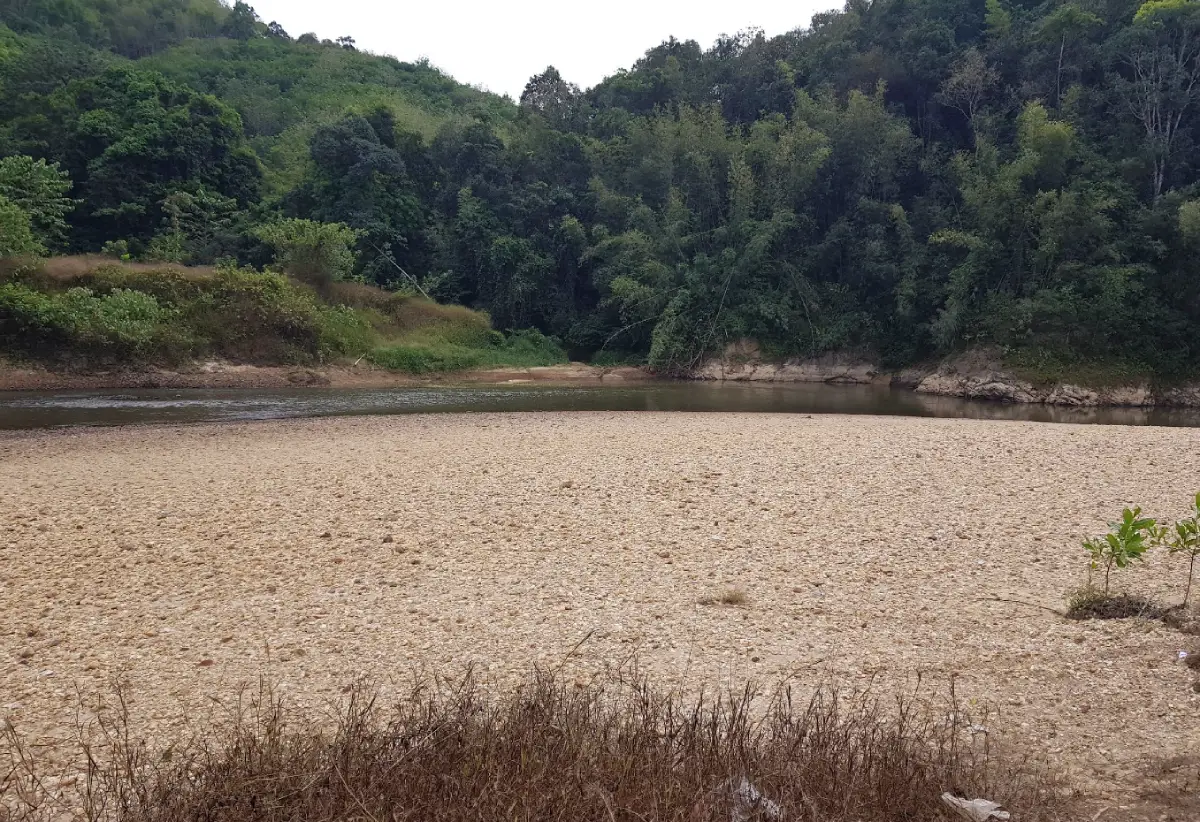
Khao Phra Narai in Phang Nga Province is an important archaeological landscape for understanding the early history of southern Thailand’s Andaman coast. It is located in Le Subdistrict, Kapong District, in an area shaped by streams, hills, and historic settlement routes. The original landscape is associated with the meeting point of Khlong Le and Khlong Kapong before the waters continue into the Takua Pa River system. This setting gave the area strategic value for movement, settlement, ritual activity, and the exchange of people, goods, and beliefs in the past.
Khao Phra Narai is not merely a small hill in Kapong. It is closely connected with major evidence of South Indian cultural and religious influence in the Thai peninsula. The site is associated with stone sculptures of Vishnu, Lakshmana, and Sita, as well as the Khao Phra Narai inscription of ancient Takua Pa. These remains indicate that Kapong and Takua Pa were once linked with maritime trade, cross-peninsula routes, and Tamil merchant communities from South India. The site therefore belongs to a much larger historical network that connected the Andaman coast with the Indian Ocean world.
The site is closely connected with Wat Narayanikaram, widely known locally as Wat Le. The temple is located in Moo 3, Le Subdistrict, Kapong District, Phang Nga Province. Today, this temple is the practical visitor point for people who want to understand the story of Khao Phra Narai. Within the temple area are replica sacred images, local historical displays, a community museum, and narratives that preserve the memory of the original archaeological landscape.
The most important image associated with the site is Phra Narai, or Vishnu, a deity of the Vaishnava tradition within Brahmanism-Hinduism. The original description refers to a standing Vishnu image flanked by Lakshmana and Sita. The sculptures were carved from stone, and the Vishnu figure is described as approximately 2.26 meters high and 85 centimeters wide, making it one of the large and significant Vishnu images connected with early southern Thai archaeology.
From an art-historical perspective, the Khao Phra Narai sculptures are associated with late Pallava-style South Indian art, which reached the southern Thai peninsula around the 12th to 14th Buddhist centuries. This artistic connection shows that the Andaman coast was not isolated. It was part of a trading and cultural corridor where Indian religious ideas, iconography, inscriptions, and artistic forms moved together with merchants, travelers, and ritual specialists.
The Khao Phra Narai inscription, also known as Inscription No. 26, is another key piece of evidence. It is a stone inscription written in Pallava script and Tamil language. Its content is associated with the Manigramam, a Tamil merchant guild from South India, and reflects the role of merchant groups in the Andaman coastal port world. The inscription is dated to around the 11th Buddhist century and is considered one of the oldest Pallava-script inscriptions in Thailand.
The name Takola is often discussed together with Khao Phra Narai and Wat Narayanikaram. Takola is linked with ancient Takua Pa, an important Andaman-side port and trading area. The discovery of sculptures, inscriptions, lingas, fragments of images, and other archaeological remains in Kapong and Takua Pa shows that this region once formed part of a network of ancient communities connected with the sea, inland waterways, forest routes, minerals, ritual life, and cross-peninsula movement.
The geography of Khao Phra Narai matters for historical interpretation. A hill near the convergence of streams was not only a natural feature. It could serve as a landmark, a ritual place, a settlement reference point, and a node in a transport network. Waterways allowed people and goods to move through the landscape, while the surrounding high ground provided orientation and symbolic value. The meeting of rivers and hills helped shape the site’s importance.
Wat Narayanikaram preserves the memory of the site in the present. The temple houses replica images of Vishnu, Lakshmana, and Sita, as well as local antiquities and historical objects. The original Vishnu and Lakshmana images are preserved at the Thalang National Museum in Phuket, while the temple continues to display replicas for worship and learning. This arrangement allows visitors to connect with the original cultural landscape while the important artifacts are protected in museum care.
The temple also has a local museum displaying old objects and antiquities from Le Subdistrict and Kapong District. These include ceramics, jars, tools, weapons, household objects, and items donated by local residents. Such a museum is valuable because it records not only major archaeological evidence but also the ordinary material culture and memory of local communities. It helps visitors see Kapong not only as an ancient ritual landscape, but also as a living community with a long cultural continuity.
The old vihara inside Wat Narayanikaram is also worth noting. It reflects southern Thai temple architecture and local religious practice. Visitors should move slowly through the temple area, beginning with respectful worship, then observing the replica images, reading the history of Takola, and exploring the local museum. This sequence helps connect sacred space, historical evidence, and community memory.
Khao Phra Narai also shows how Brahmanism-Hinduism and Buddhism can coexist within southern Thai cultural landscapes. The most important archaeological evidence is Vaishnava and Hindu in origin, but the present visitor context is a Buddhist temple. The local community’s continued respect for Phra Narai within a Buddhist temple environment reflects the flexible and layered religious culture of southern Thailand.
For travelers interested in archaeology, Khao Phra Narai is ideal as part of a Takola and ancient Takua Pa cultural route. Phang Nga is often known for beaches, limestone islands, waterfalls, and national parks, but this site reveals a deeper historical layer. Kapong and Takua Pa were connected with maritime trade, Indian religious influence, old communities, tin-related economies, and cross-cultural exchange long before modern tourism developed.
A visit to Khao Phra Narai should be approached as educational travel rather than a quick photo stop. Visitors should read the information panels, observe the replica sculptures carefully, and consider why Tamil inscriptions and large Vishnu images appeared in an inland valley connected with the Andaman coast. The answer leads to a broader story of trade, faith, art, and movement across the Thai peninsula.
One important point is the difference between the original discovery landscape and the present visitor experience. Some original objects were moved for conservation, study, and museum display. Wat Narayanikaram keeps replicas and community displays that allow visitors to understand the story in its local setting. A visit today is therefore a visit to both a living temple and a memory site connected with one of the most important archaeological discoveries in Phang Nga.
Visitors should behave respectfully. Although the key evidence is linked with Hindu tradition, the present site is a Buddhist temple and local community space. Dress politely, avoid loud behavior, do not touch antiquities without permission, do not climb onto platforms, and ask before photographing sensitive areas. Careful conduct protects both the cultural heritage and the atmosphere of the temple.
Khao Phra Narai can be included in a one-day Kapong cultural and nature route. Visitors may begin at Wat Narayanikaram, then continue to Plai Phu Hot Spring, Kapong Canyon, old Kapong market areas, or nearby local communities. This route reveals Kapong as more than a quiet inland district. It combines archaeology, religious history, hot springs, old mining landscapes, local food, and mountain-community atmosphere.
Plai Phu Hot Spring is a good nearby natural stop. It is a naturally occurring hot spring in Kapong District, where hot water and cool stream water exist in the same area. Visiting the hot spring after the historical site creates a balanced itinerary: morning cultural learning and later relaxation in the natural landscape of Kapong.
Kapong Canyon and old Kapong community areas add another historical layer. They show the later mining and local settlement identity of the district. When combined with Khao Phra Narai, they help visitors understand Kapong across different periods: ancient maritime trade and Indian cultural influence, mining-related local history, and present-day community-based tourism.
Getting There is easiest by private car. Travel into Kapong District, then continue to Le Subdistrict and Wat Narayanikaram. From Takua Pa, the site can be combined with old Takua Pa, Ban Thung Tuek, and other historical points on the Andaman trade route. From Phuket, travelers can enter Phang Nga by Sarasin Bridge and continue by road toward Kapong. A private car or rental car is recommended because local attractions in Kapong are spread across villages, streams, hills, and secondary roads.
Public transport travelers should reach Kapong or Takua Pa first, then continue by local transport or hired vehicle to Le Subdistrict. Those planning to visit Wat Narayanikaram, Plai Phu Hot Spring, Kapong Canyon, and local restaurants should allow at least half a day to one full day, depending on the route and pace.
The best time to visit is morning or afternoon. Morning light is suitable for worship, walking around the temple, and photography. Afternoon visits can be paired with hot springs or nearby community stops. During the rainy season, visitors should prepare for rain because Kapong is a green mountain district with humid weather, but this season also gives the area its well-known misty and lush atmosphere.
Travelers interested in history should read basic background on Takola, Takua Pa, Pallava art, Vaishnavism, and Tamil inscriptions before arriving. This preparation makes the visit much richer. The sculptures and inscription are not isolated objects; they are evidence of an early international coastal network linking South India, the Andaman Sea, and communities on the Thai peninsula.
Photography should be done respectfully. Focus on the temple atmosphere, replica images, museum setting, and surrounding landscape. If photographing museum objects or sacred images, ask for permission first. Avoid flash on old objects and do not move items for photographs. Respectful photography helps preserve trust between visitors and the local community.
Khao Phra Narai is suitable for families, students, historians, cultural travelers, and visitors interested in early southern Thai history. Children can learn that before modern Thailand, southern coastal communities were already connected with India, maritime trade, religions, art, and written records. The site makes history visible through a hill, a temple, a river landscape, sculptures, and community memory.
In summary, Khao Phra Narai is one of Phang Nga’s most important historical learning sites. It brings together geography, river networks, Vishnu worship, Pallava-style art, Tamil inscription evidence, the story of Takola, and community preservation at Wat Narayanikaram. A visit here reveals Phang Nga beyond beaches and islands: it shows Phang Nga as an ancient cultural corridor of trade, religion, art, and human movement across the Thai peninsula more than a thousand years ago.
| Name | Khao Phra Narai / Khao Phra Narai-Wat Narayanikaram Archaeological Site |
| Related Names | Wat Narayanikaram, Wat Le, Khao Wiang, Khao Siwichai, Khao Phra Narai Inscription Of Ancient Takua Pa |
| Location | Le Subdistrict, Kapong District, Phang Nga Province |
| Visitor Address | Wat Narayanikaram, Moo 3, Le Subdistrict, Kapong District, Phang Nga 82170, Thailand |
| Wat Narayanikaram Coordinates | 8.77389, 98.44264 |
| Place Type | Archaeological, religious, and community learning site connected with Vishnu sculptures, Tamil inscription evidence, Pallava art, and ancient Takola-Takua Pa history |
| Significance | Important evidence of South Indian cultural influence, Vaishnava Brahmanism-Hinduism, and Andaman maritime trade networks in southern Thailand |
| Period / Age | Related archaeological evidence dates broadly to the 11th–14th Buddhist centuries; the Khao Phra Narai inscription is an early Pallava-script Tamil inscription in Thailand |
| Highlights | Replica Vishnu image, replica Lakshmana image, Sita image, Khao Phra Narai inscription story, Wat Narayanikaram local museum, old vihara, and Takola history |
| Art / Belief System | Late Pallava-style South Indian art and Vaishnava tradition within Brahmanism-Hinduism |
| Open Days | Daily |
| Recommended Visiting Time | Daytime, especially morning or late afternoon |
| Current Status | A living temple and historical learning site with replica sacred images and a local museum at Wat Narayanikaram |
| Temple Caretaker | Wat Narayanikaram, Le Subdistrict, Kapong District, Phang Nga Province |
| Abbot | Phra Khru Sophon Prachanukun |
| Temple Contact Numbers | 086-272-7880, 092-996-8408 |
| Facilities / Learning Areas | Replica sacred-image area, old vihara, local museum, temple courtyard, and community antiquities learning area |
| Visitor Conduct | Dress politely, do not touch antiquities without permission, avoid flash on old objects, keep quiet, and respect the temple and local community space |
| Travel Information | Travel by road to Kapong District, then continue to Le Subdistrict and Wat Narayanikaram. From Takua Pa, the site can be combined with old Takua Pa and Ban Thung Tuek in a historical route. |
| Nearby Tourist Attractions | 1. Plai Phu Hot Spring, about 15 km 2. Kapong Canyon / Ban Saphan Suea, about 10 km 3. Old Kapong Market / Pak Thak Walking Street, about 13 km 4. Old Takua Pa Town, about 30 km 5. Ban Thung Tuek Historical Area, about 35 km 6. Ban Nam Khem Tsunami Memorial, about 45 km |
| Nearby Restaurants | 1. Kapong Ahan Restaurant, about 14 km, Tel. 076-499-666 2. Kesawalee Garden & Cafe, about 18 km, Tel. 064-051-7888 3. N PLAI WA, about 20 km, Tel. 065-552-9163 4. Kampong Restaurant, about 12 km, Tel. 099-352-1694 5. Khao Sok Dawan Oil Restaurant, about 35 km, Tel. 087-282-3236 |
| Nearby Accommodations | 1. Kapong Garden Resort, about 14 km, Tel. 076-499-666 2. Resort Kapong ATV, about 18 km, Tel. 081-737-7401, 081-415-9766 3. Mok Yam Chao Kapong Resort, about 23 km, Tel. 089-925-1754 4. Wassana Rimthara Resort, about 25 km, Tel. 082-840-9044 5. Yaowawit School, Lodge & Farm, about 25 km, Tel. 084-852-1809 |
Frequently Asked Questions (FAQ)
Q: Where is Khao Phra Narai located?
A: Khao Phra Narai is located in Le Subdistrict, Kapong District, Phang Nga Province. The main present-day visitor point is Wat Narayanikaram, also known locally as Wat Le.
Q: Why is Khao Phra Narai important?
A: It is an important archaeological site linked with Vishnu, Lakshmana, and Sita sculptures, a Tamil inscription, South Indian cultural influence, and the ancient Andaman trading world of Takola and Takua Pa.
Q: Where are the original Vishnu images now?
A: The original Vishnu and Lakshmana images are preserved at the Thalang National Museum in Phuket, while Wat Narayanikaram displays replica images for worship and learning.
Q: Why is the Khao Phra Narai inscription important?
A: The inscription is written in Pallava script and Tamil language and is associated with Tamil merchant groups. It is one of the early Pallava-script inscriptions found in Thailand.
Q: Is there an entrance fee?
A: Visitors enter a temple and community learning area. They should help keep the area clean and follow the temple’s rules while visiting.
Q: What should visitors wear?
A: Visitors should dress politely because the site is a temple and archaeological learning area. They should avoid touching antiquities or sacred objects without permission.
Q: What can be visited nearby?
A: Nearby places include Plai Phu Hot Spring, Kapong Canyon, old Kapong market areas, Old Takua Pa Town, Ban Thung Tuek, and Ban Nam Khem Tsunami Memorial.
Q: Who is Khao Phra Narai suitable for?
A: It is suitable for visitors interested in history, archaeology, Pallava-style art, Brahmanism-Hinduism, ancient trade routes, and cultural travel in Phang Nga.
 Category: ●Nature and Wildlife
 Group: ●Mountain (Doi)
Last Update : 2 MonthAgo
 Last Update : 2 MonthAgo

 Click to Access the Navigation Map GPS
Khao Narai Map
Recommend

 Art, Culture and Heritage
 Historical Sites and Monuments(2)
 Landmarks and Memorials(6)
 Art, Craft Centres, Tradition(3)
 Places of Worship
 Temple(18)
 Other Sacred Sites(8)
 Suburban Living
 Village, Community(3)
 National Parks and Marine Reserves(12)
Mountain (Doi)(8)
 Waterfalls(21)
 Hot Springs(2)
 Caves(12)
 River, Canal(4)
 Bays and Beaches(28)
 Islands(11)
 Other natural attractions(7)
 Entertainment and Agricultural
 Animal camps and shows(2)
 Farms, Parks and Ecotourism(2)
 Waterpark(3)
 Outdoor and Adventure Activities(3)
 Travel Articles, Recipes
 Travel Review, Food Review(1)
 Southern Food Menu, Southern Food Recipes(1)


