
lovethailand home >South Travel Attractions >Phang Nga Travel Attractions >Khura Buri >Koh Phra Thong > Moken Village
TL;DR: Moken Village, Phang Nga attractions : Suburban Living, Village, Community.
Moken Village
Open Days: Open During The Official Tourism Season Of Mu Ko Surin National Park
Opening Hours: Visits Follow Boat Schedules And National Park Announcements
Moken Village in Phang Nga is an ethnic sea-nomad community located within Mu Ko Surin National Park, Khura Buri District, Phang Nga Province. The village most commonly visited by travelers is at Ao Bon Yai, or Ao Bon, on Ko Surin Tai. It is one of the most meaningful cultural stops in the Surin Islands, not only because of the turquoise sea, beaches, coral reefs, and national park scenery, but because it gives visitors a chance to learn about the Moken people, a sea-oriented ethnic group whose life, knowledge, and memory have been deeply connected with the Andaman Sea for generations.
The Moken have long been known as sea people of the Andaman. In earlier times, many Moken families lived a semi-nomadic life, moving between islands and coastal areas according to the seasons. Boats were not only a means of transport but also homes, working spaces, and symbols of mobility. Their knowledge of tides, currents, reefs, fish, shellfish, coastal plants, and weather signs was passed down through families. Today, the Moken in Thailand are most visibly associated with the Surin Islands in Phang Nga, while related communities and kinship networks extend across parts of the Andaman region.
The Moken Village in the Surin Islands is important because it shows that a marine national park is not only a protected natural landscape. It is also a place connected with people, memory, language, and cultural knowledge. The Moken have long understood bays, coral reefs, safe anchorages, food-gathering areas, and signs of weather and sea movement. This knowledge helped them live in remote island environments, even though the area is far from the mainland and strongly affected by monsoon seasons, sea conditions, and later national park regulations.
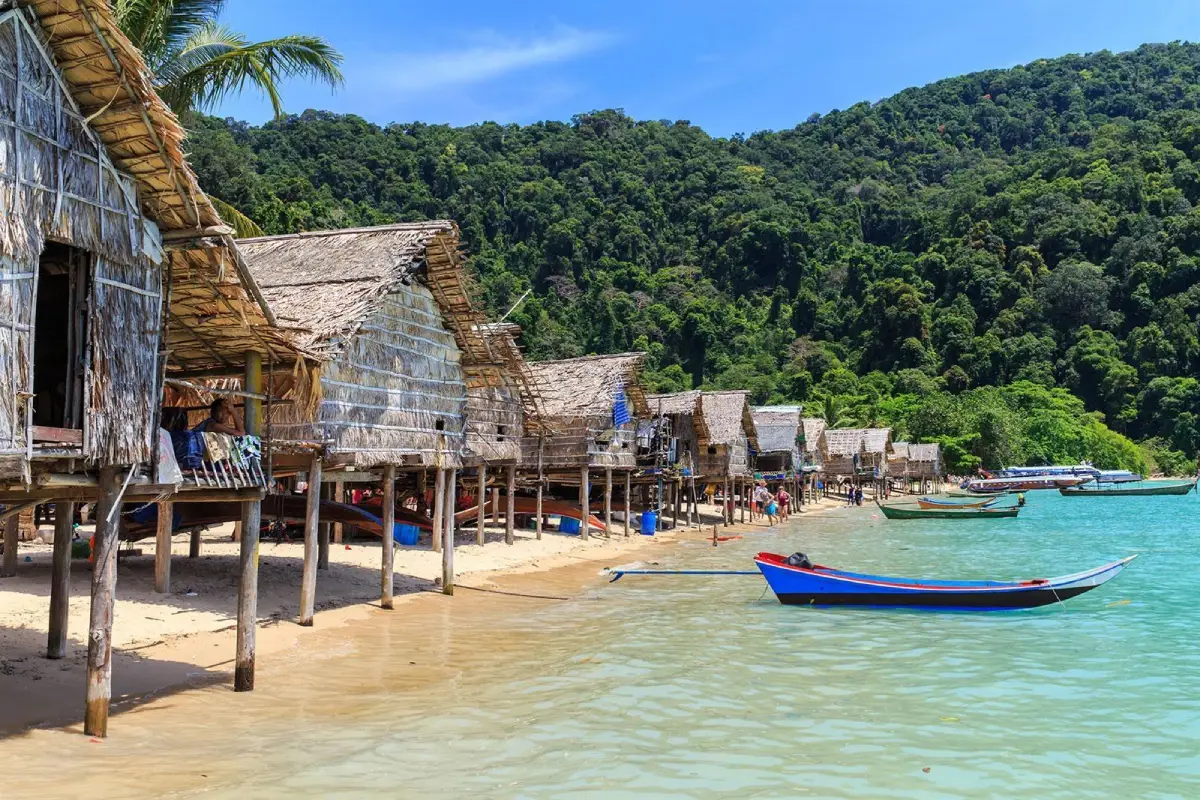
The houses of the Moken Village are among its most recognizable features. Many are built close together along the beach, raised on stilts above the ground to suit the coastal environment and tidal changes. They are simple structures made with natural or locally suitable materials such as timber, bamboo, thatch, and palm leaves. Some houses have small front platforms used for resting, preparing food, talking, or making small handicrafts. The village paths are sandy and informal, giving the place the feeling of a real coastal community rather than a staged attraction.
Moken Village lies within Mu Ko Surin National Park, one of Thailand’s important marine conservation areas. The park includes Ko Surin Nuea, Ko Surin Tai, Ko Ri, Ko Khai, and Ko Klang, with shallow coral reefs, clear water, beaches, forested hills, and high marine biodiversity. Many visitors reach Moken Village as part of a snorkeling trip that also includes locations such as Ao Chong Khad, Ao Mai Ngam, Ao Suthep, or other bays around the two main Surin islands. Although most tour visits are short, travelers who pay attention will discover a community story that is much deeper than a quick photo stop.
The history of the Moken in the Surin Islands has been shaped by major changes. In the past, Moken families lived and moved seasonally around several bays, including Ao Sai En, Ao Bon Lek, and other coastal areas. After Mu Ko Surin became a national park in 1981, access to land and natural resources changed under conservation rules. The 2004 Indian Ocean tsunami damaged earlier homes and forced major relocation and rebuilding. After that, many Moken returned and settled more permanently around Ao Bon Yai, which has become the best-known Moken village area today.
One reason the Moken became widely known outside Thailand was their knowledge of natural signs during the 2004 tsunami. Elders in the community recognized the unusual retreat of the sea and connected it with traditional stories of a great wave, warning people to move to higher ground. This event drew attention to Moken marine knowledge. However, the community should not be understood only through the tsunami story. Their identity also includes language, fishing knowledge, boat traditions, kinship, spiritual beliefs, songs, stories, and adaptation to modern pressures.
The traditional Moken boat, often called a kabang, once played a central role in Moken life. It was a home, a vehicle, and a symbol of freedom on the sea. Boat knowledge involved choosing the right tree, shaping the hull, using fire to bend wood, and working collectively over a long period. As the Moken became more settled and as conservation rules restricted access to large trees, traditional boat-building declined sharply. Much of this knowledge now survives mainly through elders and community members who still try to preserve memories of the older way of life.
Today, Moken livelihoods are strongly affected by the tourism season and national park management. During the open tourism season, some Moken earn income by working with tourism, driving boats, selling handicrafts, assisting national park operations, or providing local services. During the monsoon closure, tourism-related income falls sharply. This seasonal pattern makes life economically fragile for many families. Understanding this context helps visitors see both the benefits and the limits of tourism for the community.
Moken Village is not simply a group of houses. It is a cultural space with its own language, beliefs, craft knowledge, and marine vocabulary. Words for winds, fish, reefs, tides, boats, and tools are connected to lived experience in the sea. Handicrafts sold in the village should therefore be seen not only as souvenirs but also as a small way for the community to share culture and earn income in a changing environment. Visitors who buy from the community should do so respectfully, pay fairly, and avoid bargaining in a way that undervalues local work.
Etiquette is essential when visiting Moken Village. This is a real home community, not an open-air museum. Visitors should walk only in permitted areas, avoid entering houses or private spaces without permission, ask before taking close-up photographs of people, avoid distributing money or sweets randomly to children, and avoid behavior that makes residents feel like objects of display. Respectful travel preserves dignity and makes the visit more meaningful for both visitors and the community.
Travel to Moken Village is normally arranged through Mu Ko Surin National Park access routes. The mainland starting point is the Khura Buri pier area and the national park visitor service area in Khura Buri District, Phang Nga Province. Travelers from Bangkok can drive south along Highway 4, Phetkasem Road, toward Khura Buri, a distance of about 720 kilometres. About 6 kilometres before Khura Buri town, near kilometre marker 721, a side road leads about 2 kilometres toward Khura Buri Pier and the mainland office area of Mu Ko Surin National Park. From there, travelers continue by boat to the Surin Islands, about 60 kilometres offshore.
Visitors traveling by bus can take a Bangkok–Khura Buri route and continue by local transport to the pier. Those traveling by air can fly to Ranong or Phuket, then continue by road to Khura Buri. Boat travel from Khura Buri to the Surin Islands depends on the type of vessel and sea conditions. Speedboats are faster but more expensive, while slower boats take longer. Boat schedules and prices should always be checked for the actual travel season because they can change according to weather, operator arrangements, safety announcements, and park opening status.
The tourism season is the most important planning factor for Moken Village. The village is inside a marine national park affected by the Andaman monsoon. Mu Ko Surin National Park closes tourism and overnight stays during the monsoon period for visitor safety and ecological recovery. In 2026, the park announced closure from 15 May to 15 October 2026. Visitors should therefore check the current national park announcement before planning a trip. The most suitable period is generally after the park reopens and before the next monsoon closure.
Costs for visiting Moken Village usually include boat fare, national park entrance fee, food, snorkeling equipment, and tour package costs. There is not normally a separate village admission fee like a conventional attraction, but travelers enter the wider area of Mu Ko Surin National Park and must follow the park’s fee structure. The Surin Islands are in a national park fee group where Thai and foreign visitor rates differ. These fees are separate from boat and tour costs.
In a typical Surin Islands itinerary, Moken Village is visited together with snorkeling sites and national park service points such as Ao Chong Khad or Ao Mai Ngam. A standard tour may allow about 30 to 60 minutes in the village. Trips with good interpretation or community-led explanation may take longer. The best approach is to walk slowly, listen carefully, observe houses, boats, tools, craft displays, and the surrounding beach without disturbing daily life.
Recommended items for a visit include sea-appropriate clothing, a hat, reef-safe sunscreen, drinking water, personal medicine, a dry bag, sandals or shoes suitable for sand, and small cash for community souvenirs. Phones and cameras should be protected from water because the trip involves boarding and leaving boats. Visitors should minimize single-use plastic and follow national park waste rules.
Moken Village is best understood as a learning place. Visitors should ask what they are seeing beyond stilted houses by the sea: a transition from mobility to settlement, the impact of conservation policies on local people, the role of tourism in income, the decline of traditional boat-building, the change of language among younger generations, and the effort to keep stories, songs, boat knowledge, and marine wisdom alive. Seen in this way, Moken Village becomes much more meaningful than a scheduled stop on a snorkeling tour.
For those interested in the wider sea-people cultures of the Andaman, Moken Village should be understood alongside other sea people such as the Moklen and Urak Lawoi. These groups are often broadly called sea people, but each has its own language, history, territory, and identity. Writing or speaking about the Moken should therefore avoid generalization and should respect the name, dignity, and voice of the community itself.
Moken Village is also connected with the broader question of sustainable tourism in marine national parks. The Surin Islands contain fragile natural resources, while the Moken community is also vulnerable to cultural and economic change. Good tourism should not focus only on numbers of visitors or photographs. It should support understanding, reduce disturbance, respect national park rules, and create fair opportunities for local people. Visitors who approach the village this way help keep it meaningful for the long term.
Many short travel descriptions mention Moken Village only as a sea-gypsy village in the Surin Islands with raised houses along the beach. A more complete guide should include Ao Bon Yai on Ko Surin Tai, the connection with Mu Ko Surin National Park, settlement history, the 2004 tsunami, kabang boat traditions, the Moken language, visitor etiquette, seasonal park closure, national park fees, and respectful photography. These details help travelers plan properly and visit with cultural awareness.
Getting There starts with travel to Khura Buri District in Phang Nga Province. From Bangkok, drive along Highway 4, Phetkasem Road, for about 720 kilometres toward Khura Buri. About 6 kilometres before Khura Buri town, near kilometre marker 721, a side road leads about 2 kilometres to Khura Buri Pier and the mainland national park service area. Bus travelers can reach Khura Buri and continue by local transport to the pier. Air travelers can fly to Ranong or Phuket, then continue by road to Khura Buri. From the pier, boats travel about 60 kilometres to the Surin Islands, taking roughly 1 to 2.5 hours depending on the boat and sea conditions. Visits to Moken Village should follow the route and rules set by the national park, boat operator, or local community.
Moken Village in Phang Nga is therefore a destination that must be visited with cultural care. It is more than a village beside the sea. It is the home of an ethnic minority community with deep marine knowledge, memories of boat-based life, and ongoing adaptation to national park policies, tourism, seasons, income changes, and modern pressures. Visitors who come during the official open season, follow park rules, and respect the people of the village will find that Moken Village adds a deeper human meaning to a journey through the Surin Islands.
| Name | Moken Village / Moken Village At Ao Bon Yai |
| Location | Ao Bon Yai Or Ao Bon, Ko Surin Tai, Mu Ko Surin National Park, Khura Buri District, Phang Nga Province |
| Address | Mu Ko Surin National Park, Ko Phra Thong Subdistrict, Khura Buri District, Phang Nga 82150, Thailand |
| Coordinates | Approximately 9.4260, 97.8790, Ao Bon Yai Area, Ko Surin Tai |
| Highlights | Moken sea-people community, raised houses along the beach, marine knowledge, kabang boat heritage, handicrafts, and cultural learning within the Surin Islands |
| History / Community Character | An ethnic Moken community with a long connection to the Andaman Sea. Traditionally mobile and boat-based, the community is now more settled at Ao Bon Yai within Mu Ko Surin National Park. |
| Name Origin | The name refers to the Moken ethnic group, a sea-oriented people historically connected with islands and coastal areas of the Andaman Sea. |
| Travel Information | Travel to Khura Buri Pier in Phang Nga, then continue by boat to Mu Ko Surin National Park, about 60 km offshore. Boat travel takes about 1–2.5 hours depending on vessel type and sea conditions. |
| Current Status | A living ethnic community inside Mu Ko Surin National Park and a cultural learning stop open to visitors during the official tourism season under national park rules |
| Open Days | Open During The Official Tourism Season. In 2026, Mu Ko Surin National Park is closed for tourism and overnight stays from 15 May to 15 October 2026. |
| Opening Hours | Visits follow boat schedules and national park announcements, usually as daytime visits during Surin Islands tours. |
| Fees | No separate village admission fee, but Mu Ko Surin National Park entrance fees and boat or tour costs apply. |
| National Park Entrance Fees | Thai Visitors: Adult 100 Baht, Child 50 Baht / Foreign Visitors: Adult 500 Baht, Child 250 Baht |
| Facilities | Village walking area, boat stop during tours, some community souvenir points, and main national park facilities on Ko Surin Nuea such as visitor center, welfare shop, accommodation, and camping area during the open season |
| Main Areas / Zones | Raised-house beach area, village path, front platforms, handicraft area, Moken lifestyle learning area, Ao Bon beach, and community boat area |
| Caretaker / Local Authority | Ao Bon Yai Moken Community And Mu Ko Surin National Park, Department Of National Parks, Wildlife And Plant Conservation |
| Main Contact Number | Mu Ko Surin National Park, Tel. 076-472145, 076-472146 |
| Recommended Activities | Learn about Moken life, walk through permitted village areas, observe raised houses, listen to community stories, buy community handicrafts, photograph respectfully, and combine the visit with Surin Islands snorkeling routes |
| Visitor Etiquette | Walk only in permitted areas, do not enter homes without permission, ask before close-up photography, do not distribute items randomly to children, do not litter, and follow guidance from the national park, tour leaders, and community. |
| Nearby Tourist Attractions | 1. Ao Bon Yai, about 0 km 2. Ao Chong Khad, about 2 km by boat 3. Ao Mai Ngam, about 3 km by boat 4. Ao Sai En, about 3 km by boat 5. Ko Surin Nuea, about 3 km by boat 6. Ao Suthep, about 5 km by boat 7. Richelieu Rock, about 18 km by boat |
| Nearby Restaurants | 1. Mu Ko Surin National Park Welfare Restaurant, Ko Surin Nuea, about 2 km by boat 2. Tom Yum Goong Restaurant, Khura Buri, about 60 km from the Surin Islands by boat to mainland plus road transfer 3. Kuraburi Greenview Restaurant, about 60 km from the Surin Islands by boat to mainland plus road transfer 4. Restaurants Around Khura Buri Pier, about 60 km from the Surin Islands by boat to mainland plus road transfer 5. Local Restaurants In Khura Buri District, about 60 km from the Surin Islands by boat to mainland plus road transfer |
| Nearby Accommodations | 1. Mu Ko Surin National Park Bungalows And Camping Area, Ko Surin Nuea, about 2 km by boat 2. Kuraburi Greenview Resort, about 60 km from the Surin Islands by boat to mainland plus road transfer, Tel. 076-491734 3. Boon Piya Resort, Khura Buri, about 60 km from the Surin Islands by boat to mainland plus road transfer 4. The Camp Resort, Khura Buri, about 60 km from the Surin Islands by boat to mainland plus road transfer 5. Kuraburi Resort, about 60 km from the Surin Islands by boat to mainland plus road transfer 6. Accommodations Around Khura Buri Pier, about 60 km from the Surin Islands by boat to mainland plus road transfer |
Frequently Asked Questions (FAQ)
Q: Where is Moken Village located?
A: Moken Village is located around Ao Bon Yai or Ao Bon on Ko Surin Tai, inside Mu Ko Surin National Park, Khura Buri District, Phang Nga Province.
Q: Why is Moken Village important?
A: It is an ethnic Moken sea-people community with raised houses along the beach, marine knowledge, language, beliefs, boat traditions, and a long cultural relationship with the Andaman Sea.
Q: Is Moken Village open all year?
A: No. It follows the tourism season of Mu Ko Surin National Park. In 2026, the park is closed for tourism and overnight stays from 15 May to 15 October 2026.
Q: How do visitors get to Moken Village?
A: Visitors travel to Khura Buri Pier in Phang Nga, then take a boat about 60 km to Mu Ko Surin National Park. Visits to Moken Village must follow the route set by the national park, boat operator, or community.
Q: Is there a separate admission fee for Moken Village?
A: There is no separate village admission fee, but national park entrance fees and boat or tour costs apply.
Q: How long should visitors spend in Moken Village?
A: Standard tour programs usually allow about 30 to 60 minutes, but visits with cultural interpretation or community explanation may take longer.
Q: What etiquette should visitors follow?
A: Visitors should walk only in permitted areas, avoid entering homes without permission, ask before photographing people closely, avoid giving items randomly to children, avoid littering, and follow national park and community guidance.
Q: What nearby places can be visited with Moken Village?
A: Nearby places include Ao Chong Khad, Ao Mai Ngam, Ao Suthep, Ao Sai En, snorkeling sites around Ko Surin Nuea and Ko Surin Tai, and Richelieu Rock when included in the boat program.
 Category: ●Suburban Living
 Group: ●Village, Community
Last Update : 2 MonthAgo
 Last Update : 2 MonthAgo

 Click to Access the Navigation Map GPS
Moken Village Map
Recommend

 Art, Culture and Heritage
 Historical Sites and Monuments(2)
 Landmarks and Memorials(6)
 Art, Craft Centres, Tradition(3)
 Places of Worship
 Temple(18)
 Other Sacred Sites(8)
Village, Community(3)
 Nature and Wildlife
 National Parks and Marine Reserves(12)
 Mountain (Doi)(8)
 Waterfalls(21)
 Hot Springs(2)
 Caves(12)
 River, Canal(4)
 Bays and Beaches(28)
 Islands(11)
 Other natural attractions(7)
 Entertainment and Agricultural
 Animal camps and shows(2)
 Farms, Parks and Ecotourism(2)
 Waterpark(3)
 Outdoor and Adventure Activities(3)
 Travel Articles, Recipes
 Travel Review, Food Review(1)
 Southern Food Menu, Southern Food Recipes(1)


