
lovethailand home >South Travel Attractions >Phang Nga Travel Attractions >Thap Put >Bang Lyon > Wat Rat Uppatham (Wat Bang Riang)
TL;DR: Wat Rat Uppatham (Wat Bang Riang) is located at Bang Riang Subdistrict, Thap Put District, Phang Nga Province 82180, Thailand, open Daily, hours 09.00 – 16.00.

Wat Rat Uppatham (Wat Bang Riang)
Open Days: Daily
Opening Hours: 09.00 – 16.00
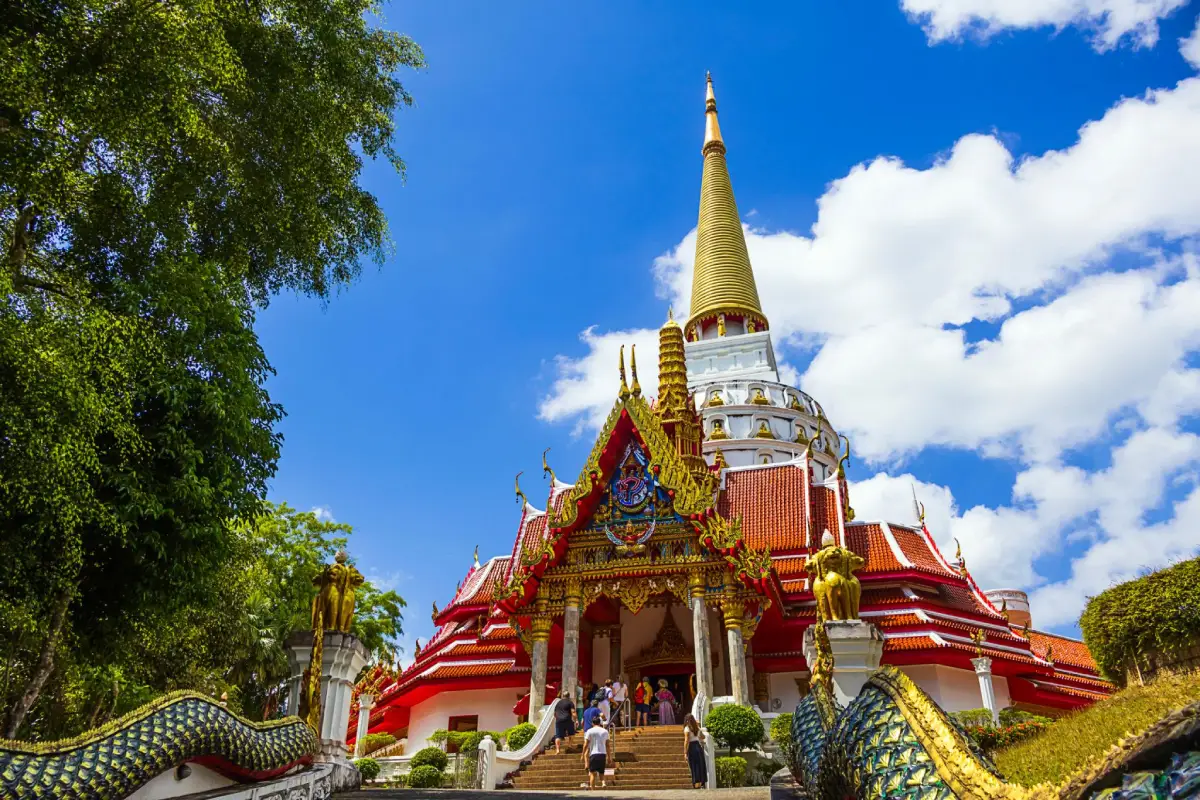
Wat Rat Uppatham, widely known as Wat Bang Riang, is one of the most remarkable Buddhist temples in Thap Put District, Phang Nga Province. Set among mountains, large trees, and peaceful natural surroundings, the temple is best known for Phra Mahathat Chedi Phutthatham Banlue on Khao Lan, the large Guan Yin statue, Phra Phuttha Atthimongkhon Chai Naga Prok, the Three Phra Ruang standing Buddha images, and the distinctive Suphannahong boat-shaped ordination hall. It is a place where Buddhist faith, hilltop architecture, local tradition, and panoramic mountain views come together in a single spiritual landscape.
Wat Bang Riang is a meaningful destination for travelers who want to experience Phang Nga beyond beaches, islands, and limestone bays. The temple offers a different side of the province: a quiet hilltop sanctuary where visitors can pay respect to sacred relics, observe Buddhist art, walk through elevated temple terraces, and look across the green hills of southern Thailand. It is suitable for Buddhist worship, cultural travel, photography, quiet reflection, and slow travel in the inland part of Phang Nga.
The temple is located in Bang Riang Subdistrict, Thap Put District, Phang Nga Province 82180. From the Thap Put District Office, travelers follow Highway 4118 toward Ban Bang Riang for about 11 km. The route leaves the main town area and gradually enters a landscape of rubber plantations, fruit orchards, forested slopes, and local villages. This setting is an important part of the visit because the journey toward the temple already introduces travelers to the rural and mountainous character of Thap Put.
Historically, Wat Rat Uppatham was originally known by local people as Wat Bang Riang. Records state that the temple was founded in 1910. Local oral history says the original temple stood east of Khlong Marui, near the foothill where Phra Mahathat Chedi Phutthatham Banlue now stands. Because access was difficult and the old site was affected by water erosion, Phor Than Ket, who served as district ecclesiastical chief at that time, worked with local residents to move the temple to its present site.
The modern development of Wat Bang Riang became especially important in 1986, when Phra Achan Chai, later known as Phra Khru Phaisan Phatthanuyut and now associated with the title Phra Thep Wachirakon, helped develop the temple in many areas. From a modest local temple, Wat Bang Riang gradually became a well-known Buddhist practice site and an important destination for worshippers and visitors from Phang Nga, nearby provinces, and other regions.
The central landmark of the temple is Phra Mahathat Chedi Phutthatham Banlue. Construction began in 1986 and was completed in 2000. The chedi rises 109 meters from its base and has a diameter of 41 meters. Its three-level structure carries symbolic meaning. The first level is an equal-sided octagonal base representing the Noble Eightfold Path. The second level is an octagonal chamber. The third level is a bell-shaped chedi. Its overall form blends southern, northern, and broader Buddhist architectural influences into one monumental structure.
Inside the chedi are sacred Buddha relics, which are the main reason many Buddhist devotees come to worship here. Paying respect to Buddha relics is a deeply meaningful act in Buddhist practice because it recalls the Buddha and his teachings. Visitors who reach the hilltop therefore come not only to see a large and beautiful monument, but also to take part in a long tradition of relic veneration, merit-making, and inner reflection.
The route from the foothill to the top of Khao Lan is about 1.3 km. Today, a concrete road allows visitors to reach the upper area more conveniently. Near the top, there is a wide parking area, resting spaces, and sacred structures arranged across the hilltop. A concrete walkway leads toward the main chedi, flanked by five-headed naga sculptures. These serpent forms symbolize protection and the sacred ascent toward a place of Buddhist worship.
About 300 meters before the hilltop, visitors pass the Three Phra Ruang standing Buddha images. These standing figures are associated with the idea of the Buddha opening the way to a new world and guiding beings away from defilement toward the path of Buddhism. This point is worth a short stop before continuing to the upper terraces because it marks a transition from the natural hillside into the more sacred space of the chedi complex.
At the hilltop, the temple grounds include Sala Thep Kumari, a Thai-style sermon hall. In front of the hall is a square pond with a figure of Mae Thorani wringing her hair at the center. The area around the chedi also includes rest spaces, sculptural details, and symbolic elements that invite visitors to walk slowly and observe the meaning of each part of the temple.
The large Guan Yin statue is another important sacred feature of Wat Bang Riang. Guan Yin represents compassion and mercy in Mahayana Buddhist tradition. Many visitors come to pay respect, pray, and take photographs here because the statue stands in a dramatic natural setting surrounded by mountain views. Nearby, Phra Phuttha Atthimongkhon Chai Naga Prok, a large Buddha image sheltered by a naga, expresses protection, inner strength, and auspiciousness.
The temple also contains a distinctive Suphannahong boat-shaped ordination hall. This structure is one of the memorable architectural features of Wat Bang Riang because its boat form creates a strong visual identity. In a Buddhist interpretation, the boat can be understood as a symbolic vehicle that helps beings cross from suffering toward the shore of Dhamma. For travelers interested in temple architecture, this lower-temple area should be explored along with the hilltop chedi.
The natural atmosphere is a major reason to visit. Wat Bang Riang is surrounded by hills, forests, and large trees. From the elevated terraces, visitors can look across the green landscape of Thap Put and Phang Nga. The combination of mountain air, temple bells, large sacred images, and the white-and-gold chedi creates a peaceful setting that feels very different from busier coastal attractions.
Wat Bang Riang is also known as a Buddhist practice site in Thap Put District. Since the temple’s major development in 1986, many Buddhist devotees have come here for religious practice and merit-making. The temple therefore functions as both a tourist attraction and a living place of Dhamma practice. Visitors should remember that this is an active sacred site, not simply a scenic viewpoint.
The current abbot and caretaker is Phra Wachirayanasophon, who also serves as the ecclesiastical district chief of Thap Put and abbot of Wat Rat Uppatham. He was formerly known by the title Phra Khru Thirathamrat. His role shows that the temple remains an important Buddhist center for Thap Put District and continues to be involved in religious life, community activities, and local Buddhist traditions.
The most important annual tradition connected with the temple is the robe procession for Phra Mahathat Chedi Phutthatham Banlue, held around Makha Bucha Day. The tradition involves carrying a ceremonial robe up to the chedi on Khao Lan. It is especially distinctive because devotees participate in an elephant procession before continuing up toward the chedi, a distance of more than 2 km. This tradition has been held since 2006 and is one of the most memorable Buddhist cultural events in Phang Nga.
The robe offering to the chedi is an act of devotion to the Buddha relics and a way to preserve local Buddhist culture. The event brings together monks, local residents, government agencies, private groups, and visitors. The image of worshippers carrying the robe up the hill toward the chedi shows the strong relationship between Buddhism, nature, and community in Thap Put.
Most visitors should allow 1 to 2 hours for Wat Bang Riang. This gives enough time to see the lower temple, the boat-shaped ordination hall, the Guan Yin statue, the naga-protected Buddha image, the Three Phra Ruang standing Buddha images, and the main chedi. Visitors who enjoy photography or meditation may want to stay longer, especially in the morning or late afternoon when the light is softer and the air is cooler.
Drivers should be careful on the uphill road. Although the road is concrete and accessible, some sections are steep. Vehicles should be in good condition, and drivers should use low gear when ascending or descending. Extra care is needed during or after rain because hillside roads can become slippery. Visitors who are not familiar with steep roads should drive slowly and avoid stopping in places that block traffic.
Temple etiquette is important. Visitors should dress modestly, covering shoulders and knees. Shoes should be removed where required. Speak quietly in worship areas, do not climb on sculptures, do not touch sacred images unnecessarily, and help keep the temple clean. Wat Bang Riang is a place of worship and Buddhist practice, so respectful behavior is part of the visit.
The best time to visit is in the morning, when the weather is cooler and the light is good for photography. Late afternoon is also pleasant for views, but visitors should allow enough time to come down from the hill before closing. Clear-weather days are best for seeing the mountain views around the chedi.
Getting There is easiest by private car or rental car. From Thap Put District Office, follow Highway 4118 toward Ban Bang Riang for about 11 km. From Phang Nga town, use Phet Kasem Road or Highway 4 toward Thap Put, then continue to the Bang Riang route. Travelers from Phuket or Khao Lak can reach Thap Put via the main Phang Nga road network, while those coming from Krabi can approach through Ao Luek and continue toward Thap Put. Public transport is less convenient for reaching the hilltop, so private transport is recommended.
A good one-day route can combine Wat Bang Riang with Ton Pariwat Waterfall, Ban Bang Phat, Tham Phung Chang, and Ao Phang Nga National Park. This route gives travelers a broad view of Phang Nga: mountains, temples, waterfalls, fishing communities, caves, mangroves, and the bay. Travelers interested in Buddhist architecture can also extend the route to Wat Mahathat Wachiramongkol in Ao Luek District, Krabi Province, which is connected with the former abbot Phra Achan Chai.
What makes Wat Bang Riang different from many temple attractions is the completeness of the experience. It has an old local temple history, a meditation role, a monumental chedi, sacred relics, a Guan Yin statue, a naga-protected Buddha image, a boat-shaped ordination hall, an uphill pilgrimage route, and a distinctive Makha Bucha robe procession. Visitors can worship, learn, photograph, walk, and reflect in one place.
In summary, Wat Rat Uppatham or Wat Bang Riang is one of the most important cultural and spiritual sites in Phang Nga. The 109-meter Phra Mahathat Chedi Phutthatham Banlue, the sacred relics, the mountain setting, the large Buddhist images, and the annual robe procession make it a destination worth adding to any inland Phang Nga itinerary. For travelers who want to see the spiritual landscape of southern Thailand, this hilltop temple is both beautiful and meaningful.
| Name | Wat Rat Uppatham |
| Common Name | Wat Bang Riang |
| Location | Bang Riang Subdistrict, Thap Put District, Phang Nga Province 82180, Thailand |
| Address | Ban Bang Riang, Bang Riang Subdistrict, Thap Put District, Phang Nga Province 82180, Thailand |
| Coordinates | 8.59684, 98.67628 |
| Highlights | Phra Mahathat Chedi Phutthatham Banlue on Khao Lan, Guan Yin statue, Phra Phuttha Atthimongkhon Chai Naga Prok, Three Phra Ruang standing Buddha images, Suphannahong boat-shaped ordination hall, and mountain views |
| History / Period | Founded in 1910 as Wat Bang Riang. In 1986, Phra Achan Chai began major development that transformed the temple into a well-known Buddhist practice and pilgrimage site. |
| Name Origin | Wat Bang Riang comes from the local village and subdistrict name. Wat Rat Uppatham is the temple’s official name. |
| Distinctive Features | Hilltop temple on Khao Lan surrounded by forests and mountains, with a 109-meter chedi, three-level symbolic structure, octagonal base, and bell-shaped upper chedi |
| Important Sacred Objects | Phra Mahathat Chedi Phutthatham Banlue, Buddha relics, Guan Yin statue, Phra Phuttha Atthimongkhon Chai Naga Prok, Three Phra Ruang standing Buddha images, Sala Thep Kumari, Mae Thorani figure, five-headed naga sculptures, and Suphannahong boat-shaped ordination hall |
| Main Areas / Zones | Lower temple area, Suphannahong boat-shaped ordination hall, Khao Lan access road, Three Phra Ruang area, Guan Yin terrace, Phra Phuttha Atthimongkhon Chai Naga Prok area, main chedi terrace, and Buddhist practice area |
| Abbot / Caretaker | Phra Wachirayanasophon, ecclesiastical district chief of Thap Put and abbot of Wat Rat Uppatham |
| Important Tradition | Robe procession for Phra Mahathat Chedi Phutthatham Banlue during Makha Bucha, held since 2006 |
| Current Status | Active Buddhist temple open for worship, sightseeing, and Buddhist practice |
| Open Days | Daily |
| Opening Hours | 09.00 – 16.00 |
| Fees | No admission fee |
| Travel Information | From Thap Put District Office, follow Highway 4118 toward Ban Bang Riang for about 11 km. Private car or rental car is recommended. |
| Main Contact Number | 089-866-2039, 084-911-1671 |
| Nearby Tourist Attractions | 1. Ton Pariwat Waterfall, 25 km 2. Ban Bang Phat, 30 km 3. Tham Phung Chang, 31 km 4. Ao Phang Nga National Park, 38 km 5. Wat Mahathat Wachiramongkol, Krabi Province, 40 km |
| Nearby Restaurants | 1. Pui Chuan Chim Thap Put, 11 km 2. Sweet Dessert Cafe By Chakunta, 12 km, Tel. 084-292-7848 3. Pua Home Cafe Thap Put, 12 km, Tel. 097-025-2107 4. Krua Ton Fon Southern Food, 16 km, Tel. 088-448-9878, 095-291-5665 5. Tha Sai Seafood, 22 km |
| Nearby Accommodations | 1. Na Nicha Resort, 14 km, Tel. 098-836-2546 2. Baan Na Resort, 15 km, Tel. 062-986-9380 3. Ton Had Resort, 16 km, Tel. 061-012-8915 4. Farinda Resort, 16 km, Tel. 081-737-8310 5. Bo Saen Villa & Spa, 17 km |
Frequently Asked Questions (FAQ)
Q: Where is Wat Rat Uppatham located?
A: Wat Rat Uppatham, or Wat Bang Riang, is located in Bang Riang Subdistrict, Thap Put District, Phang Nga Province 82180, about 11 km from Thap Put District Office.
Q: What is Wat Bang Riang known for?
A: The temple is known for Phra Mahathat Chedi Phutthatham Banlue, Guan Yin statue, Phra Phuttha Atthimongkhon Chai Naga Prok, Three Phra Ruang standing Buddha images, the Suphannahong boat-shaped ordination hall, and mountain views.
Q: What are the opening days and hours of Wat Bang Riang?
A: The temple is open daily from 09.00 to 16.00.
Q: Is there an admission fee?
A: There is no admission fee. Visitors may make donations according to their faith.
Q: Why is Phra Mahathat Chedi Phutthatham Banlue important?
A: It is a 109-meter hilltop chedi that enshrines Buddha relics and serves as the main spiritual landmark of Wat Bang Riang.
Q: Which annual tradition is connected with the temple?
A: The temple is connected with the Makha Bucha robe procession for Phra Mahathat Chedi Phutthatham Banlue, a tradition held since 2006.
Q: How can travelers get to Wat Bang Riang?
A: From Thap Put District Office, follow Highway 4118 toward Ban Bang Riang for about 11 km. Private car or rental car is the most convenient option.
Q: What nearby places can be visited with Wat Bang Riang?
A: Nearby places include Ton Pariwat Waterfall, Ban Bang Phat, Tham Phung Chang, Ao Phang Nga National Park, and Wat Mahathat Wachiramongkol in Krabi Province.
 Category: ●Places of Worship
 Group: ●Temple
Last Update : 2 MonthAgo
 Last Update : 2 MonthAgo
 Click to Access the Navigation Map GPS
Wat Rat Uppatham (Wat Bang Riang) Map
Recommend

 Art, Culture and Heritage
 Historical Sites and Monuments(2)
 Landmarks and Memorials(6)
 Art, Craft Centres, Tradition(3)
Temple(18)
 Other Sacred Sites(8)
 Suburban Living
 Village, Community(3)
 Nature and Wildlife
 National Parks and Marine Reserves(12)
 Mountain (Doi)(8)
 Waterfalls(21)
 Hot Springs(2)
 Caves(12)
 River, Canal(4)
 Bays and Beaches(28)
 Islands(11)
 Other natural attractions(7)
 Entertainment and Agricultural
 Animal camps and shows(2)
 Farms, Parks and Ecotourism(2)
 Waterpark(3)
 Outdoor and Adventure Activities(3)
 Travel Articles, Recipes
 Travel Review, Food Review(1)
 Southern Food Menu, Southern Food Recipes(1)


