
lovethailand home >South Travel Attractions >Narathiwat Travel Attractions >Muang Narathiwat >Bang Nak > Bird Procession Tradition
TL;DR: Bird Procession Tradition, open Not Held on a Fixed Annual Schedule; Organized Occasionally for Specific, hours According to the Official Schedule Announced by the Organizer.
Bird Procession Tradition
Open Days: Not Held on a Fixed Annual Schedule; Organized Occasionally for Specific Cultural or Community Occasions
Opening Hours: According to the Official Schedule Announced by the Organizer
The Bird Procession Tradition in Narathiwat is an important cultural tradition of Thailand’s southern border provinces. It reflects local artistry, community creativity, traditional craftsmanship, music, ceremonial movement, and the shared cultural memory of Malay-Thai communities in the Deep South. The tradition is known for large handcrafted bird figures carried in a procession, accompanied by local music, flower trays, attendants, martial-style performers, and community participants. It is not a fixed annual festival with the same date every year. Instead, it is organized on special occasions such as welcoming honored guests, cultural showcases, community celebrations, contests, or circumcision ceremonies locally known as “Masoyawi.”
The Bird Procession is more than a colorful parade. It is a cultural performance that brings together many forms of local knowledge in one event. Woodworking, carving, decorative design, color composition, ritual arrangement, traditional clothing, music, and martial-style movement all appear within the same procession. For travelers who want to understand Narathiwat and the southern border provinces beyond ordinary sightseeing, this tradition offers a clear view of how local communities preserve identity through shared artistic work.
Although many historical records connect the origin of the Bird Procession most strongly with Pattani, the tradition is also associated with Yala and Narathiwat. In Narathiwat, it appears within the broader cultural landscape of the southern border region and may be presented during important cultural occasions or provincial events. Its value lies not only in where it began, but also in how the tradition has traveled, adapted, and continued to represent the imagination and craftsmanship of local communities across the region.
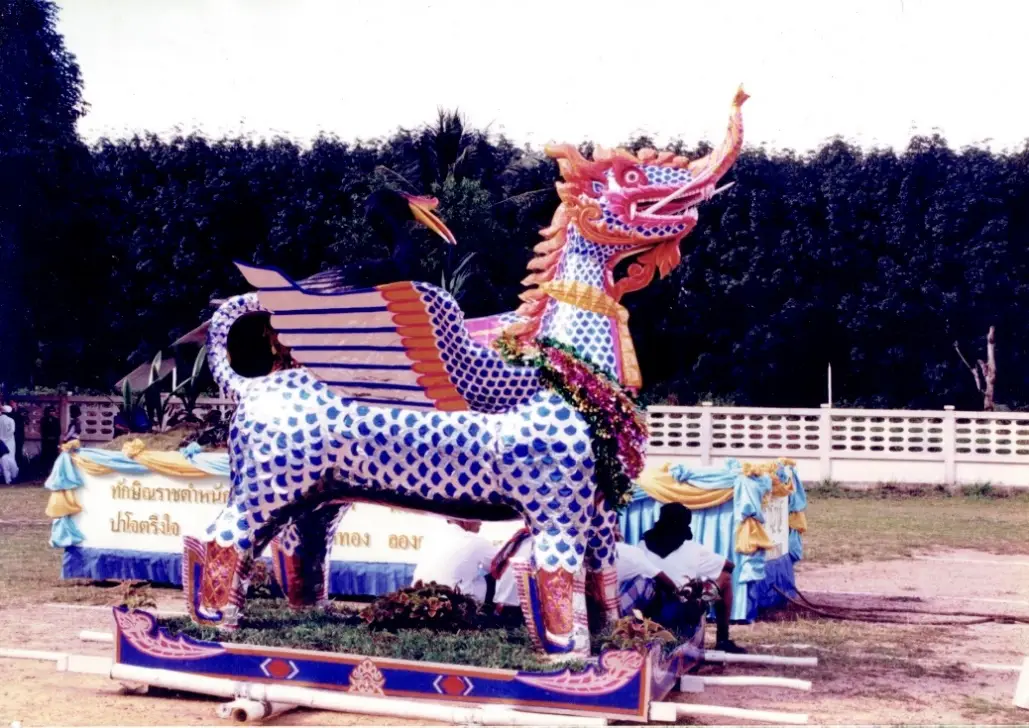
The word “bird” in this tradition does not refer to real birds. It refers to large symbolic bird figures created by local craftsmen. These figures are imaginative, mythical, and highly stylized. Some resemble celestial birds, some are linked to the idea of Garuda, some are inspired by the golden peacock, and some combine the features of a bird and a lion. Each bird is a visual language that communicates beauty, power, belief, and local creativity.
One of the best-known legends says that the tradition began in Yawa, or Java, where a ruler wished to delight his beloved child. Skilled craftsmen were asked to create magnificent bird figures based on stories of a mysterious bird from the sea. Once the birds were completed, a grand procession was organized with music, decorated flower trays, and beautifully dressed participants. This legend gives the tradition a royal and imaginative quality, connecting it with ideas of honor, splendor, and the wonder of mythical birds.
Another important meaning of the Bird Procession is respect. In the past, such a procession could be organized to honor elders, welcome distinguished guests, or show loyalty and courtesy to important visitors. A complete procession required many people, considerable resources, skilled craftsmen, musicians, and organizers. For this reason, the event represented both community strength and cultural pride.
Four main types of bird figures are commonly associated with the tradition: the Gagak Sura bird, the Garuda bird, the golden peacock bird, and the Burung Singa or lion-bird. Understanding these four figures helps visitors see the procession as more than a beautiful spectacle. Each bird carries its own symbolic meaning and artistic identity.
Gagak Sura, also called Gagak Sura or a celestial bird, is often associated with the idea of the Karavika bird. It is described as an elegant heavenly bird that flies high above the clouds. Its most recognizable feature is a tall crest divided into 4 points, along with elaborate decorative patterns. In local language it is also known as “Nok Thun Phlu” because the shape on its head resembles a ceremonial betel-leaf arrangement used in processions.
The Garuda Bird resembles Garuda and is considered powerful and fearsome. Local belief holds that this bird carries a strong spiritual force, so it has become less commonly made for processions in modern practice. This belief shows that the bird figures are not merely decorative objects. They are also connected to a cultural world of respect, caution, and ritual understanding.
The Golden Peacock Bird, locally known as Bue Kho Mas, is admired for its graceful form and refined decoration. It has an elegant crest and is usually crafted with great care. The golden peacock is respected in local culture, and its beautiful feathers symbolize dignity and delicacy. Creating this bird requires time, patience, and careful design.
Burung Singa, or the lion-bird, is one of the most striking figures in the tradition. It combines the features of a bird and a lion, giving it a powerful and commanding appearance. Its shape often suggests strength, protection, and mythical energy. For many visitors, this figure is one of the most memorable parts of the Bird Procession because it looks both majestic and imaginative.
A full Bird Procession begins with local music. Instruments such as the Javanese oboe, double-headed drums, and large gongs create the soundscape of the procession. The music sets the pace, announces the movement of the procession, and gives the event its ceremonial energy. Behind the musicians, participants carry decorated flower trays called Bunga Sireh, creating a visual layer of color and elegance.
The bird attendants are another important part of the procession. They may dress like traditional warriors and carry kris daggers or spears. Their movement is linked to local martial arts and performance traditions such as Silat, kris dance, or spear dance. Their presence gives the procession a sense of order, protection, and dignity.
The bird figure itself is the heart of the procession. Its size, weight, structure, decorative detail, and movement depend on the skill of the makers and the number of people carrying it. When the bird moves with the rhythm of the music and the steps of the carriers, it becomes more than a crafted object. It becomes a living cultural image moving through the community space.
The tradition also contains layers of belief related to protection, cleansing, and the removal of misfortune. In some local contexts, ritual words or ceremonies are associated with releasing the bird into the procession. These elements reflect older belief systems that existed in the region before later religious and cultural layers were added. This makes the tradition a vivid example of how southern border culture contains multiple historical layers.
For the local community, the Bird Procession strengthens social unity. A procession cannot be created by one person alone. It requires craftsmen, organizers, musicians, carriers, dancers, elders, young people, and spectators. The event becomes a space where knowledge is transmitted between generations. Young people can observe how the bird is built, how music is played, how the procession is arranged, and how community participation keeps the tradition alive.
For travelers, the best way to approach this tradition is to see it as part of Narathiwat’s wider cultural landscape. Narathiwat is a province shaped by linguistic, religious, ethnic, and social diversity. A visit to the Bird Procession, when it is organized, can be combined with cultural stops in Mueang Narathiwat, such as Narathiwat City Museum, Narathat Beach, Yakang Floating Market, Narathiwat Central Mosque, Kow Leng Jee Shrine, and the Bang Nara riverside area.
Getting There usually begins in Mueang Narathiwat District, the main urban center of the province and a common base for provincial cultural events. Travelers can fly to Narathiwat Airport and continue by local transport to the city, or arrive by interprovincial bus or private car. Once in the city, visitors can use a private car, rental car, taxi, or local transport to reach the announced event venue or nearby attractions.
Visitors should always check the latest event announcement before traveling because the Bird Procession is not held on a fixed annual date. When it appears as part of a cultural event, guest-welcoming ceremony, contest, or community celebration, the date, time, route, and venue depend on the organizer. Staying in Mueang Narathiwat makes it easier to adjust the travel plan once the official schedule is announced.
Good visitor etiquette is important. Travelers should respect the procession route, avoid entering the parade space unnecessarily, and should not touch the bird figures or ritual objects unless invited. Photography is usually possible in public cultural events, but visitors should avoid blocking musicians, carriers, flower-tray participants, or attendants. If the procession is part of a circumcision ceremony or a family-centered community event, extra respect is required because some parts of the event carry personal meaning for the families involved.
The charm of the Bird Procession lies in the way it turns local imagination into a moving work of art. When the music begins, the procession moves, and the handcrafted bird appears above the crowd, the tradition becomes a living expression of cultural memory. It shows that local heritage survives not only in museums or written records, but also in the hands, music, movement, and cooperation of the people who continue to practice it.
For anyone interested in Thai culture, southern traditions, or the heritage of the border provinces, the Bird Procession in Narathiwat is a valuable subject to study. It shows that southern Thai traditions are not limited to temple fairs or fixed annual religious festivals. Some traditions are occasional, community-based, and shaped by social relationships, craftsmanship, and ceremonial honor. This is what makes the Bird Procession culturally rich and deeply memorable.
The preservation of this tradition depends on careful documentation and respectful presentation. Names of the bird figures, local Malay terminology, procession roles, musical instruments, Bunga Sireh arrangements, and the knowledge of bird-making should be recorded and explained clearly. Without these details, future generations may see only the outer beauty of the procession but miss the deeper knowledge that gives it meaning.
The Bird Procession in Narathiwat is therefore more than entertainment. It is a living cultural form that combines art, belief, craftsmanship, music, community honor, and collective identity. For foreign travelers, it offers a rare opportunity to understand the southern border provinces through the eyes of local people and their creative heritage.
| Name | The Bird Procession Tradition in Narathiwat |
| Cultural Area | Southern Border Provinces of Thailand, especially Pattani, Yala, and Narathiwat |
| Travel Base | Mueang Narathiwat District, Narathiwat Province |
| Provincial Contact Address | Narathiwat Provincial Hall 2, Government Center Road, Lamphu Subdistrict, Mueang Narathiwat District, Narathiwat 96000, Thailand |
| Provincial Contact Number | 073-642616-20 |
| Current Status | A living cultural tradition that may be presented on important occasions; it is not a fixed annual festival with a permanent schedule |
| Open Days | Not held on a fixed annual schedule; organized occasionally for specific cultural or community occasions |
| Opening Hours | According to the official schedule announced by the organizer |
| Fees | No fixed permanent admission fee; details depend on the type of event and the organizer’s announcement |
| Highlights | Large handcrafted bird figures, local music, Bunga Sireh flower trays, bird attendants, kris and spear procession elements, and traditional craftsmanship |
| Main Bird Figures | 1. Gagak Sura Bird 2. Garuda Bird 3. Golden Peacock Bird 4. Burung Singa or Lion-Bird |
| Occasions | Welcoming honored guests, showing respect to elders, cultural contests, community celebrations, and circumcision ceremonies known as Masoyawi |
| Distinctive Features | A community tradition that combines local craftsmanship, music, ceremonial movement, belief, and social unity in one procession |
| Travel Information | Travel to Mueang Narathiwat by plane, interprovincial bus, private car, or rental car, then check the announced venue for each specific event |
| Visitor Guidelines | Check the latest schedule before traveling, respect the procession route, do not touch the bird figures or ritual objects without permission, and take photos without disturbing participants |
| Nearby Tourist Attractions | 1. Narathiwat City Museum, about 1 km 2. Narathat Beach, about 2 km 3. Yakang Floating Market, about 3 km 4. Narathiwat Central Mosque, about 3 km 5. Kow Leng Jee Shrine, about 1 km |
| Nearby Restaurants | 1. Rim Nam Restaurant, about 3 km, Tel. 073-511559 2. The Origano Pizza, about 2 km, Tel. 083-8189971, 083-9194302 3. BK Drink N' Food, about 6 km, Tel. 082-8257010, 086-9586693 4. Tam Sang Tam Jai Restaurant, about 1 km, Tel. 088-8328699 5. Do R3 Shop, about 1 km, Tel. 096-3324146 |
| Nearby Accommodations | 1. The Imperial Narathiwat Hotel, about 1 km, Tel. 073-515041 2. Tanyong Hotel Narathiwat, about 1 km, Tel. 073-511477 3. Paksina Hotel, about 3 km, Tel. 073-511800 4. Suptawee Home @ Narathiwat, about 2 km 5. Ruean Ram Resort, about 4 km |
Frequently Asked Questions (FAQ)
Q: What is the Bird Procession Tradition in Narathiwat?
A: It is a southern border cultural tradition featuring large handcrafted bird figures carried in a procession with local music, ceremonial flower trays, attendants, and community performers.
Q: Is the Bird Procession held every year on a fixed date?
A: No. It is not a fixed annual festival. It is organized occasionally for special occasions such as cultural events, guest-welcoming ceremonies, contests, community celebrations, or circumcision ceremonies.
Q: What are the main bird figures in the procession?
A: The main figures are the Gagak Sura bird, the Garuda bird, the golden peacock bird, and the Burung Singa or lion-bird.
Q: Is the Bird Procession a religious ceremony?
A: It is a community tradition rather than a formal religious ceremony, although some forms include older local beliefs related to protection and the removal of misfortune.
Q: Where should travelers check the latest schedule?
A: Travelers should check announcements from Narathiwat provincial authorities, cultural offices, municipal offices, or the local community organizing the event.
Q: Why is the Bird Procession important to the local community?
A: It strengthens community unity, preserves craftsmanship, supports local music and performance traditions, and passes cultural knowledge from elders to younger generations.
Q: What nearby places can visitors explore in Mueang Narathiwat?
A: Visitors can combine the trip with Narathiwat City Museum, Narathat Beach, Yakang Floating Market, Narathiwat Central Mosque, and Kow Leng Jee Shrine.
 Category: ●Art, Culture and Heritage
 Group: ●Art, Craft Centres, Tradition
Last Update : 1 WeekAgo
 Last Update : 1 WeekAgo
 Landmarks and Memorials(8)
 Royal Palace(1)
Art, Craft Centres, Tradition(7)
Royal Palace(1)
Art, Craft Centres, Tradition(7)
 Museums(4)
 Art Gallery(1)
 Places of Worship
 Temple(16)
 Mosque(23)
 Other Sacred Sites(4)
 Research and Development
 Royal Project(1)
 Suburban Living
 Village, Community(9)
 Local Market(1)
 Nature and Wildlife
 National Parks and Marine Reserves(5)
 Mountain (Doi)(2)
 Dam, Reservoir, Lake(2)
 Waterfalls(16)
 River, Canal(3)
 Bays and Beaches(5)
 Islands(1)
 Other natural attractions(4)
 Entertainment and Agricultural
 Stadium(1)
 Farms, Parks and Ecotourism(7)
 Shopping
 Shopping and Night Market(1)
 Travel Articles, Recipes
 Travel Review, Food Review(1)


