
lovethailand home >South Travel Attractions >Nakhon Si Thammarat Travel Attractions >Khanom >Thong Nian > Ko Tha Rai
TL;DR: Ko Tha Rai is located at Thong Nian Subdistrict, Khanom District, Nakhon Si Thammarat Province, open Daily, Except During National Park Seasonal Closure Periods And Unsafe Sea, hours Open 24 Hours, While Actual Boat Trips Should Be Taken During Daylight Hours.

Ko Tha Rai
Open Days: Daily, Except During National Park Seasonal Closure Periods And Unsafe Sea Conditions
Opening Hours: Open 24 Hours, While Actual Boat Trips Should Be Taken During Daylight Hours, Preferably In The Morning
Ko Tha Rai in Nakhon Si Thammarat is a small island in the northern part of Khanom’s sea, close to the upper edge of Nakhon Si Thammarat Province. It lies within Hat Khanom-Mu Ko Thale Tai National Park and is one of Khanom’s most distinctive marine attractions. Although the island is small, it combines unusual layered rock formations, the cave-like stone platform known as Phumphuang Stage, seagrass beds, coastal marine life, dolphin-feeding routes, and community-based boat tourism in one place. Ko Tha Rai is not only a scenic island stop. It is a compact natural classroom where visitors can see geology, marine ecology, wildlife, and local fishing-community tourism connected in a single sea route.
The most memorable feature of Ko Tha Rai is Phumphuang Stage, a large layered stone platform beneath a shallow cave-like overhang, with a dramatic wall of folded rock layers behind it. From the boat, the platform looks like a natural concert stage facing the sea, which is why local people call it Phumphuang Stage. The rock platform and the cliff behind it share the same folded-layer appearance as the famous Khao Hin Phap Pha formations of Khanom. This makes Ko Tha Rai different from ordinary small islands, because the attraction is not only the sea view but also the rock structure that reveals the long natural history of the coastline.
The layered rock landscape around Khanom is visually striking. Rock beds appear stacked, tilted, curved, and eroded into cliffs, alcoves, shallow caves, and stone ledges. Similar formations can be found around Ko Tha Rai, Ko Nui Nok, Khao Lak So, and the Ao Talet coast, but Phumphuang Stage on Ko Tha Rai is one of the clearest and most photogenic points. Travelers interested in nature, geology, photography, and coastal scenery should give this site enough time, because the details of the stone layers become more impressive when viewed closely from the boat.
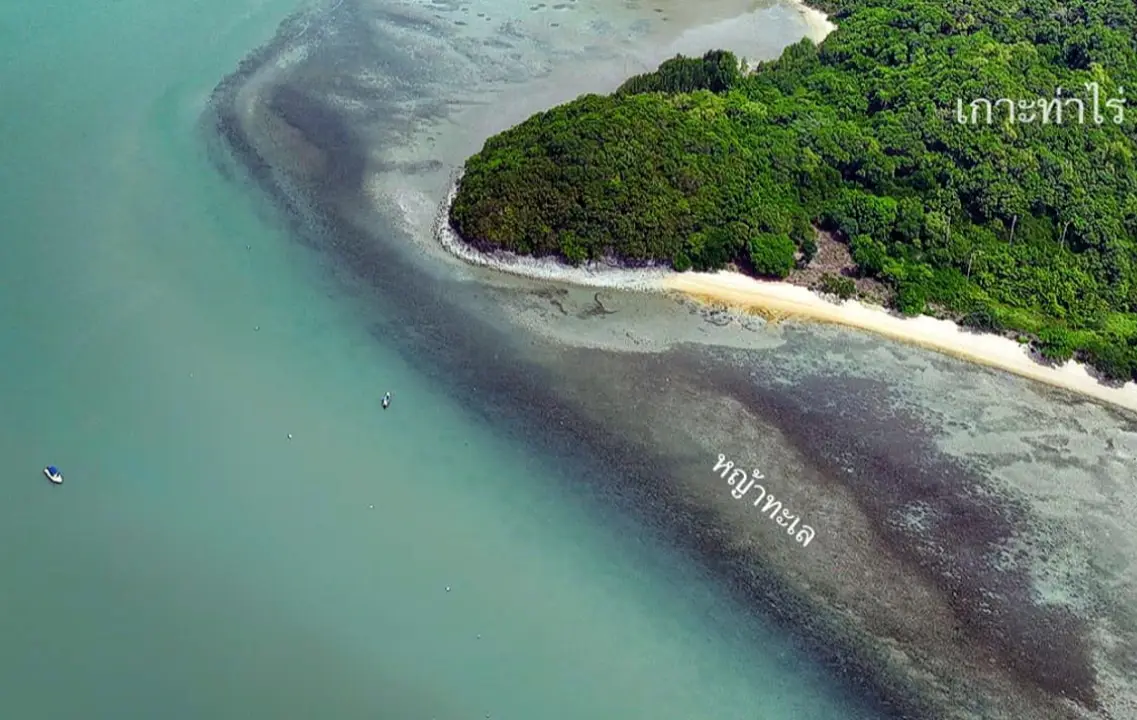
Ko Tha Rai is also important below the water surface. Seagrass beds grow along parts of the island’s coast and function like an underwater forest. They provide food, shelter, and nursery areas for juvenile marine animals. Shrimp, shellfish, crabs, fish, and many smaller organisms use the seagrass beds as habitat. The richness of Ko Tha Rai is therefore not limited to what visitors see above the water. Much of its value is hidden in the underwater ecosystem that supports coastal fisheries and marine biodiversity around Khanom.
Older local information recorded four seagrass species around Ko Tha Rai, including Enhalus acoroides, Thalassia hemprichii, Halodule uninervis, and Halophila ovalis. Later surveys by the Department of Marine and Coastal Resources found five seagrass species in the area, including Enhalus acoroides, Halodule uninervis, Halophila ovalis, Cymodocea rotundata, and a narrow-leaved Halodule species. These surveys confirm that Ko Tha Rai remains an important seagrass site in Khanom and should be treated as a conservation-sensitive marine attraction.
Even though the seagrass area around Ko Tha Rai is not large compared with some other seagrass sites in Thailand, its ecological role is significant. Seagrass is a primary producer in the marine ecosystem. It helps stabilize sediment, provides shelter for young marine life, and supports the food chain that benefits local fisheries. When seagrass remains healthy, small marine animals have better habitat, fish populations gain nursery areas, and coastal communities can continue to benefit from the sea in a more sustainable way.
Ko Tha Rai is also located along the feeding route of dolphins that live in the Khanom sea. Many travelers discover the island through Khanom boat tours that combine pink dolphin watching, Ko Nui, the freshwater well in the sea, Luang Pu Thuat worship, Khao Hin Phap Pha, Phumphuang Stage, and Ko Tha Rai. This route is one of the best ways to understand Khanom’s marine identity because it connects rare dolphins, small islands, local beliefs, layered rock formations, and community-based boat services.
Dolphin watching on the way to Ko Tha Rai should be understood as wildlife observation, not a guaranteed show. Sightings depend on weather, sea conditions, tides, food sources, and the movement of the dolphins. Morning is usually the best time for boat trips because the sea is often calmer, the sun is not too strong, and lighting is better for photography. Visitors should choose boat operators who follow responsible wildlife-viewing practices, avoid chasing dolphins, avoid surrounding dolphin groups, and do not feed wild dolphins.
The main activities at Ko Tha Rai are viewing Phumphuang Stage, photographing the layered rock cliffs, observing the folded-rock landscape, learning about seagrass ecology, enjoying the sea scenery, and combining the stop with other Khanom marine attractions. Some boat programs may include snorkeling or fishing in suitable areas, depending on season, weather, and operator arrangements. Any activity near the island should be done carefully. Visitors should not step on seagrass, collect rocks or shells, remove marine life, or leave any waste in the sea.
Phumphuang Stage is a strong photography location. The best images usually include the stone platform, cave-like overhang, layered cliff, and surrounding sea in the same frame. When the boat can safely approach the formation, the folded rock texture becomes clearly visible. Travelers should prepare a camera or phone in advance, use a waterproof bag, and keep balance while shooting from the boat, as even small waves can affect movement and safety.
Ko Tha Rai is also valuable as an educational destination. It allows visitors to learn geology from the folded rock layers, marine ecology from the seagrass beds, wildlife conservation from the dolphin route, community tourism from local boat operators, and protected-area management from the national park context. The island is therefore more than a checklist stop. Its real value lies in showing how different natural systems are connected and why tourism must be balanced with conservation.
Travel to Ko Tha Rai is possible only by boat. The main departure points are Ban Laem Prathap at Ao Thong Nian and the Ao Khwaeng Phao area. Boat tours are usually operated by local community tourism groups, coastal fishing groups, and private tour operators in Khanom. A typical sea trip often includes dolphin watching, Ko Nui, the freshwater well in the sea, Khao Hin Phap Pha, Phumphuang Stage, Ko Tha Rai, and nearby islands. Older travel information records a charter boat price of about 1,000 baht from Laem Prathap, although the actual rate may vary according to route, duration, number of passengers, and operator conditions.
Travelers should contact boat operators in advance because Ko Tha Rai is highly dependent on weather and sea conditions. If waves are strong or a national park closure applies, boat trips may be postponed or cancelled for safety. The best travel days are calm, clear, and free from heavy rain. Hat Khanom-Mu Ko Thale Tai National Park has a seasonal tourism and overnight-stay closure period from 1 November to 15 December, so travelers should confirm the current status before booking a boat trip.
Recommended items for a Ko Tha Rai boat trip include a hat, sunglasses, sunscreen, drinking water, personal medicine, a waterproof bag for phones or cameras, and footwear suitable for getting on and off a boat. A life jacket should be worn throughout the boat trip. Families traveling with children, elderly travelers, or anyone prone to seasickness should inform the operator in advance so that seating and timing can be arranged appropriately.
A practical half-day itinerary can start with an early-morning boat departure from Laem Prathap, followed by dolphin watching in the area where dolphins are active that day. The route can then continue to Ko Nui for Luang Pu Thuat worship and the freshwater well in the sea, then to Khao Hin Phap Pha and Phumphuang Stage at Ko Tha Rai, before returning to shore for seafood around Thong Nian or Khwaeng Phao Beach. Travelers with more time can continue to Ao Thong Ching, Ao Thong Not, Ao Talet Wooden Bridge, Nai Plao Beach, or Na Dan Beach.
Ko Tha Rai suits many types of travelers. Nature lovers can see islands, layered rock, seagrass, and marine life. Photographers can capture one of the most unusual seascapes in Khanom. Environment-focused travelers can learn about seagrass and dolphin conservation. Families can enjoy a boat trip that is both scenic and educational. Travelers interested in local communities can support local boat operators and see how coastal fishing communities participate in tourism.
Responsible behavior is essential when visiting Ko Tha Rai. Visitors should not litter, feed dolphins, collect marine life, step on seagrass, damage rock formations, or remove shells and stones from the island. Single-use plastic should be minimized, and all waste should be brought back to shore. Small islands are highly sensitive environments, and damaged ecosystems can take a long time to recover.
In summary, Ko Tha Rai is one of Khanom’s most valuable marine attractions. Its identity is built around Phumphuang Stage, folded rock formations, seagrass beds, dolphin routes, and community-based boat tourism. The island proves that Khanom is not only about beaches and pink dolphins, but also about geology, underwater ecosystems, and local knowledge. With careful planning, good weather, and responsible travel behavior, Ko Tha Rai can become one of the most memorable highlights of a Khanom sea trip.
| Name | Ko Tha Rai |
| Location | Thong Nian Subdistrict, Khanom District, Nakhon Si Thammarat Province |
| Address | An island in the northern Khanom sea, within Hat Khanom-Mu Ko Thale Tai National Park, Nakhon Si Thammarat Province |
| Coordinates | Latitude 9.32338, Longitude 99.77550 |
| Highlights | Phumphuang Stage, layered rock platform, folded-rock cliff, seagrass beds, dolphin route, and Khanom community-based boat tourism |
| History / Context | A small island in Khanom’s sea with geological and ecological significance, located within Hat Khanom-Mu Ko Thale Tai National Park and included in the Khanom dolphin-watching sea route |
| Name Origin | Ko Tha Rai is the local island name; its famous rock platform is called Phumphuang Stage because it resembles a natural concert stage in the sea |
| Distinctive Features | A small island with folded rock layers, seagrass habitat, and diverse coastal marine life, suitable for nature viewing, ecological learning, and marine photography |
| Travel Information | Accessible only by boat from Ban Laem Prathap at Ao Thong Nian or the Ao Khwaeng Phao area, usually as part of a Khanom dolphin-watching route including Ko Nui, Khao Hin Phap Pha, Phumphuang Stage, and Ko Tha Rai |
| Current Status | Open as a marine attraction on Khanom boat routes, subject to weather, sea conditions, and national park announcements |
| Open Days | Daily, except during national park closure periods and unsafe sea conditions |
| Opening Hours | Open 24 Hours, while actual boat trips should be arranged during daylight hours, preferably in the morning |
| Boat Fee / Main Travel Cost | Charter boat information from Laem Prathap is recorded at about 1,000 baht per boat; actual rates may vary by route, passenger number, duration, and operator |
| Seasonal Note | Hat Khanom-Mu Ko Thale Tai National Park has an annual tourism and overnight-stay closure period from 1 November to 15 December; travelers should also avoid rough-sea days |
| Facilities | No permanent visitor facilities on the island; visitors rely on boat services, life jackets, and operator support from Laem Prathap or Ao Khwaeng Phao |
| Main Areas / Zones | Phumphuang Stage, layered rock platform, cave-like overhang, folded-rock cliff, seagrass areas around the island, coastal rock line, and boat-viewing points |
| Caretaker / Local Authority | Hat Khanom-Mu Ko Thale Tai National Park, Department of National Parks, Wildlife and Plant Conservation, together with local authorities and community boat groups in Thong Nian |
| Main Contact Number | Hat Khanom-Mu Ko Thale Tai National Park, Tel. 086-475-8392 Thong Nian Subdistrict Municipality, Tel. 075-528-367 Khanom Fishing & Tour, Tel. 075-326-573 Ban Laem Prathap Ecotourism Club, Tel. 087-282-7761 |
| Nearby Tourist Attractions | 1. Phumphuang Stage, On Ko Tha Rai 2. Khao Hin Phap Pha, On The Same Boat Route 3. Ko Nui And The Freshwater Well In The Sea, About 3 km By Boat Route 4. Ko Phi, About 3 km By Boat Route 5. Laem Prathap, About 6 km By Boat Route 6. Ao Talet And Ao Talet Wooden Bridge, About 7 km 7. Khwaeng Phao Beach, About 12 km From The Laem Prathap Area |
| Nearby Restaurants | 1. Klang Aow Seafood, Khwaeng Phao Beach, About 12 km From The Laem Prathap Area, Tel. 064-048-6663 2. Khiang Talay Seafood, Khwaeng Phao Beach, About 12 km From The Laem Prathap Area, Tel. 098-734-2904 3. Khrua Khwaeng Phao At Needa Rock Resort, About 13 km From The Laem Prathap Area, Tel. 081-897-6748, 087-399-6130 4. Le Petit Saint Tropez Restaurant, About 18 km From The Laem Prathap Area, Tel. +66 63-210-4993 5. Bella Luna Restaurant, Khanom Beach Resort & Spa, About 24 km From The Laem Prathap Area, Tel. 075-528-111, 075-528-112, 082-416-7561 |
| Nearby Accommodations | 1. Klang Aow Khanom Beach Hotel / Klang Aow Resort, About 12 km From The Laem Prathap Area, Tel. 081-928-1910 2. Needa Rock Resort, About 13 km From The Laem Prathap Area, Tel. 081-897-6748, 087-399-6130 3. Le Petit Saint Tropez Beach Resort Khanom, About 18 km From The Laem Prathap Area, Tel. +66 63-210-4993 4. Aava Resort & Spa, About 22 km From The Laem Prathap Area, Tel. 075-300-310, 075-300-311, 088-765-7362 5. Chula Beach Khanom, About 23 km From The Laem Prathap Area, Tel. 089-510-1592 6. Khanom Beach Resort & Spa, About 24 km From The Laem Prathap Area, Tel. 075-528-111, 075-528-112, 082-416-7561 |
Frequently Asked Questions (FAQ)
Q: Where is Ko Tha Rai located?
A: Ko Tha Rai is located in the Khanom sea, Thong Nian Subdistrict, Khanom District, Nakhon Si Thammarat Province, within Hat Khanom-Mu Ko Thale Tai National Park.
Q: What is Ko Tha Rai known for?
A: It is known for Phumphuang Stage, a layered rock platform under a cave-like overhang, folded rock cliffs, seagrass beds, coastal marine life, and its place on the Khanom dolphin-watching route.
Q: How can travelers get to Ko Tha Rai?
A: Travelers must take a boat from Ban Laem Prathap or Ao Khwaeng Phao. Ko Tha Rai is usually included in boat programs with pink dolphin watching, Ko Nui, Khao Hin Phap Pha, and Phumphuang Stage.
Q: How much does a boat trip to Ko Tha Rai cost?
A: Charter boat information from Laem Prathap is recorded at about 1,000 baht per boat, but the actual rate may vary according to route, passenger number, duration, and operator.
Q: When is the best time to visit Ko Tha Rai?
A: Morning on a calm-sea day is the best time because the weather is more comfortable, sea conditions are usually better, and travelers may have a better chance of seeing dolphins along the route.
Q: Are there seagrass beds around Ko Tha Rai?
A: Yes. Ko Tha Rai has seagrass beds that provide food, shelter, and nursery habitat for juvenile marine life. The Department of Marine and Coastal Resources has surveyed several seagrass species in the area.
Q: Is Ko Tha Rai suitable for snorkeling or landing on the island?
A: Snorkeling or landing depends on sea conditions, tide level, and boat-operator guidance. Visitors should avoid stepping on seagrass, collecting marine life, or disturbing the island’s natural features.
Q: What should visitors be careful about when visiting Ko Tha Rai?
A: Visitors should check weather and national park announcements, wear life jackets, avoid feeding dolphins, avoid littering, and avoid traveling during rough-sea conditions or national park closure periods.
 Category: ●Nature and Wildlife
 Group: ●Islands
Last Update : 2 MonthAgo
 Last Update : 2 MonthAgo
 Click to Access the Navigation Map GPS
Ko Tha Rai Map
Recommend

 Art, Culture and Heritage
 Historical Sites and Monuments(9)
 Landmarks and Memorials(9)
 Royal Palace(1)
 Art, Craft Centres, Tradition(12)
 Museums(5)
 Educational Places
 Educational Gardens, Farm(2)
 Places of Worship
 Temple(44)
 Mosque(2)
 Other Sacred Sites(17)
 Research and Development
 Royal Project(2)
 Suburban Living
 Village, Community(8)
 Local Market(1)
 Floating Market(1)
 National Parks and Marine Reserves(6)
 Mountain (Doi)(11)
 Dam, Reservoir, Lake(10)
 Waterfalls(43)
 Hot Springs(1)
 Caves(13)
 River, Canal(3)
 Bays and Beaches(29)
Islands(2)
 Other natural attractions(3)
 Entertainment and Agricultural
 Farms, Parks and Ecotourism(3)
 Outdoor and Adventure Activities(4)
 Travel Articles, Recipes
 Travel Review, Food Review(5)
 Southern Food Menu, Southern Food Recipes(18)


