
lovethailand home >South Travel Attractions >Nakhon Si Thammarat Travel Attractions >Lan Saka >Khao Kaeo > Karom Waterfall
TL;DR: Karom Waterfall is located at Khao Luang National Park, Village No. 4, Khao Kaeo Subdistrict, Lan Saka District, Nakhon Si Thammarat Province, open Daily During The Park’s Open Season, hours 08.30 – 16.30.

Karom Waterfall
Open Days: Daily During The Park’s Open Season
Opening Hours: 08.30 – 16.30
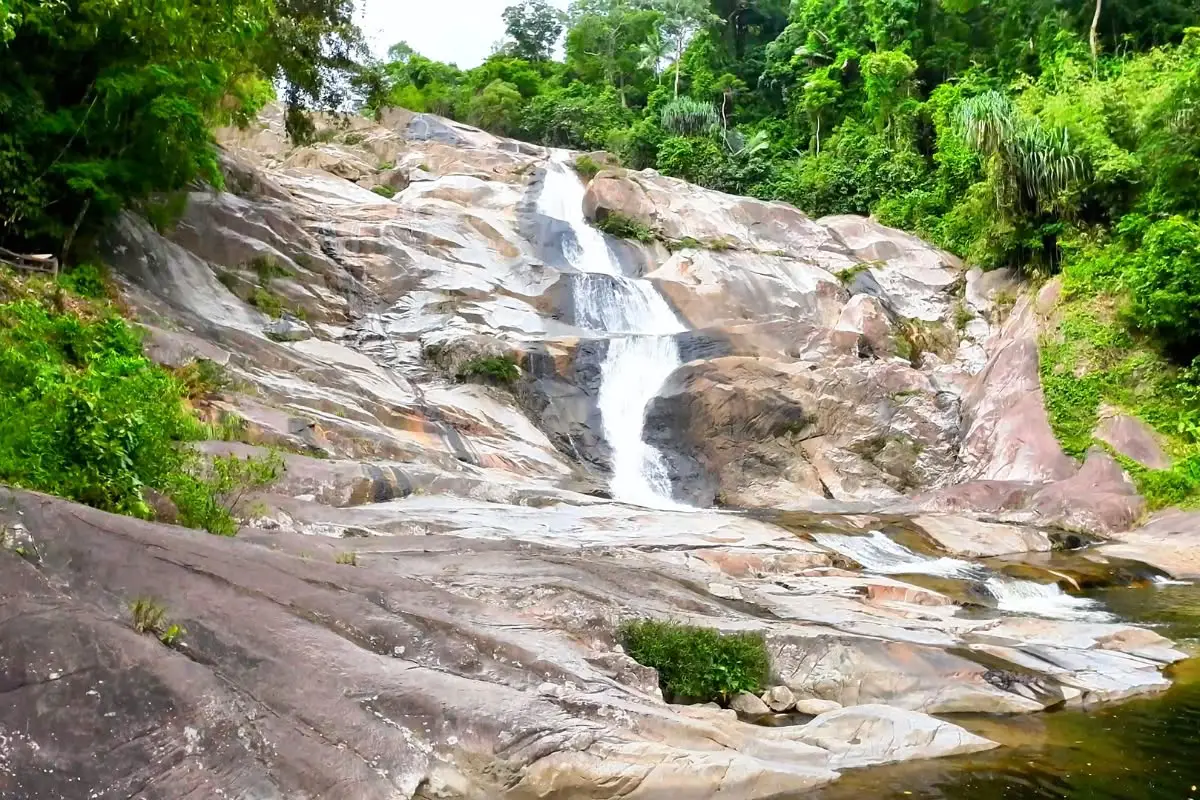
Karom Waterfall in Nakhon Si Thammarat is a major waterfall within Khao Luang National Park in Lan Saka District. It is also the headquarters area of the national park. The waterfall has 19 tiers, with 7 tiers open to visitors: Nan Thurian, Nan Chong Sai, Nan Phai, Nan Nam Rang, Nan Phueng, Nan Toei, and Nan Dat Fa. Nan Dat Fa is the most famous tier, known for its broad sloping cliff, large natural pool, and historical royal inscriptions connected to King Rama V and King Rama VI.
Karom Waterfall is one of the most important natural attractions in Nakhon Si Thammarat Province. Located in Village No. 4, Khao Kaeo Subdistrict, Lan Saka District, it lies within Khao Luang National Park and is closely connected with the park headquarters. The waterfall is formed by mountain streams flowing down from the Nakhon Si Thammarat mountain range, descending through broad rocks, steep cliff surfaces, natural pools, and humid evergreen forest. It is a place where visitors can enjoy water, forest, history, and nature education in one visit.
Karom Waterfall is especially convenient because the national park headquarters is located in the same area. Travelers can find visitor information, basic facilities, staff assistance, and access to the waterfall more easily than at many deeper forest waterfalls. The site is around 20 km from Nakhon Si Thammarat city. Visitors can drive along Highway 4015 toward Lan Saka District, look for the large Khao Luang National Park sign on the right-hand side, and continue for a little over 1 km to reach the park headquarters and Karom Waterfall area.
The water source of Karom Waterfall comes from the Nakhon Si Thammarat mountain range and the forested watershed of Khao Luang. The stream flows down the mountain slope and forms a series of waterfall tiers locally known as nan. Karom Waterfall has 19 tiers in total, but 7 tiers are open for general recreation and nature visits: Nan Thurian, Nan Chong Sai, Nan Phai, Nan Nam Rang, Nan Phueng, Nan Toei, and Nan Dat Fa. Limiting visitor access helps protect the more sensitive upper areas and keeps travel safer in a natural, wet, and sometimes slippery landscape.
The most famous tier is Nan Dat Fa, the seventh tier and the main highlight for many visitors. This tier has a wide rock face sloping at about 45 degrees. Water flows down from the upper cliff, spreads across broad rock surfaces, and falls into a large natural pool below. During normal water conditions, the stream often divides into 2 visible channels. During the rainy season, or after rainfall, the water spreads more fully across the cliff and creates a powerful white curtain of water.
The beauty of Nan Dat Fa lies not only in the waterfall itself but also in the balance between water, rock, and surrounding forest. As water descends from the cliff to the pool below, the sound echoes against the rocks and forest. The atmosphere becomes cool, fresh, and restorative. Visitors can rest in permitted areas, enjoy the scenery, take photographs, and experience one of the most scenic waterfall tiers in the Khao Luang area.
Karom Waterfall is also historically significant. In 1907, King Chulalongkorn, Rama V, visited Nan Dat Fa with 4 of his royal children. Later, in 1917, King Vajiravudh, Rama VI, visited the waterfall during his journey to the southern provinces and inscribed his royal initials “V.P.R. 2460” on the cliff at Nan Dat Fa. This makes Karom Waterfall more than a natural attraction; it is also a historical landscape connected to royal visits to Nakhon Si Thammarat.
The royal inscription at Nan Dat Fa gives Karom Waterfall a different character from many other waterfalls. Visitors come not only to enjoy a mountain stream but also to see a real historical trace preserved within the natural landscape. The site therefore combines scenic value, cultural memory, and local identity. For travelers interested in both nature and Thai history, Karom Waterfall is one of the most meaningful places in Lan Saka District.
The waterfall sits within Khao Luang National Park, an important ecosystem in southern Thailand. The park contains mountains, humid evergreen forest, hill evergreen forest, streams, and watershed areas that support nearby communities. Around Karom Waterfall, visitors can observe forest plants and ecological features such as mosses, lichens, tree ferns, figs, fungi, and large root structures. The landscape reveals how water, rocks, soil, plants, and small organisms work together in a tropical rainforest system.
The Karom Waterfall nature trail helps visitors understand this ecosystem in a more structured way. Interpretive stations focus on topics such as moss, lichens, tree ferns, figs, termites and fungi, mushrooms, plant succession, and buttress roots. These subjects may look small at first, but they explain how the forest functions. Mosses and lichens grow on rocks and tree trunks in moist conditions. Tree ferns reflect the humidity of the forest. Fungi and termites help decompose organic matter. Buttress roots support large trees in wet and sloping ground.
The idea of plant succession is especially useful for understanding that forests are not static. When an area is disturbed, early plant communities appear first and gradually develop into more complex forest structures. At the same time, buttress roots help large rainforest trees remain stable in damp soil. Walking the nature trail at Karom Waterfall therefore turns a simple waterfall visit into an opportunity to understand the wider forest system that creates and protects the water source.
For water activities, some pools at Karom Waterfall are suitable for playing in permitted areas. Visitors should still remember that this is a real natural waterfall. Rocks may be slippery because of algae and moisture. Water levels can change after rainfall. The current can become stronger when it rains upstream. Children should remain under adult supervision at all times. Visitors should not jump into pools without knowing the depth and should not climb wet rocks for photographs.
The best time to visit depends on the desired experience. During the rainy season and shortly after rainfall, the waterfall is more powerful and dramatic, especially at Nan Dat Fa. However, visitors must be more careful about flash floods, stronger current, and slippery paths. During lighter rain periods or calmer water conditions, the stream is clearer and more suitable for relaxing near the water. Morning to early afternoon is the best time to arrive because visitors have enough time to walk, rest, and leave the area before closing time.
Karom Waterfall is suitable for several types of travelers. Families can enjoy a nature stop close to the city. Groups of friends can relax by the water. Photographers can capture flowing water, broad rock surfaces, and rainforest details. Students and nature learners can use the nature trail as an outdoor classroom. History-minded visitors can appreciate the royal inscriptions and the connection with King Rama V and King Rama VI. This combination makes Karom Waterfall one of the most complete natural attractions near Nakhon Si Thammarat city.
Useful items to bring include shoes with good grip, quick-drying clothes, a towel, waterproof phone protection, drinking water, mosquito repellent, and a bag for carrying trash back out of the park. Visitors who want to walk to higher tiers should start in the morning and ask park staff about route conditions before proceeding. Some parts of the route may become slippery, wet, or temporarily closed depending on the weather.
Responsible behavior is essential. Visitors should not leave trash, bring unnecessary single-use foam or plastic containers, make loud noise, collect plants, or touch and damage historical inscriptions. Karom Waterfall is both a natural site and a historically meaningful place. Protecting the water, forest, rocks, and royal inscription helps preserve the site for future visitors.
The park headquarters area provides basic facilities such as a visitor center, food services or shops in the area, toilets, shower facilities, camping areas, resting spaces, and national park staff. This makes Karom Waterfall suitable for a half-day or full-day visit. Travelers who want to stay overnight should contact the national park or check the Department of National Parks booking system before traveling, because accommodation, camping access, and seasonal closures may change according to official announcements.
Karom Waterfall can be combined with nearby attractions in Lan Saka District and Nakhon Si Thammarat city. Nature-focused travelers can continue to Kaeo Surakan Cave, Tha Phae Waterfall, or Kiriwong Village. Travelers interested in culture and history can continue to Wat Phra Mahathat Woramahawihan, Nakhon Si Thammarat National Museum, or the old city wall. With good planning, Karom Waterfall can be included in a one-day route from the city.
Getting There by private car is the most convenient option. From Nakhon Si Thammarat city, take Highway 4015 toward Lan Saka District for about 20 km. When you see the large Khao Luang National Park sign on the right-hand side, turn into the access road and continue for a little over 1 km to reach the park headquarters and Karom Waterfall. Travelers without their own vehicle can use local songthaew or hired transport toward Lan Saka and tell the driver they want to get off at Nam Tok Karom or Khao Luang National Park.
Karom Waterfall shows a different side of Nakhon Si Thammarat. The province is widely known for temples, old city history, and southern culture, but it also has a rich mountain watershed close to the city. Karom Waterfall is one of the best gateways to understanding Khao Luang as a major mountain, a water source for communities, and a protected rainforest landscape with high ecological value.
With its 19 waterfall tiers, the beauty of Nan Dat Fa, the royal inscription “V.P.R. 2460,” nature trail, and convenient access from Nakhon Si Thammarat city, Karom Waterfall deserves a place in any nature-focused travel plan. It is a place to rest, swim carefully in permitted areas, learn about rainforest ecology, appreciate Thai history, and spend meaningful time with the mountain water of Khao Luang.
| Name | Karom Waterfall |
| Location | Khao Luang National Park, Village No. 4, Khao Kaeo Subdistrict, Lan Saka District, Nakhon Si Thammarat Province |
| Address | Khao Kaeo Subdistrict, Lan Saka District, Nakhon Si Thammarat 80230, Thailand |
| Coordinates | Khao Luang National Park Headquarters / Karom Waterfall, Lan Saka District, Nakhon Si Thammarat |
| Highlights | 19 waterfall tiers, 7 tiers open to visitors, Nan Dat Fa as the main highlight, and the royal inscription “V.P.R. 2460” |
| History | King Rama V visited Nan Dat Fa in 1907, and King Rama VI visited in 1917 and inscribed his royal initials on the cliff at Nan Dat Fa |
| Name Origin | Karom is the local name of the waterfall and watershed area near Khao Luang National Park Headquarters in Lan Saka District |
| Distinctive Features | Mountain water from the Nakhon Si Thammarat range flows across broad rocks and a sloping cliff; Nan Dat Fa has a slope of about 45 degrees and a large natural pool below |
| Travel Information | From Nakhon Si Thammarat city, take Highway 4015 toward Lan Saka for about 20 km, then turn into the Khao Luang National Park access road for a little over 1 km |
| Current Status | Open during Khao Luang National Park operating season; temporary closures may occur due to weather or nature recovery announcements |
| Open Days | Daily During The Park’s Open Season |
| Opening Hours | 08.30 – 16.30 |
| Fees | Thai visitors: adult 40 baht, child 20 baht / Foreign visitors: adult 200 baht, child 100 baht / Motorcycle 20 baht, car 30 baht |
| Facilities | Visitor center, food services or shops in the area, toilets, shower facilities, camping areas, resting spaces, and national park staff supervision |
| Main Areas / Zones | Nan Thurian, Nan Chong Sai, Nan Phai, Nan Nam Rang, Nan Phueng, Nan Toei, Nan Dat Fa, Karom Waterfall Nature Trail, and Khao Luang National Park Headquarters |
| Caretaker | Khao Luang National Park, Department of National Parks, Wildlife and Plant Conservation |
| Main Contact Number | 075-300-494, 075-300-495 |
| Official Website / Official Page | Khao Luang National Park Official Page |
| Nearby Tourist Attractions | 1. Kaeo Surakan Cave, about 3 km 2. Tha Phae Waterfall, about 7 km 3. Kiriwong Village, about 13 km 4. Wat Phra Mahathat Woramahawihan, about 22 km 5. Nakhon Si Thammarat National Museum, about 22 km |
| Nearby Restaurants | 1. Lansaka Cafe’, about 4 km, Tel. 062-074-6336 2. Lan Saka Made-To-Order Local Restaurant, about 5 km 3. Ban Khao Kaeo Restaurant, about 5 km 4. Krua Lan Saka, about 6 km 5. Kiriwong Community Restaurants, about 13 km |
| Nearby Accommodations | 1. D’Endless Resotel, about 5 km 2. Pool House Lansaka, about 6 km 3. Chiwako View, about 8 km 4. Kiriwong Community Homestays, about 13 km 5. Hotels In Nakhon Si Thammarat City, about 22 km |
Frequently Asked Questions (FAQ)
Q: Where is Karom Waterfall located?
A: Karom Waterfall is located in Khao Luang National Park, Village No. 4, Khao Kaeo Subdistrict, Lan Saka District, Nakhon Si Thammarat Province.
Q: What are the opening hours of Karom Waterfall?
A: The waterfall is generally open from 08.30 to 16.30 during the park’s open season. Temporary closures may occur due to weather or nature recovery announcements.
Q: Is there an entrance fee for Karom Waterfall?
A: Yes. The national park entrance fee is 40 baht for Thai adults, 20 baht for Thai children, 200 baht for foreign adults, and 100 baht for foreign children, with additional vehicle fees by vehicle type.
Q: How many tiers does Karom Waterfall have?
A: Karom Waterfall has 19 tiers, with 7 tiers open to visitors: Nan Thurian, Nan Chong Sai, Nan Phai, Nan Nam Rang, Nan Phueng, Nan Toei, and Nan Dat Fa.
Q: Why is Nan Dat Fa important?
A: Nan Dat Fa is the most scenic tier of Karom Waterfall and is historically important because King Rama V visited the area in 1907, while King Rama VI visited in 1917 and inscribed his royal initials “V.P.R. 2460” on the cliff.
Q: Can visitors swim at Karom Waterfall?
A: Visitors can enjoy the water in permitted areas, but they should be careful of slippery rocks, deeper pools, and strong water flow after heavy rain.
Q: How do travelers get to Karom Waterfall from Nakhon Si Thammarat city?
A: Take Highway 4015 toward Lan Saka for about 20 km, then turn into the Khao Luang National Park access road for a little over 1 km to reach the park headquarters and waterfall area.
Q: What nearby places can be visited with Karom Waterfall?
A: Nearby places include Kaeo Surakan Cave, Tha Phae Waterfall, Kiriwong Village, Wat Phra Mahathat Woramahawihan, and Nakhon Si Thammarat National Museum.
 Category: ●Nature and Wildlife
 Group: ●Waterfalls
Last Update : 2 MonthAgo
 Last Update : 2 MonthAgo
 Click to Access the Navigation Map GPS
Karom Waterfall Map
Recommend

 Art, Culture and Heritage
 Historical Sites and Monuments(9)
 Landmarks and Memorials(9)
 Royal Palace(1)
 Art, Craft Centres, Tradition(12)
 Museums(5)
 Educational Places
 Educational Gardens, Farm(2)
 Places of Worship
 Temple(44)
 Mosque(2)
 Other Sacred Sites(17)
 Research and Development
 Royal Project(2)
 Suburban Living
 Village, Community(8)
 Local Market(1)
 Floating Market(1)
 National Parks and Marine Reserves(6)
 Mountain (Doi)(11)
 Dam, Reservoir, Lake(10)
Waterfalls(43)
 Hot Springs(1)
 Caves(13)
 River, Canal(3)
 Bays and Beaches(29)
 Islands(2)
 Other natural attractions(3)
 Entertainment and Agricultural
 Farms, Parks and Ecotourism(3)
 Outdoor and Adventure Activities(4)
 Travel Articles, Recipes
 Travel Review, Food Review(5)
 Southern Food Menu, Southern Food Recipes(18)


