
lovethailand home >South Travel Attractions >Krabi Travel Attractions >Koh Lanta >Koh Lanta Yai > Ban Sangka U
TL;DR: Ban Sangka U is located at Moo 7, Ko Lanta Yai Subdistrict, Ko Lanta District, Krabi Province, open Ban Sangka U is a living residential community. Visits should be made, hours There are no fixed opening hours like a gated attraction. Daytime visits are.
Ban Sangka U
Open Days: Ban Sangka U is a living residential community. Visits should be made respectfully, and advance local contact is recommended for cultural activities or ritual observation
Opening Hours: There are no fixed opening hours like a gated attraction. Daytime visits are recommended, while early-morning or late-evening disturbance to residential areas should be avoided
Ban Sangka U in Krabi is an Urak Lawoi sea-people community located in Moo 7, Ko Lanta Yai Subdistrict, Ko Lanta District, Krabi Province. The village is known for its traditional coastal fishing lifestyle, waterfront houses, Urak Lawoi language, ancestor beliefs, To Chan Shrine, and the important “Loi Ruea” or “Ari Pajak” boat-floating ceremony held twice a year around the full moons of the 6th and 11th lunar months. It is one of the best places on Koh Lanta to understand the island through ethnic heritage, sea-people culture, and living coastal traditions.
Ban Sangka U is an Urak Lawoi sea-people village on Koh Lanta Yai in Krabi Province. It is located in Moo 7, Ko Lanta Yai Subdistrict, Ko Lanta District, on the eastern side toward the southern part of the island. The village sits close to the sea, fishing areas, and traditional boat-landing points. Unlike the beach-resort image often associated with Koh Lanta, Sangka U reveals a deeper side of the island: a place of language, memory, ancestry, fishing knowledge, ritual life, and long-standing relationships between people and the Andaman Sea.
Ban Sangka U is important as a community of the Urak Lawoi, an indigenous sea-people group often referred to in Thai as Chao Leh or Thai Mai. The Urak Lawoi have long been connected with sea travel, coastal fishing, marine resources, and ancestor-based beliefs. They have their own spoken language, their own ritual system, and strong kinship networks. For this reason, Sangka U should not be approached simply as a photo stop. It is a living cultural community that deserves time, attention, and respect.
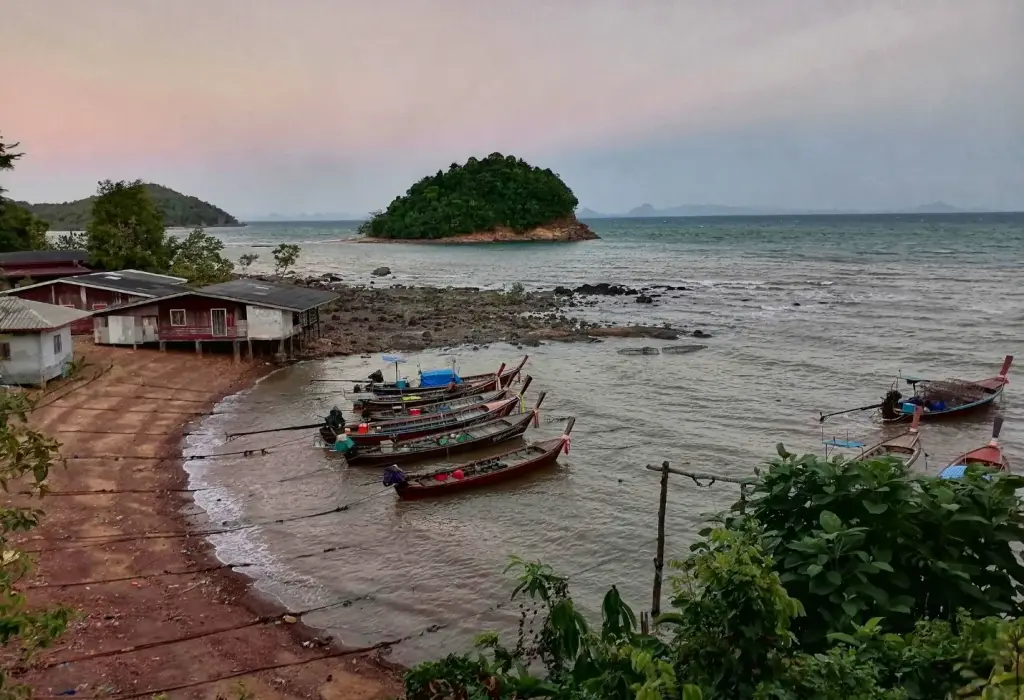
The village landscape is closely tied to the eastern coast of Koh Lanta Yai. The settlement occupies a relatively narrow coastal area, with the sea on one side and hill terrain and island roads on the other. Many houses are built in rows along the shoreline. Some are raised or extend toward the water, reflecting the community’s need to stay close to boats, fishing gear, and the tide. This coastal form of settlement shows how Urak Lawoi life has adapted to the sea over many generations.
The houses in Ban Sangka U are part of the village’s identity. Many are positioned close together along the shore, and some are connected by walkways. Other houses sit slightly higher on the slope and face the sea. Front platforms and open spaces are used for resting, talking with relatives, caring for children, repairing nets, fixing fishing tools, and preparing for work at sea. These everyday scenes are among the most meaningful aspects of visiting Sangka U, because they reveal the living rhythm of a coastal community.
The history of Ban Sangka U as a permanent community is linked to the movement of Urak Lawoi families from earlier settlements, especially from the Ban Hua Laem Klang area, toward Sangka U Bay and Ma Le Bay. The first families settled here to live, farm coconuts, and build a more permanent base. More families later followed. Ban Sangka U was officially established as Moo 7 of Ko Lanta Yai Subdistrict in 1987. Since then, it has remained one of the significant Urak Lawoi communities on Koh Lanta.
For travelers interested in social history, Ban Sangka U offers important insight into the relationship between the Urak Lawoi, land, state systems, tourism, and the sea. In the past, the community relied heavily on marine knowledge and fishing. As outside society became more influential through land administration, resorts, tourism, wage labor, and modern markets, villagers adapted in many ways. Yet the core of their identity continues through language, kinship, ritual, ancestor belief, and the sea.
Traditional fishing remains central to Sangka U’s identity. For the Urak Lawoi, fishing is not only an occupation; it is a body of knowledge formed by living with wind, waves, tides, seasons, and marine life. Local fishermen use motorized long-tail boats to go out to sea, set nets, catch fish, and work with coastal resources according to seasonal conditions. Their knowledge comes from lived experience and direct observation of the sea.
Some villagers also practice small-scale agriculture on foothill land, growing coconut, cashew, and stink bean. However, agriculture is not the main livelihood for every household, because much of community life has historically centered on the sea. As tourism on Koh Lanta expanded, some residents began working in service jobs, resorts, construction, transport, and tourism-related labor. This has diversified income, but the sea remains the symbolic and cultural foundation of Ban Sangka U.
One of the strongest cultural features of Ban Sangka U is the continued use of the Urak Lawoi language. Many adults still speak it in daily life and pass it on to younger family members. Although Thai is increasingly used through education and wider communication, Urak Lawoi can still be heard in conversations, rituals, songs, and communication among relatives. Language helps the community maintain a sense of belonging and continuity with its ancestors.
Urak Lawoi belief in Ban Sangka U is deeply connected to ancestors and spiritual guardians. A key sacred place is To Chan Shrine, the village ancestor shrine. The annual worship of the ancestor shrine is held on the 1st waxing day of the 7th lunar month. Villagers prepare food, offerings, flowers, incense, candles, and other ritual items. A spiritual leader known as the To Mor conducts the ritual, while Ramana music and communal gathering reinforce social unity and respect for ancestors.
Another ritual connected to fishing is the boat guardian-spirit ceremony. Families that own fishing boats perform this ritual to ask for protection and good fortune at sea. The To Mor conducts prayers and symbolic actions such as incense burning, circling the boat, scattering popped rice, offering betel and tobacco, sprinkling lime water and kaffir lime leaves on the bow and stern, and tying a red cloth to the bow. Though some details have changed over time, the purpose remains the same: to keep the boat, crew, and sea journey safe.
The most distinctive and important ceremony of Ban Sangka U is the Loi Ruea ceremony, also known as Ari Pajak. It is held twice a year around the 14th and 15th waxing days of the 6th and 11th lunar months. These periods mark seasonal transitions: from the hot season into the rainy season, and from the rainy season toward the dry season. For the Urak Lawoi, the ceremony is a major act of cleansing, protection, and renewal for the whole village.
At the center of the ceremony is the Pajak boat. The boat is made from specific woods such as salacca palm and devil tree wood, with ritual permission sought before cutting the materials. The boat is decorated with carved symbolic forms, including birds, fish-tooth patterns, snake motifs, and small wooden figures representing the misfortune and suffering of each household. Rice, kitchen items, and symbolically negative things are placed inside the boat so that they can be carried away from the village.
The meaning of Loi Ruea is much deeper than floating a boat into the sea. The ceremony connects the community with ancestral spirits and the sacred ancestral homeland known in Urak Lawoi belief as Gunung Jerai. The Pajak boat carries illness, misfortune, harmful influences, and the spirits of animals that were taken for food back toward their proper spiritual destination. It is an act of apology, renewal, purification, protection, and continuity with ancestral law.
During the Loi Ruea period, the whole community becomes involved. Responsibilities are shared among villagers: contacting the To Mor, informing households, preparing materials, building the ritual boat, arranging offerings, organizing procession elements, singing Ramana songs, and participating in night-time ritual activity. After the boat is floated, further rituals involving protective wooden markers are performed around the village. This system shows how belief, social organization, and coastal space are woven together in Urak Lawoi life.
For visitors, the Loi Ruea ceremony is culturally powerful but must be approached with respect. It is a sacred community ritual, not a staged performance. Visitors should dress modestly, avoid entering ritual spaces without permission, avoid touching ritual objects, and ask before taking close photographs of people, elders, spiritual leaders, or offerings. Observing with humility helps preserve the dignity of the ceremony and the comfort of the community.
Outside ritual periods, Ban Sangka U remains a peaceful fishing village where visitors can observe coastal life slowly. Wooden houses, front platforms, fishing gear, boats, nets, elders, children, and everyday household activity form the visual texture of the village. Its beauty is not polished or staged. It is the beauty of lived reality: a shoreline community still carrying traces of work, kinship, tide, and memory.
Travel to Ban Sangka U is by road on Koh Lanta Yai. From Sala Dan Pier, the western beach areas, or Lanta Old Town, visitors can drive or ride a rented motorcycle toward the eastern side of the island and continue south to the village. This route is suitable for those who want to explore the quieter, more local side of Koh Lanta. The eastern side of the island has a different atmosphere from the western beaches: calmer, more residential, more traditional, and more connected to fishing life.
From Krabi Town, travelers first need to reach Koh Lanta by road and vehicle ferry, minivan, or transfer service. After arriving on Koh Lanta Yai, continue by local road to Ban Sangka U. Because the village is in the southern part of the island, travel time is longer than to Sala Dan, Klong Dao, or Long Beach. Still, the journey is worthwhile for travelers who want to understand Koh Lanta beyond its resort zones.
Ban Sangka U can be combined with nearby attractions in the same itinerary. Lanta Old Town, the Koh Lanta Community Museum, Ban Thung Yee Pheng, Kantiang Bay, Bamboo Bay, and Mu Ko Lanta National Park are all suitable nearby stops. A half-day route can combine Lanta Old Town and Ban Sangka U. A full-day route can continue south to Mu Ko Lanta National Park or return to the western beaches for sunset.
Visitors should remember that Ban Sangka U is a living residential village, not an open-air museum or a commercial tourist venue. Walk quietly, avoid blocking household entrances, do not enter private homes or platforms without permission, and use local services respectfully. If you want deeper interpretation, ritual observation, or community-based activities, it is best to coordinate in advance with local authorities, community leaders, or knowledgeable residents.
Ban Sangka U is best suited for travelers interested in culture, ethnicity, community history, fishing life, and responsible travel. It is not a place to rush through quickly. Its value lies in listening, observing, and understanding context. Visitors who slow down will see that Koh Lanta is not only a beach destination, but also an island shaped by people who carry the memory of the Andaman Sea through language, ritual, boats, and everyday life.
In summary, Ban Sangka U in Krabi is an Urak Lawoi sea-people community of high cultural value on Koh Lanta Yai. It brings together the sea, houses, language, kinship, coastal fishing, ancestor belief, To Chan Shrine, and the Loi Ruea boat-floating ceremony in one living village. A visit to Sangka U gives travelers a deeper understanding of Koh Lanta as a place where the sea is not only scenery, but home, memory, work, and identity.
| Name | Ban Sangka U |
| Location | Moo 7, Ko Lanta Yai Subdistrict, Ko Lanta District, Krabi Province |
| Address | Moo 7, Ban Sangka U, Ko Lanta Yai Subdistrict, Ko Lanta District, Krabi Province 81150 |
| Coordinates | 7.485522, 99.1087 |
| Highlights | Urak Lawoi sea-people community, coastal fishing life, waterfront houses, Urak Lawoi language, To Chan Shrine, and the Loi Ruea or Ari Pajak boat-floating ceremony |
| History | The community developed from Urak Lawoi families who moved from Ban Hua Laem Klang to Sangka U Bay and Ma Le Bay. Ban Sangka U was officially established as Moo 7 of Ko Lanta Yai Subdistrict in 1987 |
| Ethnic Group | Urak Lawoi sea people, also known in Thai as Chao Leh or Thai Mai |
| Community Character | A coastal village on the eastern side of Koh Lanta Yai, with houses along the shore, raised platforms, boat areas, and everyday fishing-related activity |
| Main Ritual | Loi Ruea or Ari Pajak, held twice a year around the 14th and 15th waxing days of the 6th and 11th lunar months, to remove misfortune from the village and reconnect descendants with ancestral spirits |
| Sacred Place | To Chan Shrine, the ancestral shrine of the Urak Lawoi in Ban Sangka U |
| Travel Information | Travel by road on Koh Lanta Yai along the eastern side of the island from Sala Dan or Lanta Old Town toward the southern part of the island. Visitors can use a car, rental car, rented motorcycle, or local transfer service |
| Current Status | A living coastal ethnic community where Urak Lawoi language, fishing life, ancestor beliefs, and traditional rituals remain active |
| Open Days | Ban Sangka U is a living residential community. Visits should be made respectfully, and advance local contact is recommended for cultural activities or ritual observation |
| Opening Hours | There are no fixed opening hours like a gated attraction. Daytime visits are recommended, while early-morning or late-evening disturbance to residential areas should be avoided |
| Entrance Fee | There is no village entrance fee like a gated attraction. Costs depend on actual services used, such as local transport, food, accommodation, or community activities |
| Main Areas / Zones | Waterfront houses, boat-landing area, fishing spaces, To Chan Shrine, Loi Ruea ritual area, community walking area, and the route connected to Lanta Old Town |
| Spiritual Leader | The To Mor serves as the spiritual ritual leader in Urak Lawoi ceremonial practice |
| Main Contact | Contact local Ko Lanta Yai authorities or community coordinators before joining specific community activities or ritual observation |
| Nearby Tourist Attractions | 1. Lanta Old Town, about 7 km 2. Koh Lanta Community Museum, about 7 km 3. Ban Thung Yee Pheng, about 15 km 4. Kantiang Bay, about 10 km 5. Bamboo Bay, about 12 km 6. Mu Ko Lanta National Park, about 14 km |
| Nearby Restaurants | 1. Sunshine Restaurant, Ban Sangka U, about 1 km, Tel. 092-869-3018 2. JY Restaurant, about 6 km, Tel. 096-852-3459, 064-579-9706 3. Chaithalay Koh Lanta, Lanta Old Town, about 7 km, Tel. 091-778-2879 4. Fresh Restaurant Koh Lanta, about 7 km, Tel. 086-628-0378, 075-697-306 5. Apsara Cafe, about 7 km, Tel. 075-697-253 6. Krua Lanta Yai, about 7 km, Tel. 075-697-062 |
| Nearby Accommodations | 1. Sanggaou Bungalows, about 1 km 2. Lanta Sang Kha Ao Nature Resort & Spa, about 1 km 3. Sang Kha Ou Resort and Spa, about 1 km 4. Mango House Seafront Villas and Suites, Lanta Old Town, about 7 km, Tel. 089-867-1067 5. Tonmai Suites, Lanta Old Town, about 7 km 6. The Mangrove House Old Town, about 7 km |
Frequently Asked Questions (FAQ)
Q: Where is Ban Sangka U located?
A: Ban Sangka U is located in Moo 7, Ko Lanta Yai Subdistrict, Ko Lanta District, Krabi Province, on the eastern side toward the southern part of Koh Lanta Yai.
Q: Why is Ban Sangka U culturally important?
A: It is an Urak Lawoi sea-people community where coastal fishing life, Urak Lawoi language, ancestor beliefs, To Chan Shrine, and the Loi Ruea boat-floating ceremony remain active.
Q: When is the Loi Ruea ceremony held?
A: It is held twice a year around the 14th and 15th waxing days of the 6th and 11th lunar months, marking important seasonal transitions for the Urak Lawoi community.
Q: What does the Loi Ruea ceremony mean?
A: It is a ritual of cleansing and protection, using the Pajak boat to carry misfortune, illness, and harmful influences away from the village while reconnecting the community with ancestral spirits.
Q: How can travelers get to Ban Sangka U?
A: Travelers can drive or ride along the eastern road of Koh Lanta Yai from Sala Dan or Lanta Old Town toward the southern part of the island. Cars, rental vehicles, rented motorcycles, and local transfers can be used.
Q: Is there an entrance fee for Ban Sangka U?
A: There is no village entrance fee like a gated attraction. Costs depend on actual services used, such as local transport, food, accommodation, or community-arranged activities.
Q: How should visitors behave in Ban Sangka U?
A: Visitors should dress modestly, walk quietly, ask before taking photos of people, homes, or rituals, avoid entering private areas, and follow local guidance.
Q: What nearby places can be combined with Ban Sangka U?
A: Ban Sangka U can be combined with Lanta Old Town, the Koh Lanta Community Museum, Ban Thung Yee Pheng, Kantiang Bay, Bamboo Bay, and Mu Ko Lanta National Park.
 Category: ●Suburban Living
 Group: ●Village, Community
Last Update : 2 MonthAgo
 Last Update : 2 MonthAgo
 Click to Access the Navigation Map GPS

 Art, Culture and Heritage
 Historical Sites and Monuments(1)
 Landmarks and Memorials(7)
 Art, Craft Centres, Tradition(2)
 Museums(2)
 Educational Places
 Educational Gardens, Farm(1)
 Places of Worship
 Temple(3)
 Mosque(2)
 Other Sacred Sites(2)
 Research and Development
 Royal Project(1)
Village, Community(6)
 Nature and Wildlife
 National Parks and Marine Reserves(5)
 Mountain (Doi)(2)
 Dam, Reservoir, Lake(3)
 Waterfalls(12)
 Hot Springs(3)
 Caves(20)
 River, Canal(2)
 Bays and Beaches(36)
 Islands(23)
 Other natural attractions(7)
 Entertainment and Agricultural
 Farms, Parks and Ecotourism(1)
 Outdoor and Adventure Activities(1)
 Travel Articles, Recipes
 Travel Review, Food Review(2)
 Southern Food Menu, Southern Food Recipes(1)


