
lovethailand home >South Travel Attractions >Krabi Travel Attractions >Muang >Sai Thai > Wat Sai Thai
TL;DR: Wat Sai Thai is located at Moo 4, Ban Sai Thai, Sai Thai Subdistrict, Mueang Krabi District, Krabi Province, open Open Daily, hours 08.00 – 17.00.
Wat Sai Thai
Open Days: Open Daily
Opening Hours: 08.00 – 17.00
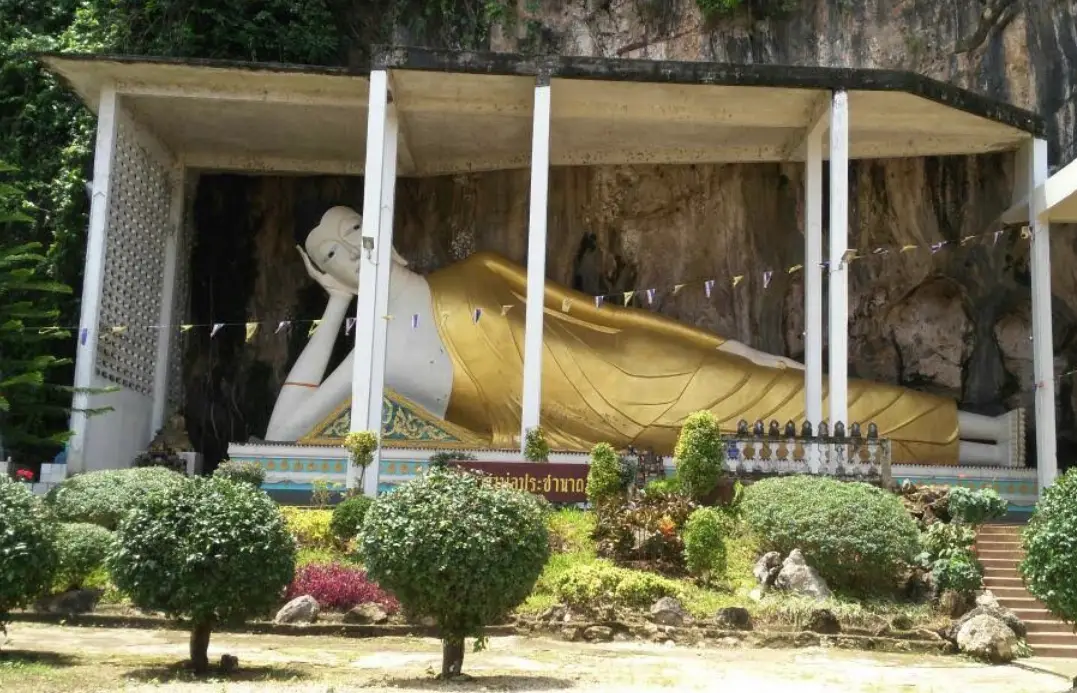
Wat Sai Thai in Krabi Province is an old Buddhist temple and a peaceful cultural stop in Sai Thai Subdistrict, Mueang Krabi District. Located in Moo 4, Ban Sai Thai, along Route 4034 between Krabi Town and Ao Nang, the temple is best known for its 16-meter reclining Buddha image in the posture of subduing Asurindrahur. The golden reclining Buddha rests against a limestone cliff and natural cave setting, giving the temple a distinctive atmosphere that combines Buddhist devotion, local community life, and Krabi’s dramatic limestone landscape.
In brief, Wat Sai Thai is a community temple in Sai Thai Subdistrict, Mueang Krabi District, located on the route between Krabi Town and Ao Nang. Its highlight is the 16-meter reclining Buddha image in the Asurindrahur-subduing posture, built as a moral reminder to abandon pride and self-importance. The temple also has a spacious parking area, a multipurpose pavilion, a crematorium structure, cave openings, limestone cliffs, and traces of earlier use of natural caves by monks. It opens daily from 08.00 to 17.00 with no admission fee.
The appeal of Wat Sai Thai begins with its location. The temple stands on slightly elevated ground, surrounded in parts by limestone hills and close to one of the main roads linking Krabi Town with Ao Nang. It is easy to reach from Krabi Town, Ao Nang, Noppharat Thara, Ao Nam Mao, and the Shell Cemetery route. The temple grounds are not large or difficult to walk through, but they contain enough cultural and natural features to make the stop worthwhile: a reclining Buddha, a cave setting, limestone cliffs, a temple courtyard, and areas used for local religious activities.
Wat Sai Thai is listed as a Buddhist temple in Sai Thai Subdistrict and was established as a temple in 1926. This makes it an important long-standing spiritual center for the local community. Yet the significance of the site goes beyond its formal temple history. The cave and limestone areas around the temple show that this landscape had a role before the current temple setting developed. In earlier times, monks used the cave openings as places to stay and practice. Over time, the site became a proper temple where local residents came to make merit and participate in Buddhist ceremonies.
The temple’s main attraction is the 16-meter reclining Buddha image. The statue lies in a serene posture with a golden body and a limestone cliff as its backdrop. From the open courtyard, visitors can clearly see how the Buddhist image and natural rock formation complement each other. The statue is not enclosed in a heavy building; instead, it is set in a semi-open space where the mountain itself becomes part of the sacred setting. This gives Wat Sai Thai a quiet and memorable visual identity.
The reclining Buddha was built during the time of Phra Pradap Sonarato, the fourth abbot of the temple. Its posture is associated with the episode in which the Buddha subdued Asurindrahur, a powerful being who believed in his own greatness. In the story, Asurindrahur thought that even the Buddha would fear him. Knowing this through his spiritual insight, the Buddha appeared in a vast reclining form, showing Asurindrahur a greatness far beyond his own. Asurindrahur then abandoned his pride and listened to the Buddha’s teaching.
This meaning gives the reclining Buddha at Wat Sai Thai more depth than a beautiful devotional image alone. It presents a simple but powerful Buddhist lesson about letting go of pride, arrogance, and self-importance. Human beings in every period can become attached to position, power, opinions, and the belief that they are superior to others. The reclining Buddha reminds visitors to soften the mind, reduce ego, and become more open to wisdom.
When entering the temple, visitors first encounter a wide open courtyard that provides convenient parking and a clear view toward the Buddha image and limestone cliff. On one side is a multipurpose pavilion used for religious activities and community gatherings. A restored crematorium structure stands near the pavilion, showing that the temple remains active in the religious and social life of the local community. Wat Sai Thai is therefore not only a place for visitors to photograph a famous reclining Buddha; it is still a functioning temple for the people of Ban Sai Thai.
The temple’s setting against limestone hills gives it a very different atmosphere from urban temples or beachside attractions. The surrounding rock face makes the site feel calm, sheltered, and compact. The golden reclining Buddha below the limestone wall creates a strong contrast between human-made sacred art and natural geology. This is one reason the temple is often remembered by travelers who pass between Krabi Town and Ao Nang.
The cave area is also significant. In earlier times, monks used cave openings as places for residence and meditation because they were quiet, shaded, and suitable for seclusion. Some cave areas have traces of archaeological significance and were protected with barriers to help safeguard important remains or spaces. Although parts of the site have changed over time, these traces show that the caves are not merely a scenic background but part of the temple’s historical and cultural landscape.
Geographically, Wat Sai Thai is connected with Krabi’s limestone terrain. Krabi is famous for cliffs, caves, karst towers, and landscapes shaped by ancient marine and geological processes. The Sai Thai area itself is part of a wider cultural and natural landscape that links hills, caves, coastal routes, villages, and older human use of the land. A visit to Wat Sai Thai therefore offers a small but meaningful glimpse into how religion, landscape, and community history meet in Krabi.
Wat Sai Thai remains important to the people of Ban Sai Thai as a local Buddhist center. Residents use the temple for merit-making, religious ceremonies, listening to Dhamma, Buddhist holy days, and annual community events. During important Buddhist occasions such as Makha Bucha, Visakha Bucha, Asalha Bucha, Buddhist Lent, and the end of Buddhist Lent, the temple serves as a gathering place for local devotion. This continuing community function gives the temple a living quality that goes beyond tourism.
For photography, Wat Sai Thai is simple but rewarding. The reclining Buddha can be photographed clearly from the front courtyard, with the limestone cliff rising behind it. Visitors can also capture the pavilion, restored crematorium structure, cave entrance, shaded trees, and natural rock textures. Morning and late afternoon are usually the best times for softer light and more comfortable walking conditions.
Visitors who come to worship should begin by calming the mind, paying respect to the Buddha image, and making offerings or donations at the designated areas if they wish. The central meaning of the image is not only to ask for blessings but also to reflect on the message of humility. Many people pray for peace of mind, the removal of obstacles, good fortune, and a fresh start, but the deeper lesson of the temple is the letting go of rigid self-attachment.
Temple etiquette is important. Visitors should dress modestly, keep their voices low, avoid climbing on structures or touching sacred images, stay out of restricted areas, and avoid littering. Care should also be taken around cave and rock areas because some paths may be uneven or damp. Respectful behavior helps preserve the temple’s calm atmosphere for both worshippers and local residents.
Getting There to Wat Sai Thai is easy from Krabi Town. Take the road toward Ao Nang or Route 4034 for about 8 km. The temple lies along the Krabi Town – Ao Nang route and is a convenient stop for travelers moving between the town and the coast. It can be reached by private car, rental car, rented motorbike, taxi, hired vehicle, or local tour transport.
Wat Sai Thai can be included in either a half-day or full-day itinerary. From Krabi Town, visitors can stop at Wat Sai Thai and continue to Ao Nam Mao, the Shell Cemetery, and Ao Nang Beach. From Ao Nang, the temple can be visited on the way into Krabi Town, followed by Khao Khanap Nam, the Black Crab Monument, Wat Kaew Korawaram, or Krabi Walking Street. This makes the temple useful for travelers who want to combine Buddhist culture, town attractions, and coastal scenery in one route.
One of the advantages of Wat Sai Thai is that it does not require a long visit. Most travelers can spend about 30 to 60 minutes worshipping, photographing the reclining Buddha, and walking around the temple grounds. Those interested in Buddhist symbolism and the meaning of the Asurindrahur-subduing posture may want to spend longer reflecting on the statue and its story.
As a cultural destination, Wat Sai Thai is valuable because it is not an overbuilt attraction. It is a local temple with a meaningful Buddha image, limestone scenery, cave history, and a calm community setting. Visitors experience a side of Krabi that is quieter and closer to local life than the province’s beaches and island tours.
Overall, Wat Sai Thai is suitable for travelers who want to make merit, see a distinctive reclining Buddha, photograph a temple against a limestone cliff, or take a peaceful break between Krabi Town and Ao Nang. Its strength lies in simplicity, calmness, and meaning. The image of the golden reclining Buddha resting beneath the limestone hill remains one of the memorable cultural sights along this route.
Wat Sai Thai should therefore be considered a worthwhile stop in Mueang Krabi District, especially for visitors who want to see Krabi beyond beaches and islands. The temple reveals a landscape of Buddhist faith, village identity, caves, limestone hills, and local memory. Paying respect to the reclining Buddha in the posture of subduing Asurindrahur turns a short roadside stop into a quiet lesson about humility and inner peace.
| Name | Wat Sai Thai, Krabi Province |
| Location | Moo 4, Ban Sai Thai, Sai Thai Subdistrict, Mueang Krabi District, Krabi Province |
| Address | Moo 4, Sai Thai Subdistrict, Mueang Krabi District, Krabi 81000, Thailand |
| Coordinates | Approximately 8.082310, 98.868791 |
| Highlights | A 16-meter reclining Buddha image in the posture of subduing Asurindrahur, set against a limestone cliff and natural cave landscape |
| History | A local Buddhist temple in Sai Thai Subdistrict, established in 1926. The cave area was formerly used by monks and has traces of archaeological significance. |
| Name Origin | The temple name comes from Ban Sai Thai and Sai Thai Subdistrict, the local community where the temple is located. |
| Distinctive Features | A community temple with a large reclining Buddha, limestone cliff, cave openings, open courtyard, multipurpose pavilion, and a peaceful setting suitable for worship and short cultural visits |
| Travel Information | From Krabi Town, take the road toward Ao Nang or Route 4034 for about 8 km. The temple is accessible by private car, rental car, rented motorbike, taxi, hired vehicle, or tour transport. |
| Current Status | Open as a Buddhist temple and religious tourism site in Sai Thai Subdistrict, still used for Buddhist ceremonies and community religious activities |
| Open Days | Open Daily |
| Opening Hours | 08.00 – 17.00 |
| Fees | No Admission Fee; voluntary merit-making or donations are accepted |
| Facilities | Parking area, multipurpose pavilion, worship area, open courtyard, and resting areas within the temple grounds |
| Main Areas / Zones | Front Parking Area Multipurpose Pavilion Crematorium Structure Reclining Buddha In The Asurindrahur-Subduing Posture Cave Opening And Limestone Cliff Area Worship Area Community Buddhist Activity Area |
| Abbot / Caretaker | Wat Sai Thai monastic community and Ban Sai Thai local community |
| Main Contact Number | Wat Sai Thai, Tel. 075-612-700, 075-700-600 / Sai Thai Subdistrict Administrative Organization, Tel. 075-623-402 |
| Official Website / Official Page | Sai Thai Subdistrict Administrative Organization Website and government cultural information sources |
| Nearby Tourist Attractions | 1. Ao Nam Mao, about 6 km 2. Shell Cemetery, about 7 km 3. Khao Khanap Nam, about 8 km 4. Ao Nang Beach, about 8 km 5. Wat Kaew Korawaram, about 8 km 6. Black Crab Monument And Krabi Riverfront, about 8 km 7. Krabi Walking Street, about 8 km 8. Tiger Cave Temple, about 12 km |
| Nearby Restaurants | 1. Khao Klong Sai Thai, about 1 km, Tel. 080-212-2424 2. Ko Sin Sai Thai, about 2 km, Tel. 080-538-6159, 083-182-6487 3. Five Star PTT Sai Thai-Ao Nang, about 2 km, Tel. 062-350-2462 4. Ruean Mai Restaurant, about 4 km 5. Nong Joke Krabi Restaurant, about 6 km, Tel. 075-611-639, 062-072-7887 6. Ruanthip Restaurant, about 8 km, Tel. 075-611-635, 075-632-043 7. Krua Thara, about 13 km, Tel. 075-637-361, 091-825-9252 |
| Nearby Accommodations | 1. Sai Thai Garden Home, about 2 km, Tel. 075-700-654, 089-289-6274 2. Krabi Garden Home, about 3 km, Tel. 082-287-1452 3. Poonsiri Resort Aonang, about 7 km, Tel. 075-656-260 4. Naga Peak Resort, about 8 km, Tel. 083-968-6809 5. Aonang Phu Petra Resort, about 8 km, Tel. 075-612-666 6. The ShellSea Krabi, about 8 km, Tel. 075-819-519 |
Frequently Asked Questions (FAQ)
Q: Where is Wat Sai Thai in Krabi located?
A: Wat Sai Thai is located in Moo 4, Ban Sai Thai, Sai Thai Subdistrict, Mueang Krabi District, Krabi Province, along Route 4034 between Krabi Town and Ao Nang.
Q: What are the opening hours of Wat Sai Thai?
A: Wat Sai Thai is open daily from 08.00 to 17.00.
Q: Is there an admission fee?
A: There is no admission fee. Visitors may make merit or donate voluntarily at designated points inside the temple.
Q: What is the main highlight of Wat Sai Thai?
A: The main highlight is the 16-meter reclining Buddha image in the posture of subduing Asurindrahur, set against a limestone cliff and natural cave setting.
Q: What does the Asurindrahur-subduing posture mean?
A: It represents the Buddhist lesson of letting go of pride and self-importance, based on the story of Asurindrahur abandoning arrogance after witnessing the Buddha’s spiritual greatness.
Q: What type of visit is Wat Sai Thai suitable for?
A: It is suitable for worship, photography, a short cultural stop, and a peaceful break between Krabi Town and Ao Nang. A typical visit takes about 30 to 60 minutes.
Q: How do visitors get to Wat Sai Thai from Krabi Town?
A: From Krabi Town, take the road toward Ao Nang or Route 4034 for about 8 km. The temple can be reached by private car, rental car, rented motorbike, taxi, hired vehicle, or tour transport.
Q: What nearby places can be visited after Wat Sai Thai?
A: Nearby places include Ao Nam Mao, the Shell Cemetery, Khao Khanap Nam, Ao Nang Beach, Wat Kaew Korawaram, the Black Crab Monument, Krabi Walking Street, and Tiger Cave Temple.
 Category: ●Places of Worship
 Group: ●Temple
Last Update : 2 MonthAgo
 Last Update : 2 MonthAgo
 Click to Access the Navigation Map GPS

 Art, Culture and Heritage
 Historical Sites and Monuments(1)
 Landmarks and Memorials(7)
 Art, Craft Centres, Tradition(2)
 Museums(2)
 Educational Places
 Educational Gardens, Farm(1)
Temple(3)
 Mosque(2)
 Other Sacred Sites(2)
 Research and Development
 Royal Project(1)
 Suburban Living
 Village, Community(6)
 Nature and Wildlife
 National Parks and Marine Reserves(5)
 Mountain (Doi)(2)
 Dam, Reservoir, Lake(3)
 Waterfalls(12)
 Hot Springs(3)
 Caves(20)
 River, Canal(2)
 Bays and Beaches(36)
 Islands(23)
 Other natural attractions(7)
 Entertainment and Agricultural
 Farms, Parks and Ecotourism(1)
 Outdoor and Adventure Activities(1)
 Travel Articles, Recipes
 Travel Review, Food Review(2)
 Southern Food Menu, Southern Food Recipes(1)


