
lovethailand home >South Travel Attractions >Krabi Travel Attractions >Muang >Krabi Noi > Wat Tham Suea
TL;DR: Wat Tham Suea is located at Ban Tham Suea, Krabi Noi Subdistrict, Mueang Krabi District, Krabi Province, open Open Daily, hours 06.00 – 18.00.
Wat Tham Suea
Open Days: Open Daily
Opening Hours: 06.00 – 18.00
Wat Tham Suea in Krabi Province, widely known as Tiger Cave Temple, is one of the most important Buddhist and cultural landmarks in Krabi. Located at Ban Tham Suea in Krabi Noi Subdistrict, Mueang Krabi District, the temple lies only about 5 – 9 km from Krabi Town, depending on the starting point and route. It is a destination where Buddhist faith, meditation practice, limestone caves, forest scenery, archaeology, and a dramatic mountaintop viewpoint come together in one remarkable place.
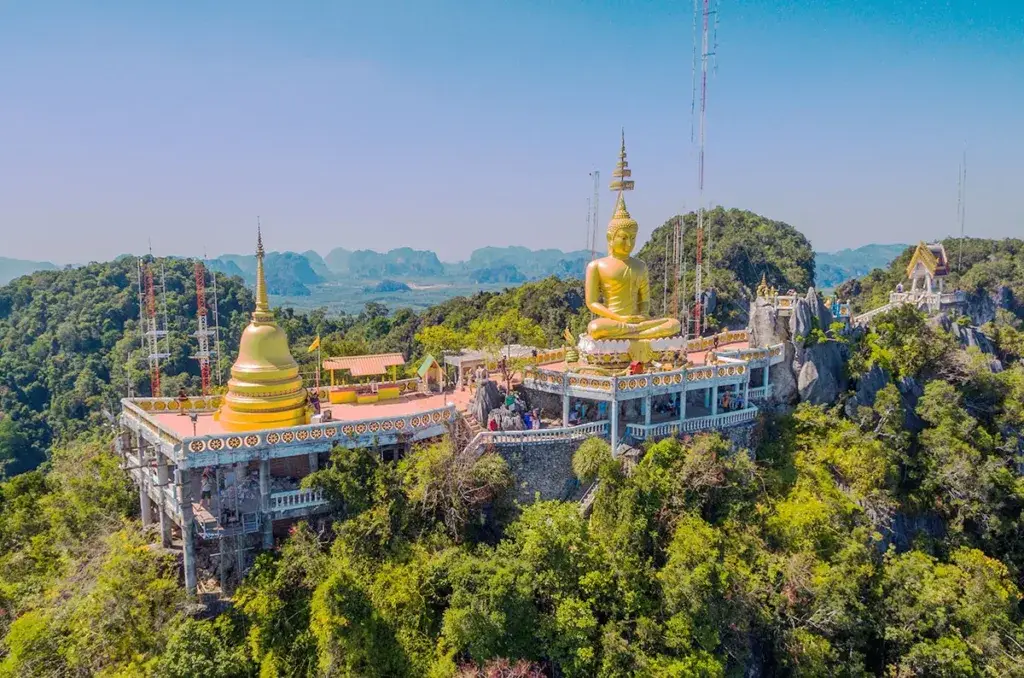
In brief, Wat Tham Suea is a major meditation temple founded from a forest meditation retreat established by Luang Pho Chamniarn Silasettho in 1975. It was officially elevated to temple status on 30 December 1985. The temple is famous for its tiger-related cave legend, peaceful forest setting, natural caves, large Guanyin statue, white jade Buddha image, replica Buddha footprint, and the challenging 1,237-step staircase to Khao Kaeo summit. At the top are a large Buddha image, a golden stupa, a replica Buddha footprint, and one of the finest panoramic viewpoints in Krabi.
The name “Tiger Cave Temple” comes from local belief that a large tiger once lived in the cave area near Khao Kaeo, formerly associated with the Ao Luk Thanu limestone range. Inside the cave, natural rock formations are said to resemble tiger paw marks. Over time, the name Tham Suea, meaning tiger cave, became firmly attached to the place. As wandering monks came to the caves for solitude and meditation, and as villagers began visiting to pay respect, the site gradually developed from a quiet forest retreat into one of Krabi’s most respected temples.
The figure most closely associated with the temple is Luang Pho Chamniarn Silasettho, a renowned meditation master deeply respected by Buddhists in southern Thailand. In 1975, he established the Tham Suea meditation retreat in this forested limestone area. As faith in his teaching and conduct grew, more people came to practice, make merit, and support the retreat. The site was later officially recognized as a temple in 1985. His legacy remains central to the identity of Wat Tham Suea.
The temple grounds cover a large forested area with plains, valleys, cliffs, limestone caves, and a high summit. Its natural surroundings make it very different from Krabi’s coastal tourist sites. Visitors encounter old trees, climbing roots, limestone formations, shaded paths, and secluded meditation areas. Wat Tham Suea is therefore not only a temple but also a forest sanctuary and a place where nature supports religious practice.
Important caves around the temple include Tham Khon Than, Tham Lot, Tham Chang Kaeo, Tham Luk Thanu, Tham Phra, and other smaller caves. Some of these caves have long been used for meditation by monks, laymen, and laywomen. Others are valued for their natural limestone formations and spiritual atmosphere. Their importance lies not only in geology but also in the history of forest practice and Buddhist devotion at the temple.
The lower cave area deserves time and attention before visitors attempt the summit climb. Inside the cave are sacred images and devotional spaces integrated with natural rock walls. Many visitors begin here by paying respect, making merit, and experiencing the quiet atmosphere that gave rise to the temple. The cave helps explain why this location was first chosen by meditation monks seeking seclusion and simplicity.
Wat Tham Suea also has archaeological significance. The area has yielded evidence from both prehistoric and early historic periods, including stone tools, pottery fragments, unbaked votive tablets, and other ancient objects. These finds show that the caves and limestone landscape of Krabi have been connected with human life for a very long time. A visit to the temple therefore includes layers of nature, religion, and archaeology.
The lower temple grounds contain several important religious structures and devotional points, including the ordination hall, sermon hall, assembly areas, a stupa, the Guanyin statue, and other sacred images. Most visitors begin by making merit, paying respect, or walking around the lower temple area. From there, they can choose whether to explore the caves, walk through the forested paths, or climb the 1,237 steps to the summit.
One of the most popular devotional points in the temple is the large Guanyin statue, standing more than 5 meters tall. Many visitors come to pray for health, family peace, compassion, and good fortune. The temple also houses a white jade Buddha image in Burmese artistic style and a replica Buddha footprint, both of which are meaningful to worshippers. These sacred objects make Wat Tham Suea an important site for merit-making and spiritual reflection.
The most famous feature of Wat Tham Suea is the staircase to Khao Kaeo summit. The route has 1,237 steps and is known for being steep and physically demanding. At the top are a large Buddha image, a golden stupa, and a replica Buddha footprint. The summit also offers a 360-degree view over Krabi Town, Khao Khanap Nam, limestone hills, plains, forested areas, and the distant Andaman Sea.
The climb should not be treated merely as a fitness challenge. For many visitors, it becomes an exercise in patience, mindfulness, and determination. Numbers marked along the staircase help climbers track progress, but some sections are steep and high. Visitors should climb slowly, rest when needed, and avoid pushing beyond their physical limits. Those with heart conditions, high blood pressure, knee problems, or dizziness should assess their condition carefully before attempting the climb.
The best times to climb are early morning or late afternoon, when the heat is less intense. Morning visits may offer soft light and, in some seasons, mist over the surrounding hills. Late afternoon visits can provide beautiful warm light, but visitors must allow enough time to descend before dark. Proper shoes, drinking water, modest but comfortable clothing, and minimal baggage are strongly recommended.
At the summit, the view is the reward for the climb. The terrace opens onto sweeping scenery of Krabi’s limestone landscape, town area, roads, plains, forest, and distant coastline. This wide view helps visitors understand Krabi beyond beaches and islands. The province’s inland hills, plains, and karst formations are just as visually powerful as its coastal scenery.
Visitors who cannot climb the summit can still enjoy the temple. The lower area includes the cave, Guanyin statue, white jade Buddha image, forest paths, temple courtyards, and meditation spaces. A visit to Wat Tham Suea does not require climbing all 1,237 steps. The experience can be adjusted to each visitor’s health, time, and purpose.
Monkeys live in several parts of the temple grounds and are part of the site’s familiar atmosphere. Visitors should be careful with food, drinks, plastic bags, sunglasses, hats, phones, and small personal items. Do not feed the monkeys, approach baby monkeys, or hold food visibly. Avoiding feeding helps reduce aggressive behavior and protects the animals’ natural habits.
Because Wat Tham Suea is a Buddhist temple and meditation site, visitors should dress respectfully. Avoid sleeveless tops, revealing clothing, very short shorts, and inappropriate attire. Those planning to climb should choose clothing that is both modest and easy to move in. Shoes should grip well, especially during or after rain, when steps can become slippery.
For those interested in Buddhist practice, Wat Tham Suea remains important as a meditation temple in Krabi. The forest, caves, and hills provide an atmosphere of quiet discipline. Even though the temple is now widely visited by tourists, its foundation remains strongly connected with meditation, seclusion, and the Buddhist search for inner calm.
As a travel destination, Wat Tham Suea connects easily with several Krabi routes. From Krabi Town, visitors can combine it with Khao Khanap Nam, the Black Crab Monument, Krabi Walking Street, or Wat Kaew Korawaram. Nature-focused routes can continue to Khao Phanom Bencha National Park, Huai To Waterfall, clear-water canals, or Emerald Pool depending on time. Visitors staying in Ao Nang can also make a half-day trip to the temple before returning to the coast.
Getting There from Krabi Town is straightforward. Take Phetkasem Road and turn onto Ratsadon Phatthana Road toward Krabi Noi Subdistrict. The distance from town is around 5 – 9 km, depending on the starting point. The temple is well known locally and can be reached by private car, rental car, taxi, hired vehicle, or local transport on some routes. From Krabi International Airport, the temple is also convenient to reach by car because both are within Mueang Krabi District.
Drivers should allow time for parking and walking into the temple area, especially on weekends, Buddhist holy days, or festival periods. Visitors who plan to climb the summit should arrive early enough to complete the ascent and descent safely. Families and older visitors can focus on the lower temple area, the cave, Guanyin statue, and other devotional points without attempting the staircase.
There is generally no admission fee for Wat Tham Suea. Visitors may make merit or donate voluntarily at designated points. As with any Buddhist temple, visitors should respect monks, nuns, meditators, and local worshippers. Avoid loud behavior, disruptive photography, entering restricted areas, climbing on sacred or natural formations, or touching objects without permission.
Wat Tham Suea continues to develop its Buddhist facilities, including major religious structures, a new ordination hall, assembly areas, and monastic buildings. Recent public information identifies Phra Thep Wachirakorn, Deputy Ecclesiastical Regional Governor of Region 17, as acting abbot of Wat Tham Suea. The temple remains a major center of Buddhist faith, local devotion, and religious tourism in Krabi.
The attraction of Wat Tham Suea lies in how many dimensions it brings together: a meditation monastery, sacred caves, forest paths, Buddhist images, archaeology, wildlife, a steep pilgrimage staircase, and an extraordinary summit view. Visitors receive more than a typical temple visit. They encounter faith, history, nature, and personal endurance in a single destination.
Wat Tham Suea is therefore one of the places not to miss in Krabi. It reveals a deeper side of the province beyond beaches and islands. Here, Krabi appears as a land of Buddhist devotion, caves, forests, ancient human traces, limestone mountains, and expansive viewpoints. A visit to Tiger Cave Temple is not only a trip to a famous landmark but a journey through the spiritual, natural, and historical identity of Krabi.
| Name | Wat Tham Suea, Krabi / Tiger Cave Temple |
| Location | Ban Tham Suea, Krabi Noi Subdistrict, Mueang Krabi District, Krabi Province |
| Address | Moo 11, Ban Tham Suea, Krabi Noi Subdistrict, Mueang Krabi District, Krabi 81000, Thailand |
| Coordinates | Approximately 8.1250, 98.9258 |
| Highlights | Tiger Cave, Guanyin statue, white jade Buddha image, replica Buddha footprint, forest caves, meditation areas, and the 1,237-step climb to Khao Kaeo summit with a 360-degree Krabi viewpoint |
| History | Founded as a meditation retreat by Luang Pho Chamniarn Silasettho in 1975 and officially elevated to temple status on 30 December 1985. The area also contains archaeological evidence from prehistoric and early historic periods. |
| Name Origin | The name comes from local belief that a tiger once lived in the cave area and that a natural rock formation inside the cave resembles a tiger paw mark. |
| Distinctive Features | A Buddhist temple, forest monastery, meditation site, cave complex, archaeological area, and high viewpoint in one destination |
| Travel Information | From Krabi Town, take Phetkasem Road and turn onto Ratsadon Phatthana Road toward Krabi Noi Subdistrict. The temple is about 5 – 9 km from town and is accessible by private car, rental car, taxi, or hired vehicle. |
| Current Status | Open as a Buddhist temple, meditation site, and religious tourism landmark of Krabi, with ongoing development of Buddhist facilities within the temple grounds |
| Open Days | Open Daily |
| Opening Hours | 06.00 – 18.00 |
| Fees | No Admission Fee; voluntary donations are accepted |
| Facilities | Parking area, restrooms, resting pavilions, merit-making areas, meditation areas, limited drink or supply stalls during some periods, and staircase access to the summit |
| Main Areas / Zones | Tiger Cave Tham Khon Than Tham Lot Tham Chang Kaeo Tham Luk Thanu Tham Phra Forest And Meditation Areas Guanyin Statue White Jade Buddha Image Replica Buddha Footprint 1,237-Step Staircase Khao Kaeo Summit Summit Stupa And Large Buddha Image |
| Abbot / Caretaker | Phra Thep Wachirakorn, Deputy Ecclesiastical Regional Governor of Region 17, is identified in recent public information as acting abbot of Wat Tham Suea. The temple was founded by Luang Pho Chamniarn Silasettho. |
| Main Contact Number | Krabi Noi Subdistrict Municipality, Tel. 075-652-779 |
| Official Website / Official Page | Krabi Noi Subdistrict Municipality Website and official government tourism information sources |
| Nearby Tourist Attractions | 1. Krabi Provincial Stadium, about 3 km 2. Big C Krabi, about 4 km 3. Khao Khanap Nam, about 8 km 4. Black Crab Monument And Krabi Riverfront, about 9 km 5. Krabi Walking Street, about 9 km 6. Wat Kaew Korawaram, about 10 km 7. Clear-Water Canal / Khlong Root, about 18 km 8. Khao Phanom Bencha National Park, about 23 km |
| Nearby Restaurants | 1. Tiger Cafe Restaurant, about 1 km, Tel. 084-707-1775 2. Isan Baan Na Tham Suea, about 1 km, Tel. 099-357-8717 3. Luk Tan Loi Kaeo Tham Suea, about 1 km, Tel. 089-652-7875, 080-143-9591 4. Tod Man Kung Mueang Krabi Branch 4 Tham Suea, about 1 km, Tel. 092-749-7986 5. Cha Fin Shop Near Khanom Khrok Tham Suea, about 1 km, Tel. 062-264-7750 6. Kaphrao Boran Than Khun Wat Tham Suea, about 1 km, Tel. 096-857-4195 7. Pa Tu Som Tam Tham Suea, about 2 km, Tel. 086-272-8617 |
| Nearby Accommodations | 1. Thip Thip Resort Wat Tham Suea, about 2 km 2. Palmkaew Resort, about 5 km, Tel. 075-701-950 3. Phuhi Hotel, about 5 km, Tel. 075-701-085 4. Tairada Boutique Hotel, about 6 km, Tel. 075-667-824 5. Krabi Front Bay Resort, about 13 km, Tel. 075-626-777 6. Krabi Seabass Hotel, about 9 km |
Frequently Asked Questions (FAQ)
Q: Where is Wat Tham Suea in Krabi located?
A: Wat Tham Suea is located at Moo 11, Ban Tham Suea, Krabi Noi Subdistrict, Mueang Krabi District, Krabi Province, about 5 – 9 km from Krabi Town.
Q: What are the opening hours of Wat Tham Suea?
A: The temple is open daily. The recommended visiting and climbing period is approximately 06.00 – 18.00.
Q: Is there an admission fee?
A: There is generally no admission fee. Visitors may make merit or donate voluntarily at designated points inside the temple.
Q: How many steps lead to the summit?
A: The staircase to Khao Kaeo summit has 1,237 steps. It is steep and physically demanding, so visitors should bring water, wear suitable shoes, and rest as needed.
Q: What can visitors see at the summit?
A: The summit has a large Buddha image, a golden stupa, a replica Buddha footprint, and a 360-degree viewpoint overlooking Krabi Town, Khao Khanap Nam, limestone mountains, and the Andaman Sea.
Q: Is Wat Tham Suea suitable for older visitors?
A: The lower temple area is suitable for older visitors who want to make merit and see the caves, but the 1,237-step climb should be attempted only if health and fitness allow.
Q: Are there monkeys at Wat Tham Suea?
A: Yes. Monkeys live in parts of the temple grounds. Visitors should keep belongings secure, avoid visible food, never feed the monkeys, and avoid getting too close.
Q: What nearby places can be visited after Wat Tham Suea?
A: Nearby places include Khao Khanap Nam, the Black Crab Monument, Krabi Walking Street, Wat Kaew Korawaram, clear-water canals, and Khao Phanom Bencha National Park.
 Category: ●Places of Worship
 Group: ●Temple
Last Update : 2 MonthAgo
 Last Update : 2 MonthAgo
 Click to Access the Navigation Map GPS
Wat Tham Suea Map
Recommend

 Art, Culture and Heritage
 Historical Sites and Monuments(1)
 Landmarks and Memorials(7)
 Art, Craft Centres, Tradition(2)
 Museums(2)
 Educational Places
 Educational Gardens, Farm(1)
Temple(3)
 Mosque(2)
 Other Sacred Sites(2)
 Research and Development
 Royal Project(1)
 Suburban Living
 Village, Community(6)
 Nature and Wildlife
 National Parks and Marine Reserves(5)
 Mountain (Doi)(2)
 Dam, Reservoir, Lake(3)
 Waterfalls(12)
 Hot Springs(3)
 Caves(20)
 River, Canal(2)
 Bays and Beaches(36)
 Islands(23)
 Other natural attractions(7)
 Entertainment and Agricultural
 Farms, Parks and Ecotourism(1)
 Outdoor and Adventure Activities(1)
 Travel Articles, Recipes
 Travel Review, Food Review(2)
 Southern Food Menu, Southern Food Recipes(1)


