
lovethailand home >South Travel Attractions >Krabi Travel Attractions >Muang >Pak Nam > Phra Nang Cave Beach
TL;DR: Phra Nang Cave Beach is located at Railay Peninsula, Ao Nang Subdistrict, Mueang Krabi District, Krabi Province, open Daily, hours Open throughout the day for the beach area; boat transfers, beach activities.

Phra Nang Cave Beach
Open Days: Daily
Opening Hours: Open throughout the day for the beach area; boat transfers, beach activities, rock climbing, and tourism services depend on boat schedules, weather, sea conditions, and national park measures
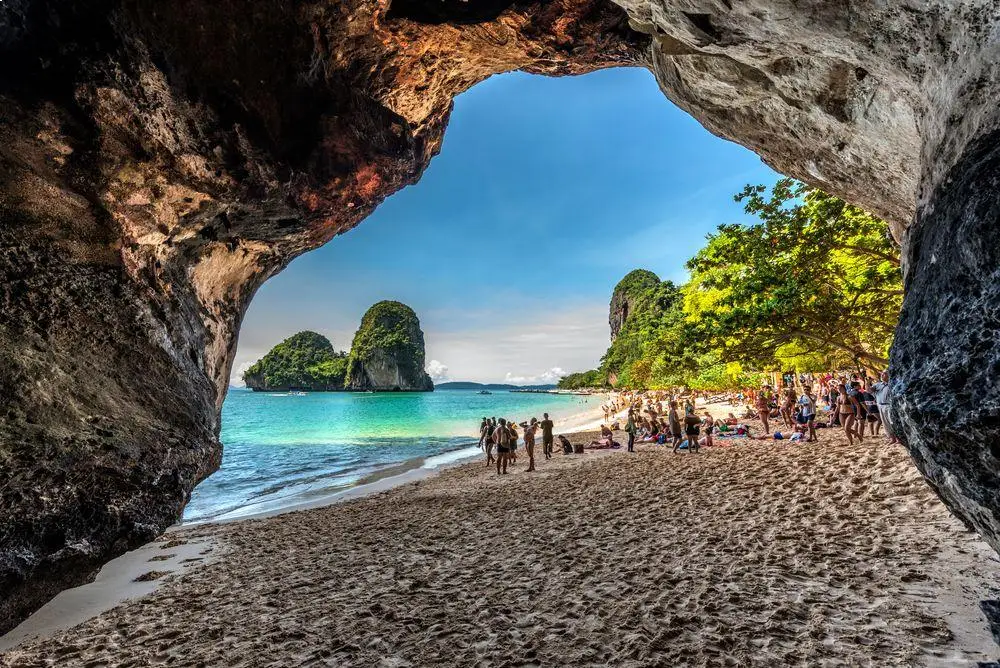
Phra Nang Cave Beach in Krabi Province is one of the most distinctive beaches on the Railay Peninsula, located in Ao Nang Subdistrict, Mueang Krabi District, within Hat Noppharat Thara-Mu Ko Phi Phi National Park. The beach is known for its fine white sand, clear water, towering limestone cliffs, sea-cave scenery, and views of small offshore islands in the Andaman Sea. It is more than a scenic beach: one side of the bay is shaped by a limestone mountain with Phra Nang Cave at the end of the beach, where stalactites and stalagmites create layered natural formations and where a local shrine reflects the coastal beliefs of the area.
Phra Nang Cave Beach belongs to the wider Railay area, together with Railay West Beach, Railay East Beach, and Nam Mao Beach. These beaches cannot be reached directly by car because limestone cliffs block road access. Visitors must arrive by long-tail boat from Ao Nang, Ao Nam Mao, Noppharat Thara, or nearby boat service points. This boat-only access is part of the beach’s character. Even though the beach is popular, the approach by sea gives visitors a strong first impression of Krabi’s limestone coast, with cliffs rising behind the sand and long-tail boats floating in clear water.
The landscape around Phra Nang Cave Beach is part of Krabi’s coastal karst system. Over time, seawater, wind, rain, and natural erosion shaped the limestone into cliffs, caves, overhangs, rock pockets, stalactites, and stalagmites. The result is a beach where geological scenery is not just a background but the main identity of the place. The vertical cliffs, the cave mouth, the white sand, and the offshore islands all combine to create one of Krabi’s most recognizable coastal scenes.
Phra Nang Cave is the main landmark of the beach. Inside and around the cave, limestone formations show the slow work of mineral-rich water over long periods. The cave also contains Phra Nang Shrine, respected by local boatmen and coastal communities. The shrine reflects a long relationship between people and the sea, where safety, livelihood, travel, and local belief are closely connected. Visitors should behave respectfully, avoid touching cave formations, avoid moving offerings, avoid climbing inside the cave, and keep noise low around the shrine area.
The beach itself is suitable for swimming, walking, kayaking, photography, relaxing on the sand, and enjoying the views of limestone islands offshore. In calm conditions, the water can be very clear, with blue-green shades near the shore. During the day, the beach can become busy with visitors arriving by boat, while early morning and late afternoon are often more atmospheric. The cave-framed view looking out toward the sea is one of the most popular photo angles in the area.
Swimming is enjoyable when the sea is calm, but visitors should remain aware of long-tail boats, changing sand levels, rocks near the cliffs, and seasonal waves. Families with children should stay close to shore and supervise them at all times. Non-swimmers should use a life jacket if entering deeper water. Visitors should avoid swimming across boat routes and should follow local safety guidance, especially during monsoon periods.
Popular activities at Phra Nang Cave Beach include swimming, sunbathing, kayaking, photography, sunset viewing, beach sports, and rock climbing in the wider Railay area. Railay and Phra Nang are internationally known for limestone climbing routes, but climbing should only be done with proper equipment and qualified local operators. Visitors should not climb cliffs independently without safety gear or experience.
The beach is especially strong for photography. From inside the cave, the limestone opening frames the beach, sea, and offshore islands like a natural window. From the sand, visitors can capture long-tail boats, cliffs, clear water, and the curve of the bay in one view. Morning is better for lighter crowds, while late afternoon gives softer light. Those staying overnight in Railay have the best chance to see the beach before and after the main day-trip crowds arrive.
Getting There requires boat travel. From Krabi Town, travel by road to Ao Nang or Ao Nam Mao, then continue by long-tail boat to Railay or Phra Nang. From Ao Nang, the boat ride usually takes around 15 minutes depending on sea conditions. From Ao Nam Mao, boats commonly land on the Railay East side, from where visitors can walk to Phra Nang Cave Beach. Once on the Railay Peninsula, Railay West, Railay East, and Phra Nang are connected by walking paths.
Ao Nang is the most convenient mainland base for visiting Phra Nang Cave Beach because it has regular boat services, accommodation, restaurants, and tour operators. Krabi Town is also possible as a base, but travelers should allow extra road-transfer time before reaching the boat pier. Staying in Railay is the most convenient option for early morning or evening visits, as visitors can walk to the beach without relying on a boat each time.
The best season to visit is generally from November to April, when the Andaman Sea is more likely to be calm, skies are clearer, rainfall is lower, and conditions are better for boat travel, swimming, kayaking, climbing, and photography. The beach can be visited year-round when conditions are safe, but the rainy season requires more caution because wind, waves, and boat schedules may change quickly. If boat operators advise that the sea is unsafe, visitors should adjust the plan rather than force the trip.
Offshore scenery is another major attraction. From Phra Nang Cave Beach and nearby Ao Nang, visitors can see islands such as Chicken Island, Ko Mo, Ko Thap, and Ko Poda. Their shapes change depending on viewing angle and imagination, with Chicken Island especially known for its recognizable rock form. These islands add depth to the seascape and explain why Phra Nang feels more visually dramatic than many open beaches.
The wider Railay area gives travelers several nearby places to explore. Railay West is known for its wide beach and sunset views. Railay East is a boat landing and accommodation area backed by mangroves. Tonsai Beach has a strong climbing and backpacker identity. Railay Viewpoint is suitable for physically prepared visitors. This compact geography makes Phra Nang Cave Beach suitable for a half-day trip, a full-day visit, or a relaxed overnight stay in Railay.
Facilities around Phra Nang Cave Beach are more available than on remote islands, but they are still more limited than in Ao Nang. Most restaurants, shops, and accommodations are in Railay West, Railay East, and nearby resorts. Visitors should bring drinking water, sun protection, a towel, a dry bag, suitable sandals for boats and sand, and cash for boat transfers or local services. The beach itself should be treated mainly as a natural recreation area rather than a full-service mainland beach.
Travelers who want to stay close to the beach can choose Railay accommodation in several styles, from luxury resorts near Phra Nang to mid-range properties on Railay West or Railay East. Staying in Railay allows more time at the beach during quieter hours and makes it easier to explore the area on foot. However, luggage handling can be less convenient than staying in Ao Nang because Railay is boat-access only, and some transfers require walking on sand or shallow-water landings.
Phra Nang Cave Beach suits many types of travelers. Couples enjoy the scenic and romantic setting. Families can swim in calm conditions close to shore. Friends and photographers come for the cave-framed views and long-tail boats. Adventure travelers come for kayaking and rock climbing. First-time Krabi visitors come because the beach concentrates many of Krabi’s signature elements in one place: limestone cliffs, clear water, white sand, caves, boats, and island views.
Main safety points include seasonal waves, cliff areas, boat movement, cave surfaces, and heat. Visitors should avoid walking too close to cliff faces during heavy rain or strong wind, should not climb rocks without equipment, should avoid swimming when conditions are unsafe, and should check return-boat timing. The beach can become crowded in the middle of the day, so awareness of personal belongings and boat traffic is also important.
Responsible travel is especially important at Phra Nang Cave Beach. Visitors should respect Phra Nang Cave and shrine, avoid touching stalactites and stalagmites, avoid scratching cave walls, and keep the shrine area orderly. On the beach, visitors should take waste back, avoid using soap or shampoo in the sea, avoid feeding fish, avoid collecting shells or coral fragments, and use reef-friendly sunscreen where possible. The beach receives many visitors, so individual behavior has a direct impact on cleanliness and long-term quality.
Compared with nearby beaches, Phra Nang Cave Beach has a stronger cave-and-cliff identity than Railay West, which is broader and known for sunset views. Railay East is more of a boat landing, mangrove, accommodation, and service zone. Tonsai Beach is associated with rock climbing and a more rustic atmosphere. Phra Nang stands out because it combines a beautiful beach, cave shrine, limestone formations, clear water, and offshore island views in one compact place.
A practical half-day plan can start from Ao Nang by long-tail boat, continue to Railay, walk to Phra Nang Cave Beach, swim, photograph the cave and beach, visit the cave respectfully, and return via Railay West. A full-day plan can add kayaking, Railay East, Tonsai Beach, or a climbing activity. Travelers staying overnight in Railay should visit early morning or late afternoon for better light, fewer crowds, and a calmer experience.
Phra Nang Cave Beach is therefore more than a beautiful Krabi beach. It is a place where limestone geology, natural caves, local belief, long-tail boat travel, island scenery, and beach recreation meet in one setting. With good preparation, safe boat access, suitable sea conditions, and respectful visitor behavior, Phra Nang Cave Beach can become one of the most complete and memorable coastal experiences in Krabi.
| Name | Phra Nang Cave Beach / Ao Tham Phra Nang |
| Location | Railay Peninsula, Ao Nang Subdistrict, Mueang Krabi District, Krabi Province |
| Address | Phra Nang Cave Beach, Ao Nang Subdistrict, Mueang Krabi District, Krabi Province 81180, Thailand |
| Coordinates | Approximately 8.00577, 98.83860 |
| Highlights | White sand beach, clear water, limestone cliffs, Phra Nang Cave, Phra Nang Shrine, offshore island views, kayaking, swimming, photography, and rock climbing in the Railay area |
| History | A natural beach in Hat Noppharat Thara-Mu Ko Phi Phi National Park, significant for limestone scenery, marine tourism, and the local coastal belief connected with Phra Nang Shrine |
| Name Origin | The name comes from Phra Nang Cave at the end of the beach, a limestone cave with formations and a shrine respected by local boatmen and coastal communities |
| Distinctive Features | Approximately 400-metre beach surrounded by limestone cliffs, a cave at the beach end, clear water, and offshore views toward Chicken Island, Ko Mo, Ko Thap, and Ko Poda |
| Travel Information | No direct road access. Travel by long-tail boat from Ao Nang, Ao Nam Mao, or Noppharat Thara. From Ao Nang, the ride usually takes about 15 minutes depending on sea conditions, followed by walking through the Railay area to Phra Nang Cave Beach. |
| Current Status | Open as a beach and cave attraction within the national park area. Travel and activities depend on boat schedules, weather, sea conditions, and local management measures. |
| Open Days | Daily |
| Opening Hours | Open throughout the day for the beach area; boats and tourism activities operate according to operators and sea conditions |
| Fees | The area is within Hat Noppharat Thara-Mu Ko Phi Phi National Park. The standard national park fee is Thai adults 40 baht, Thai children 20 baht; foreign adults 200 baht, foreign children 100 baht. Boat and activity fees depend on the selected operator. |
| Facilities | Long-tail boat transfers, Railay accommodations and restaurants, rock-climbing services, kayaking, beach relaxation areas, and nearby resort services |
| Main Areas / Zones | Phra Nang Cave Beach, Phra Nang Cave, Phra Nang Shrine, limestone cliff zone, swimming area, kayaking area, cave-view photo point, and walking route to Railay West and Railay East |
| Caretaker / Related Authority | Hat Noppharat Thara-Mu Ko Phi Phi National Park and local authorities in Ao Nang Subdistrict |
| Main Contact Number | Hat Noppharat Thara-Mu Ko Phi Phi National Park: 075-656-150 |
| Nearby Tourist Attractions | 1. Phra Nang Cave, about 0 km 2. Railay West Beach, about 0.8 km by walking 3. Railay East Beach, about 0.7 km by walking 4. Tonsai Beach, about 2 km by boat or natural trail 5. Ao Nang, about 3 km by boat 6. Ko Poda, about 6 km by boat 7. Thale Waek / Chicken Island-Ko Thap-Ko Mo, about 7 km by boat |
| Nearby Restaurants | 1. The Grotto, Rayavadee, about 0.1 km, Tel. 075-817-630 2. Krua Village Restaurant, Railay Village Resort, about 0.8 km, Tel. 075-819-412 to 075-819-413 3. Railay Restaurant, Railay Bay Resort & Spa, about 0.8 km, Tel. 075-819-401 to 075-819-410, 091-036-7916 4. Railay Café, Railay Bay Resort & Spa, about 0.8 km, Tel. 075-819-401 to 075-819-410, 091-036-7916 5. Princess Restaurant, Railay Princess Resort & Spa, about 0.7 km, Tel. 075-819-555, 062-973-3003 6. Sand Sea Restaurant, Sand Sea Resort, about 0.9 km, Tel. 075-819-463 to 075-819-464, 094-592-1544 |
| Nearby Accommodations | 1. Rayavadee, about 0.1 km, Tel. 075-817-630 2. Railay Village Resort, about 0.8 km, Tel. 075-819-412 to 075-819-413 3. Railay Bay Resort & Spa, about 0.8 km, Tel. 075-819-401 to 075-819-410, 091-036-7916 4. Sand Sea Resort, about 0.9 km, Tel. 075-819-463 to 075-819-464, 094-592-1544 5. Railay Princess Resort & Spa, about 0.7 km, Tel. 075-819-555, 062-973-3003 6. Bhu Nga Thani Resort & Villas Railay, about 0.8 km, Tel. 075-819-452 to 075-819-453, 087-283-7744 7. Avatar Railay Resort, about 0.8 km, Tel. 075-818-333, 086-332-9555 |
Frequently Asked Questions (FAQ)
Q: Where is Phra Nang Cave Beach located?
A: Phra Nang Cave Beach is on the Railay Peninsula in Ao Nang Subdistrict, Mueang Krabi District, Krabi Province, within Hat Noppharat Thara-Mu Ko Phi Phi National Park.
Q: Can travelers reach Phra Nang Cave Beach by car?
A: No. The beach has no direct road access because limestone cliffs block the area. Travelers must take a long-tail boat from Ao Nang, Ao Nam Mao, or Noppharat Thara, then walk through the Railay area.
Q: What is Phra Nang Cave Beach known for?
A: It is known for white sand, clear water, limestone cliffs, Phra Nang Cave, Phra Nang Shrine, offshore island views, kayaking, swimming, photography, and rock climbing in the Railay area.
Q: When is the best time to visit Phra Nang Cave Beach?
A: November to April is generally the best period because the Andaman Sea is calmer, the sky is clearer, rainfall is lower, and boat travel is easier to arrange.
Q: Can visitors swim at Phra Nang Cave Beach?
A: Yes, swimming is possible when the sea is calm and no safety warning is present. Visitors should watch for boat movement, waves, rocks, and children should remain close to adults.
Q: What is important about Phra Nang Cave?
A: Phra Nang Cave contains limestone formations and Phra Nang Shrine, a local coastal shrine respected by boatmen and nearby communities. Visitors should behave respectfully and avoid touching cave formations.
Q: Are there restaurants and accommodations near the beach?
A: Yes. Most restaurants and accommodations are in Railay West, Railay East, and nearby resorts within walking distance from the beach.
Q: What should visitors be careful about?
A: Visitors should check return-boat timing, watch for monsoon waves, avoid unsafe cliff areas, respect the cave and shrine, keep the beach clean, and avoid damaging limestone formations or marine life.
 Category: ●Nature and Wildlife
 Group: ●Bays and Beaches
Last Update : 2 MonthAgo
 Last Update : 2 MonthAgo
 Click to Access the Navigation Map GPS
Phra Nang Cave Beach Map
Recommend

 Art, Culture and Heritage
 Historical Sites and Monuments(1)
 Landmarks and Memorials(7)
 Art, Craft Centres, Tradition(2)
 Museums(2)
 Educational Places
 Educational Gardens, Farm(1)
 Places of Worship
 Temple(3)
 Mosque(2)
 Other Sacred Sites(2)
 Research and Development
 Royal Project(1)
 Suburban Living
 Village, Community(6)
 National Parks and Marine Reserves(5)
 Mountain (Doi)(2)
 Dam, Reservoir, Lake(3)
 Waterfalls(12)
 Hot Springs(3)
 Caves(20)
 River, Canal(2)
Bays and Beaches(36)
 Islands(23)
 Other natural attractions(7)
 Entertainment and Agricultural
 Farms, Parks and Ecotourism(1)
 Outdoor and Adventure Activities(1)
 Travel Articles, Recipes
 Travel Review, Food Review(2)
 Southern Food Menu, Southern Food Recipes(1)


