
lovethailand home >South Travel Attractions >Krabi Travel Attractions >Ao Luek >Ao Luek Tai > Khao Karos
TL;DR: Khao Karos is located at Moo 5, Ban Khuan O, Ao Luek Noi Subdistrict, Ao Luek District, Krabi Province, open Daily, hours 08.00 – 17.00.

Khao Karos
Open Days: Daily
Opening Hours: 08.00 – 17.00
Khao Karos in Krabi Province is a natural and archaeological attraction in Ao Luek Noi Subdistrict, Ao Luek District. The site is known for its large limestone range shaped by sea water, wind, and time into cliffs, caves, rock overhangs, passages, lagoons, and dramatic formations surrounded by rich mangrove forest. Visitors usually reach Khao Karos from Ban Khuan O Pier by local long-tail boat, with the boat ride taking about 10–15 minutes. Its main highlights include the “Devil’s Gorge of Two Moods,” ancient rock paintings on limestone cliffs, cave openings, stalactites, stalagmites, hidden lagoons, and a chance to learn about local coastal fishing life in Ao Luek Noi.
Khao Karos is located around Moo 5, Ban Khuan O, Ao Luek Noi Subdistrict, Ao Luek District, Krabi Province. It represents a different side of Krabi from the well-known beaches and islands. Here, travelers find coastal limestone mountains, mangrove waterways, local fishing communities, archaeological traces, and quiet natural scenery in one route. The place is especially suitable for visitors who want to understand Krabi beyond beach tourism, because it combines ecology, geology, local culture, boat travel, and traces of prehistoric human presence.
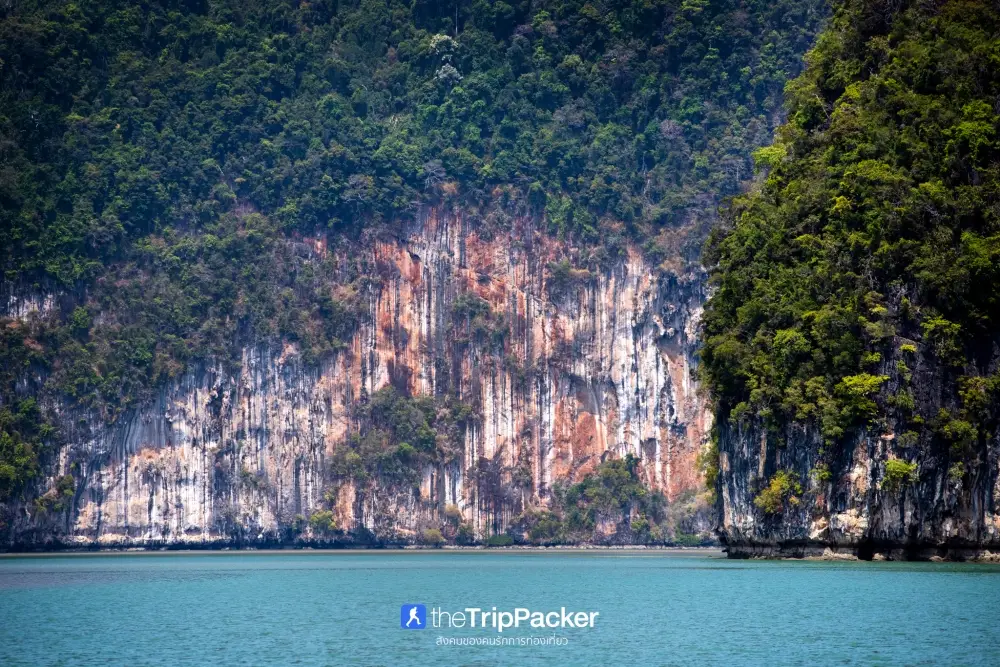
The landscape of Khao Karos is defined by overlapping limestone hills standing near the coast and Khlong Karos. The surface of the cliffs is full of hollows, weathered rock faces, cave-like openings, and unusual shapes formed by natural erosion. Some sections resemble faces, while others look like overhanging walls guarding the water below. These striking formations have given the site its well-known nickname, the “Devil’s Gorge,” or in Thai tourism language, “the Devil’s Gorge of Two Moods,” because the face-like cliff appears to change expression depending on the angle and intensity of sunlight.
The word “Karos” is commonly explained as coming from Jawi language, carrying a meaning related to something unattractive or visually unusual. In today’s travel context, that original sense has become part of the site’s charm. What might once have been described as rough, uneven, or strange now appears as a powerful natural sculpture. When the rugged limestone cliffs are framed by green mangroves, winding water channels, reflected light, and local long-tail boats, the so-called unattractive landscape becomes one of the most memorable scenes in Ao Luek.
The ecosystem around Khao Karos is important. The area is surrounded by healthy mangrove forest, including mangrove species such as kongkang, lamphu, tabun, samae, and other coastal plants. These forests are not merely a green backdrop for photographs. They serve as nursery grounds for aquatic life, protect the shoreline, support local food resources, and provide habitat for birds, monkeys, langurs, crabs, fish, shellfish, and many smaller organisms. A boat ride through Khlong Karos therefore works as a living outdoor classroom in mangrove ecology.
Most visits begin at Ban Khuan O Pier, not far from the local community and Ao Luek Noi Subdistrict area. Travelers can take a local long-tail boat or arrange kayaking with local operators to explore the limestone cliffs and mangrove routes. The boat ride to Khao Karos takes about 10–15 minutes. From there, the boat follows the waterway along cliff walls, cave openings, narrow passages, lagoons, and rock formations that invite imagination at every turn.
One of the most memorable features of Khao Karos is the cliff face that resembles a devil-like face. The eyes, nose, and mouth are not carved by humans, but are natural marks shaped by erosion, rain, wind, and tidal conditions over time. When the boat approaches the cliff, the hollows and shadows begin to form a recognizable face. In morning light, the expression may seem stern or sad; in afternoon light, the same formation may appear to smile. This is the reason behind the idea of the cliff having “two moods.”
Khao Karos is also significant because of ancient rock paintings found on limestone cliffs and cave areas. These paintings include human figures, animal figures, line drawings, and geometric forms, often described in red pigment. They show that this coastal limestone area was used by people in the past and give the site archaeological value beyond its scenic beauty. For visitors, the rock paintings transform the journey from a nature cruise into an encounter with the long human history of the Andaman coast.
The rock paintings encourage travelers to imagine the relationship between ancient people and the coastal environment. Caves, overhangs, mountains, and tidal waterways may once have been used as shelters, ritual spaces, route markers, or places for symbolic expression. The figures on the rock are not only ancient art; they are evidence that humans have interacted with the coastline of Krabi for a very long time, long before modern communities formed around Ao Luek Noi.
Nearby names such as Ao Makham, Khao Kalok, and Khao Khian are also associated with the wider Khao Karos area in local travel information. These areas are linked with through-caves, cliff paintings, limestone passages, and distinctive rock scenery. A boat route around Khao Karos is therefore not limited to one single viewpoint. The landscape opens gradually. Around one bend, visitors may see a cliff face; around another, a cave opening; beyond that, a mangrove channel or a hidden lagoon.
The lagoons are another reason why Khao Karos feels special. In limestone coastal landscapes, lagoons often appear as enclosed or semi-enclosed spaces connected to outer waterways. When water levels are suitable, visitors can enter or approach these areas by boat or kayak. Inside, the atmosphere becomes quieter and more enclosed than the open channel. Limestone walls, mangrove roots, still water, and reflected light create a calm scene that suits travelers seeking a peaceful nature experience.
Activities at Khao Karos include long-tail boat cruising, kayaking, limestone cliff photography, viewing ancient rock paintings from a respectful distance, observing mangrove ecology, and learning about coastal fishing life from local people. Visitors who prefer a relaxed trip can choose a boat sightseeing route. Those who want to get closer to the landscape can join a kayak route through narrower channels and areas that larger boats cannot enter. Kayaking should always follow the advice of local guides because water levels, tides, and weather conditions affect access and safety.
Ban Khuan O is closely connected to Khao Karos. The name Khuan O is locally explained as having evolved from “Khuan U,” referring to a place once associated with boat building or a boatyard. The community has long been linked with fishing, boat use, coastal livelihoods, and the mangrove environment. It is also a Muslim community that preserves a clear local identity. A visit to Khao Karos should therefore be understood not only as a visit to cliffs and caves, but also as a visit to a living community that has relied on and cared for this landscape.
The presence of the present-day Karos and Ban Khuan O communities supports local beliefs that the area has long been used by people. While some archaeological questions require further academic study, the rock paintings and suitable shelter-like landscape clearly point to the historical importance of this coastal limestone area. Travelers who visit Khao Karos are not only seeing beautiful scenery; they are also encountering a place where landscape and human memory overlap.
Tide level is important when planning a visit. Some parts of the route, especially cave passages, lagoons, narrow channels, and kayak sections, may depend on the water level of the day. If the tide is too high or too low, access to certain points may be limited or the route may need to change. Visitors should contact the local community or boat operator before traveling to choose a suitable time. Morning and late afternoon are generally comfortable for boat trips and photography, but tide and weather remain the main practical factors.
The most comfortable season for visiting Khao Karos is the period when the Andaman coast has calmer weather and clearer skies, especially from the late year into the early hot season. This period usually offers better light and safer boating conditions than the monsoon months. Even so, Khao Karos is a coastal site that requires boat travel, so daily weather conditions still matter. If there is heavy rain, strong wind, or rough water, travelers should postpone the trip or follow the route recommended by local operators.
Visitors should prepare for a mangrove-and-waterway trip. Light clothing, shoes that can get wet, sun protection, mosquito repellent, drinking water, and a waterproof bag for phones or cameras are useful. Anyone joining a kayak activity should wear a life jacket at all times and stay with the group. Families with young children or elderly travelers may prefer a boat-only route rather than a route requiring paddling or moving through tighter passages.
Khao Karos suits travelers who enjoy quiet nature, limestone scenery, mangrove ecosystems, caves, and community-based travel. It is a good destination for families who want children to learn about nature, photographers looking for unusual cliff shapes, culture-focused travelers interested in ancient rock paintings, and visitors who want to avoid the busiest beach and island routes. The experience is less about commercial facilities and more about landscape, stories, local boats, and the atmosphere of the mangrove coast.
Khao Karos can be combined with other attractions in Ao Luek. A half-day trip may include a boat ride from Ban Khuan O, the Devil’s Gorge, ancient rock paintings, mangrove scenery, and a meal in Ao Luek. A full-day route can add Than Bok Khorani National Park, Phi Hua To Cave, Tham Lot, or Laem Sak community. These destinations share related themes: limestone geology, caves, mangroves, archaeology, and local life around Ao Luek.
Responsible travel is especially important here. The mangrove ecosystem and ancient rock paintings are fragile. Visitors should not touch or mark the paintings, should not remove stones, shells, or natural objects, should not feed wildlife, and should never throw waste into the mangroves or waterways. Good travel behavior supports both the local community and long-term conservation of the place.
The special quality of Khao Karos is the feeling of discovery. Visitors do not arrive at a fully commercialized beach or a ready-made photo spot. Instead, they enter a waterway, move through mangroves, approach cliffs, and discover details gradually. From far away, the mountains appear as a large limestone range. Up close, the rock face reveals hollows and shapes. Looking upward, travelers may notice ancient paintings. Turning into a channel, they may find a quiet lagoon. Each part of the route adds another layer to the place.
Listening to local guides or boat operators makes the visit more meaningful. Local people can explain which angle shows the devil-like face most clearly, when the light changes the expression of the cliff, which route is best for the tide, where the rock paintings are located, and which areas should be viewed from a safe distance. Their knowledge turns the landscape from a set of rock formations into a place with names, stories, and community memory.
For practical planning, travelers coming from Krabi Town should allow about 1 hour for the drive toward Ao Luek Noi, depending on the starting point and traffic. After arriving in the Ban Khuan O area, allow time to arrange the boat, prepare gear, and complete the sightseeing route. A basic boat trip may take around 1.5 to 2 hours, while kayaking or community-based add-ons can require a half day or more. Travelers who want to continue toward Ko Hong from the Ban Khuan O area should check with local boat operators because travel time depends on weather, water level, and the selected route.
Khao Karos offers many strong photography angles. The first is the layered limestone range above the mangrove forest. The second is the devil-face cliff photographed from the boat at an angle where the full face is visible. The third is a composition with a local long-tail boat, waterway, and mangrove forest together. The fourth is a cave or rock passage with natural light entering from the opening. The fifth is the everyday life of local people around the waterway. Morning and late afternoon light usually works best, and waterproof protection for camera equipment is recommended.
Although Khao Karos is not far from the main routes of Ao Luek, the atmosphere inside the waterways feels calm and removed from busy roads. The sound of the boat softens as it enters the channel, and the mangrove forest creates a quiet natural corridor. This is not a destination built for loud entertainment or rushed activities. It is most rewarding for travelers who appreciate stillness, local knowledge, subtle details, and landscapes with deep stories.
Getting There from Krabi Town is straightforward by road and boat. Drive along Highway 4 toward Ao Luek and Ao Luek Noi, then turn toward Ban Khuan O for about 4 km to reach the local pier area. From Ban Khuan O Pier, continue by long-tail boat or kayak to Khao Karos. The boat ride normally takes about 10–15 minutes. From Krabi International Airport, take Highway 4 toward Ao Luek and continue to Ban Khuan O before boarding a local boat.
In summary, Khao Karos is one of the most rewarding places for travelers who want to see Krabi in a deeper and quieter way. It offers unusual limestone cliffs, a rich mangrove ecosystem, ancient rock paintings, lagoons, cave passages, local boat culture, and the living community of Ban Khuan O. Its value is not in large-scale facilities, but in the authenticity of the landscape, the quietness of the waterways, and the stories that make every part of the boat journey meaningful.
| Name | Khao Karos |
| Other Names | Devil’s Gorge of Two Moods, Ko Karos, Khao Garos |
| Location | Moo 5, Ban Khuan O, Ao Luek Noi Subdistrict, Ao Luek District, Krabi Province |
| Address | Ban Khuan O, Ao Luek Noi Subdistrict, Ao Luek District, Krabi 81110, Thailand |
| Coordinates | Approximately 8.280178, 98.743050 around Ban Khuan O, Ao Luek Noi |
| Highlights | Coastal limestone range, Devil’s Gorge of Two Moods, ancient rock paintings, cave passages, hidden lagoons, mangrove scenery, and local boat routes |
| History | The area contains ancient rock paintings on limestone cliffs and cave areas, locally associated with prehistoric activity and described in community tourism information as around 3,000–5,000 years old |
| Name Origin | The name Karos is commonly explained as deriving from Jawi language, referring to an unattractive or unusual appearance, matching the rugged weathered limestone landscape |
| Distinctive Features | Limestone cliffs eroded into hollows, caves, narrow passages, a devil-face cliff, and lagoon areas reached by boat or kayak depending on water level |
| Travel Information | From Krabi Town, take Highway 4 toward Ao Luek, then turn toward Ban Khuan O for about 4 km. From Ban Khuan O Pier, take a long-tail boat to Khao Karos for about 10–15 minutes |
| Current Status | Open as a natural and community-based attraction. Boat and kayak access depends on weather and water levels |
| Open Days | Daily |
| Opening Hours | 08.00 – 17.00; water activities depend on weather and tide conditions |
| Fees | No direct admission fee for the natural site. Long-tail boat or kayak fees depend on route, group size, and local operator |
| Facilities | Ban Khuan O Pier, local boat services, kayak services on selected routes, life jackets from boat operators, and community tourism coordination points |
| Main Areas / Zones | Ban Khuan O Pier, Khlong Karos, Devil’s Gorge of Two Moods, mangrove route, cave passages, cave openings, lagoon areas, Ao Makham, Khao Kalok, Khao Khian, and ancient cliff painting points |
| Caretaker / Tourism Coordinator | Ao Luek Noi Community Tourism and local boat operators in the Ban Khuan O area |
| Main Contact Number | Ao Luek Noi Community Tourism, Tel. 093-153-5329 |
| Official Website / Official Page | Ao Luek Noi Community Tourism Facebook page and TAT STAR community tourism information |
| Nearby Tourist Attractions | 1. Ban Khuan O Pier, about 2 km 2. Phi Hua To Cave, Than Bok Khorani National Park, about 13 km, Tel. 075-681096 3. Than Bok Khorani National Park, about 16 km, Tel. 075-681071, 075-682058 4. Tham Lot, Ao Luek, about 13 km 5. Laem Sak / Laem Sak Old Town, about 20 km 6. Wat Mahathat Wachiramongkol, Wat Bang Thong, about 31 km |
| Nearby Restaurants | 1. At Ao Luek Restaurant, about 17 km, Tel. 075-610-910 2. Ao Luek Ocean View, about 16 km, Tel. 062-503-1106, 065-081-0581 3. Chong Khao Noodles House, about 18 km, Tel. 065-426-6163 4. Aree Seafood & Bo Tho Sea Canoe, about 18 km, Tel. 081-085-7839, 090-485-9273 5. Chop Cha Mat Ao Luek Branch, about 16 km, Tel. 084-358-3405 6. Bung Ann Seafood, about 17 km, Tel. 086-278-2913 |
| Nearby Accommodations | 1. Ao Luek Homie Homestay, about 16 km, Tel. 092-619-0789 2. Krabi Bamboo Kingdom – Aoluek Paradise, about 17 km, Tel. 063-619-5354 3. Ao Luek Hometel – Whole House Accommodation, about 17 km, Tel. 098-727-4235 4. Ao Luek Panoramic Pool Villa, about 19 km, Tel. 065-348-9794 5. Lanlay Homestay, about 18 km, Tel. 087-283-0099 |
Frequently Asked Questions (FAQ)
Q: Where is Khao Karos located?
A: Khao Karos is located around Moo 5, Ban Khuan O, Ao Luek Noi Subdistrict, Ao Luek District, Krabi Province. It is reached by boat from Ban Khuan O Pier.
Q: How do visitors get to Khao Karos?
A: From Krabi Town, drive along Highway 4 toward Ao Luek, turn toward Ban Khuan O for about 4 km, then continue by long-tail boat or kayak. The boat ride takes about 10–15 minutes.
Q: What are the main highlights of Khao Karos?
A: The highlights are the limestone cliffs, Devil’s Gorge of Two Moods, ancient rock paintings, mangrove scenery, cave passages, lagoons, and coastal fishing community life.
Q: Is there an entrance fee for Khao Karos?
A: There is no direct admission fee for the natural site, but visitors need to pay for long-tail boat or kayak services depending on the route, group size, and local operator.
Q: When is the best time to visit Khao Karos?
A: Morning and late afternoon are good for boating and photography. Access to some lagoons or cave passages also depends on tide level and weather conditions.
Q: Is Khao Karos suitable for kayaking?
A: Yes. The mangrove channels, limestone passages, and some lagoon areas are suitable for kayaking, but visitors should go with local operators and follow safety advice.
Q: Why are the ancient rock paintings at Khao Karos important?
A: The paintings show human figures, animal forms, and geometric shapes on limestone cliffs and cave areas, reflecting past human activity along the Andaman coast.
Q: What nearby places can be combined with Khao Karos?
A: Khao Karos can be combined with Phi Hua To Cave, Tham Lot, Than Bok Khorani National Park, Laem Sak, Wat Mahathat Wachiramongkol, and restaurants around Ao Luek.
 Category: ●Nature and Wildlife
 Group: ●Mountain (Doi)
Last Update : 2 MonthAgo
 Last Update : 2 MonthAgo

 Click to Access the Navigation Map GPS
Khao Karos Map
Recommend

 Art, Culture and Heritage
 Historical Sites and Monuments(1)
 Landmarks and Memorials(7)
 Art, Craft Centres, Tradition(2)
 Museums(2)
 Educational Places
 Educational Gardens, Farm(1)
 Places of Worship
 Temple(3)
 Mosque(2)
 Other Sacred Sites(2)
 Research and Development
 Royal Project(1)
 Suburban Living
 Village, Community(6)
 National Parks and Marine Reserves(5)
Mountain (Doi)(2)
 Dam, Reservoir, Lake(3)
 Waterfalls(12)
 Hot Springs(3)
 Caves(20)
 River, Canal(2)
 Bays and Beaches(36)
 Islands(23)
 Other natural attractions(7)
 Entertainment and Agricultural
 Farms, Parks and Ecotourism(1)
 Outdoor and Adventure Activities(1)
 Travel Articles, Recipes
 Travel Review, Food Review(2)
 Southern Food Menu, Southern Food Recipes(1)


