
lovethailand home >South Travel Attractions >Krabi Travel Attractions >Khlong Thom >Khlong Thom Nuea > Khao Pra-Bang Khram Wildlife Sanctuary
TL;DR: Khao Pra-Bang Khram Wildlife Sanctuary is located at Ban Bang Tiao, Moo 2, Khlong Thom Nuea Subdistrict, Khlong Thom District, Krabi Province, open Daily, hours 08.30 - 16.30.

Khao Pra-Bang Khram Wildlife Sanctuary
Open Days: Daily
Opening Hours: 08.30 - 16.30
Khao Pra-Bang Khram Wildlife Sanctuary in Krabi Province is one of southern Thailand’s most important remaining lowland rainforest areas. Located around Ban Bang Tiao, Moo 2, Khlong Thom Nuea Subdistrict, Khlong Thom District, the sanctuary is known for the Tina Jolliffe Nature Trail, Thung Tiao forest, Emerald Pool, Sa Kaew, Blue Pool, birdwatching, and the critically important habitat of Gurney’s Pitta, known in Thai as Nok Taew Raew Thong Dam. It is not only a beautiful natural attraction, but also a high-value conservation landscape.
Khao Pra-Bang Khram Wildlife Sanctuary is located in Khlong Thom District, Krabi Province, and is one of the most meaningful inland nature sites in southern Thailand. Many visitors know the area because of Emerald Pool, but the sanctuary is much more than a swimming spot. It protects a rare lowland rainforest ecosystem, mineral-fed streams, natural pools, wet forest, bird habitat, and one of the most significant wildlife conservation stories in Thailand. A visit here allows travelers to experience Krabi beyond beaches and islands, through forest, water, rare birds, and ecological learning.
The sanctuary is situated around Ban Bang Tiao, Moo 2, Khlong Thom Nuea Subdistrict. It is reached by the same general route used for Khlong Thom Hot Stream Waterfall. From Krabi Town, travelers follow Highway 4 toward Khlong Thom, then turn toward Route 4038 and continue along local roads for about 17 kilometers into the Bang Tiao area. Although the destination is often advertised as Emerald Pool, the broader conservation name is Khao Pra-Bang Khram Wildlife Sanctuary and Khao Nor Chu Chi lowland forest.
The importance of this area comes from its lowland rainforest. Lowland forests in southern Thailand have been heavily reduced by agriculture, rubber plantations, oil palm plantations, roads, and settlement expansion. Remaining fragments are therefore extremely valuable, especially for species that depend on humid, shaded, ground-level forest conditions. Khao Pra-Bang Khram is one of the places where visitors can still see the structure of this ecosystem through an accessible nature trail.
The sanctuary is strongly associated with Gurney’s Pitta, a rare and highly threatened ground-dwelling bird. In Thailand, the species is known as Nok Taew Raew Thong Dam. Its rediscovery and conservation status played a major role in drawing attention to the importance of the Khao Nor Chu Chi lowland forest. The bird is not only a target species for birdwatchers; it represents the survival of an entire habitat type that has become increasingly rare.
The sanctuary is also an important birdwatching area. More than 300 bird species have been recorded in the broader forest area, and more than 100 species have been found along the nature trail. Birds associated with the site include pigeons, barbets, blue-winged leafbirds, bulbuls, sunbirds, spiderhunters, brown-winged kingfishers, black hornbills, and other southern forest birds. This makes the sanctuary valuable for birdwatchers, photographers, students, naturalists, and travelers who want to understand the biodiversity of Krabi’s inland forests.
The central learning route is the Tina Jolliffe Nature Trail, also known as the Thung Tiao trail. It is named in memory of Tina Jolliffe, a British conservation-minded figure associated with the early idea of protecting this rainforest from destruction. The trail is about 2.7 kilometers long and passes through shaded lowland forest, streams, pools, wet ground, forest plants, and interpretive signs. It is designed for visitors to learn directly from the forest environment rather than simply walk quickly to the swimming area.
The trail begins about 800 meters before reaching Emerald Pool. Along the route, visitors pass through real lowland rainforest conditions: humid air, forest-floor vegetation, vines, ferns, small streams, leaf litter, insects, birds, and shaded water channels. Interpretive signs explain ecological features and help visitors understand the forest. The best way to walk this trail is slowly and quietly, listening for birds and observing the small details of the forest floor.
The trail also shows why lowland rainforest cannot easily be replaced by plantations or simplified green areas. Ground-dwelling birds such as Gurney’s Pitta depend on quiet, shaded, moist forest floor habitat with leaf litter, insects, and natural cover. The structure of the forest is as important as the presence of trees. This is why visitors should stay on the marked trail and avoid entering closed or sensitive areas.
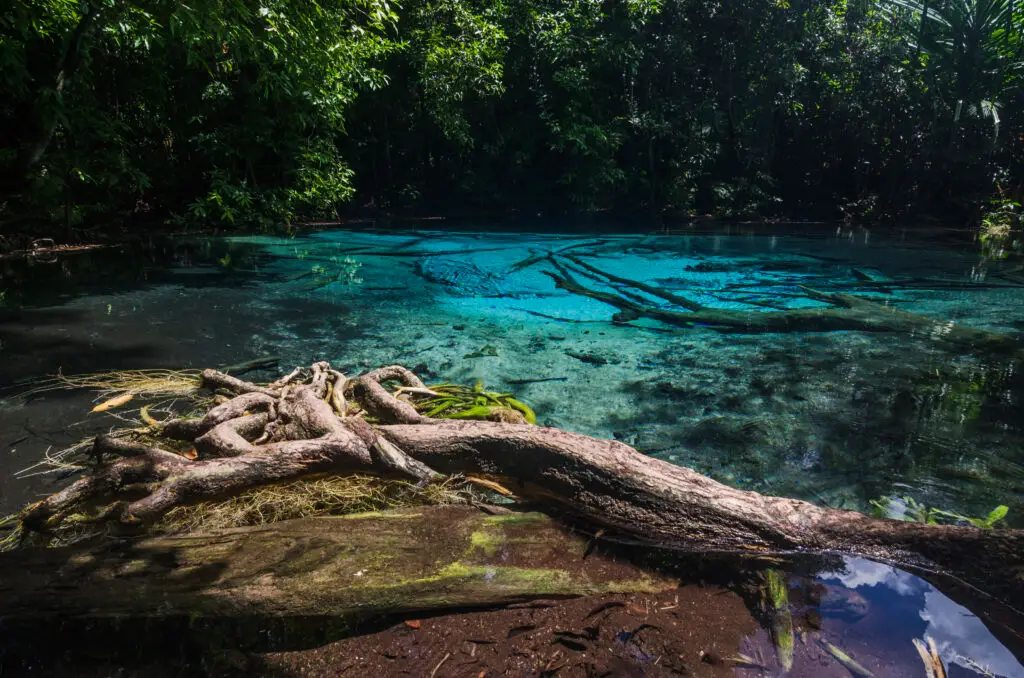
The best-known attraction inside the sanctuary is Emerald Pool, a natural limestone and mineral pool with clear green to turquoise water. The pool’s color changes with light, time of day, water condition, and visitor activity. Its warm mineral water comes from natural spring sources within the lowland forest. Swimming is allowed only at Emerald Pool and only in the permitted area. Visitors should remember that the pool is inside a wildlife sanctuary, not a commercial water park.
There are two main walking options from the entrance to Emerald Pool. One is a direct route of about 800 meters, suitable for visitors who want the shortest access. The other follows the longer nature trail through forest and stream scenery. Both eventually connect with the Emerald Pool area. Travelers with enough time should use the nature route at least one way because it gives better context to the water, forest, roots, and wetland ecosystem that make the pool possible.
Near Emerald Pool are Sa Kaew and Blue Pool. Blue Pool is a bright blue spring source further upstream from Emerald Pool. It is a viewing area only and swimming is not allowed. The ground and spring system are sensitive, and the area is connected with wildlife habitat. Blue Pool is closed during the May to October breeding season protection period for Gurney’s Pitta and related habitat conservation.
Visitors should understand that this site has two roles at the same time: recreation and conservation. Swimming, photography, and walking are allowed only under rules set by the wildlife sanctuary. Visitors must not enter the water at Sa Kaew, Blue Pool, upstream streams, or any restricted section. Soap, shampoo, lotions, and chemicals must not be used in natural water. Loud behavior should be avoided because it disturbs both wildlife and other visitors who come for nature study.
Birdwatching in Khao Pra-Bang Khram requires responsible behavior. Visitors should use binoculars, walk quietly, stay on trails, avoid playing bird calls, avoid approaching nests or feeding areas, and avoid revealing sensitive locations of rare birds. Anyone who wants to study birds seriously should coordinate with staff or knowledgeable local guides because some areas are not appropriate for general access.
The current visitor fee for the Emerald Pool area is 20 baht for Thai adults, 10 baht for Thai children, 200 baht for foreign adults, and 100 baht for foreign children. The site opens daily from 08.30 to 16.30. Visitors should allow enough time for walking in and out, especially if using the nature trail. Arriving early is recommended for a quieter forest experience, better light, and fewer visitors at the pool.
Facilities near the entrance include the ticket area, parking areas, restaurants, small shops, toilets, and visitor services. Inside the forest route, visitors should carry only what is necessary and avoid eating in the forest or near water sources. Food waste attracts wildlife and creates management problems. The visitor area is not a primary overnight site for general tourists. Travelers should stay outside the wildlife sanctuary in Khlong Thom, Khlong Thom Nuea, or near the hot spring area.
The best time to visit is morning. The air is cooler, the forest is quieter, and the pool is less disturbed. Late morning and afternoon are more suitable for swimming, though the site can become crowded on weekends and holidays. For photography and birdwatching, early arrival is strongly recommended. For Blue Pool, visitors should travel outside the seasonal closure period and check current local notices before going.
The appearance of the forest changes by season. During drier periods, the water is often clearer and walking conditions are easier. During rainy months, the forest becomes lush and green, but paths may be slippery and water clarity may change. The May to October closure of Blue Pool and upstream sensitive areas protects wildlife during a critical period, so visitors should plan with conservation rules in mind.
Getting There from Krabi Town is straightforward by private vehicle or hired transport. Take Highway 4 toward Khlong Thom, continue past the Krabi Town junction toward Trang, and turn left toward Route 4038 before reaching Khlong Thom town. Follow signs toward Khao Pra-Bang Khram Wildlife Sanctuary and Ban Bang Tiao for about 17 kilometers. Public transport is less convenient because the entrance is located away from the main highway, so travelers without a vehicle should arrange a transfer in advance.
Khao Pra-Bang Khram can be combined with nearby nature attractions in the same day. The most common route includes Emerald Pool, the Tina Jolliffe Nature Trail, Khlong Thom Hot Stream Waterfall, Khlong Thom Saline Hot Spring, and Wat Khlong Thom Museum. However, the schedule should not be too rushed because the forest trail and pool area deserve enough time for walking, resting, and understanding the landscape.
Important visitor rules include staying on marked trails, not climbing over fences, not swimming outside permitted zones, not collecting plants or animals, not feeding wildlife, not playing loud music, not littering, not smoking in fire-risk areas, and not using drones without permission. This is a wildlife sanctuary, so the rules directly protect habitats, rare birds, water sources, and forest recovery.
In summary, Khao Pra-Bang Khram Wildlife Sanctuary in Krabi should be understood as more than Emerald Pool. Behind the famous green water is one of southern Thailand’s most important lowland rainforest habitats. The Tina Jolliffe Nature Trail helps visitors understand the forest, Emerald Pool and Blue Pool reveal the beauty of mineral spring systems, and the story of Gurney’s Pitta shows why conservation matters. With respectful travel, careful walking, and strict attention to sanctuary rules, this site becomes one of Krabi’s most meaningful inland nature experiences.
| Name | Khao Pra-Bang Khram Wildlife Sanctuary |
| Location | Ban Bang Tiao, Moo 2, Khlong Thom Nuea Subdistrict, Khlong Thom District, Krabi Province |
| Address | Khao Pra-Bang Khram Wildlife Sanctuary Office, Moo 2, Ban Bang Tiao, Khlong Thom Nuea Subdistrict, Khlong Thom District, Krabi Province 81120 |
| Coordinates | 7.925077, 99.268118 around Emerald Pool / 7.9226, 99.2599 around the sanctuary entrance |
| Highlights | Tina Jolliffe Nature Trail, Thung Tiao lowland forest, Emerald Pool, Sa Kaew, Blue Pool, birdwatching, and Gurney’s Pitta habitat |
| Natural Importance | One of southern Thailand’s important remaining lowland rainforest areas, with more than 300 bird species recorded and a critical association with Gurney’s Pitta |
| Background | The Khao Nor Chu Chi and Khao Pra-Bang Khram lowland forest became a major conservation focus because of its rare rainforest habitat and the presence of Gurney’s Pitta |
| Nature Trail | Tina Jolliffe Nature Trail, also known as the Thung Tiao trail, is about 2.7 km long and begins about 800 meters before Emerald Pool, with interpretive signs along the way |
| Main Water Features | Sa Kaew, Emerald Pool, and Blue Pool. Swimming is allowed only at Emerald Pool in the permitted area; Blue Pool is for viewing only |
| Travel Information | From Krabi Town, take Highway 4 toward Khlong Thom, turn toward Route 4038 before reaching Khlong Thom town, and follow signs toward Ban Bang Tiao and the wildlife sanctuary for about 17 km |
| Distance From Krabi Town | About 55 - 60 km depending on the route |
| Current Status | Open as a nature tourism and nature-study area inside a wildlife sanctuary. Visitors must follow staff instructions and sanctuary regulations strictly |
| Open Days | Daily |
| Opening Hours | 08.30 - 16.30 |
| Entrance Fee | Thai adults 20 baht, Thai children 10 baht / Foreign adults 200 baht, foreign children 100 baht |
| Seasonal Closure Area | Blue Pool and the area north of Emerald Pool close from May to October to protect Gurney’s Pitta breeding-season habitat and upstream forest areas |
| Main Areas / Zones | Ticket point, 800-meter direct path, 2.7-km Tina Jolliffe Nature Trail, Sa Kaew, Emerald Pool, Blue Pool, Thung Tiao forest, birdwatching areas, shops, toilets, and entrance parking areas |
| Facilities | Ticket counter, toilets, food stalls, small shops, parking areas near the entrance, nature trail, interpretive signs, and sanctuary staff on duty |
| Caretaker / Responsible Office | Department of National Parks, Wildlife and Plant Conservation / Khao Pra-Bang Khram Wildlife Sanctuary |
| Main Contact Number | 089-873-7749, 087-477-1105 |
| Nearby Tourist Attractions | 1. Emerald Pool, about 0.8 km from the walking start 2. Blue Pool, about 1.4 km from the entrance 3. Khlong Thom Hot Stream Waterfall, about 8 km 4. Khlong Thom Saline Hot Spring, about 15 km 5. Wat Khlong Thom Museum, about 20 km 6. Tiger Cave Temple, about 55 km |
| Nearby Restaurants | 1. Ruen Morakot, about 0.2 km, Tel. 093-249-8448 2. Krua Rim Tarn Emerald Pool, about 0.5 km, Tel. 082-817-4577, 084-851-5449 3. Num Dim Sum Khlong Thom, about 20 km, Tel. 061-824-3119 4. Pantaree Restaurant Khlong Thom, about 20 km, Tel. 086-801-5477 5. Verandah Coffee, about 20 km, Tel. 086-747-7270 6. 2_90 Coffee Khlong Thom, about 21 km, Tel. 093-726-1895 |
| Nearby Accommodations | 1. VP Resort Emerald Pool, about 5 km, Tel. 075-699-045, 081-439-2656 2. Wareerak Hot Spring & Wellness, about 8 km, Tel. 075-637-130, 062-457-6350 3. Klong Thom Resort, about 20 km, Tel. 075-699-270 4. Vanilla Ville Resort, about 21 km, Tel. 081-802-9761 5. Nattha Waree Hot Springs Resort and Spa, about 25 km, Tel. 075-601-642 |
Frequently Asked Questions (FAQ)
Q: Where is Khao Pra-Bang Khram Wildlife Sanctuary located?
A: It is located at Ban Bang Tiao, Moo 2, Khlong Thom Nuea Subdistrict, Khlong Thom District, Krabi Province. It is the protected area that includes Emerald Pool and the Tina Jolliffe Nature Trail.
Q: What is the sanctuary known for?
A: It is known for lowland rainforest, the Tina Jolliffe Nature Trail, Emerald Pool, Sa Kaew, Blue Pool, birdwatching, and Gurney’s Pitta habitat.
Q: What are the opening hours?
A: The visitor area is open daily from 08.30 to 16.30.
Q: How much is the entrance fee?
A: The entrance fee is 20 baht for Thai adults, 10 baht for Thai children, 200 baht for foreign adults, and 100 baht for foreign children.
Q: How long is the Tina Jolliffe Nature Trail?
A: The Tina Jolliffe Nature Trail, also known as the Thung Tiao trail, is about 2.7 km long and begins about 800 meters before Emerald Pool.
Q: Can visitors swim at Emerald Pool?
A: Swimming is allowed only at Emerald Pool and only in the permitted area. Blue Pool, Sa Kaew, upstream streams, and restricted sections are not swimming areas.
Q: Is Blue Pool open all year?
A: Blue Pool and the upstream area close from May to October to protect Gurney’s Pitta breeding-season habitat and sensitive forest areas. When open, it is a viewing-only area and swimming is not allowed.
Q: What should visitors prepare before going?
A: Visitors should bring comfortable walking shoes, suitable nature clothing, drinking water, mosquito repellent, a waterproof bag, and swimwear if planning to use the permitted swimming area. All visitors should stay on marked trails and follow wildlife sanctuary rules.
 Category: ●Nature and Wildlife
 Group: ●National Parks and Marine Reserves
Last Update : 2 MonthAgo
 Last Update : 2 MonthAgo

 Click to Access the Navigation Map GPS
Khao Pra-Bang Khram Wildlife Sanctuary Map
Recommend

 Art, Culture and Heritage
 Historical Sites and Monuments(1)
 Landmarks and Memorials(7)
 Art, Craft Centres, Tradition(2)
 Museums(2)
 Educational Places
 Educational Gardens, Farm(1)
 Places of Worship
 Temple(3)
 Mosque(2)
 Other Sacred Sites(2)
 Research and Development
 Royal Project(1)
 Suburban Living
 Village, Community(6)
National Parks and Marine Reserves(5)
 Mountain (Doi)(2)
 Dam, Reservoir, Lake(3)
 Waterfalls(12)
 Hot Springs(3)
 Caves(20)
 River, Canal(2)
 Bays and Beaches(36)
 Islands(23)
 Other natural attractions(7)
 Entertainment and Agricultural
 Farms, Parks and Ecotourism(1)
 Outdoor and Adventure Activities(1)
 Travel Articles, Recipes
 Travel Review, Food Review(2)
 Southern Food Menu, Southern Food Recipes(1)


