
lovethailand home >Northeastern Travel Attractions >Yasothon Travel Attractions >Sai Mun >Na Wiang > Ho Trai Wat Sa Trai Nurak
TL;DR: Ho Trai Wat Sa Trai Nurak is located at Wat Sa Trai Nurak, Ban Na Wiang, Moo 1, Na Wiang Subdistrict, Sai Mun District, Yasothon 35170, Thailand, open Daily, hours 08.00 – 17.00.
Ho Trai Wat Sa Trai Nurak
Open Days: Daily
Opening Hours: 08.00 – 17.00
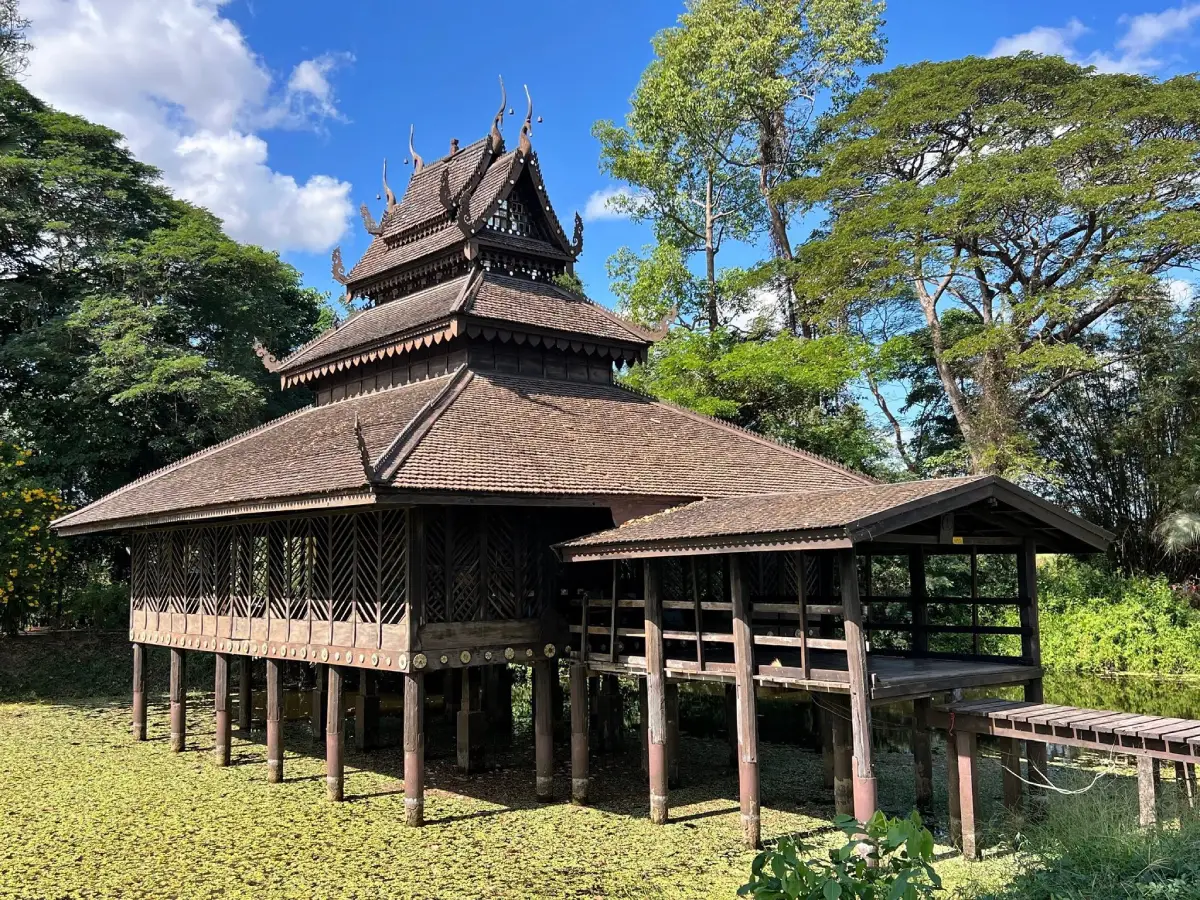
Ho Trai Wat Sa Trai Nurak, also known as the Historical Ho Trai Museum of Wat Sa Trai Nurak, is one of the most important religious, architectural, and cultural heritage sites in Sai Mun District, Yasothon Province. It is located at Wat Sa Trai Nurak, Ban Na Wiang, Moo 1, Na Wiang Subdistrict, Sai Mun District, Yasothon 35170. The site is about 25 km from Yasothon city. Its main highlight is an old wooden scripture hall standing in the middle of a pond. The building was originally used to store Buddhist scriptures, palm-leaf manuscripts, and sacred texts belonging to the temple. Its architecture combines Isan, Lan Xang, and Tai Yai or Shan influences, creating a rare and memorable waterside scripture repository.
This place is more than an old wooden building in a temple compound. It is a physical record of Buddhist learning, local craftsmanship, and the importance of palm-leaf manuscripts in northeastern Thai society. In traditional Buddhist temples, a ho trai was built to preserve sacred texts and protect them from humidity, insects, termites, and other threats. Placing the building in the middle of a pond was both practical and symbolic. The surrounding water helped separate the manuscript repository from ordinary space, while also giving the building a quiet and sacred presence.
Wat Sa Trai Nurak, also known locally as Wat Na Wiang, is an old temple of the Na Wiang community. Local tradition links the temple with the migration of Lao people from Vientiane during the 23rd to 24th Buddhist centuries. The story is connected with the wider historical movement of people in the Mekong region and the establishment of communities in what is now Yasothon Province. This background makes the temple more than a village monastery. It is part of the cultural memory of Lao-Isan settlement, Buddhist faith, and community formation in Sai Mun District.
The temple’s history is associated with Phra Khru Lak Kham, also known as Phra Khru Lak Kham Cha, a Lao monk who played an important role in founding the temple and preserving Buddhist manuscripts brought from Vientiane. This connection shows that Wat Sa Trai Nurak once served as a center of Buddhist education and scriptural preservation. The ho trai was therefore not a decorative structure. It was built as a treasury of Dhamma, protecting religious knowledge and transmitting Buddhist wisdom across generations.
The ho trai is a wooden rectangular building measuring about 8.30 meters wide and 10.50 meters long. It stands on 30 round wooden posts above the pond and faces east. The interior is divided into a manuscript storage room and a surrounding veranda. The manuscript room is enclosed and raised on a high lotus-shaped base, decorated with small mirror elements. At the front is a single door with beautifully carved floral patterns. The veranda walls are made with diagonal wooden latticework, creating a refined rhythm of light, shadow, and ventilation.
The roof is one of the most distinctive parts of the building. The lower roof is a hipped form, while the upper levels rise in tiers. The upper gabled sections are decorated with elements commonly found in Thai and Lao Buddhist architecture, such as carved roof finials, bargeboards, and ornamental forms. These layered roofs give the small wooden building a strong sense of dignity and sacredness. Although the ho trai is not large, its proportions and details make it visually powerful and elegant.
The setting in the middle of the pond is central to the experience. From the edge of the water, visitors can see the dark wooden structure reflected on the surface. The rows of wooden posts, the shaded veranda, the tiered roof, and the surrounding trees create a calm atmosphere. The building appears separate from everyday activity, as if the world of sacred texts has been carefully protected by water, wood, and temple space. This relationship between architecture and nature is one of the reasons the site is so memorable.
The design of a ho trai in the middle of water also reflects practical local wisdom. Palm-leaf manuscripts are delicate natural materials. They must be protected from moisture, insects, and animals. Raising the building on wooden posts and surrounding it with water helped reduce the risk of damage. At the same time, the physical separation emphasized the importance of the texts kept inside. The structure therefore combines function, conservation, and religious meaning in a single architectural form.
The palm-leaf manuscripts preserved at the site are among its most important cultural treasures. These manuscripts contain Buddhist teachings and local religious texts passed down through the temple. They are evidence of Buddhist learning, local writing systems, Dhamma education, and the role of temples as knowledge centers in Isan society. Each palm-leaf bundle represents the work of scribes, monks, teachers, and community members who valued the preservation of sacred knowledge.
Wat Sa Trai Nurak is also connected with the local version of the Phrathat Ta Kung legend, a religious literary tradition associated with Ban Na Wiang. This legend reflects Buddhist faith, the role of sacred relics, and the use of Lao-Isan language and Pali in local religious storytelling. This connection adds further depth to the ho trai. It is not only a place for storing manuscripts, but also part of a broader culture of writing, recitation, memory, and the transmission of Buddhist meaning.
Today, the building functions as the Historical Ho Trai Museum. It preserves palm-leaf manuscripts and religious objects, while the area near the sermon hall displays local household tools and everyday objects donated by villagers. These displays form part of the Thai Cultural Integration Center of Na Wiang Subdistrict. Visitors can therefore learn not only about Buddhist texts, but also about local fishing tools, agricultural tools, household utensils, and the daily life of rural Isan communities.
The museum’s notable objects include manuscript cabinets, palm-leaf scripture bundles, old religious objects, traditional textiles, agricultural tools, and community artifacts. These items show how the temple functioned as a place where religious knowledge and local life came together. A village temple was not only a place for ceremonies. It also preserved manuscripts, objects, tools, memories, and the identity of the community.
Ho Trai Wat Sa Trai Nurak was officially registered as an ancient monument by the Fine Arts Department on 28 June 1990, with a protected area of about 3 rai, 1 ngan, and 5 square wa. This official protection is important because the building is an old wooden structure that requires careful conservation. The registration helps protect the ho trai, its wooden structure, pond setting, and surrounding cultural environment from inappropriate alteration or damage.
The ho trai has undergone important restoration work. In the past, the pond sometimes dried out, allowing termites to damage the wooden structure. The village reported the problem and requested help. In 1996, the Fine Arts Department, through its regional conservation unit, prepared restoration plans and repaired the building while preserving its original character. This restoration helped the building remain standing and allowed later generations to study and appreciate one of Yasothon’s most important wooden heritage structures.
The beauty of the ho trai lies in the balance between structure and detail. The building is compact, but its proportions are clear and strong. The surrounding veranda gives it lightness and connects it visually with the water. The enclosed manuscript room gives the building a sense of protection and seriousness. The carved wooden door shows refined craftsmanship, while the tiered roof creates a sacred silhouette. Every part of the building has both practical and aesthetic value.
Visitors interested in wooden architecture should take time to observe the details carefully. The 30 round wooden posts support the structure above the pond. The veranda creates a shaded edge around the manuscript room. The diagonal latticework allows air circulation and adds visual rhythm. The carved door panels demonstrate skill in floral design. The roof, with its layered form and religious ornaments, gives the building its sacred presence. Together, these elements show the intelligence and elegance of traditional local carpentry.
Visitors interested in Buddhism and manuscripts will find the site especially meaningful. Palm-leaf manuscripts required careful preparation, writing, binding, wrapping, and storage. A ho trai was part of the system that preserved Buddhist knowledge. The manuscript room and scripture cabinets therefore represent more than storage. They show the work of monks, scribes, teachers, and villagers who helped transmit the Dhamma through written materials. This makes the ho trai an important place for understanding Buddhist learning in local society.
For those interested in local life, the cultural displays around the temple add another dimension to the visit. Fishing tools, farming tools, household objects, and local utensils help explain how people lived, worked, and maintained their community. These objects show that temple culture and everyday life were closely connected. The temple was a place of worship, learning, gathering, and memory. This is why the Historical Ho Trai Museum is valuable not only for religious history, but also for understanding rural Isan culture.
The atmosphere of Wat Sa Trai Nurak is calm and suitable for slow cultural travel. Visitors can begin by paying respect inside the temple, then walk toward the pond and observe the ho trai from different angles. After that, they can visit the museum and local cultural displays. This order helps visitors understand the site through faith, architecture, manuscripts, and community life. A visit of at least one hour is recommended for seeing the details properly.
Proper behavior is essential because the site is a temple, museum, and registered ancient monument. Visitors should dress modestly, speak quietly, avoid touching palm-leaf manuscripts, scripture cabinets, carved doors, or old wooden elements unnecessarily, and avoid climbing on railings or bridges. Waste should never be thrown into the pond. Respectful behavior helps preserve both the sacred atmosphere and the fragile wooden structure.
For Thai visitors, Ho Trai Wat Sa Trai Nurak offers a deeper understanding of Isan temple culture. It shows how temples preserved Buddhist scriptures, how local carpenters created sacred wooden architecture, and how communities used temples as centers of religious and cultural memory. The site is especially suitable for visitors interested in old temples, woodwork, palm-leaf manuscripts, local museums, and the cultural history of Yasothon.
For foreign travelers, the ho trai is a clear example of a type of Thai Buddhist architecture that is not always seen on standard tourist routes. It shows that Thai temples are not only made up of ordination halls, stupas, and Buddha images. They also include special buildings designed to protect sacred texts. The water-surrounded setting, wooden construction, manuscript tradition, and cultural displays make this site a strong introduction to local Buddhism in northeastern Thailand.
Sai Mun District is closely associated with the historical ho trai in its local identity. The district’s cultural image includes Phra That Fun, Dong Mafai forest, the historical scripture hall, and natural mushrooms. This shows that Ho Trai Wat Sa Trai Nurak is not an isolated tourist spot. It is part of the identity of Sai Mun District and represents the district’s religious and cultural heritage.
Getting There is easiest by private car or rental car. Set the destination to Wat Sa Trai Nurak, Ban Na Wiang, Moo 1, Na Wiang Subdistrict, Sai Mun District, Yasothon Province. From Yasothon city, travel toward Sai Mun District and continue to Na Wiang Subdistrict. The distance from the provincial town is about 25 km. The route passes through rural and community roads, so daytime travel is recommended. Visitors unfamiliar with the area can use navigation together with local directions.
Travelers coming from Kut Chum District or Mueang Yasothon can combine the visit with other attractions in Sai Mun and Mueang Yasothon. A full cultural route can include Ho Trai Wat Sa Trai Nurak, Phra That Fun, Phra That Kong Khao Noi, Phaya Kan Khak Museum, Phaya Thaen Public Park, Wat Mahathat, and Ban Singha Tha Old Town. A private vehicle gives the most flexibility for connecting temples, museums, restaurants, and accommodations.
The best time to visit is in the morning or late afternoon. Morning is good for worship and quiet observation, while late afternoon gives softer light on the wooden building and the pond. During the rainy season, visitors should be careful on wooden bridges and walkways because surfaces may become slippery. The pond should be kept clean, and visitors should avoid throwing food or objects into the water.
Photography is one of the enjoyable parts of visiting the ho trai. Good viewpoints include the pond edge, the wooden bridge, the front of the building, the carved door panels, and side angles showing the wooden posts and veranda. Photography should remain respectful. Visitors should not climb, lean on fragile wooden parts, enter restricted areas, or disturb religious activities. The best photographs should express the age, stillness, craftsmanship, and sacred character of the place.
Nearby restaurants are mainly located in Sai Mun District and along the route back to Yasothon city. Visitors should plan meals according to the travel route because Ban Na Wiang is a rural community, and large restaurants may not be located directly beside the temple. The district offers local Thai restaurants, Isan food, cafes, and drink shops, while Yasothon city provides more options for those continuing their trip.
Accommodation is available in Sai Mun District and in Mueang Yasothon. Visitors who want to stay closer to Sai Mun can choose local accommodation in the district, while those who prefer more restaurants, markets, and transport options can stay in Yasothon city. Staying in the city also makes it easy to continue to Phra That Kong Khao Noi, Phaya Kan Khak Museum, Wat Mahathat, and Ban Singha Tha Old Town.
What makes Ho Trai Wat Sa Trai Nurak worth visiting is the completeness of its cultural layers. It has a wooden scripture hall standing in a pond, palm-leaf manuscripts, manuscript cabinets, carved doors, a wooden bridge, water reflections, local cultural displays, community artifacts, and a history connected with Lao-Isan settlement and Buddhist manuscript preservation. It is a temple, museum, ancient monument, and local learning center in one place.
In summary, Ho Trai Wat Sa Trai Nurak in Yasothon Province is an old wooden scripture hall in the middle of a pond at Wat Sa Trai Nurak, Ban Na Wiang, Na Wiang Subdistrict, Sai Mun District. It is open daily from 08.00 to 17.00 and has no entrance fee. The building measures about 8.30 by 10.50 meters, stands on 30 round wooden posts, and contains a manuscript storage room, surrounding veranda, carved wooden door, and tiered roof with distinctive religious ornamentation. Today it serves as the Historical Ho Trai Museum and a learning center for palm-leaf manuscripts and local culture. It is one of the most meaningful places in Yasothon for visitors who want to understand Buddhist manuscripts, wooden architecture, Isan culture, and the living heritage of a rural temple community.
| Name | Ho Trai Wat Sa Trai Nurak / Historical Ho Trai Museum / Wat Sa Trai Nurak / Wat Na Wiang |
| Location | Wat Sa Trai Nurak, Ban Na Wiang, Moo 1, Na Wiang Subdistrict, Sai Mun District, Yasothon 35170, Thailand |
| Highlights | Old wooden scripture hall in the middle of a pond, Isan-Lan Xang architecture with Tai Yai influence, palm-leaf manuscript room, scripture cabinets, carved wooden door, and local cultural displays inside the temple |
| History / Importance | Wat Sa Trai Nurak or Wat Na Wiang dates to the 23rd–24th Buddhist centuries according to local tradition. The temple is connected with Lao migration from Vientiane, and the ho trai was used to preserve Buddhist scriptures and palm-leaf manuscripts from the past |
| Period | Around the 24th Buddhist century; the ho trai is an old wooden scripture hall more than 100 years old |
| Architectural Features | Rectangular wooden building about 8.30 meters wide and 10.50 meters long, standing on 30 round wooden posts, with a manuscript room, surrounding veranda, carved floral wooden door, tiered roof, roof ornaments, and wooden bridge connection |
| Travel Information | From Yasothon city, travel toward Sai Mun District and continue to Na Wiang Subdistrict, Ban Na Wiang, Moo 1. The site is about 25 km from the provincial town. A private car or rental car is the most convenient option |
| Current Status | Open as the Historical Ho Trai Museum, registered ancient monument, village temple, and learning center for palm-leaf manuscripts and local culture |
| Open Days | Daily |
| Opening Hours | 08.00 – 17.00 |
| Entrance Fee | Free admission |
| Facilities | Worship area, ancient monument viewing area, wooden bridge to the ho trai, museum area, local cultural display area, sermon hall, toilets, and parking area inside the temple |
| Main Areas / Zones | Ho trai in the pond, wooden bridge, palm-leaf manuscript room, surrounding veranda, scripture cabinets, pond area, Thai Cultural Integration Center, sermon hall, and temple worship area |
| Area Caretaker / Abbot | Phra Khru Worakhet Sophon |
| Contact Number | 085-764-8259 |
| Related Organizations | Wat Sa Trai Nurak, Fine Arts Department, and Na Wiang Subdistrict Municipality |
| Nearby Tourist Attractions | 1. Wat Sa Trai Nurak And Historical Ho Trai Museum, same site, Tel. 085-764-8259 2. Phra That Fun, Sai Mun District, about 28 km 3. Dong Mafai Forest Area, Sai Mun District, about 30 km 4. Phra That Kong Khao Noi, Tat Thong Subdistrict, about 35 km 5. Phaya Kan Khak Museum, Mueang Yasothon, about 38 km, Tel. 045-714-212 6. Ban Singha Tha Old Town, about 39 km |
| Nearby Restaurants | 1. Im Aroi Restaurant, Sai Mun District, about 28 km, Tel. 088-560-2706 2. Khrok Nua Khrua Saep, Sai Mun District, about 28 km, Tel. 087-831-7114, 094-081-9707 3. Friends Café, Sai Mun District, about 28 km, Tel. 085-024-7642 4. Café Amazon PTT Sai Mun, about 29 km, Tel. 085-858-5788 5. Lan Nana Cake Sai Mun Branch, about 29 km, Tel. 087-655-5084 6. Restaurants in Mueang Yasothon, about 38 km |
| Nearby Accommodations | 1. Ban Rak Resort, Sai Mun District, about 30 km, Tel. 045-787-280, 086-530-1182 2. Chatphiman Resort Yasothon, Tat Thong Subdistrict, about 35 km, Tel. 045-713-989 3. The Zen Hotel Yasothon, about 38 km, Tel. 045-711-455 4. JP Emerald Hotel Yasothon, about 39 km, Tel. 045-714-456 5. The Green Park Grand Hotel Yasothon, about 40 km, Tel. 045-714-700-4 6. The Greenview Hotel Yasothon, about 40 km, Tel. 062-131-8575 |
Frequently Asked Questions (FAQ)
Q: Where is Ho Trai Wat Sa Trai Nurak located?
A: Ho Trai Wat Sa Trai Nurak is located at Wat Sa Trai Nurak, Ban Na Wiang, Moo 1, Na Wiang Subdistrict, Sai Mun District, Yasothon 35170, Thailand.
Q: What are the opening days and hours?
A: The site is open daily from 08.00 to 17.00.
Q: Is there an entrance fee?
A: There is no entrance fee. Visitors can enter respectfully during opening hours.
Q: What is the main highlight of Ho Trai Wat Sa Trai Nurak?
A: The main highlight is an old wooden scripture hall standing in the middle of a pond, with Isan-Lan Xang architecture, Tai Yai influence, carved wooden doors, a manuscript storage room, scripture cabinets, and a peaceful waterside setting.
Q: What was the ho trai used for in the past?
A: It was used to store Buddhist scriptures, Dhamma texts, and palm-leaf manuscripts, protecting them from moisture, insects, termites, and other damage.
Q: Who is the abbot of Wat Sa Trai Nurak?
A: The abbot of Wat Sa Trai Nurak is Phra Khru Worakhet Sophon.
Q: How can travelers get to Ho Trai Wat Sa Trai Nurak?
A: From Yasothon city, travel toward Sai Mun District, then continue to Na Wiang Subdistrict and Ban Na Wiang, Moo 1. The site is about 25 km from the provincial town, and a private car or rental car is the most convenient option.
Q: What should visitors be careful about when visiting?
A: Visitors should dress modestly, speak quietly, avoid touching palm-leaf manuscripts, scripture cabinets, carved doors, or old wooden parts unnecessarily, avoid climbing railings, keep the pond clean, and photograph the site respectfully.
 Category: ●Places of Worship
 Group: ●Other Sacred Sites
Last Update : 3 MonthAgo
 Last Update : 3 MonthAgo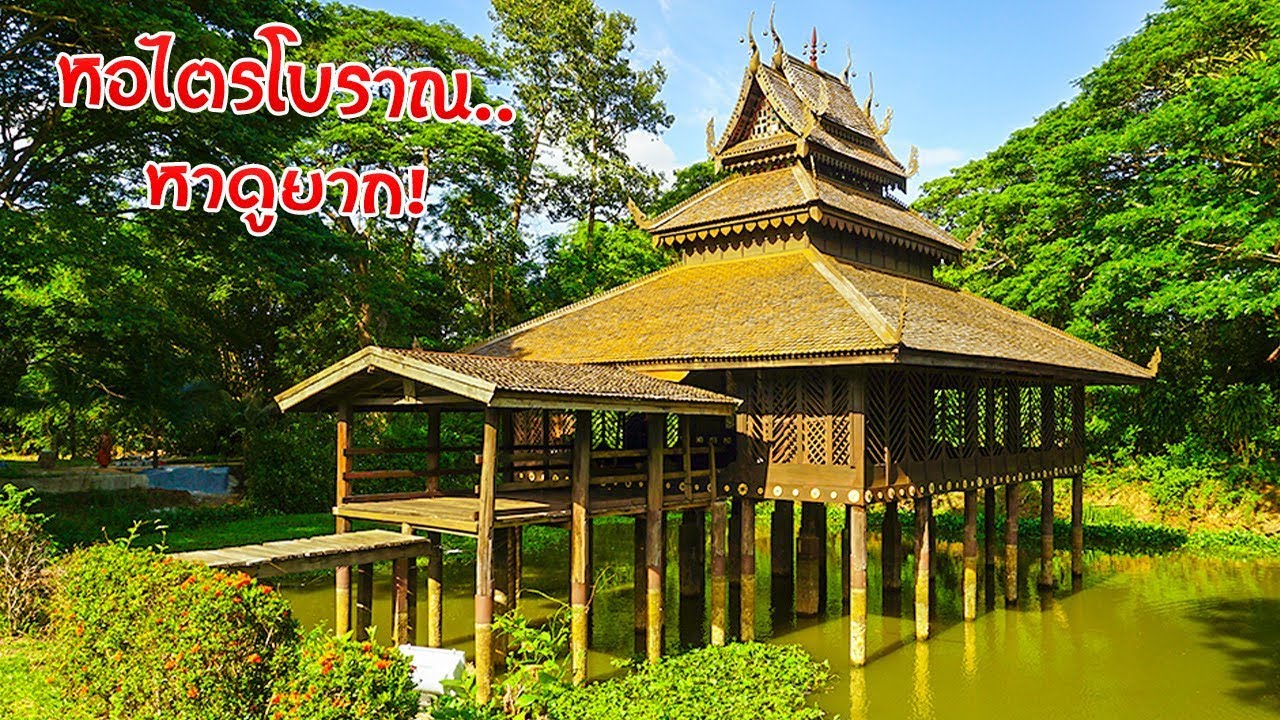
 Click to Access the Navigation Map GPS
Ho Trai Wat Sa Trai Nurak Map

 Art, Culture and Heritage
 Historical Sites and Monuments(6)
 Landmarks and Memorials(1)
 Art, Craft Centres, Tradition(4)
 Museums(1)
 Historic Homes and Cities(1)
 Temple(22)
 Church(1)
Other Sacred Sites(10)
Church(1)
Other Sacred Sites(10)
 Research and Development
 Royal Project(2)
 Suburban Living
 Village, Community(3)
 Local Market(1)
 Nature and Wildlife
 National Parks and Marine Reserves(2)
 Mountain (Doi)(2)
 Dam, Reservoir, Lake(7)
 River, Canal(2)
 Bays and Beaches(1)
 Other natural attractions(2)
 Entertainment and Agricultural
 Farms, Parks and Ecotourism(1)
 Travel Articles, Recipes
 Travel Review, Food Review(2)


