
lovethailand home >Northeastern Travel Attractions >Yasothon Travel Attractions >Muang Yasothon >Nai Muang > Ban Sing Tha Old Town
TL;DR: Ban Sing Tha Old Town, Yasothon attractions : Art, Culture and Heritage, Historic Homes and Cities.
Ban Sing Tha Old Town
Open Days: Ban Sing Tha Old Town can be explored daily; Singha Tha Museum opens Tuesday – Sunday and closes on Monday
Opening Hours: The public old-town streets can be visited throughout the day; Singha Tha Museum opens Tuesday – Friday from 09.00 – 16.00 and Saturday – Sunday from 09.30 – 16.30
Ban Sing Tha Old Town in Yasothon Province is one of the most meaningful historic quarters in northeastern Thailand. Located in Mueang Yasothon District, this old community preserves the atmosphere of Yasothon’s early urban settlement through heritage shophouses, a city pillar shrine, old temples, a local museum, small cafés, and lived-in neighborhood streets. The area is suitable for travelers who want to understand Yasothon beyond the well-known Bun Bang Fai Rocket Festival. It offers a compact yet rich cultural route where visitors can walk, photograph old buildings, visit Singha Tha Museum, pay respect at the city pillar shrine, and experience the quiet rhythm of a historic Isan town.
Ban Sing Tha is closely connected with the foundation history of present-day Yasothon. The community appears in local historical narratives as one of the important early settlements that later shaped the identity of the city. It developed as a trading quarter and a residential area where temples, shops, shrines, and homes were located within walking distance of one another. Even today, visitors can still sense that older urban pattern. Streets are narrow and human-scaled, heritage buildings stand close to active homes and shops, and the whole quarter feels more like a living neighborhood than a staged tourist attraction.
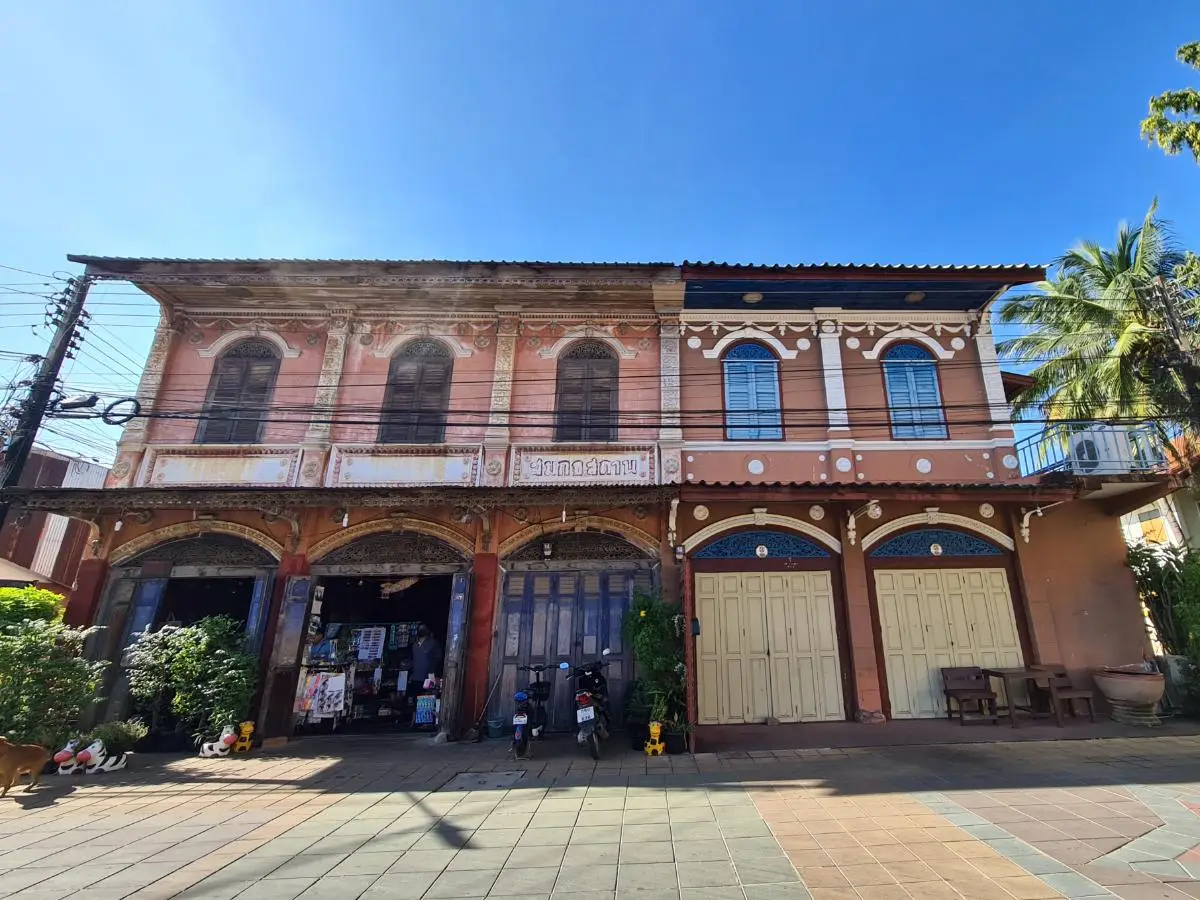
The most recognizable feature of Ban Sing Tha is its row of old shophouses. These buildings combine Chinese and European architectural influences, reflecting the period when regional trade, Vietnamese craftsmanship, and French influence in the wider Mekong region affected the taste and construction style of wealthy local families. Many houses were designed for both living and trading, with wooden folding doors, arched openings, decorative stucco, ventilation panels, and pastel-colored facades. The result is a distinctive architectural landscape that is different from the newer parts of Yasothon city.
Unlike larger old towns that have been heavily commercialized, Ban Sing Tha remains modest and authentic. The area does not feel overly renovated or artificially arranged for tourism. Some buildings continue to function as homes or local shops, while others have become cafés, small businesses, or community spaces. This combination of old and new gives the quarter its strongest charm. Travelers see not only preserved architecture but also the everyday life that continues around it.
A good starting point for exploring Ban Sing Tha is the area around Yasothon City Pillar Shrine and Singha Tha Museum. The city pillar shrine is an important spiritual landmark of Yasothon and stands within the old quarter. Architecturally, it blends Chinese, Thai, and Lao elements. The shrine is also notable for having 3 city pillars, a feature that makes it especially distinctive. For local residents, this shrine is closely tied to the protective spirit of the city and the historic memory of Ban Sing Tha as a founding community.
Visiting the city pillar shrine helps travelers understand the cultural identity of the old quarter. Ban Sing Tha was not simply a commercial street; it was a place where faith, trade, ancestry, and civic identity came together. The shrine represents the spiritual center of the area, while the surrounding streets, temples, and shophouses represent its social and economic life. A walk from the shrine into the nearby lanes gives a clear sense of how compact and interconnected the old community was.
Another essential stop is Singha Tha Museum, also known as Ban Sing Tha Old Town Museum. The museum is located on Uthairam Rit Road in Nai Mueang Subdistrict, Mueang Yasothon District. It was established as a learning center for the history of Ban Sing Tha and Yasothon city. Inside, the exhibitions present the story of settlement, local life, trade, culture, and the development of the community from the past to the present. The museum gives structure and context to what visitors see outside on the streets.
The museum project began in 2017, the building was completed in 2018, and the site was later transferred to Yasothon Municipality for management in 2020. Further development, exhibition improvement, and collaboration continued from 2021 to 2025. Today, the museum has 2 floors and several exhibition sections. It is designed to explain Ban Sing Tha not only as a beautiful old quarter but also as a key historical area where the story of Yasothon can be understood in a clear and accessible way.
Travelers who want a complete walking route should begin at the museum or the city pillar shrine, then continue along Si Sunthon Road, Uthairam Rit Road, and the nearby lanes. This route allows visitors to see heritage shophouses, pastel-colored facades, wooden doors, coffee shops, Wat Sing Tha, Wat Mahathat, and several photogenic corners. Walking is the best way to explore the area because many details are easy to miss when passing by in a vehicle.
Wat Sing Tha is another important part of the old quarter. The temple serves as a spiritual anchor for the community and a useful landmark for travelers exploring the old streets. Nearby, Wat Mahathat is one of Yasothon’s most important temples. It is associated with Phra That Anon, also known as Phra That Yasothon, and Phra Phuttha Butsayarat, a revered Buddha image connected to the city’s history. Combining Ban Sing Tha with Wat Mahathat gives travelers a broader understanding of how commerce, faith, and urban life developed together in Yasothon.
From an architectural point of view, Ban Sing Tha is valuable because it shows how a small Isan town absorbed outside influences while maintaining its local character. Some buildings show Sino-Portuguese or Sino-European features, while the layout and daily use of the buildings remain deeply connected to Isan town life. These houses are not just attractive facades. They are evidence of changing trade routes, family wealth, craftsmanship, and cultural adaptation.
For photography, the most popular corners are the old shophouses near Wat Sing Tha and the colorful buildings with arched windows, wooden shutters, folding doors, and decorative moldings. Morning and late afternoon are the best times for photography because the light is softer and the temperature is more comfortable for walking. Visitors should remember that many old buildings remain private homes or active shops, so photographs should be taken respectfully from public areas without disturbing residents.
Ban Sing Tha is also convenient for food and café stops. Visitors can enjoy coffee in a heritage shophouse, try local restaurants in town, or continue to restaurants near the Lam Thuan area. Vachi Old Town, located close to Wat Sing Tha, is one of the most relevant cafés for visitors who want to experience the old-town atmosphere. Other options in the city include rice porridge restaurants, Isan restaurants, Thai restaurants, and newer cafés near the municipal market.
The area is suitable for families, students, cultural travelers, and foreign visitors. It functions almost like an open-air classroom. Instead of learning history only through dates and names, visitors can see how history appears in streets, buildings, shrines, temples, museum displays, and local businesses. This makes Ban Sing Tha especially useful for travelers who want an approachable introduction to Yasothon’s history.
Ban Sing Tha is also a good example of living heritage conservation. The old buildings are not isolated from community life. Some still serve as homes and shops, the city pillar shrine remains a place of worship, nearby temples continue to serve local residents, and Singha Tha Museum helps explain the historical meaning of the area to younger generations and visitors. This balance between conservation and everyday use gives the old town a strong sense of authenticity.
A quick visit to Ban Sing Tha can take around 1 to 2 hours if travelers only walk through the old buildings and city pillar shrine. However, a more complete visit should take at least half a day. This allows enough time to visit Singha Tha Museum, walk the old streets, stop at Wat Mahathat, take photographs, and enjoy a café or local meal. Travelers who enjoy slow cultural exploration will get more value by not rushing through the area.
The cost of visiting Ban Sing Tha is low. The old-town streets are public spaces and do not charge an admission fee. Singha Tha Museum has a separate admission fee: 20 baht for Thai visitors, 40 baht for foreign visitors, and free entry for visitors with disabilities. This makes the area suitable for independent travelers, families, student groups, and international visitors who want a meaningful cultural experience without a high travel budget.
Getting There is easy because Ban Sing Tha is located in Yasothon city. Travelers can use a private car, rental car, or local transport. The most convenient landmarks are Yasothon City Pillar Shrine, Singha Tha Museum, Wat Sing Tha, and Wat Mahathat. From Yasothon Bus Terminal, visitors can take local transport into the city center. Once in the old quarter, walking is the best way to explore the streets and architectural details.
Travelers arriving by car can park in suitable areas near the city pillar shrine, Wat Sing Tha, or other permitted parking spots nearby. After parking, the old quarter can be explored on foot. This is better for the community and allows visitors to enjoy the atmosphere at a slower pace. During weekends, holidays, or festival periods, especially around the Bun Bang Fai Rocket Festival season, visitors should allow extra time for traffic and parking.
The old quarter can be understood as several connected zones. The first zone is the heritage shophouse area, where the main architectural character of Ban Sing Tha can be seen. The second is the city pillar shrine zone, which represents the spiritual center of the old town. The third is Singha Tha Museum, which explains the history of the community through exhibitions. The fourth is the temple zone around Wat Sing Tha and Wat Mahathat. The fifth is the café and restaurant zone, where travelers can rest and experience the present-day life of the city.
A practical itinerary is to begin in the morning at the city pillar shrine, walk through the heritage shophouse streets, visit Singha Tha Museum during opening hours, continue to Wat Mahathat, and then have lunch or coffee in town. In the afternoon, travelers can add Phaya Thaen Park, the Giant Toad Museum, or That Kong Khao Noi. This route gives a well-rounded impression of Yasothon, combining old-town history, Buddhist heritage, local legends, and modern landmarks.
For international travelers, Ban Sing Tha offers a side of Isan that is not always visible in standard travel itineraries. It is not a grand monumental site, but it is rich in everyday heritage. Its charm lies in the scale of the streets, the old buildings, the active community, and the way local history is preserved within ordinary urban life. This makes it a rewarding stop for travelers who enjoy cultural depth rather than only famous landmarks.
Overall, Ban Sing Tha Old Town is one of the most important cultural areas in Yasothon. It brings together the history of the city’s foundation, Chinese-European shophouse architecture, the city pillar shrine, important temples, a local museum, cafés, restaurants, and community life. It shows that Yasothon is not only a province of festivals, but also a place with a long urban memory and a distinctive architectural identity. For both Thai and foreign visitors, Ban Sing Tha is a compact, walkable, and meaningful old town that deserves a place in any Yasothon travel plan.
| Name | Ban Sing Tha Old Town |
| Location | Yasothon Municipality, Mueang Yasothon District, Yasothon Province |
| Address | Ban Sing Tha historic quarter around Si Sunthon Road, Uthairam Rit Road, and the area near Yasothon City Pillar Shrine, Nai Mueang Subdistrict, Mueang Yasothon District, Yasothon 35000 |
| Highlights | Historic old-town quarter, Chinese-European heritage shophouses, Yasothon City Pillar Shrine, Wat Sing Tha, Wat Mahathat, Singha Tha Museum, cafés, and local community atmosphere |
| History | A historic community connected to the foundation of Yasothon city, with more than 200 years of local history and a former role as an important trading quarter |
| Name Origin | Ban Sing Tha is the historic community name associated with the foundation history of Yasothon and is still used for the old-town quarter today |
| Distinctive Features | Old wooden-and-masonry shophouses, folding wooden doors, arched openings, stucco details, ventilation panels, and Chinese-European architecture that remains part of everyday community life |
| Travel Information | Located in Yasothon city and accessible by private car, rental car, or local transport. Useful landmarks include Yasothon City Pillar Shrine, Singha Tha Museum, Wat Sing Tha, and Wat Mahathat |
| Current Status | Open to visitors as a living old-town community with active homes, shops, temples, a shrine, and a local museum |
| Open Days | The old-town streets can be visited daily; Singha Tha Museum opens Tuesday – Sunday and closes on Monday |
| Opening Hours | The public streets can be visited throughout the day; Singha Tha Museum opens Tuesday – Friday from 09.00 – 16.00 and Saturday – Sunday from 09.30 – 16.30 |
| Fees | The old-town streets are free to visit; Singha Tha Museum admission is 20 baht for Thai visitors, 40 baht for foreign visitors, and free for visitors with disabilities |
| Facilities | Walkable old-town streets, restaurants, cafés, temples, city pillar shrine, museum, and nearby parking areas where permitted |
| Main Areas / Zones | 1. Ban Sing Tha Heritage Shophouse Zone 2. Yasothon City Pillar Shrine Zone 3. Singha Tha Museum / Ban Sing Tha Old Town Museum Zone 4. Wat Sing Tha Zone 5. Wat Mahathat And Phra That Anon Zone 6. Old-Town Café And Restaurant Zone 7. Heritage Street Photography Zone |
| Caretaker | Yasothon Municipality is the local authority connected with the old-town area, and Singha Tha Museum is under the care of Yasothon Municipality |
| Main Contact Number | Yasothon Municipality Tel. 045-712252 / Singha Tha Museum Tel. 045-712252 |
| Official Website / Official Page | Singha Tha Museum Website: singhathamuseum.com / Yasothon Municipality Website: yasocity.go.th |
| Nearby Tourist Attractions | 1. Singha Tha Museum, About 0 km 2. Yasothon City Pillar Shrine, About 0.1 km 3. Wat Sing Tha, About 0.2 km 4. Wat Mahathat / Phra That Anon, About 0.5 km 5. Giant Toad Museum / Phaya Thaen Park, About 2.6 km 6. That Kong Khao Noi, About 12 km |
| Nearby Restaurants | 1. Vachi Old Town, About 0.24 km, Tel. 098-428-5246, 062-994-2559 2. Khao Tom Yok Yasothon, About 0.61 km, Tel. 093-329-3779 3. Coconut Smoothie At Wat Sing Tha, About 0.3 km, Tel. 095-815-4051 4. Tud Ting Lap Ped, About 1.68 km, Tel. 045-711-600 5. Baan Khun Ya Rim Thuan, About 1.85 km, Tel. 095-231-2221 6. Arabus Experience Café Yasothon Municipal Market, About 1 km, Tel. 098-280-5288 |
| Nearby Accommodations | 1. BM Grand Hotel, About 0.7 km, Tel. 045-712-333 2. Big Elephant Hotel, About 1.1 km, Tel. 045-711-123 3. The Colour Hotel Yasothon, About 1.3 km, Tel. 045-971-794 4. The Green Park Grand Hotel Yasothon, About 1.7 km, Tel. 045-714-700 5. The Zen Hotel Yasothon, About 2.3 km, Tel. 045-711-455 |
Frequently Asked Questions (FAQ)
Q: Where Is Ban Sing Tha Old Town Located?
A: Ban Sing Tha Old Town is located in Yasothon Municipality, Mueang Yasothon District, Yasothon Province, near Yasothon City Pillar Shrine, Wat Sing Tha, Wat Mahathat, and Singha Tha Museum.
Q: Is Ban Sing Tha Old Town Open Every Day?
A: The old-town streets can be explored daily. Singha Tha Museum, located in the same area, opens Tuesday to Sunday and closes on Monday.
Q: Is There An Admission Fee For Ban Sing Tha Old Town?
A: Walking through the old-town streets is free. Singha Tha Museum has a separate admission fee: 20 baht for Thai visitors, 40 baht for foreign visitors, and free entry for visitors with disabilities.
Q: What Are The Main Highlights Of Ban Sing Tha Old Town?
A: Highlights include Chinese-European heritage shophouses, Yasothon City Pillar Shrine, Wat Sing Tha, Wat Mahathat, Singha Tha Museum, old-town cafés, and the living community atmosphere.
Q: How Long Should Visitors Spend In Ban Sing Tha Old Town?
A: A short visit takes around 1 to 2 hours, but visitors who want to see the museum, temples, cafés, and photography spots should allow at least half a day.
Q: How Can Travelers Get To Ban Sing Tha Old Town?
A: Travelers can reach the area by private car, rental car, or local transport in Yasothon city. Useful landmarks are Yasothon City Pillar Shrine, Singha Tha Museum, Wat Sing Tha, and Wat Mahathat.
Q: Is Ban Sing Tha Old Town Suitable For Foreign Travelers?
A: Yes. It is a compact, walkable old town where foreign travelers can experience historic architecture, local faith, museum exhibitions, cafés, temples, and everyday Isan community life in one area.
 Category: ●Art, Culture and Heritage
 Group: ●Historic Homes and Cities
Last Update : 3 MonthAgo
 Last Update : 3 MonthAgo
 Click to Access the Navigation Map GPS
Ban Sing Tha Old Town Map

 Historical Sites and Monuments(6)
 Landmarks and Memorials(1)
 Art, Craft Centres, Tradition(4)
 Museums(1)
Historic Homes and Cities(1)
Museums(1)
Historic Homes and Cities(1)
 Places of Worship
 Temple(22)
 Church(1)
 Other Sacred Sites(10)
 Research and Development
 Royal Project(2)
 Suburban Living
 Village, Community(3)
 Local Market(1)
 Nature and Wildlife
 National Parks and Marine Reserves(2)
 Mountain (Doi)(2)
 Dam, Reservoir, Lake(7)
 River, Canal(2)
 Bays and Beaches(1)
 Other natural attractions(2)
 Entertainment and Agricultural
 Farms, Parks and Ecotourism(1)
 Travel Articles, Recipes
 Travel Review, Food Review(2)


