
lovethailand home >Northeastern Travel Attractions >Ubon Ratchathani Travel Attractions >Khuang Nai >Sang Tho > Nong Lao Hin Reservoir
TL;DR: Nong Lao Hin Reservoir is located at Ban Si Bua, Sang Tho Subdistrict, Khueang Nai District, Ubon Ratchathani Province, open Daily, hours 08.00 – 17.00.

Nong Lao Hin Reservoir
Open Days: Daily
Opening Hours: 08.00 – 17.00
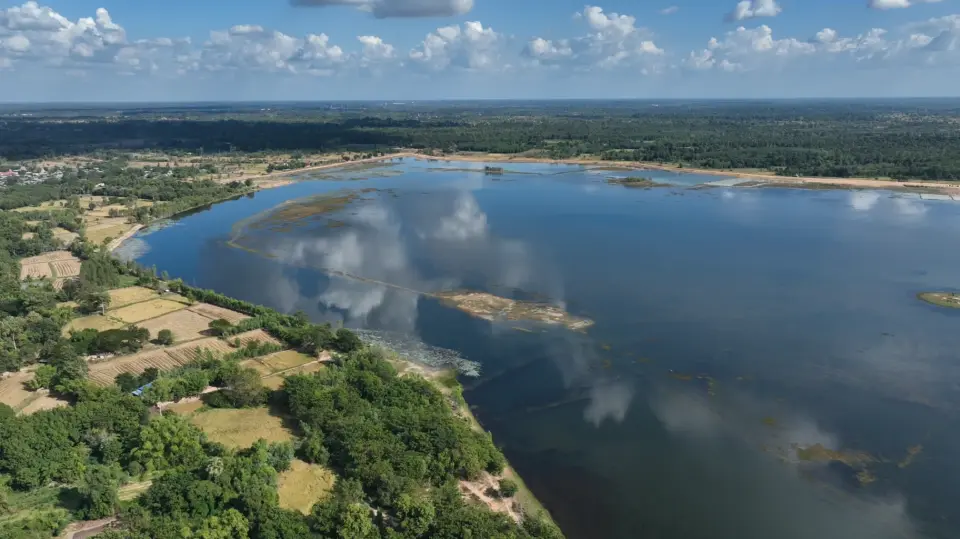
Nong Lao Hin Reservoir in Ubon Ratchathani is an important community reservoir at Ban Si Bua, Sang Tho Subdistrict, Khueang Nai District. It serves local households, farming areas, freshwater fisheries, and community recreation. This is not a commercial tourist attraction built around large facilities or entertainment. Its real value lies in its wide water surface, agricultural landscape, local fishing life, irrigation role, and quiet rural atmosphere. For Thai and foreign travelers who want to understand Ubon Ratchathani beyond temples and city landmarks, Nong Lao Hin Reservoir offers a meaningful look at how water, farming, food, and village life are closely connected in rural northeastern Thailand.
The reservoir is located in Ban Si Bua, Sang Tho Subdistrict, Khueang Nai District, Ubon Ratchathani Province. This area is part of a rural agricultural landscape with villages, rice fields, local roads, farming routes, and community water-use systems. The reservoir was originally constructed in 1951 and has continued to function as a key local water source. Current irrigation data identifies it as a reservoir under the Ubon Ratchathani Irrigation Project, Regional Irrigation Office 7. The surrounding reservoir area covers approximately 1,200 rai, while the irrigation service area supports about 916 rai of agricultural land. Its normal storage capacity is 2.48 million cubic meters.
The atmosphere of Nong Lao Hin Reservoir is different from urban parks or well-developed scenic attractions. The area remains strongly connected with local agriculture. Around the reservoir, visitors can see rice fields, farm plots, rural roads, local houses, small shelters, and open sky. The landscape is simple but meaningful. It shows how a reservoir becomes part of daily life rather than a separated sightseeing spot. Travelers who enjoy quiet places, rural scenery, and authentic community environments will find the reservoir more rewarding than those looking for entertainment-based tourism.
The first major role of Nong Lao Hin Reservoir is water supply for local communities. It supports domestic use for nearby villages and helps secure water availability during dry periods. In a rural setting, a reservoir is not only a body of water; it is a shared resource that helps stabilize community life. When water is available, households, farms, and local activities can continue more reliably. During the rainy season, the reservoir helps hold excess water, while in the dry season, stored water becomes essential for the surrounding community.
The second important role is irrigation. Sang Tho Subdistrict and Khueang Nai District have strong agricultural identities. Many local residents depend on rice farming, post-harvest crops, and seasonal agriculture. Water from Nong Lao Hin Reservoir supports these farming cycles and helps farmers plan cultivation in both wet and dry seasons. Visitors who look carefully at the surrounding landscape will understand that the reservoir is directly connected to food production. It is part of a wider system that includes water storage, fields, local labor, roads, and village economies.
The third role is freshwater fisheries. Nong Lao Hin Reservoir functions as a fish-breeding and local fishing area. Public fish-release activities have been carried out in the reservoir to help maintain the aquatic ecosystem. This reflects the traditional importance of reservoirs and natural water bodies in Isan communities. Fish from local water sources contribute to household food, seasonal income, and local food culture. Fishing here is not only an economic activity; it is also local knowledge shaped by water levels, seasons, fish behavior, tools, and community rules.
As a landscape, Nong Lao Hin Reservoir is beautiful in a quiet rural way. Morning is suitable for seeing soft light over the water, fresh air, and calm surroundings. Late afternoon is ideal for warm light, wide sky, and reflections on the water surface. The open view makes the place attractive for photography, especially for travelers who like simple rural scenes rather than crowded landmarks. The reservoir edge, embankment, fields, local fishing activity, and changing sky all create natural compositions.
The reservoir is also useful for learning about local water management. Over time, reservoirs can become shallow because of sediment and long-term use. Nong Lao Hin Reservoir has been included in dredging and improvement work by irrigation authorities to increase water storage, reduce flood impacts during the rainy season, and store water for dry-season use. This makes the site a practical example of how water infrastructure must be maintained continuously to support community livelihoods.
For local people, Nong Lao Hin Reservoir is more than an irrigation structure. It is part of the memory of Ban Si Bua and Sang Tho Subdistrict. Children grow up seeing the reservoir. Farmers depend on its water. Local fishers know its seasons. People returning home from other areas often remember the reservoir as part of their hometown landscape. This emotional connection gives the place cultural value even though it is not a temple, ancient site, or formal ceremonial ground.
Travelers visiting Nong Lao Hin Reservoir will see a living local place rather than a staged tourist attraction. The reservoir is still used by the community. People may fish, pass through the area for agricultural work, or use surrounding roads as part of daily life. Visitors can walk in safe areas, sit quietly, take photographs, observe local activities, and drive slowly around the rural landscape. The experience is best approached with patience and respect.
Ban Si Bua and Sang Tho Subdistrict also give the trip a deeper rural context. The route into the area passes through villages and farmland, allowing travelers to see another side of Ubon Ratchathani. This is not the Ubon known only for the Candle Festival, large temples, or Mekong viewpoints. It is the Ubon of rice fields, irrigation systems, local roads, freshwater fish, and small communities. For travelers who want a more complete understanding of the province, this route is valuable.
The rainy season to early cool season is especially pleasant because the surrounding fields become greener and the reservoir usually has more water. The scenery feels fresh, and the relationship between water and farming is easy to observe. During the dry season, the reservoir may look different, but that season reveals its importance as a stored water source. Changes in water level are part of the story of the place. They help visitors understand why reservoirs are vital to rural communities.
The most practical way to reach Nong Lao Hin Reservoir is by private car or rental car. From Ubon Ratchathani city, travelers can drive toward Khueang Nai District, continue to Sang Tho Subdistrict, and then enter Ban Si Bua. The route uses local roads through agricultural areas and villages. Public transportation is not convenient for direct access because the reservoir is not a major urban attraction with frequent transit connections. Travelers should check the route in advance, especially during the rainy season when some local road sections may be affected by water or soft ground.
Getting There from Ubon Ratchathani city is best planned as a half-day countryside route. Drive toward Khueang Nai District, then continue through local roads to Sang Tho Subdistrict and Ban Si Bua. The reservoir can be combined with nearby places in Khueang Nai such as Wat Sang Tho, Wat Khueang Klang, Wat Pa Sila Lek, Kua Noi Ban Chi Thuan, and the Lion Pulpit with Vietnamese-style art at Ban Chi Thuan. This creates a more complete route that includes water, agriculture, temples, local art, and village heritage.
Nong Lao Hin Reservoir is suitable for light recreation. Visitors can enjoy the view, rest by the water, take photographs, observe fishing life, and explore nearby rural roads. Activities that should be avoided include swimming in unsafe areas, littering, disturbing local fishing, entering private farmland without permission, making loud noise, or driving into restricted reservoir areas. The reservoir is a shared community resource, so visitors should use the space politely.
Families can visit the reservoir as a gentle outdoor stop. Children can learn about water, fish, birds, rice fields, and the relationship between irrigation and agriculture. However, adults should supervise children closely because reservoir edges, embankments, and rural paths may not have complete barriers. Elderly visitors can enjoy the place if they choose easy viewpoints and avoid uneven walking areas. The site is better for quiet observation than for intensive walking.
For photographers, Nong Lao Hin Reservoir provides strong rural imagery. The water surface, earthen embankment, fields, fishing activity, farm roads, birds, and evening sky can produce calm and meaningful photographs. Morning and late afternoon are the best times because the light is softer. When photographing local residents, especially fishers or farmers at close distance, visitors should ask permission first. Respectful photography helps maintain trust between travelers and the community.
Food options can be found in the wider Khueang Nai area. After visiting the reservoir, travelers can continue to local restaurants, Isan food shops, cafés, grilled chicken restaurants, and drink shops in or near Khueang Nai town. This makes the trip more practical and enjoyable. Visitors can combine rural sightseeing with local meals without returning to Ubon Ratchathani city immediately.
Accommodation choices are available in Khueang Nai and nearby districts, as well as in Ubon Ratchathani city. Travelers who want to explore Khueang Nai in depth can stay closer to the district area. Those who prefer city convenience, airport access, and a wider selection of restaurants may stay in Ubon Ratchathani city and visit the reservoir as a half-day trip. The best choice depends on whether the travel plan focuses on rural Khueang Nai or the wider Ubon city route.
Nearby attractions add depth to a visit. Wat Sang Tho gives travelers a local temple stop within Sang Tho Subdistrict. Wat Khueang Klang is an old temple in Khueang Nai. Wat Pa Sila Lek appears in local tourism listings. Ban Chi Thuan is important for its cultural heritage, including Kua Noi Ban Chi Thuan, Wat Thung Si Wilai, and the Lion Pulpit with Vietnamese-style art. These places allow visitors to connect the reservoir with religion, art, local history, and village identity.
The Lion Pulpit at Ban Chi Thuan is especially important for travelers interested in local art. It is located in the sermon hall of Wat Sri Nuan Saeng Sawang Arom and is shaped as a lion supporting a pulpit structure. The work is associated with Vietnamese-style craftsmanship and is believed to date from 1925. Combining this site with Nong Lao Hin Reservoir gives travelers a route that moves from water and agriculture to art and cultural heritage.
Wat Thung Si Wilai and the Ban Chi Thuan area add another layer of local history. The community is known for old temples, local stories, and cultural objects that reflect the long history of settlement in the lower Isan region. When this cultural route is combined with Nong Lao Hin Reservoir, travelers can understand how water, temples, agriculture, and local memory form the foundation of rural life in Ubon Ratchathani.
Nong Lao Hin Reservoir is also a good place for environmental reflection. A community reservoir must be cared for by many groups: irrigation officers, local administrative bodies, water users, farmers, fishers, and residents. If the water is polluted or the area is damaged, the impact returns directly to the community. Visitors therefore have a responsibility to keep the site clean and respect the rules of shared resource use.
Responsible behavior is simple but important. Visitors should not throw waste into the water, damage embankments, enter private farms, block local access roads, disturb fishing activity, or make excessive noise. If government officers or villagers are conducting water-management, fish-release, or maintenance activities, visitors should give them space to work. The reservoir’s main purpose is to serve the community, and tourism should support that purpose rather than interfere with it.
A half-day itinerary can begin from Ubon Ratchathani city in the morning, continue to Nong Lao Hin Reservoir for scenery and photography, then move to Wat Sang Tho or Wat Khueang Klang, followed by lunch in Khueang Nai. A full-day route can add Ban Chi Thuan, Kua Noi Ban Chi Thuan, the Lion Pulpit, and Wat Thung Si Wilai. This route gives travelers a wide view of Khueang Nai District, from water and agriculture to local temples and community art.
During the farming season, the landscape around the reservoir becomes especially lively. Rice fields turn green, local roads become active with agricultural movement, and the link between water and farming becomes visible. During the dry season, the reservoir’s role as stored water becomes clearer. Each season reveals a different meaning. This makes Nong Lao Hin Reservoir more than a scenic water body; it is a seasonal landscape that reflects how rural communities live with water.
Overall, Nong Lao Hin Reservoir is best for travelers who appreciate quiet, authentic, and locally meaningful places. It is a community reservoir that supports water supply, farming, freshwater fish, local food security, and rural recreation. Its beauty lies in wide water, open sky, village life, fishing activity, and the calm rhythm of Ban Si Bua. Visitors who travel with understanding will see that one reservoir can tell many stories about community life.
Nong Lao Hin Reservoir is therefore suitable for both Thai and foreign travelers who want to see a deeper side of Ubon Ratchathani. It is not only a place to stop for a photograph. It is a place to understand rural water management, farming culture, local fisheries, and the quiet strength of village landscapes in northeastern Thailand. When combined with nearby temples and cultural sites in Khueang Nai, the reservoir becomes part of a meaningful travel route that connects nature, community, and heritage.
| Name | Nong Lao Hin Reservoir, Ubon Ratchathani |
| Location | Ban Si Bua, Sang Tho Subdistrict, Khueang Nai District, Ubon Ratchathani Province |
| Address / Reference Area | Nong Lao Hin Reservoir, Ban Si Bua, Sang Tho Subdistrict, Khueang Nai District, Ubon Ratchathani 34150 |
| Coordinates | 15.30018973, 104.4894918 |
| Highlights | A large community reservoir at Ban Si Bua, used for irrigation, fish breeding, local fishing, rural scenery, and community-based relaxation |
| Type Of Attraction | Natural attraction, reservoir, community water source, agricultural learning area, and local freshwater fishery landscape |
| Distinctive Features | Wide water surface, surrounding rice fields, local fishing life, agricultural roads, and a quiet rural atmosphere suitable for rest and photography |
| History / Area Development | Constructed in 1951 as a water source for 3 villages and an irrigation source for farming communities around Ban Si Bua and nearby agricultural areas |
| Size / Capacity | Reservoir area about 1,200 rai, irrigation service area about 916 rai, and normal storage capacity 2.48 million cubic meters |
| Importance | Important for domestic water use, agriculture, rainy-season water storage, dry-season water reserves, local fishing, and community aquatic ecosystem maintenance |
| Best Time To Visit | Morning and late afternoon for walking, photography, and lakeside views; rainy season to early cool season for green fields and fresh rural scenery |
| Travel Information | Travel by private car or rental car from Ubon Ratchathani city to Khueang Nai District, then continue through Sang Tho Subdistrict to Ban Si Bua. The route uses local roads through villages and farmland. |
| Current Status | Open as a community reservoir, leisure area, agricultural water source, and local fishing area, with dredging and improvement work to increase water-storage capacity |
| Open Days | Daily |
| Opening Hours | 08.00 – 17.00 |
| Fees | No admission fee |
| Facilities | Access roads, some reservoir-side roads, community parking areas, natural viewpoints, and restaurants/cafés in the wider Khueang Nai area |
| Main Areas / Zones | Reservoir water zone, embankment and irrigation structure zone, agricultural transport road zone, irrigated farming zone, local fishing zone, Ban Si Bua waterside zone, and surrounding rice-field viewpoint zone |
| Caretaker | Ubon Ratchathani Irrigation Project, Regional Irrigation Office 7, Royal Irrigation Department, together with Sang Tho Subdistrict Administrative Organization as the local administrative area |
| Main Contact Number | Ubon Ratchathani Irrigation Project: 045-841684, 045-841685 / Sang Tho Subdistrict Administrative Organization: 045-429336 |
| Official Website / Official Page | Ubon Ratchathani Irrigation Project website, Regional Irrigation Office 7, and Sang Tho Subdistrict Administrative Organization website |
| Visitor Guidelines | Keep the area clean, do not throw waste into the water, avoid unsafe swimming areas, do not disturb local fishing or farming activity, and use the community space respectfully |
| Nearby Tourist Attractions | 1. Wat Sang Tho, Sang Tho Subdistrict, about 8 km 2. Sang Tho Subdistrict Administrative Organization and Sang Tho community area, about 10 km 3. Wat Khueang Klang, Khueang Nai District, about 17 km 4. Wat Pa Sila Lek, Khueang Nai District, about 18 km 5. Kua Noi Ban Chi Thuan, about 24 km 6. Lion Pulpit with Vietnamese-style art at Ban Chi Thuan, about 25 km 7. Wat Thung Si Wilai, Ban Chi Thuan, about 25 km |
| Nearby Restaurants | 1. Khrua Rim Nam Khueang Nai, about 16 km, Tel. 081-997-5145 2. I-So-Late Sip & Taste Khueang Nai, about 17 km, Tel. 094-929-4466 3. Ban Hao Sao Mee Haeng MeeHang Cafe’, about 18 km, Tel. 088-012-3987 4. Kai Yang Ban Khaen, Khueang Nai Branch, about 18 km, Tel. 083-815-6053 5. LightRoaster Khueang Nai, about 19 km, Tel. 066-153-6282, 081-424-9928 6. Siam Coffee, Yang Chum Noi-Khueang Nai, about 22 km, Tel. 090-331-0818 |
| Nearby Accommodations | 1. Pornsawan Hotel / Pornsawan Mansion, Khueang Nai, about 17 km, Tel. 045-391-346, 091-767-5961, 094-129-6158 2. Seamthong Resort, Khueang Nai, about 18 km, Tel. 081-117-8732 3. Ban Hao Resort, Khueang Nai, about 19 km, Tel. 084-688-3882, 081-786-3171 4. Baan Kok Resort, Khueang Nai District, about 28 km, Tel. 080-252-6451 5. Villa Diamond Accommodation, Ban That Noi, Khueang Nai District, about 30 km, Tel. 097-102-0333 |
Frequently Asked Questions (FAQ)
Q: Where is Nong Lao Hin Reservoir located?
A: Nong Lao Hin Reservoir is located at Ban Si Bua, Sang Tho Subdistrict, Khueang Nai District, Ubon Ratchathani Province. It is an important community and irrigation reservoir.
Q: Is Nong Lao Hin Reservoir open to visitors?
A: Yes. It is open daily from 08.00 to 17.00. Visitors can enjoy the view, rest by the water, and observe the local rural landscape.
Q: Is there an admission fee for Nong Lao Hin Reservoir?
A: No. There is no admission fee for general visitors.
Q: What is Nong Lao Hin Reservoir known for?
A: It is known for its wide water surface, rural atmosphere, fish-breeding role, local fishing life, and importance as an irrigation source for nearby farming communities.
Q: When is the best time to visit Nong Lao Hin Reservoir?
A: Morning and late afternoon are the best times for scenery, photography, and fresh air. The rainy season to early cool season is ideal for green fields and a lively rural atmosphere.
Q: How can travelers get to Nong Lao Hin Reservoir?
A: Travelers should use a private car or rental car from Ubon Ratchathani city toward Khueang Nai District, then continue to Sang Tho Subdistrict and Ban Si Bua through local roads.
Q: Is Nong Lao Hin Reservoir suitable for families?
A: Yes. It is suitable for families who want a quiet rural stop, but adults should supervise children carefully near reservoir edges and uneven local roads.
Q: What nearby attractions can be visited with Nong Lao Hin Reservoir?
A: Nearby places include Wat Sang Tho, Wat Khueang Klang, Wat Pa Sila Lek, Kua Noi Ban Chi Thuan, the Lion Pulpit at Ban Chi Thuan, and Wat Thung Si Wilai.
 Category: ●Nature and Wildlife
 Group: ●Dam, Reservoir, Lake
Last Update : 4 WeekAgo
 Last Update : 4 WeekAgo
 Click to Access the Navigation Map GPS
Nong Lao Hin Reservoir Map
Recommend

 Art, Culture and Heritage
 Historical Sites and Monuments(5)
 Landmarks and Memorials(2)
 Royal Palace(1)
 Art, Craft Centres, Tradition(7)
 Museums(3)
 Places of Worship
 Temple(37)
 Other Sacred Sites(4)
 Research and Development
 Royal Project(2)
 Suburban Living
 Village, Community(2)
 Local Market(4)
 National Parks and Marine Reserves(5)
 Mountain (Doi)(6)
Dam, Reservoir, Lake(8)
Mountain (Doi)(6)
Dam, Reservoir, Lake(8)
 Waterfalls(12)
 Hot Springs(1)
 Caves(2)
 River, Canal(11)
 Bays and Beaches(8)
 Islands(2)
 Other natural attractions(6)
 Entertainment and Agricultural
 Zoos and Aquariums(1)
 Animal camps and shows(1)
 Farms, Parks and Ecotourism(1)


