
lovethailand home >Northeastern Travel Attractions >Ubon Ratchathani Travel Attractions >Na Tan >Na Tan > Hat Chom Dao
TL;DR: Hat Chom Dao is located at Ban Non Tan, Na Tan Subdistrict, Na Tan District, Ubon Ratchathani Province, open Daily, hours Open All Day.
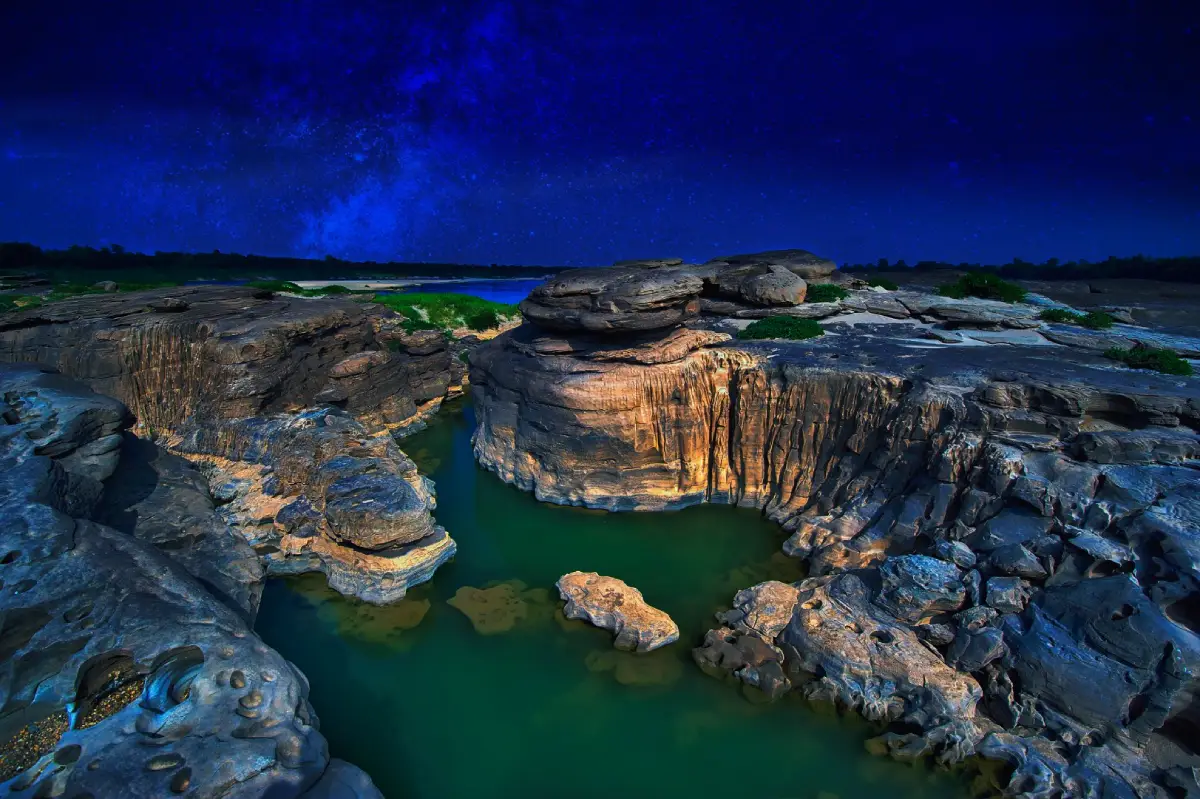
Hat Chom Dao
Open Days: Daily
Opening Hours: Open All Day
Admission Fees: No Admission Fee
Hat Chom Dao in Ubon Ratchathani, also known as Kaeng Chom Dao or Kaeng Hin Ngam, is a remarkable natural attraction along the Mekong River in Ban Non Tan, Na Tan Subdistrict, Na Tan District, Ubon Ratchathani Province. The site is famous for its vast sandstone riverbank, dramatic rock terraces, narrow channels, eroded stone walls, natural basins, pale sand, and wide-open sky. During the rainy season, many of these rock formations are submerged beneath the Mekong River. When the water level drops from around November to early May, the hidden sandstone landscape appears and reveals one of the most unusual natural scenes in northeastern Thailand. With its sculpted rocks, reflective pools, and open sky, Hat Chom Dao is a destination for travelers who want to see the Mekong River in a deeper and more memorable way.
Hat Chom Dao is not a man-made attraction. Its beauty comes from the long work of water, wind, sunlight, heat, moisture, and time. The Mekong River has shaped the sandstone surface through seasonal floods and strong currents. Sand, gravel, and small stones carried by the water slowly polished, cut, and widened the rock surface. Over time, this process created grooves, hollows, basins, cavities, layered lines, and narrow channels. Some areas look like carved stone walls, some resemble natural corridors, and some form pools that reflect the sky like mirrors. This is why Hat Chom Dao is often described as an outdoor art gallery created by nature itself.
The name “Hat Chom Dao” means a beach for watching the stars, and the name fits the atmosphere of the place very well. The area is broad and open, with a wide view of the sky above the Mekong River. During the day, visitors can explore the rock terraces, sandbars, and sculpted sandstone formations. In the evening, the light softens and the rocks change color. At night, when the sky is clear, the open riverside landscape becomes a beautiful place for stargazing. The combination of dark sky, exposed sandstone, reflective water, and the wide Mekong River gives Hat Chom Dao a quiet and distinctive character.
Hat Chom Dao is often compared with Sam Phan Bok because both destinations are sandstone landscapes shaped by the Mekong River. However, they offer different experiences. Sam Phan Bok is best known for thousands of rock basins, while Hat Chom Dao is known for its broad rock formations, layered stone walls, deep grooves, reflective water channels, sand, and sky. If Sam Phan Bok is a landscape of basins and hollows, Hat Chom Dao is a landscape of rock walls, stone corridors, river light, and open atmosphere. Travelers who visit both places will see how the same river can create different forms of natural beauty.
The formation of Hat Chom Dao began with sandstone rapids lying beneath the Mekong River during the high-water season. As strong currents moved across the rock, they carried sand, gravel, and small stones across cracks, lower points, and weak surfaces. These materials acted like natural polishing tools. Repeated movement gradually carved the stone into lines, holes, grooves, basins, and channels. The process took a very long time and continued through countless flood seasons. When the river level drops, the exposed rock surface shows the visible record of water movement, erosion, and geological change.
The beauty of Hat Chom Dao lies not only in its large-scale scenery but also in small details. Visitors who walk slowly across the rock field will notice layered textures following the direction of water flow. Some lines curve like waves, some stretch across broad stone surfaces, and some are cut into the rock like channels. Small holes appear across the surface in many areas, while other parts are smooth and polished by long exposure to the river. Each section of stone has its own form, color, and texture, making the place feel like a collection of natural sculptures spread across the Mekong riverside.
Across the Mekong River, the opposite side in Laos shows long stretches of pale sand. On the Thai side, however, the riverside becomes a massive sandstone landscape with strong erosion patterns. This contrast between sand and rock gives Hat Chom Dao a striking visual identity. One side of the river appears soft and pale, while the other side is rugged, carved, and layered. Standing on the Thai side, visitors can see how the same river creates different landscapes on opposite banks. This makes the view more meaningful than a simple scenic stop.
The best period to visit Hat Chom Dao is from November to early May, when the Mekong River level is low and the rock formations are visible. January to April is especially good for seeing the broad sandstone terrace clearly. During the rainy season and high-water period, many parts of the rock field are hidden beneath the river, so the full landscape cannot be seen. Hat Chom Dao is therefore a seasonal destination. Travelers who want to see the sculpted rocks, basins, channels, and sandbar scenery should plan their visit during the dry season.
The best time of day to explore the site is early morning or late afternoon. From around 06:00 to 09:00, the weather is cooler and the soft morning light brings out the stone textures gently. From around 16:00 to 18:00, the afternoon light becomes warmer, shadows grow longer, and the rock surface gains more depth. Midday visits are possible, but the area is exposed to strong sun and the stone surface can become very hot. Travelers who want comfort, good photographs, and safer walking conditions should choose the morning or late afternoon.
Hat Chom Dao contains several important areas and named points. Local tourism information has described notable zones such as Tham Ta Uan, Tham Ta Ma, Kon Sam Sao, Chong Sao Sok, Grand Canyon Na Tan, the Mekong River Sculpture area, Kaeng Hin Ngam or Hin Chom Naphha, Pha Wat Chai, Pha Diao Dai, Chong Biat Sao, Aeng Ma Khoi, Chong Khaep Song Fang Khong, and Hat Chom Dao or Hat Sai Khao. Each area has a different appearance. Some are known for rock walls and channels, some for basins and stone patterns, some for wide photography angles, and some for quiet riverside views.
Hin Chom Naphha is one of the most memorable highlights of Hat Chom Dao. This area contains large rock formations with a narrow space between 2 stone walls. Below the gap is a pool or water channel that can reflect the sky clearly. This makes it one of the most popular photo spots. In the morning, the reflection looks bright and fresh. In the afternoon, the light becomes warmer. At night, under a clear sky, the same place becomes a quiet stargazing scene. The changing light makes this area different at every hour of the day.
Grand Canyon Na Tan is another important area that shows the scale of the eroded sandstone landscape. The rock walls, grooves, and channels create the feeling of walking through a small canyon beside the Mekong River. It is not the same size as large canyons overseas, but its uniqueness comes from being a seasonal riverside canyon that appears when the Mekong water drops. The landscape changes with the river level, giving Hat Chom Dao a living character that shifts from one season to another.
Chong Khaep Song Fang Khong is a natural narrow channel area that shows the power of the Mekong River. Here, the shape of the rock and the water passage create a stronger visual sense of current and movement. Visitors should observe this area carefully and avoid approaching fast water unnecessarily. The point is also meaningful for understanding local fishing life, because people living along the Mekong know the timing of water, current, and fish movement through long experience. The river landscape is therefore both a scenic place and a living space for local communities.
The white sand zone at Hat Chom Dao adds another dimension to the trip. Besides cliffs and rock terraces, the site also contains sandy areas formed by sediment carried by the Mekong River. Some sections are pale and fine, while others become dry and cracked in the dry season. Looking across the river toward the long sandbank on the Lao side, visitors can appreciate how sand, rock, water, and sky come together in the same landscape. The sandy area offers a softer contrast after walking through the rugged stone formations.
Hat Chom Dao is an excellent destination for photography. Wide-angle photographs can capture the rock terrace, river, and sky. Close-up images reveal lines, textures, cavities, and polished surfaces in the sandstone. Reflection shots are especially beautiful around pools and narrow channels. Late afternoon light works well with stone walls, while night photography can capture stars above the Mekong landscape. Photographers should move carefully, especially near wet surfaces, uneven rocks, and deep channels.
Preparation is important because Hat Chom Dao is a large open-air rock landscape with limited shade. Visitors should wear shoes with good grip, such as sneakers or hiking shoes. Drinking water, a hat, sunglasses, sun protection, and light breathable clothing are essential, especially for daytime visits. The stone surface can become very hot under strong sun. Travelers who are sensitive to heat should avoid midday and choose early morning or late afternoon instead.
Food services at the rock area are limited. There may be seasonal drink stalls or basic local services near the access area, but travelers should not expect a large restaurant beside the rock field. Those planning to spend several hours at Hat Chom Dao should bring enough drinking water and light snacks. All rubbish must be taken back and disposed of properly. Plastic bottles, food bags, and waste should never be left in rock basins or on the stone terrace, because the site’s beauty depends on the cleanliness of its natural surface.
Travelers who want to reach deeper areas of Hat Chom Dao should use local transport or follow local staff when services are available. Driving a private car down into the rock field is not recommended without permission. The access route can be steep, rough, and suitable mainly for pickup trucks or vehicles driven by people familiar with the area. Walking is possible in some sections, but the site is wide and some points take longer to reach than expected. Visitors should plan enough time, especially when going to distant zones or returning before dark.
Getting There from Ubon Ratchathani city is best done by private car, rental car, or pickup truck. Take Highway 2050 through Trakan Phuet Phon District toward Na Tan District, connect to the local road and Highway 2112, then turn toward the Hat Chom Dao access route. The final section is a local or dirt road of about 1.4–2 km depending on the access point in use. Drivers should proceed carefully, especially after rain or when the surface is dusty and loose. Private transport is the most convenient choice because it allows travelers to control the timing and combine Hat Chom Dao with other Mekong riverside attractions.
A full-day itinerary from Ubon Ratchathani can include Na Tan, Khemarat, and the upper Mekong route. Travelers may visit Wat Pak Saeng and Phra Chao Yai Ong Tue, Na Tan Camping, Sam Phan Bok, Khemarat Walking Street, Wat Bung Khi Lek and Lan Phra Khao, or other riverside viewpoints. Hat Chom Dao works especially well as a late-afternoon stop because the light is beautiful, the temperature is lower, and the atmosphere becomes more peaceful before sunset.
For families with children, Hat Chom Dao can be a valuable outdoor learning site. Children can see real examples of erosion, sandstone layering, seasonal water levels, and the way a river shapes landforms. Parents can explain why the rocks are hidden during high water, why they appear in the dry season, and how currents slowly carve grooves and basins. Adults should supervise children closely because the rock field has uneven levels, deep hollows, wet surfaces, and areas near water that require caution.
For in-depth travelers, Hat Chom Dao should be understood as a geological, ecological, and community landscape. The Mekong River is not only a border or a scenic river. It is a powerful natural force that shapes stone, moves sand, supports local life, and defines seasonal rhythms. The exposed rock field tells the story of water and time. The sandbanks show the movement of sediment. The local use of the area reflects a way of life connected with the river. Visiting Hat Chom Dao therefore offers more than photography; it offers a deeper understanding of the Mekong landscape.
Visitors should allow at least 2–3 hours to explore Hat Chom Dao comfortably. Those who want to walk to several zones should allow more time because the area is large and some sections require slow and careful movement. Travelers who want to stargaze or camp in the area should coordinate with local staff in advance for safety and permission. Overnight stays should respect local rules, avoid loud noise, avoid fires on the rock surface, and leave no waste behind.
Hat Chom Dao offers different moods throughout the day. Dawn brings soft light and quiet air. Daytime reveals the detailed lines and textures of the rock. Late afternoon gives warm golden light and long shadows. Night brings the meaning of the name Chom Dao to life as stars appear above the Mekong. This changing atmosphere is what makes the destination more than an ordinary rock field. It is a place where stone, river, sand, light, and sky come together in a landscape shaped by time.
In conclusion, Hat Chom Dao in Ubon Ratchathani is a distinctive Mekong riverside attraction in Ban Non Tan, Na Tan District. It is known for its wide sandstone rock field, eroded textures, natural basins, narrow channels, white sand, and open sky. The best time to visit is from November to early May, especially in the morning and late afternoon. The destination is suitable for Thai travelers, foreign visitors, photographers, families, nature lovers, and anyone seeking a deeper experience of the Mekong River. Its beauty is not built by human hands but created slowly by water, stone, sunlight, and time.
| Name | Hat Chom Dao / Kaeng Chom Dao / Kaeng Hin Ngam |
| Thai Name | หาดชมดาว / แก่งชมดาว / แก่งหินงาม |
| Location | Ban Non Tan, Na Tan Subdistrict, Na Tan District, Ubon Ratchathani Province |
| Address | W84R+XHW, Na Tan Subdistrict, Na Tan District, Ubon Ratchathani 34170, Thailand |
| Highlights | A wide Mekong riverside sandstone landscape with eroded rock lines, natural basins, rock channels, cliffs, white sand, sunrise, sunset, and stargazing views |
| History / Natural Formation | Formed by long-term erosion from Mekong currents during the high-water season, creating sandstone lines, grooves, cavities, basins, and unusual rock walls |
| Name Origin | The name “Hat Chom Dao” reflects the site’s open riverside landscape, which is suitable for viewing the sky, moonlight, sunset, and stars during the dry season |
| Distinctive Features | Broad sandstone terrace, layered rock textures, high rock walls, narrow channels, clear pools, white sand, and a Mekong landscape that changes with the river season |
| Best Travel Period | November – early May, especially 06:00 – 09:00 and 16:00 – 18:00 for walking, photography, and natural light |
| Travel Information | From Ubon Ratchathani city, take Highway 2050 through Trakan Phuet Phon District toward Na Tan District, connect to Highway 2112, then turn into the Hat Chom Dao access road. The final section is a local or dirt road of about 1.4 – 2 km. |
| Current Status | Open to visitors as a natural Mekong riverside attraction in Na Tan District, Ubon Ratchathani Province |
| Open Days | Daily |
| Opening Hours | Open All Day |
| Fees | No admission fee. Local transport, guiding, or seasonal services are charged separately depending on the selected service. |
| Facilities | Parking area, access path, seasonal drink stalls, viewpoints, photo spots, walking areas across the rock field, and seasonal local services |
| Main Areas / Zones | Tham Ta Uan, Tham Ta Ma, Kon Sam Sao, Chong Sao Sok, Grand Canyon Na Tan, Mekong River Sculpture area, Kaeng Hin Ngam or Hin Chom Naphha, Pha Wat Chai, Pha Diao Dai, Chong Biat Sao, Aeng Ma Khoi, Chong Khaep Song Fang Khong, and Hat Chom Dao or Hat Sai Khao |
| Caretaker | Na Tan local administrative organization, Na Tan District, Ubon Ratchathani Province, and Ban Non Tan community |
| Main Contact Number | Na Tan Subdistrict Administrative Organization Tel. 045-305-086 / Tourism Authority of Thailand, Ubon Ratchathani Office Tel. 045-243-770, 045-250-714 |
| Nearby Tourist Attractions | 1. Wat Pak Saeng and Phra Chao Yai Ong Tue, about 8 km 2. Na Tan Camping by the Mekong River, about 10 km 3. Sam Phan Bok, about 20 km 4. Hat Salueng – Sam Phan Bok Boat Point, about 22 km 5. Wat Bung Khi Lek and Lan Phra Khao, about 26 km 6. Khemarat Walking Street, about 30 km 7. Hat Sai Sung Khemarat, about 35 km |
| Nearby Restaurants | 1. Na Tan Camping, about 10 km, Tel. 098-115-2152 2. The Goose Farm Stay & Cafe, about 4 km, Tel. 065-163-5964 3. Klom Coffee at Took Jai Na Tan, about 15 km, Tel. 082-874-9902 4. Shabu Indy Khemarat, about 30 km, Tel. 080-468-5164 5. Lae Khong Restaurant Khemarat, about 32 km, Tel. 093-452-6778, 087-111-2836 6. Khemkhong Cafe @khemmarat, about 32 km |
| Nearby Accommodations | 1. The Goose Farm Stay, about 4 km, Tel. 065-163-5964 2. Na Tan Camping, about 10 km, Tel. 098-115-2152 3. The Khong @ Khemarat, about 32 km, Tel. 063-038-9888, 080-010-8999 4. Laekhong River Resort, about 32 km, Tel. 045-491-501, 087-111-2836 5. The Goose Beds Corner Khemarat, about 30 km, Tel. 065-163-5964 6. Kiang Khong Homestay Khemarat, about 31 km, Tel. 087-965-4114 |
Frequently Asked Questions (FAQ)
Q: Where is Hat Chom Dao in Ubon Ratchathani located?
A: Hat Chom Dao is located at Ban Non Tan, Na Tan Subdistrict, Na Tan District, Ubon Ratchathani Province. It is a sandstone rock and beach landscape along the Mekong River.
Q: What are the opening days and hours of Hat Chom Dao?
A: Hat Chom Dao is open daily and can be visited throughout the day. The best walking times are 06:00 – 09:00 and 16:00 – 18:00.
Q: Is there an admission fee for Hat Chom Dao?
A: There is no admission fee. Local transport, guiding, or seasonal services are charged separately depending on the selected service.
Q: When is the best time to visit Hat Chom Dao?
A: November to early May is the best period because the Mekong River level drops and the sandstone formations become clearly visible. Morning and late afternoon are the most comfortable times.
Q: What makes Hat Chom Dao special?
A: The site is known for wide sandstone terraces, eroded rock lines, narrow channels, clear pools, white sand, and open-sky views suitable for sunrise, sunset, and stargazing.
Q: What should visitors prepare before visiting Hat Chom Dao?
A: Visitors should wear shoes with good grip and bring drinking water, a hat, sunglasses, sun protection, and comfortable walking clothes because the area is an open rock field with strong sunlight.
Q: Can Hat Chom Dao and Sam Phan Bok be visited in the same trip?
A: Yes. Sam Phan Bok is about 20 km from Hat Chom Dao, making both places suitable for a one-day Mekong riverside route.
Q: Is Hat Chom Dao suitable for foreign travelers?
A: Yes. It is suitable for foreign travelers who want to experience an unusual Mekong sandstone landscape, local riverside scenery, and a quieter natural attraction in Ubon Ratchathani.
 Category: ●Nature and Wildlife
 Group: ●Other natural attractions
Last Update : 3 MonthAgo
 Last Update : 3 MonthAgo
 Click to Access the Navigation Map GPS
Hat Chom Dao Map
Recommend

 Art, Culture and Heritage
 Historical Sites and Monuments(5)
 Landmarks and Memorials(2)
 Royal Palace(1)
 Art, Craft Centres, Tradition(7)
 Museums(3)
 Places of Worship
 Temple(37)
 Other Sacred Sites(4)
 Research and Development
 Royal Project(2)
 Suburban Living
 Village, Community(2)
 Local Market(4)
 National Parks and Marine Reserves(5)
 Mountain (Doi)(6)
 Dam, Reservoir, Lake(8)
 Waterfalls(12)
 Hot Springs(1)
 Caves(2)
 River, Canal(11)
 Bays and Beaches(8)
 Islands(2)
Other natural attractions(6)
 Entertainment and Agricultural
 Zoos and Aquariums(2)
 Animal camps and shows(1)
 Farms, Parks and Ecotourism(1)
 Waterpark(1)
 Travel Articles, Recipes
 Travel Review, Food Review(1)


