
lovethailand home >Northeastern Travel Attractions >Ubon Ratchathani Travel Attractions >Warin Chamrap >Non Phueng > Wat Nong Pah Pong
TL;DR: Wat Nong Pah Pong, Ubon Ratchathani attractions : Places of Worship, Temple.
Wat Nong Pah Pong
Open Days: The temple is open daily; Phra Bodhinyanathera Museum follows its own museum visiting hours
Opening Hours: Temple 05.00 – 18.00 / Phra Bodhinyanathera Museum 08.00 – 16.30
Wat Nong Pah Pong in Ubon Ratchathani is one of Thailand’s most important forest monasteries and a deeply meaningful destination for travelers interested in Buddhist practice, Thai Forest Tradition, and the legacy of Ajahn Chah, also known in Thai as Luang Pu Chah Subhatto or Phra Bodhinyanathera. Located in Ban Phong Sawang, Moo 10, Non Phueng Subdistrict, Warin Chamrap District, Ubon Ratchathani Province, the monastery is known not for decorative grandeur, but for its quiet forest atmosphere, disciplined monastic life, simple architecture, and strong connection to meditation practice. For Thai visitors, it is a sacred place associated with one of the country’s most respected meditation masters. For international travelers, it is a gateway to understanding the Thai Forest Tradition in the setting where Ajahn Chah built one of his most influential monastic communities.
The appeal of Wat Nong Pah Pong lies in its calmness. The moment visitors enter the monastery grounds, the atmosphere changes from ordinary travel to a more contemplative experience. Tall trees, shaded walkways, simple monastic buildings, and quiet spaces create an environment that encourages mindfulness. Unlike many famous temples in Thailand that attract attention through dazzling murals, golden ornaments, or large crowds, Wat Nong Pah Pong speaks through restraint. Its beauty is in silence, order, humility, and the feeling that every part of the monastery exists to support inner training rather than visual spectacle.
Wat Nong Pah Pong was established in 1954, when Ajahn Chah began developing the forested area into a place suitable for Buddhist practice. At that time, the area was still dense woodland, difficult to access, and far from the comfort of urban life. This was exactly the kind of environment that supported strict training in the forest monk tradition. The early monastery began with very simple huts, basic facilities, and a disciplined routine centered on meditation, restraint, and the Vinaya. Over time, this modest forest hermitage became one of the most influential meditation monasteries in Thailand.
The name “Nong Pah Pong” reflects the original landscape of the area. “Nong” refers to a natural pond or wetland, while “Pah Pong” evokes the dense forest growth that once covered the site. The name therefore preserves the memory of the monastery’s natural beginning. Wat Nong Pah Pong was not born as an ornamental urban temple. It grew out of a forest, out of hardship, and out of a commitment to spiritual practice. This origin remains central to its identity today.
Ajahn Chah Subhatto is the central figure in the history and meaning of Wat Nong Pah Pong. He was a highly respected Thai forest meditation master whose teachings emphasized direct practice, mindfulness, simplicity, patience, and the observation of body and mind in daily life. His teaching style was clear, practical, and often expressed through ordinary language. He did not present Buddhism as an abstract philosophy but as a way of training the heart in every situation. This made his teachings accessible to Thai villagers, monks, lay practitioners, and international students alike.
One of the reasons Wat Nong Pah Pong became internationally known is that Ajahn Chah’s teachings reached beyond language and culture. Many foreign monks and lay practitioners came to study with him, and the tradition later spread to monasteries in Europe, North America, Australia, and other parts of the world. The nearby Wat Pah Nanachat, or International Forest Monastery, was established as a branch monastery for foreign monks and practitioners following Ajahn Chah’s training lineage. Together, Wat Nong Pah Pong and Wat Pah Nanachat form one of the most important centers of Thai Forest Tradition for international Buddhist practice.
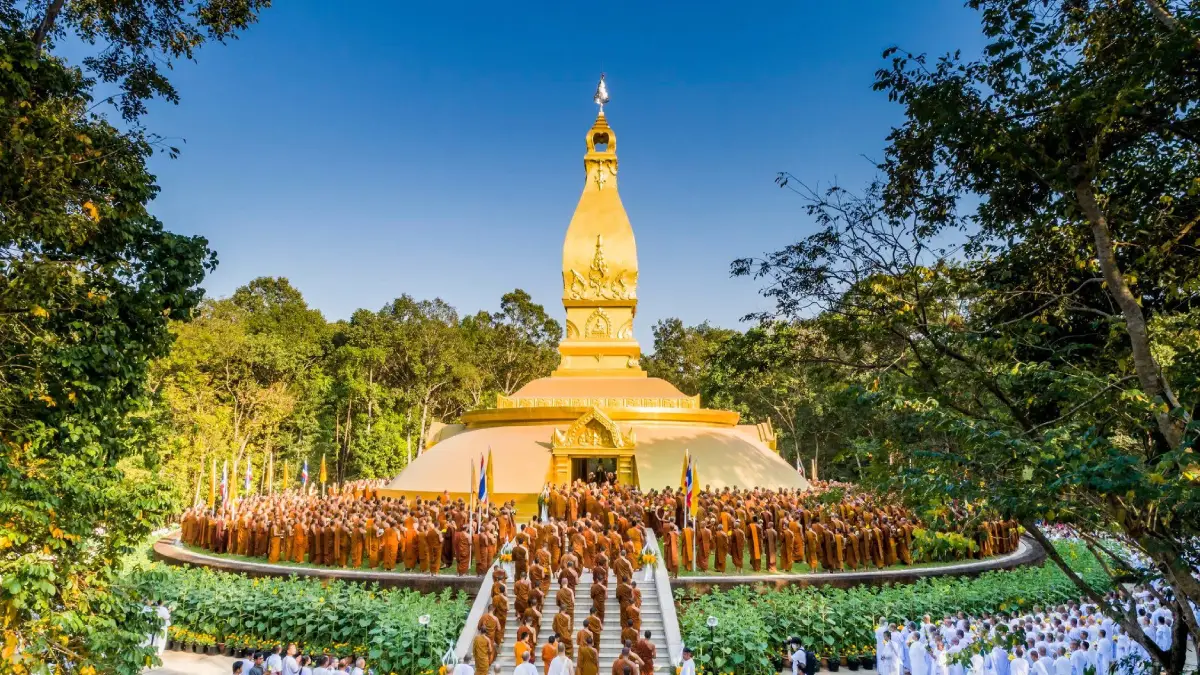
Inside Wat Nong Pah Pong, Phra Bodhinyanathera Museum is one of the most important places to visit. The museum presents objects connected with Ajahn Chah’s life and monastic practice, including personal requisites, monastic items, a wax figure, and displays that help visitors understand the simplicity of his life. The museum is not merely a collection of relics. It is a quiet educational space that shows how a great teacher lived with discipline, moderation, and deep commitment to the Dhamma. For foreign travelers, the museum offers a tangible introduction to Ajahn Chah’s life before encountering his teachings in books or recordings.
Another major landmark inside the monastery is Chedi Si Bodhinyana, an important memorial site associated with Ajahn Chah. Devotees and visitors come here to pay respect, reflect on his legacy, and connect with the living memory of his teachings. The chedi is a place of reverence rather than entertainment. Its significance is best appreciated slowly, with quiet attention. Visitors should move respectfully, keep their voices low, and allow the atmosphere of the place to guide their behavior.
The ordination hall and meditation areas of Wat Nong Pah Pong also reflect the spirit of a forest monastery. The architecture is simple and functional, designed to support monastic practice rather than impress visitors. Walking through these spaces, travelers can sense the discipline behind the monastery’s life. It is a place where Buddhist practice is not separated from daily conduct. The forest, buildings, pathways, and silence all work together to create a setting for training the mind.
The current abbot of Wat Nong Pah Pong is Phra Phrom Wachirayan Sophon, also known as Luang Por Liem Thitadhammo. He is a senior forest monk who continues the lineage and discipline of Ajahn Chah. His role is important because Wat Nong Pah Pong is not only a memorial site but an active monastery. Monks still live, practice, and train here. Visitors should remember that this is not a museum alone, but a living religious community.
Every January, Wat Nong Pah Pong becomes a major gathering place for the Ajahn Chah memorial observance, known in Thai as Achariya Bucha. Monks, novices, lay devotees, and disciples from many places come to practice, chant, listen to Dhamma talks, and pay respect to Ajahn Chah. This annual period reflects the strength of the teacher-student relationship within the Thai forest tradition. Travelers who visit during this time should be especially mindful of the monastery rules, as the temple becomes a major center of religious practice.
For ordinary travelers, Wat Nong Pah Pong is best visited slowly. A meaningful visit can begin with paying respect in the temple grounds, walking quietly under the trees, visiting Phra Bodhinyanathera Museum during opening hours, and then continuing to Chedi Si Bodhinyana. A rushed visit will miss the essence of the place. The monastery is designed to be felt as much as seen. Its value comes from atmosphere, restraint, and the opportunity to become quiet within oneself.
Clothing and behavior matter at Wat Nong Pah Pong. Visitors should dress modestly, covering shoulders and knees, and avoid clothing that is too short, tight, or flashy. Voices should be kept low. Photography should be respectful, especially near monks, meditation areas, or religious activities. Some parts of the monastery are reserved for monks or serious practice and should not be entered without permission. Respecting these boundaries is part of understanding the monastery correctly.
For foreign travelers, Wat Nong Pah Pong offers a different perspective on Thai temple culture. It is not a place centered on ritual tourism or photogenic decoration. Instead, it represents the practical, contemplative side of Thai Buddhism. The monastery helps visitors understand why the Thai Forest Tradition has had such a strong influence internationally: it is direct, disciplined, simple, and grounded in lived experience. Even travelers who are not Buddhist can appreciate the calm and sincerity of the place.
Wat Nong Pah Pong can be combined with nearby cultural and religious attractions in Warin Chamrap and Ubon Ratchathani. Wat Pah Nanachat is one of the closest and most relevant companion sites, especially for those interested in international Buddhist practice. In Ubon city, travelers can continue to Ubon Ratchathani National Museum, Thung Si Mueang, Wat Phra That Nong Bua, and Wat Ban Na Mueang. This route gives visitors a broader understanding of Ubon Ratchathani as a province of Buddhist heritage, local culture, and important monastic lineages.
Travelers who want to practice meditation or request a longer stay should clearly distinguish between a day visit and formal monastery residence. Day visitors can enter during visiting hours and respectfully tour the accessible areas. Staying for practice requires following the monastery’s rules and contacting the temple in advance. Wat Nong Pah Pong is a disciplined forest monastery, and those who wish to practice there must be prepared for simplicity, restraint, and respect for the monastic routine.
The best time to visit is in the morning or late afternoon, when the weather is more comfortable and the forest atmosphere is at its calmest. The morning visit gives travelers a sense of stillness and freshness. The afternoon works well for visiting the museum and walking quietly around the memorial areas. In the rainy season, the monastery grounds are lush and green. In the cool season, the atmosphere is especially pleasant for walking and contemplation.
Getting There is most convenient by private car, local taxi, or hired transport from Ubon Ratchathani city or Warin Chamrap. The monastery is approximately 13 – 18 km from central Ubon Ratchathani depending on the route. Travelers arriving by train can continue from Ubon Ratchathani Railway Station in Warin Chamrap by local transport. A private car is the most flexible option because it allows travelers to combine Wat Nong Pah Pong with Wat Pah Nanachat and other nearby sites in one trip.
Upon arrival, visitors should park in the designated area and enter the monastery quietly. Reading signs, observing local behavior, and following temple etiquette will make the visit smoother and more respectful. Wat Nong Pah Pong rewards attentive visitors. The more quietly one walks through the place, the more clearly its meaning appears.
Wat Nong Pah Pong is one of the places that reveals Ubon Ratchathani beyond its better-known festivals and city landmarks. It shows the province as a center of forest meditation, monastic discipline, and spiritual continuity. For travelers seeking a deeper cultural experience, this monastery is one of the most meaningful places to visit in northeastern Thailand.
| Name | Wat Nong Pah Pong |
| Location | Ban Phong Sawang, Moo 10, Non Phueng Subdistrict, Warin Chamrap District, Ubon Ratchathani Province |
| Address | Non Phueng Subdistrict, Warin Chamrap District, Ubon Ratchathani 34190, Thailand |
| Coordinates | 15.1554, 104.8234 |
| Highlights | A major Thai forest monastery founded by Ajahn Chah Subhatto, featuring Phra Bodhinyanathera Museum, Chedi Si Bodhinyana, and a peaceful forest setting for reflection and Buddhist learning |
| History | Ajahn Chah began developing the forest monastery in 1954. It later became a major center of Thai Forest Tradition and the model for many branch monasteries in Thailand and abroad |
| Name Origin | The name reflects the original landscape of the area, with natural wetlands and dense forest growth suitable for forest monastic practice |
| Distinctive Features | A quiet forest monastery focused on simplicity, monastic discipline, meditation practice, and Ajahn Chah’s Dhamma lineage |
| Travel Information | Located about 13 – 18 km from central Ubon Ratchathani depending on the route. Private car, local taxi, or hired transport is recommended |
| Current Status | Open to visitors and remains an active Thai forest monastery in Ubon Ratchathani Province |
| Open Days | The temple is open daily; Phra Bodhinyanathera Museum follows its own museum visiting hours |
| Opening Hours | Temple 05.00 – 18.00 / Phra Bodhinyanathera Museum 08.00 – 16.30 |
| Facilities | Parking and accessibility support for visitors with disabilities |
| Main Areas / Zones | Phra Bodhinyanathera Museum Chedi Si Bodhinyana Ordination Hall Dhamma Hall And Meditation Areas Shaded Forest Grounds |
| Abbot / Caretaker | Phra Phrom Wachirayan Sophon (Liem Thitadhammo) |
| Main Contact Number | 045-267-563 |
| Official Website / Official Page | www.ajahnchah.memorial |
| Nearby Tourist Attractions | 1. Wat Pah Nanachat, about 8 km 2. Ban Ta Tit Chrysanthemum Community Enterprise, about 7 km 3. Wat Ban Na Mueang, about 18 km 4. Ubon Ratchathani National Museum, about 18 km 5. Thung Si Mueang, about 18 km 6. Wat Phra That Nong Bua, about 21 km |
| Nearby Restaurants | 1. Somtum Chao Mor Warin Chamrap, about 6 km, Tel. 094-269-8050, 084-083-0105, 094-605-3266 2. Jane Moo Kratha Warin Chamrap, about 8 km, Tel. 094-225-9509 3. Krua 88 Warin Chamrap, about 8 km, Tel. 085-861-1397 4. Somtum Yai Lamduan Warin Chamrap, about 9 km, Tel. 086-871-2434 5. Krua Suki Boran Warin Chamrap, about 10 km, Tel. 080-760-3304 |
| Nearby Accommodations | 1. Rung Arun Hotel, about 6 km, Tel. 045-268-013 2. Tharnthip Resort, about 8 km, Tel. 089-849-1028 3. Ubon Nhamsub Resort, about 8 km, Tel. 085-491-6873, 087-561-0348, 081-709-6607 4. U-Place at Ubon Ratchathani University, about 11 km, Tel. 045-353-084 5. U Duay Gan Garden Home Ubon, about 13 km, Tel. 091-835-9784 6. Velawarin Hotel, about 13 km, Tel. 080-369-7639 |
Frequently Asked Questions (FAQ)
Q: Where is Wat Nong Pah Pong located?
A: Wat Nong Pah Pong is located in Ban Phong Sawang, Moo 10, Non Phueng Subdistrict, Warin Chamrap District, Ubon Ratchathani Province.
Q: What are the opening hours of Wat Nong Pah Pong?
A: The temple grounds are open daily from 05.00 to 18.00, while Phra Bodhinyanathera Museum is open from 08.00 to 16.30.
Q: Why is Wat Nong Pah Pong important?
A: It is the forest monastery founded by Ajahn Chah Subhatto and became the model for many Thai Forest Tradition branch monasteries in Thailand and overseas.
Q: What can visitors see inside Wat Nong Pah Pong?
A: Important areas include Phra Bodhinyanathera Museum, Chedi Si Bodhinyana, the ordination hall, Dhamma hall, meditation areas, and quiet shaded forest grounds.
Q: Who is the abbot of Wat Nong Pah Pong?
A: The abbot is Phra Phrom Wachirayan Sophon, also known as Luang Por Liem Thitadhammo.
Q: How should visitors dress at Wat Nong Pah Pong?
A: Visitors should dress modestly, covering shoulders and knees, speak quietly, and respect monks, meditation areas, and temple rules.
Q: How much time should travelers spend at Wat Nong Pah Pong?
A: Travelers should allow at least 1 to 2 hours to pay respect, walk through the monastery, visit the museum, and see Chedi Si Bodhinyana without rushing.
Q: What nearby places can be visited with Wat Nong Pah Pong?
A: Nearby places include Wat Pah Nanachat, Wat Ban Na Mueang, Ubon Ratchathani National Museum, Thung Si Mueang, and Wat Phra That Nong Bua.
Tel : 045267563
 Tel : 045267563
 Category: ●Places of Worship
 Group: ●Temple
Last Update : 3 MonthAgo
 Last Update : 3 MonthAgo
 Click to Access the Navigation Map GPS
Wat Nong Pah Pong Map
Recommend

 Art, Culture and Heritage
 Historical Sites and Monuments(5)
 Landmarks and Memorials(2)
 Royal Palace(1)
 Art, Craft Centres, Tradition(7)
 Museums(3)
Temple(37)
 Other Sacred Sites(4)
 Research and Development
 Royal Project(2)
 Suburban Living
 Village, Community(2)
 Local Market(4)
 Nature and Wildlife
 National Parks and Marine Reserves(5)
 Mountain (Doi)(6)
 Dam, Reservoir, Lake(8)
 Waterfalls(12)
 Hot Springs(1)
 Caves(2)
 River, Canal(11)
 Bays and Beaches(8)
 Islands(2)
 Other natural attractions(6)
 Entertainment and Agricultural
 Zoos and Aquariums(2)
 Animal camps and shows(1)
 Farms, Parks and Ecotourism(1)
 Waterpark(1)
 Travel Articles, Recipes
 Travel Review, Food Review(1)


