
lovethailand home >Northeastern Travel Attractions >Ubon Ratchathani Travel Attractions >Muang Ubon Ratchathani >Rai Noi > Wat Sa Prasan Suk
TL;DR: Wat Sa Prasan Suk is located at Ban Na Muang, Moo 2, Rai Noi Subdistrict, Mueang Ubon Ratchathani District, Ubon Ratchathani Province, open Daily, hours 07.00 – 19.00.
Wat Sa Prasan Suk
Open Days: Daily
Opening Hours: 07.00 – 19.00
Wat Sa Prasan Suk, also known as Wat Ban Na Muang, in Ubon Ratchathani is one of the most distinctive temples in northeastern Thailand. Located at Ban Na Muang, Moo 2, Rai Noi Subdistrict, Mueang Ubon Ratchathani District, the temple is widely recognized for its extraordinary boat-shaped ordination hall built in the form of the Suphannahong Royal Barge and decorated with reddish-brown ceramic. The temple also features the Thammanakkharat Naga water vihara, a grand entrance arch with Indra riding the three-headed Erawan elephant, a ceramic-decorated bell tower, the Luang Pu Bunmi Museum, and peaceful temple grounds suitable for worship, photography, cultural learning, and a slow visit. For international travelers, this temple offers one of the clearest examples of contemporary Thai-Isan Buddhist architecture, where faith, symbolism, craftsmanship, and local imagination are brought together in a memorable religious landscape.
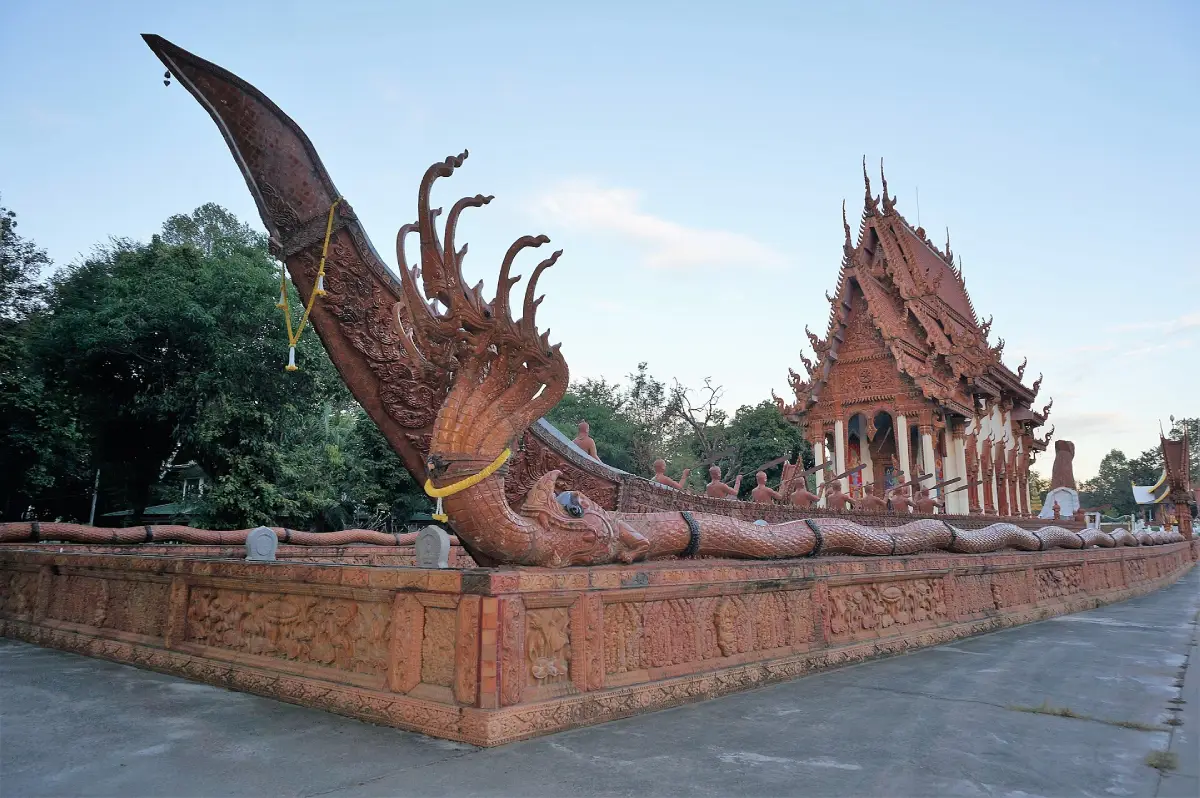
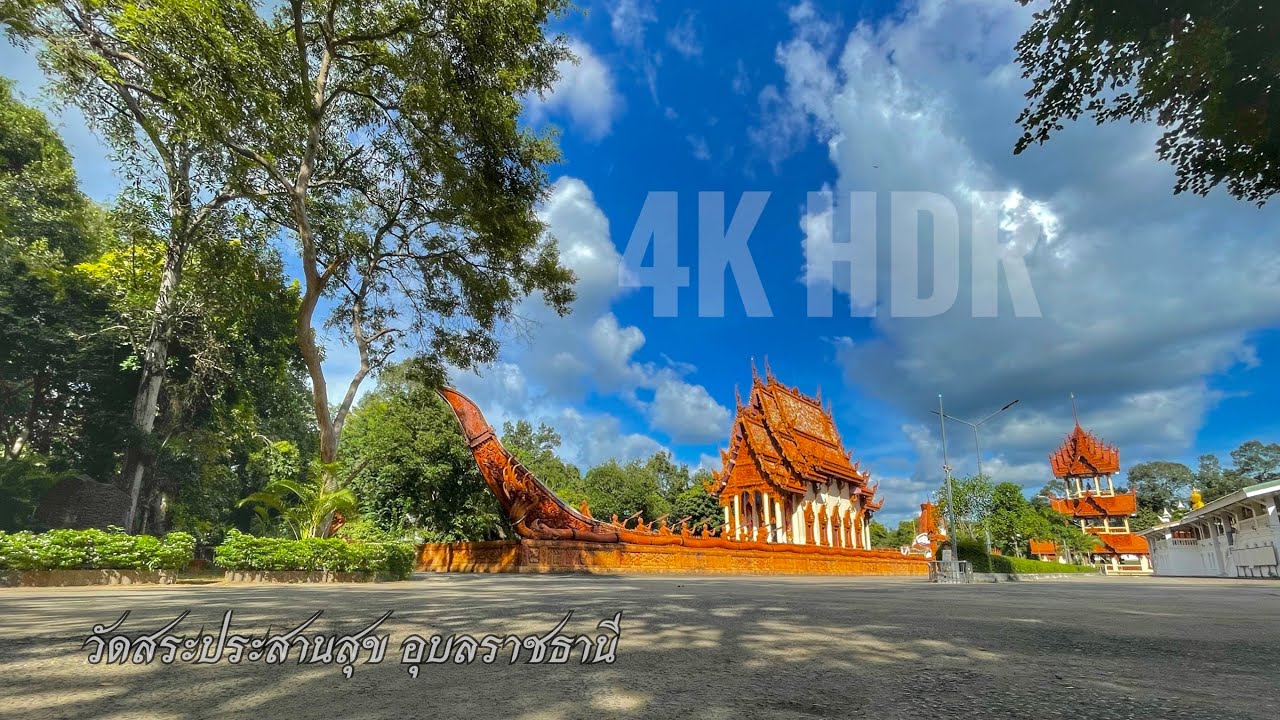
The most famous landmark of Wat Sa Prasan Suk is the Suphannahong Royal Barge Ubosot. Instead of following the plain rectangular form of many temple halls, this ordination hall is set on a large barge-like base, with the prow and stern rising dramatically. The reddish-brown ceramic decoration creates a strong visual identity, while the carved details make the structure look almost like a monumental sculpture. From a distance, the building appears as a sacred royal barge standing on the temple ground. Up close, visitors can appreciate the ceramic texture, the careful decorative work, and the way Thai temple architecture has been reinterpreted through a powerful symbolic form. This is the reason the temple is frequently called the boat temple of Ubon Ratchathani.
The use of the Suphannahong Royal Barge form is not only decorative. In Thai Buddhist interpretation, the image of a boat can suggest a journey across the sea of suffering toward the shore of wisdom and peace. By shaping the ordination hall as a sacred boat, the temple gives its religious architecture a deeper meaning. Visitors who come only for photography will immediately notice the spectacular form, but those who spend more time with the site will also understand how the structure represents spiritual travel, merit-making, discipline, and the movement of the mind toward calmness. The building is therefore both an architectural highlight and a visual teaching.
Wat Sa Prasan Suk is closely connected with Luang Pu Bunmi Chotipalo, also known as Phra Phawana Wisalathera, a highly respected meditation monk of Ubon Ratchathani. He played a central role in developing the temple and became deeply revered by local people and devotees from nearby provinces. His reputation came from disciplined conduct, devotion to Buddhist practice, and his role in making the temple a place of faith and merit. After his passing, his body was enshrined for public veneration inside the temple. This makes Wat Sa Prasan Suk more than a visually unusual temple. It is also a living place of memory and devotion linked to one of the important monk figures of the province.
The temple developed within the Ban Na Muang community in Rai Noi Subdistrict, north of central Ubon Ratchathani. Its early foundation is associated with Phra Sasanadilok (Sen), the preceptor of Luang Pu Bunmi Chotipalo. Later, Luang Pu Bunmi continued to develop the temple with strong support from villagers, lay followers, and disciples. Over time, Wat Sa Prasan Suk grew from a local community temple into a well-known religious and cultural landmark. The temple’s buildings and sculptural forms reflect the power of collective faith. They were not created only as tourist attractions, but as physical expressions of Buddhist devotion, local identity, and the wish to make the temple a place where people could approach the Dhamma with confidence and joy.
The Suphannahong Ubosot is the main religious structure of the temple. It functions as an ordination hall and a sacred space for Buddhist rituals. The barge-shaped base gives the hall a dramatic profile, while the layered roof and Thai decorative elements preserve the identity of a Buddhist temple building. The ceramic surface changes in appearance depending on the light. In the morning and late afternoon, the warm tones of the ceramic are especially beautiful. Visitors should dress modestly, remove shoes before entering religious buildings, and maintain a respectful attitude because the building is not only a photogenic landmark but also an active sacred space.
Another major highlight is the Thammanakkharat Naga water vihara. This structure stands in the middle of a pond and is shaped around the figure of a five-headed Naga. In Isan and the Mekong cultural world, the Naga is an important symbol connected with water, protection, fertility, spiritual power, and Buddhism. The Naga form at Wat Sa Prasan Suk gives the water vihara a strong regional identity. Visitors walk toward the building through a path associated with the body or tail of the Naga, creating the feeling of entering a sacred space protected by a mythical serpent. The pond, reflection, and sculptural form make this one of the most atmospheric areas of the temple.
The water around the vihara adds calmness to the temple experience. The Naga form, the reflection of the structure, and the quiet pond create a sense of sacred movement and stillness at the same time. This area is especially beautiful in soft light. Travelers who want good photographs should visit in the morning or late afternoon, but the deeper value of the site comes from understanding how water, Naga symbolism, and Buddhist worship are linked in local culture. The structure shows how Isan Buddhist art often connects religion with the natural and mythic world of the Mekong region.
The entrance arch of Indra riding the three-headed Erawan elephant is another unforgettable element of Wat Sa Prasan Suk. The arch stands at the entrance to the temple and immediately creates a sense of ceremony. In Thai and Buddhist-influenced visual culture, Erawan is a powerful and auspicious symbol. Passing under the elephant arch is popularly regarded as an auspicious act before entering the temple grounds. The arch therefore works as more than a gateway. It marks the transition from ordinary space into a religious area and gives visitors a memorable first impression of the temple’s symbolic language.
The ceramic-decorated bell tower continues the visual style of the temple. Like the Ubosot, it uses ceramic ornamentation to create unity across the temple grounds. A bell tower in a Buddhist temple is connected with time, awareness, merit-making, and the rhythm of monastic life. At Wat Sa Prasan Suk, the bell tower is also part of the artistic identity of the temple. It helps complete the experience of walking through a temple where every major structure has been shaped with a strong visual concept.
The Luang Pu Bunmi Museum is one of the most meaningful areas of the temple. It contains objects and spaces associated with Luang Pu Bunmi Chotipalo and serves as a place where devotees pay respect to his memory. For visitors, this area explains why the temple has such strong emotional importance for local people. The spectacular architecture may attract travelers at first, but the museum reveals the spiritual foundation behind the place. The temple’s beauty was built on faith, discipline, and the respect that the community had for Luang Pu Bunmi’s life and teachings.
Luang Pu Bunmi was known as a monk of disciplined practice and simple conduct. His influence shaped the character of the temple. Wat Sa Prasan Suk is therefore not merely a decorative temple with unusual buildings. It is a religious community that grew around meditation practice, Buddhist discipline, and the confidence of laypeople. The structures inside the temple support faith, but the heart of the place remains devotion to Buddhist practice and remembrance of a respected monk. Visitors who take time to learn about Luang Pu Bunmi will understand the temple much more deeply.
The overall atmosphere of Wat Sa Prasan Suk is peaceful and shaded. Even though the temple has become popular as a photographic destination, it remains a place of worship and local merit-making. Trees, open spaces, religious buildings, and water features create an environment suitable for slow walking. Families, students, and cultural travelers can use the temple as a learning site for Thai Buddhist symbolism, Isan Naga belief, contemporary temple design, and the role of monks in community life. The temple is visually easy to enjoy, but it also rewards careful observation.
Wat Sa Prasan Suk is suitable for several kinds of visitors. Buddhist travelers come to make merit and pay respect. Architecture lovers come to see how traditional temple forms have been reimagined through the image of a royal barge and Naga vessel. Photographers come for the dramatic shapes of the Ubosot, the water vihara, the Erawan elephant gate, and the bell tower. Travelers interested in local religious history come to learn about Luang Pu Bunmi Chotipalo. International visitors come to see a temple that expresses Isan Buddhist culture in a vivid and accessible way.
The temple can easily be included in a cultural route around Ubon Ratchathani. It is located not far from the city and can be paired with Ban Kan Lueang Archaeological Open Museum, Wat Ban Kan Lueang, Wat Phra That Nong Bua, Ubon Ratchathani Zoo, Thung Si Mueang, and Ubon Ratchathani National Museum. A good route can begin at Wat Sa Prasan Suk in the morning, continue to nearby archaeological or temple sites, and then return to the old city area in the afternoon. This gives travelers a fuller view of Ubon Ratchathani: religious architecture, archaeology, city history, and local faith all appear within one day.
Getting There is straightforward from Ubon Ratchathani city. Travelers can take Highway 231 in the same direction as Wat Ban Kan Lueang. After passing Wat Ban Kan Lueang, continue to the intersection leading toward Trakan Phuet Phon and turn right onto Highway 2050, the route toward the airport. Wat Sa Prasan Suk is on the left-hand side in the Ban Na Muang area. The temple is close enough to the city for a short visit by private car, taxi, local hired vehicle, or ride-hailing service. Travelers staying in central Ubon Ratchathani can include it easily in a half-day itinerary.
The best times to visit are morning and late afternoon. Morning is quiet and suitable for worship, while late afternoon gives warmer light for photography. The reddish ceramic surface of the boat-shaped Ubosot is particularly attractive when the sunlight is soft. Visitors who want to see the major areas should allow at least 1 to 2 hours. This gives enough time to pass through the Erawan elephant arch, visit the Suphannahong Ubosot, walk to the Naga water vihara, see the bell tower, and pay respect at the Luang Pu Bunmi Museum.
Wat Sa Prasan Suk is open daily from 07.00 to 19.00 and admission is free. Visitors may enter the temple grounds, worship, make merit, and enjoy the architecture without buying a ticket. Because the temple is still an active Buddhist place, proper etiquette is important. Travelers should dress modestly, remove shoes before entering religious buildings, keep voices low, avoid touching sacred objects or display items without permission, and not climb on decorative structures. Photography is appropriate in general outdoor areas, but visitors should be careful inside religious buildings and around spaces where people are praying.
For foreign travelers, Wat Sa Prasan Suk is a strong introduction to contemporary Thai temple creativity. The temple shows that Buddhist architecture in Thailand is not fixed in one form. It can use ancient symbols in new ways. The Suphannahong barge suggests spiritual travel. The Naga water vihara reflects the world of Isan and Mekong beliefs. The Erawan elephant arch expresses auspicious entry. The Luang Pu Bunmi Museum connects architecture with the memory of a revered monk. All of these elements make the temple easy to appreciate visually and meaningful to understand culturally.
The temple also helps visitors understand the relationship between local faith and tourism. Many people first come because they have seen photographs of the boat-shaped ordination hall. Once they arrive, they discover a deeper place: a living temple, a local community site, a place of worship, and a memorial to Luang Pu Bunmi. This balance between visual attraction and religious meaning is what gives Wat Sa Prasan Suk its lasting value. It is a temple that offers beauty, but it also asks visitors to approach that beauty with respect.
Within the broader image of Ubon Ratchathani, Wat Sa Prasan Suk adds another dimension to the province’s cultural identity. Ubon is known for the Candle Festival, historic temples, old-city museums, and Buddhist devotion. Wat Sa Prasan Suk shows the creative and contemporary side of that identity. It transforms familiar Buddhist symbols into large-scale architecture that visitors can walk through and experience directly. For travelers seeking both photographs and cultural understanding, this temple is one of the most rewarding stops in Ubon Ratchathani.
The strength of Wat Sa Prasan Suk lies in the way it combines scale, symbolism, and calmness. The Suphannahong Ubosot feels grand. The Naga water vihara feels sacred. The Erawan elephant gate feels auspicious. The Luang Pu Bunmi Museum feels intimate and devotional. Together, these areas create a temple experience that is visually memorable and spiritually grounded. A visit here is not only a chance to see an unusual temple; it is a chance to understand how faith, craft, community, and local identity can be shaped into architecture.
| Name | Wat Sa Prasan Suk / Wat Ban Na Muang |
| Location | Ban Na Muang, Moo 2, Rai Noi Subdistrict, Mueang Ubon Ratchathani District, Ubon Ratchathani Province |
| Address | Ban Na Muang, Moo 2, Rai Noi, Mueang Ubon Ratchathani, Ubon Ratchathani 34000, Thailand |
| Map Location | Search For Wat Sa Prasan Suk Or Wat Ban Na Muang On Online Maps |
| Highlights | Suphannahong Royal Barge Ubosot, Thammanakkharat Naga Water Vihara, Indra On The Three-Headed Erawan Elephant Gate, Ceramic Bell Tower And Luang Pu Bunmi Museum |
| History | A temple in the Ban Na Muang community associated with Phra Sasanadilok (Sen) and later developed by Luang Pu Bunmi Chotipalo, a revered meditation monk of Ubon Ratchathani. |
| Name Origin | Wat Sa Prasan Suk reflects the temple’s peaceful atmosphere and water features, while Wat Ban Na Muang refers to the Ban Na Muang community where the temple is located. |
| Distinctive Features | A contemporary Thai-Isan Buddhist temple using the forms of the Suphannahong royal barge, Naga, Erawan elephant, and ceramic decoration as major architectural symbols. |
| Travel Information | From Ubon Ratchathani city, take Highway 231 in the same direction as Wat Ban Kan Lueang, then turn right onto Highway 2050 toward the airport. The temple is on the left in Ban Na Muang. |
| Current Status | Open To Visitors And Still Used As An Active Buddhist Temple In The Ban Na Muang Area |
| Open Days | Daily |
| Opening Hours | 07.00 – 19.00 |
| Fees | Free Admission |
| Facilities | Temple parking area, worship spaces, walkways, photography areas, restrooms, and shaded areas within the temple grounds |
| Main Areas / Zones | Suphannahong Royal Barge Ubosot Thammanakkharat Naga Water Vihara Indra On The Three-Headed Erawan Elephant Gate Ceramic Bell Tower Luang Pu Bunmi Museum Buddha Worship Area Shaded Temple Grounds |
| Caretaker | Wat Sa Prasan Suk, The Temple Monastic Community And Ban Na Muang Community |
| Important Former Abbot | Phra Phawana Wisalathera, also known as Luang Pu Bunmi Chotipalo, a revered former abbot who played a major role in developing the temple. |
| Nearby Tourist Attractions | 1. Ban Kan Lueang Archaeological Open Museum, About 3 km 2. Wat Ban Kan Lueang, About 3 km 3. Wat Phra That Nong Bua, About 5 km 4. Ubon Ratchathani Zoo, About 6 km 5. Thung Si Mueang, About 7 km 6. Ubon Ratchathani National Museum, About 8 km |
| Nearby Restaurants | 1. Yum Krua Zab Lert Ros Ban Na Muang, About 0.5 km, Tel. 091-830-4125 2. Ari Papaya Salad Ban Na Muang, About 0.7 km, Tel. 082-215-4579 3. Mustache Coffee Ban Na Muang Intersection Branch, About 1 km, Tel. 090-269-7655 4. Stewed Noodles Rai Noi Market, About 3 km, Tel. 064-678-3519 5. Amphawa Noodle Rai Noi, About 3 km, Tel. 097-268-4493 6. Grillbro BBQ Rai Noi, About 3 km, Tel. 098-149-5626 |
| Nearby Accommodations | 1. A+ Hotel Ubon Ratchathani, About 4 km, Tel. 080-544-7888 2. B2 Ubon Ratchathani Airport Premier Hotel, About 4 km, Tel. 045-950-881 3. Preme Village, About 5 km, Tel. 093-498-3224 4. Wangnong Resort Ubon Ratchathani, About 6 km, Tel. 094-291-5419 5. Sunee Grand Hotel & Convention Center, About 6 km, Tel. 045-352-900 6. V Hotel Ubon, About 7 km, Tel. 097-334-4480 |
Frequently Asked Questions (FAQ)
Q: Where is Wat Sa Prasan Suk located?
A: Wat Sa Prasan Suk, also known as Wat Ban Na Muang, is located at Ban Na Muang, Moo 2, Rai Noi Subdistrict, Mueang Ubon Ratchathani District, Ubon Ratchathani Province.
Q: What are the opening hours of Wat Sa Prasan Suk?
A: The temple is open daily from 07.00 to 19.00.
Q: Is there an admission fee?
A: No. Admission to Wat Sa Prasan Suk is free.
Q: What is Wat Sa Prasan Suk famous for?
A: The temple is famous for its Suphannahong Royal Barge Ubosot, Thammanakkharat Naga water vihara, Indra on the three-headed Erawan elephant gate, ceramic bell tower, and Luang Pu Bunmi Museum.
Q: Who was Luang Pu Bunmi Chotipalo?
A: Luang Pu Bunmi Chotipalo, also known as Phra Phawana Wisalathera, was an important former abbot and revered meditation monk who played a major role in developing Wat Sa Prasan Suk.
Q: How long should visitors spend at Wat Sa Prasan Suk?
A: Visitors should allow about 1 to 2 hours to see the Erawan elephant gate, Suphannahong Ubosot, Naga water vihara, bell tower, and Luang Pu Bunmi Museum.
Q: How do travelers get to Wat Sa Prasan Suk?
A: From central Ubon Ratchathani, take Highway 231 toward Wat Ban Kan Lueang, then turn right onto Highway 2050 toward the airport. The temple is on the left in Ban Na Muang.
Q: What nearby attractions can be visited after Wat Sa Prasan Suk?
A: Nearby attractions include Ban Kan Lueang Archaeological Open Museum, Wat Ban Kan Lueang, Wat Phra That Nong Bua, Ubon Ratchathani Zoo, Thung Si Mueang, and Ubon Ratchathani National Museum.
 Category: ●Places of Worship
 Group: ●Temple
Last Update : 3 MonthAgo
 Last Update : 3 MonthAgo
 Click to Access the Navigation Map GPS
Wat Sa Prasan Suk Map
Recommend

 Art, Culture and Heritage
 Historical Sites and Monuments(5)
 Landmarks and Memorials(2)
 Royal Palace(1)
 Art, Craft Centres, Tradition(7)
 Museums(3)
Temple(37)
 Other Sacred Sites(4)
 Research and Development
 Royal Project(2)
 Suburban Living
 Village, Community(2)
 Local Market(4)
 Nature and Wildlife
 National Parks and Marine Reserves(5)
 Mountain (Doi)(6)
 Dam, Reservoir, Lake(8)
 Waterfalls(12)
 Hot Springs(1)
 Caves(2)
 River, Canal(11)
 Bays and Beaches(8)
 Islands(2)
 Other natural attractions(6)
 Entertainment and Agricultural
 Zoos and Aquariums(2)
 Animal camps and shows(1)
 Farms, Parks and Ecotourism(1)
 Waterpark(1)
 Travel Articles, Recipes
 Travel Review, Food Review(1)


