
lovethailand home >Northeastern Travel Attractions >Si Sa Ket Travel Attractions >Kan Thora Rak >Kra Chaeng > Sisa Asoke Buddhist Center
TL;DR: Sisa Asoke Buddhist Center is located at Moo 15, Ban Sisa Asoke, Krachaeng Subdistrict, Kantharalak District, Si Sa Ket Province 33110, Thailand, open Daily, hours 06.00 - 17.00.
Sisa Asoke Buddhist Center
Open Days: Daily
Opening Hours: 06.00 - 17.00
Sisa Asoke Buddhist Center, Si Sa Ket, is located at Moo 15, Ban Sisa Asoke, Krachaeng Subdistrict, Kantharalak District, Si Sa Ket Province. It is a Buddhist practice center, an intentional community, a study-visit destination, and a living learning site for the Boonniyom way of life. Unlike conventional tourist temples that are visited mainly for large statues, ornate halls, or ceremonial spectacle, Sisa Asoke is known for simplicity, discipline, vegetarian living, non-toxic agriculture, community self-reliance, and a daily life shaped by Buddhist precepts. Visitors come here to study how Dhamma can be practiced through work, food, education, farming, community organization, and ethical living.
The central value of Sisa Asoke is practical Buddhism. Here, religion is not limited to chanting, worship, or sermons. It appears in the rhythm of everyday life: morning and evening practice, communal cleaning, shared work, vegetarian cooking, organic farming, community products, school activities, and the refusal of intoxicants and harmful habits. The site therefore offers a rare opportunity to see Buddhist principles translated into a functioning community system rather than kept only as ideas in books.
The history of Sisa Asoke began in 1974 when samanas from Santi Asoke traveled to the public cemetery area of Ban Krachaeng, a place used by local people for burial and cremation. The area was about 5 kilometers from Kantharalak town toward Si Sa Ket city. In the beginning, many villagers approached the monks with expectations shaped by older beliefs, such as asking for lottery numbers or supernatural help. The Asoke samanas used that encounter as an opportunity to teach a different form of Dhamma: keeping the Five Precepts and Eight Precepts, reducing and abandoning intoxicants, gambling, drugs, smoking, and other harmful habits, and developing compassion through vegetarian practice.
By 1976, the number of practitioners had grown. Devotees from Si Sa Ket and nearby provinces helped build the Buddhist center in the place once locally known as the cemetery. Samanas from Santi Asoke stayed there regularly and took turns residing during the rains retreat. On Buddhist observance days, lay supporters came together to plant trees, build a simple Dhamma hall, create a modest chapel, construct small forest huts between trees, improve the walking meditation areas, and provide toilets and basic facilities. The early development of Sisa Asoke shows its essential character: it was built not for luxury, but for training, discipline, and shared effort.
One of the most important early activities was the annual Dhamma training event first organized on Makha Bucha Day in 1976. The event became known as “Pluk Sek Phra Thae Thae Khong Phut,” meaning the consecration of true noble people in the Buddhist sense. The phrase does not refer to the making of amulets. It means training human beings to become more noble through conduct. Participants practiced the Eight Precepts, ate vegetarian food once a day, did not wear shoes, and trained themselves through strict discipline. The event later shifted to April before Songkran and has continued as a major annual tradition of the community.
The heart of Sisa Asoke is training life to reduce attachment, extravagance, and harmful habits. Study visitors see that the community emphasizes freedom from vices, simple eating, shared work, non-chemical farming, moral education, and disciplined community life. These principles are not taught only in lecture form. They are visible in daily work such as growing vegetables, preparing vegetarian meals, producing herbal products, running a community store, maintaining schools, and receiving outside study groups.
In 1987, Dhamma practitioners in Si Sa Ket and nearby provinces became more closely connected with Sisa Asoke. Monthly observance gatherings were organized on the first Saturday and Sunday of each month, and participants stayed overnight. A group of young learners known as “Saeng Saew Noi Rian Tham” also received weekly training. Some lay supporters wanted to live near the Buddhist center, so they created a community called “Buddhadhamma Village,” modeled partly on Pathom Asoke. This allowed practitioners to live close to the center and apply Buddhist principles in daily household life.
The rules of Buddhadhamma Village express the Asoke way of life clearly. Members are expected to keep at least the Five Precepts, abandon vices, eat vegetarian food no more than twice a day, avoid certain private electrical appliances, avoid keeping animals, avoid personal profit-seeking businesses inside the village, and avoid superstition-based practices such as spirit possession, fortune-telling, occult objects, and magic. The purpose is to train simplicity, reduce possession, avoid distractions, and build a community whose central value is Dhamma rather than consumption.
Daily life at Sisa Asoke is a form of continuous practice. Community members follow routines such as morning chanting, cleaning the Buddhist center, studying Dhamma, working for the common good, producing food and goods, evening practice, and caring for shared spaces. Resources are handled with restraint and a strong emphasis on collective benefit. The community’s philosophy is to use what is truly useful, save what can be saved, avoid waste, and direct labor toward shared well-being rather than personal accumulation.
Non-toxic agriculture is one of the strongest identities of Sisa Asoke. The community began serious natural farming after land was acquired for collective use. Members grew rice, vegetables, fruit trees, mushrooms, and forests, while also making biological fertilizer and reducing chemical dependence. Because the community is rooted in compassion and vegetarian living, farming is not treated only as food production. It is part of a moral system that aims to avoid harm, build self-reliance, and create healthy food for the community.
Visitors can also find community products and non-toxic agricultural goods for sale. These are not sold merely as tourist souvenirs. They represent the labor and values of the community. Products may include brown rice, vegetables, mushrooms, herbal goods, natural household products, and other practical items produced within or associated with the community. Buying these goods allows visitors to support a system of livelihood based on honest work, restraint, and shared benefit.
Education is another major dimension of Sisa Asoke. The community developed schools based on the Sammāsikkhā and Sammā-ājīva approaches, including Sammāsikkhā Sisa Asoke School and Sammā-ājīva Sikkhā Sisa Asoke. These schools combine academic learning, moral training, practical work, community responsibility, and simple living. The educational system reflects the Thai idea of “Ban-Wat-Rongrian,” or home, temple, and school, merged into one living community with religion as the ethical center.
For study groups, Sisa Asoke is suitable for students, government agencies, organic farming groups, vegetarian communities, community-development groups, moral education programs, and anyone interested in self-reliant living. A visit can include learning about community organization, food systems, farming, ethical education, household production, Dhamma practice, and the relationship between spiritual discipline and community sustainability. The experience is most valuable when visitors approach the place with respect and a willingness to understand a way of life that differs from consumer culture.
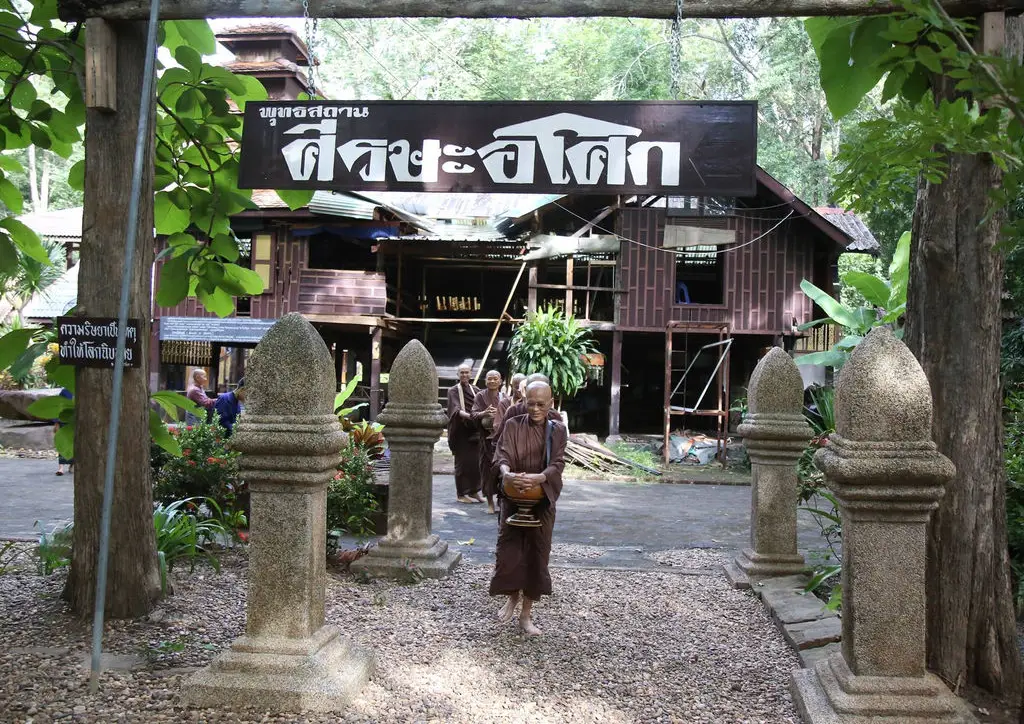
The physical atmosphere of Sisa Asoke is simple but systematic. Visitors may see wooden buildings, Dhamma halls, communal work areas, a vegetarian kitchen, community shops, farming areas, schools, accommodation zones, and shaded spaces under large trees. The place is not a resort or a theme park. It is a working community. Visitors should therefore respect private areas, avoid entering residential or monastic zones without permission, and ask before photographing people.
Sisa Asoke is best understood as a living classroom. Walking through the community, visitors can observe how Buddhist precepts affect diet, work, trade, education, and environmental care. The practice of vegetarianism, for example, is not only a health choice. It is connected with compassion, non-harming, discipline, and reduced attachment to taste. Organic farming is not only agricultural technique. It is linked with self-reliance, community food security, and respect for the natural world.
The community’s environmental approach is grounded in restraint and careful use of resources. Tree planting, vegetable growing, composting, herbal products, reduced chemical use, and shared labor all show that sustainability begins with disciplined people. Sisa Asoke demonstrates that ecological practice does not need to begin with expensive technology. It can begin with simple habits, common work, reduced desire, and respect for life.
The local economy of Sisa Asoke also follows its own logic. The goal is not personal profit maximization but collective survival, usefulness, and ethical livelihood. Activities such as rice milling, herbal products, mushroom cultivation, vegetable production, community retail, and simple household goods are linked with daily needs. This makes Sisa Asoke a valuable example for those studying alternative economics, community enterprise, and livelihood systems based on morality.
Leadership within the Asoke community emphasizes service rather than command. People are respected because of their conduct, sacrifice, and usefulness to the community. This shows visitors that community development does not always begin with capital, status, or official authority. It can begin with people who keep discipline, work hard, live simply, and dedicate themselves to shared benefit. This is one of the strongest lessons of Sisa Asoke as a study-visit destination.
Visitors should follow appropriate etiquette. Modest clothing is expected. Smoking, alcohol, intoxicants, gambling, and disruptive behavior do not belong in the area. Visitors should avoid bringing meat-based food into the community, should speak quietly, should not litter, and should respect the vegetarian way of life. These practices help preserve the atmosphere of the Buddhist center and allow the community to continue its daily routine without disturbance.
Those who wish to stay longer or study as temporary guests are expected to accept basic principles such as keeping the Five Precepts, avoiding vices, eating vegetarian food no more than twice a day, and helping with suitable community work. Staying at Sisa Asoke is therefore different from staying at a hotel. It is a form of learning through participation, discipline, simplicity, and shared responsibility.
Sisa Asoke is located in Kantharalak District, an important district of southeastern Si Sa Ket. The district includes markets, restaurants, hotels, government offices, and routes to natural and historical attractions such as Kaeng Tat Hin, Kaeng Tawan, Nam Tok Sida, Prasat Don Tuan, Wat Phu Sam Sawan, Wat Tham Samroeng Phutthasiri, and the Phanom Dong Rak borderland landscape. This makes Sisa Asoke suitable for a half-day or full-day learning route combined with local attractions in Kantharalak.
Getting There from Si Sa Ket city is straightforward. Take the Si Sa Ket - Kantharalak road toward Kantharalak District, about 60 to 65 kilometers by road. From Kantharalak town, continue to Krachaeng Subdistrict and Ban Sisa Asoke, about 5 kilometers away. Private car, van, or hired local transport is the most convenient option. Groups planning a formal study visit should contact the Buddhist center in advance so that the visit can be organized properly.
From Kantharalak town, the trip to Ban Sisa Asoke takes only a short time. The center is close enough to town for visitors to access restaurants, accommodation, shops, and basic services. Travelers can stay in Kantharalak and visit Sisa Asoke in the morning, or travel from Si Sa Ket city as a day trip. A meaningful study visit should allow at least two to three hours for walking through the main areas, listening to explanations, observing community work, and purchasing non-toxic products.
The best time to visit is in the morning, when the weather is cooler and community activities are easier to observe. Morning visits may show communal work, food preparation, agricultural activity, and general daily rhythm. Afternoon visits are also possible, especially for product purchases or shorter observation, but visitors should avoid disturbing chanting, meetings, study sessions, or internal community routines. The proper pace for visiting Sisa Asoke is quiet, respectful, and attentive.
There is no fixed tourist admission fee at Sisa Asoke Buddhist Center. Visitors may enter during opening hours in the areas open to the public. Donations, support for community products, and purchases of non-toxic agricultural goods are voluntary. This keeps the place closer to a Buddhist learning community than a commercial tourist attraction. Visitors should treat the area as a living community with spiritual discipline, not as an entertainment venue.
For international visitors, Sisa Asoke offers a different view of Thai Buddhism. It is not centered on grand statues, golden stupas, or elaborate ceremonies. It shows Buddhism as a disciplined way of life: vegetarian food, shared labor, organic farming, communal education, reduced consumption, and moral self-training. Foreign travelers interested in practical Buddhism, intentional communities, organic agriculture, vegetarian culture, and alternative ways of living will find Sisa Asoke highly meaningful.
Sisa Asoke has several layers of value. It is a Buddhist center for Dhamma practice, a Boonniyom community, an organic farming learning site, a vegetarian lifestyle community, a school-based community model, a place for study visits, and a cultural destination in Kantharalak District. Its importance does not come from architectural grandeur but from the consistency between its teachings and its way of life.
In summary, Sisa Asoke Buddhist Center is an essential learning destination in Si Sa Ket for those interested in Dhamma, community life, organic farming, vegetarian practice, and self-reliant living. Its story begins in the former cemetery area of Ban Krachaeng, develops through the creation of a simple Buddhist center, expands into Buddhadhamma Village, and continues today as a Boonniyom community with schools, agriculture, study visits, and community products. A visit here offers calm, insight, and a practical example of how Buddhist values can shape an entire way of life.
| Place Name | Sisa Asoke Buddhist Center, Si Sa Ket |
| Related Names | Sisa Asoke Buddhist Center, Ban Sisa Asoke, Boonniyom Sisa Asoke Community, Buddhadhamma Village, Sisa Asoke Non-Toxic Agriculture, Sammāsikkhā Sisa Asoke |
| Place Type | Buddhist Practice Center, Boonniyom Community, Study-Visit Destination, Non-Toxic Agriculture Learning Site, Vegetarian Community, And Community Product Center |
| Location | Moo 15, Ban Sisa Asoke, Krachaeng Subdistrict, Kantharalak District, Si Sa Ket Province 33110, Thailand |
| Setting | Located in Ban Sisa Asoke, about 5 km from Kantharalak town and on the route linking Si Sa Ket city with Kantharalak District |
| Distance From Key Points | About 5 km from Kantharalak town and about 60 - 65 km from Si Sa Ket city by the Si Sa Ket - Kantharalak road |
| Significance | A Buddhist center and Boonniyom community where visitors can study Dhamma practice, precept-based living, vegetarianism, non-toxic agriculture, self-reliance, and community education |
| Historical Summary | The center began when Santi Asoke samanas camped at the public cemetery of Ban Krachaeng in 1974. In 1976, more practitioners joined and helped build a simple Buddhist center. In 1987, Buddhadhamma Village was formed and later developed into the Boonniyom Sisa Asoke community with Buddhist practice, schools, non-toxic agriculture, and study visits as key elements. |
| Main Practice Principles | Keeping the Five Precepts and Eight Precepts, abandoning vices, eating vegetarian food, living simply, working for the common good, practicing self-reliance, doing non-toxic agriculture, and building a community with religion as its ethical center |
| Caretaker / Contact Body | Sisa Asoke Buddhist Center And Boonniyom Sisa Asoke Community |
| Current Status | Open as a Buddhist practice place, study-visit site, non-toxic agriculture learning center, and community product center |
| Open Days | Daily |
| Opening Hours | 06.00 - 17.00 |
| Admission Fee | Free Admission. Donations, support for community products, and purchases of non-toxic agricultural goods are voluntary. |
| Main Activities | Annual Dhamma training, monthly observance gatherings, chanting, Dhamma listening, study visits, non-toxic agriculture, community production, vegetarian cooking, and Boonniyom lifestyle learning |
| Main Areas / Zones | 1. Buddhist Center And Dhamma Hall Zone 2. Chanting And Practice Area 3. Boonniyom Sisa Asoke Community Zone 4. Buddhadhamma Village Zone 5. Non-Toxic Agriculture Zone 6. Vegetable Plots And Community Food Production Zone 7. Community Shop And Non-Toxic Product Zone 8. Sammāsikkhā Sisa Asoke School Zone 9. Sammā-Ājīva Sikkhā Sisa Asoke School Zone 10. Vegetarian Kitchen Zone 11. Study-Visit Learning Zone 12. Quiet Shaded Community Area |
| Facilities | Study-visit reception area, Dhamma hall, community shop, non-toxic product sales area, farming areas, parking arranged by the community, toilets, and basic services in Kantharalak town |
| Related Contact | Sisa Asoke Buddhist Center, Tel. 088-585-0267 Kantharalak Town Municipality, Tel. 045-663-480, 045-663-481 Kantharalak Town Municipality Office, Tel. 045-663-480 Ext. 1 |
| Travel Information | From Si Sa Ket city, take the Si Sa Ket - Kantharalak road toward Kantharalak District, about 60 - 65 km. From Kantharalak town, continue to Krachaeng Subdistrict and Ban Sisa Asoke, about 5 km. Private car, van, or hired local transport is convenient. |
| Visitor Etiquette | Dress modestly, keep quiet, do not smoke, do not bring alcohol or intoxicants, do not eat meat-based food inside the community, do not photograph people without permission, do not enter residential areas without permission, and respect the vegetarian way of life. |
| Nearby Tourist Attractions | 1. Kantharalak Town And Local Market, about 5 km 2. Kantharalak City Pillar Shrine, about 6 km 3. Nong Kwang Deet Health Park, about 7 km 4. Wat Tham Samroeng Phutthasiri / Luang Pho Yai Puat Hai, about 12 km 5. Wat Phu Sam Sawan, about 18 km 6. Kaeng Tawan, about 28 km 7. Kaeng Tat Hin, about 30 km 8. Prasat Don Tuan, about 43 km 9. Wat Pa Maha Chedi Kaew / Million Bottle Temple, about 35 km, Tel. 084-524-3770 10. Si Sa Ket City, about 60 - 65 km |
| Nearby Restaurants | 1. Attalak Coffee Kantharalak, about 5 km, Tel. 094-525-1926 2. PunThai Coffee Kantharalak 1, about 5 km, Tel. 080-046-1469 3. Lotus's Eats Kantharalak, about 5 km, Tel. 095-205-4617 4. Anda Patisserie 5 Kantharalak, about 6 km, Tel. 088-159-6424 5. Cupper Crown Cafe Kantharalak, about 8 km, Tel. 064-535-6551 6. Cafe Lang Ban Kantharalak, about 6 km, Tel. 098-093-7878 7. Nata Café Kantharalak, about 10 km, Tel. 081-073-3885 8. KFC Lotus Kantharalak, about 5 km, Tel. 091-557-8823 |
| Nearby Accommodations | 1. Kantharalak House Resort, about 5 km, Tel. 097-356-7414 2. Sabaijai Resort Kantharalak, about 6 km, Tel. 081-600-3300 3. Phulda Resort Kantharalak, about 7 km, Tel. 087-879-7245 4. Phulda Resort, about 7 km, Tel. 045-662-951 5. Kantharalak Palace Hotel, about 6 km, Tel. 045-635-157 6. S.B. Hotel Kantharalak, about 6 km, Tel. 045-663-103 7. B2 Sisaket Boutique & Budget Hotel, Mueang Si Sa Ket, about 65 km, Tel. 052-009-161, 088-263-2897 |
Frequently Asked Questions (FAQ)
Q: Where is Sisa Asoke Buddhist Center located?
A: Sisa Asoke Buddhist Center is located at Moo 15, Ban Sisa Asoke, Krachaeng Subdistrict, Kantharalak District, Si Sa Ket Province. It is about 5 km from Kantharalak town and about 60 - 65 km from Si Sa Ket city.
Q: What are the opening days and hours?
A: Sisa Asoke Buddhist Center is open daily from 06.00 to 17.00. Visitors can study the community, observe the learning areas, buy non-toxic products, and learn about the Boonniyom way of life during these hours.
Q: Is there an admission fee?
A: There is no fixed tourist admission fee. Donations, support for community products, and purchases of non-toxic agricultural goods are voluntary.
Q: What is the main highlight of Sisa Asoke?
A: The main highlight is its role as a Buddhist practice center and Boonniyom community where Dhamma is practiced through precepts, vegetarian living, non-toxic agriculture, self-reliance, shared work, and community education.
Q: Who should visit Sisa Asoke Buddhist Center?
A: It is suitable for people interested in Dhamma practice, self-reliant communities, organic and non-toxic agriculture, vegetarian living, community-based education, and simple living based on Buddhist ethics.
Q: What can visitors see and study inside the community?
A: Visitors can see the Dhamma hall, practice areas, Boonniyom community, Buddhadhamma Village, non-toxic farming areas, community product shop, schools, vegetarian kitchen, and study-visit learning zones.
Q: How should visitors behave at Sisa Asoke?
A: Visitors should dress modestly, speak quietly, avoid smoking, alcohol, intoxicants, meat-based food, and disruptive behavior, ask before photographing people, avoid entering private residential areas, and respect the vegetarian way of life.
Q: How can visitors get to Sisa Asoke Buddhist Center?
A: From Si Sa Ket city, take the Si Sa Ket - Kantharalak road toward Kantharalak District, about 60 - 65 km. From Kantharalak town, continue to Krachaeng Subdistrict and Ban Sisa Asoke, about 5 km. Private car, van, or hired local transport is convenient.
 Category: ●Suburban Living
 Group: ●Village, Community
Last Update : 3 MonthAgo
 Last Update : 3 MonthAgo
 Click to Access the Navigation Map GPS
Sisa Asoke Buddhist Center Map

 Art, Culture and Heritage
 Historical Sites and Monuments(12)
 Landmarks and Memorials(1)
 Art, Craft Centres, Tradition(8)
 Places of Worship
 Temple(13)
 Other Sacred Sites(3)
Village, Community(2)
Other Sacred Sites(3)
Village, Community(2)
 Nature and Wildlife
 National Parks and Marine Reserves(2)
 Dam, Reservoir, Lake(7)
 Waterfalls(5)
 River, Canal(5)
 Bays and Beaches(2)
 Entertainment and Agricultural
 Zoos and Aquariums(1)
 Farms, Parks and Ecotourism(3)
 Travel Articles, Recipes
 Travel Review, Food Review(1)


