
lovethailand home >Northeastern Travel Attractions >Sakon Nakhon Travel Attractions >Muang Sakon Nakhon >That Choeng Chum > Sakon Nakhon Rajabhat University
TL;DR: Sakon Nakhon Rajabhat University, Sakon Nakhon attractions : University, Rajabhat University.

Sakon Nakhon Rajabhat University
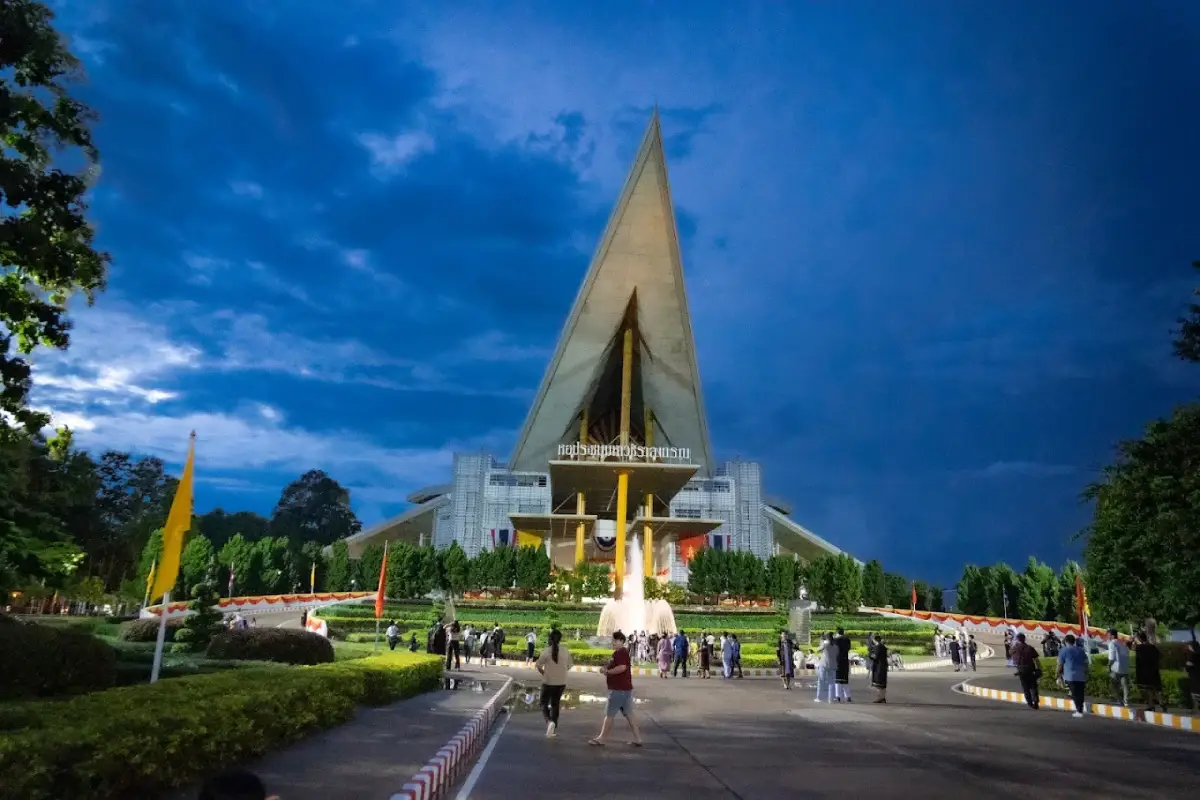
Open Days: Monday–Friday for administrative offices, excluding public holidays and university-announced holidays
Opening Hours: 08:30–16:30 for administrative offices and registration services. The museum, library, and other facilities follow separate schedules.
Sakon Nakhon Rajabhat University (SNRU), known in Thai as มหาวิทยาลัยราชภัฏสกลนคร, is a public university located at 680 Nittayo Road, That Choeng Chum Subdistrict, Mueang Sakon Nakhon District, Sakon Nakhon Province 47000, Thailand. Situated approximately 6 kilometers from central Sakon Nakhon, the university began as Sakon Nakhon Teacher Training School, established on 17 July 1964. It became Sakon Nakhon Teachers College on 16 January 1970, was transformed into Sakon Nakhon Rajabhat Institute in 1995, and obtained university status on 15 June 2004. In 2026, the institution celebrated its 62nd anniversary and operated seven faculties covering education, science and technology, humanities and social sciences, management science, agricultural technology, industrial technology, and nursing. The Faculty of Nursing welcomed its first students in the 2026 academic year. The university is known for its contributions to teacher education, regional development, research, community engagement, and the preservation of local heritage. It is also home to Sakon Nakhon Museum, an important learning center for the province's history, archaeology, and cultural traditions.
Sakon Nakhon Rajabhat University has maintained a close relationship with the people of Sakon Nakhon and upper northeastern Thailand for more than six decades. Initially established to prepare teachers for local schools, it gradually expanded into a multidisciplinary institution responding to changing educational and social needs. Today, its activities include teacher preparation, business and industrial education, agricultural technology, digital learning, community-oriented research, and the development of professional skills. This development reflects the broader mission of Thailand's Rajabhat universities, which combine higher education with a commitment to improving the quality of life of local communities.
The university stands on Nittayo Road, part of an important regional transportation corridor connecting Sakon Nakhon with Udon Thani and neighboring areas. The campus contains academic buildings, the Office of the President, scientific laboratories, library facilities, student activity areas, auditoriums, sports grounds, dormitories, and landscaped spaces. Roads and walking routes connect these facilities, allowing the campus to accommodate formal academic activities alongside the everyday needs of students and staff.
Sakon Nakhon Province has a distinctive natural and cultural environment. Its landscape is shaped by the Sakon Nakhon Basin, Nong Han Lake, and the Phu Phan mountain range. The province is also recognized for traditional indigo-dyed textiles, weaving knowledge, agriculture, livestock production, Buddhist festivals, and communities with diverse cultural backgrounds. These characteristics provide valuable opportunities for research and education in history, culture, environmental management, agricultural production, and community development. The university's role as a regional institution is closely connected with this wider setting.
The history of the university began on land that had previously been associated with government and police activities. Before becoming an educational institution, the site belonged to the Ministry of Defence and the Royal Thai Police and had been used by Provincial Police Training School Region 4 in Sakon Nakhon. After the police school ceased operating at the location, the Ministry of Interior planned to use the land for a new provincial government complex. Construction of a provincial hall building was completed in 1963, but the government subsequently decided to construct the provincial administrative center at a different site.
This change created an opportunity for the Ministry of Education to request the land and completed buildings for a teacher training school. Field Marshal Sarit Thanarat, a former Prime Minister of Thailand, played an important role in authorizing the transfer of the site for educational purposes. Sakon Nakhon Teacher Training School was consequently established on 17 July 1964. A building originally intended for provincial administration thus became part of a growing educational institution serving Sakon Nakhon and surrounding provinces.
During the 1964 academic year, the newly established school admitted its first cohort of 70 students, comprising 48 men and 22 women. Because the institution was still developing its teaching and administrative capacity, these students were initially placed at teacher training colleges in Ubon Ratchathani, Maha Sarakham, and Udon Thani. The arrangement illustrates the cooperative approach used to expand teacher education in Thailand during a period when new institutions often depended on support from established colleges before they could conduct all teaching activities independently.
Chamnog Phawaphutthanon Na Maha Sarakham served as the school's first headmaster and helped establish its early administrative and educational foundations. In 1965, the school admitted another 152 students and had 18 teachers. The following academic year, 146 new students were admitted, while the number of teaching staff increased to 24. Phot Thanyakhant subsequently served as headmaster. Rising student numbers and the expansion of teaching facilities reflected the growing need for trained teachers in Sakon Nakhon and the surrounding region.
On 16 January 1970, the Ministry of Education elevated Sakon Nakhon Teacher Training School to Sakon Nakhon Teachers College. This change represented an important step in the development of its educational administration and academic responsibilities. The college expanded teacher preparation through both regular daytime and evening programs, making further education more accessible to students with different circumstances. Teacher education at the time played a vital role in addressing staffing needs in rural schools and improving opportunities for children and young people across northeastern Thailand.
The college began offering its first Bachelor of Education programs in the 1975 academic year, marking its transition into degree-level teacher preparation. Subsequent changes included the restructuring of academic arrangements in 1976 and the introduction of two-year post-diploma bachelor's pathways in 1978. The institution also provided professional development for teachers and educational personnel already working in schools. These opportunities helped serving teachers improve their qualifications without having to begin a completely new educational pathway.
By the mid-1980s, Sakon Nakhon Teachers College had begun expanding beyond teacher education alone. In 1985, academic opportunities were extended into liberal arts and science, reflecting changing workforce needs. In 1986, the college developed continuing education arrangements for working personnel through four-year bachelor's programs and two-year post-diploma programs. The Khuru Thayat teacher development initiative began in 1987. These developments demonstrated how the institution gradually broadened its role while continuing to maintain its original commitment to the teaching profession.
A major milestone occurred on 14 February 1992, when King Bhumibol Adulyadej bestowed the name Rajabhat Institute upon Thailand's teachers colleges. The name became associated with institutions committed to education and service to the people. The Rajabhat Institute Act B.E. 2538 subsequently provided the legal framework for their transformation. In 1995, Sakon Nakhon Teachers College became Sakon Nakhon Rajabhat Institute, with Assistant Professor Dr. Prasit Kongsatsana serving as the institute's first rector.
The transition to Rajabhat Institute status expanded opportunities for academic diversification. While teacher education remained a central responsibility, the institution increasingly developed programs in science and technology, humanities and social sciences, management, agricultural technology, and industrial technology. These fields were relevant to the changing needs of government agencies, schools, businesses, industry, and local communities. The growing range of subjects also allowed students to pursue higher education across a wider selection of professional and academic disciplines within Sakon Nakhon.
On 15 June 2004, Sakon Nakhon Rajabhat Institute was elevated to Sakon Nakhon Rajabhat University under the Rajabhat University Act B.E. 2547, which had been published in the Royal Gazette on 14 June 2004. Assistant Professor Dr. Watthana Suwannatrai served as the university's first acting president. University status strengthened the institution's ability to develop teaching, research, academic services, cultural programs, and cooperation with organizations within Thailand and abroad.
From its establishment in 1964 to 2026, Sakon Nakhon Rajabhat University underwent a remarkable transformation over 62 years. It evolved from a small teacher training school into a multidisciplinary public university serving a wide range of educational and professional needs. Its history parallels the expansion of higher education in Thailand, particularly the shift from institutions focused primarily on teacher preparation toward universities responsible for research, innovation, workforce development, and meaningful engagement with local communities.
In 2026, Assistant Professor Chakrit Chanchitpreecha served as President of Sakon Nakhon Rajabhat University. The university operated seven faculties: the Faculty of Education, Faculty of Science and Technology, Faculty of Humanities and Social Sciences, Faculty of Management Science, Faculty of Agricultural Technology, Faculty of Industrial Technology, and Faculty of Nursing. The university also maintained a Graduate School to support postgraduate education and research. The expansion into nursing was particularly significant because it created new opportunities for professional healthcare education within the region.
The Faculty of Nursing represents one of the university's most important recent developments. The project to establish the faculty was initiated under university regulations announced on 27 September 2024. Administrative development continued during 2025, and the university approved the formal establishment of the faculty on 24 December 2025. Its Bachelor of Nursing Science curriculum received approval from the Thailand Nursing and Midwifery Council on 10 August 2026. The faculty then opened applications for its first student cohort in September 2026 and organized orientation activities for new students in October that year.
The Bachelor of Nursing Science program is a four-year degree comprising 125 academic credits. It aims to prepare nursing professionals with appropriate knowledge, practical abilities, ethical awareness, and responsibility toward patients and communities. Compliance with professional nursing education standards is essential because the discipline directly concerns patient safety and professional competence. The introduction of nursing education therefore represents an important expansion of higher education opportunities for students interested in healthcare careers in Sakon Nakhon and neighboring provinces.
The Faculty of Education remains the academic unit most closely connected with the university's historical origins. Its programs prepare teachers across a wide range of subject areas, including Thai, English, Mathematics, Science, Social Studies, Physical Education, Early Childhood Education, Elementary Education, Special Education, Music Education, Home Economics, and educational technology-related disciplines. Teacher education involves not only subject knowledge but also educational psychology, teaching methods, assessment, classroom management, and professional ethics. These areas are essential to preparing graduates for the responsibilities of teaching in schools.
The Faculty of Science and Technology offers education in fundamental sciences, applied sciences, computing, and public health. Its published programs include Chemistry, Physics, Biology, Mathematics, Computer Science, Computer and Digital Technology, Data Science, Environmental Science, and Public Health. These fields support the development of professionals in digital technology, data analysis, environmental management, scientific research, and community health. The faculty also provides academic expertise that can be applied to practical problems affecting organizations and communities throughout the region.
The Faculty of Humanities and Social Sciences plays an important role in education concerning languages, culture, law, politics, arts, and community development. Its published disciplines include Law, Political Science, Tourism, Community Development, Thai for Communication, English, English for Business Communication, Chinese, Digital Information and Media Management, Visual Arts, and Music. The combination of these fields encourages students to explore the relationships among language, culture, social institutions, and the changing needs of contemporary society. It also provides opportunities for research and educational activities connected with the cultural heritage of Sakon Nakhon.
The Faculty of Management Science prepares graduates in business administration, accounting, marketing, logistics, retail business management, business computing, game and esports business, public administration, and communication arts. Its academic activities are relevant to organizations that increasingly depend on digital tools, effective management, financial planning, and communication. In Sakon Nakhon, where small businesses, agricultural enterprises, tourism services, and community products contribute to the local economy, management expertise can also be used to improve business operations and create additional economic value.
The Faculty of Agricultural Technology connects scientific knowledge with the agricultural economy of northeastern Thailand. Its programs address Plant Science, Animal Science, Aquaculture, Veterinary Technology, Food Science and Technology, and Agribusiness Administration. These disciplines support education in agricultural production, farm management, animal health, food processing, and product development. Practical learning and applied research can help students understand challenges involving climate, water resources, production costs, food quality, and market requirements.
The Faculty of Industrial Technology focuses on disciplines related to Electrical and Electronics Technology, Civil and Architectural Technology, and Mechanical and Production Technology. The faculty's academic activities support the development of technical competence through practical learning and laboratory-based training. Students in industrial technology need opportunities to understand equipment, systems, manufacturing methods, construction processes, and engineering applications. Such knowledge is particularly relevant to employment in technical services, industrial organizations, and related professional fields.
The Graduate School supports postgraduate study and advanced research at Sakon Nakhon Rajabhat University. Its published programs cover areas such as Educational Administration, Curriculum and Instruction Research, Science Teaching, Public Administration, Engineering, Physics, Public Health, Digital Business Management, and related interdisciplinary fields. Postgraduate education provides opportunities for teachers, working professionals, graduates, and researchers to strengthen their expertise, conduct advanced study, and apply specialized knowledge to challenges in their professional environments.
During the 2026 academic year, the Graduate School announced admissions for master's and doctoral programs and introduced a Higher Graduate Diploma program in Learning Management Innovation. These announcements illustrate the continued development of postgraduate offerings. Prospective students should consult the current academic year's admission regulations and individual program requirements, since program titles, admission schedules, available study plans, and the number of places offered may vary between admission rounds.
The university's institutional identity reflects its historical relationship with the Rajabhat system. Its emblem incorporates elements connected with the royal insignia of King Rama IX, including symbols traditionally associated with royal authority and wisdom. The emblem features five principal colors: blue, green, gold, orange, and white, representing the monarchy, the natural environment, intellectual development, local arts and culture, and the purity of knowledge. Sakon Nakhon Rajabhat University's own institutional colors are green and pink, which appear in university flags and identifying materials.
The university's motto, “Paññā Lokasmiṃ Pajjoto,” means “Wisdom Is the Light of the World.” It expresses the belief that knowledge and education illuminate human understanding and contribute to meaningful lives. The university's principal Buddha image is Phra Phuttha Ratchapanya Barami. Its symbolic tree and flower are the golden shower tree, locally known as Ratchaphruek or Khun, which produces distinctive clusters of yellow flowers. These symbols help strengthen the shared identity of students, academic staff, and alumni while emphasizing knowledge, ethics, and responsibility to society.
One of the university's most interesting destinations is Sakon Nakhon Museum, located in Building 1 on campus. The museum occupies a two-story reinforced-concrete building designed in an adapted Thai architectural style. The building dates to 1963 and was originally associated with the planned provincial government offices before the land was repurposed for teacher education. Its history gives the museum additional significance, as the building itself preserves evidence of the site's transformation into an educational institution.
Sakon Nakhon Museum developed from the Sakon Nakhon Provincial Cultural Center, which was established in 1980 as part of national efforts to preserve and present local cultural heritage. Its purpose was to collect, conserve, and exhibit archaeological and historical materials from Sakon Nakhon Province. As the university's cultural administration developed, the center evolved through different organizational arrangements. In 2016, the former Arts and Culture Center was renamed Sakon Nakhon Museum, reflecting its continuing role as a provincial history and cultural learning institution.
The museum presents exhibitions about local history, archaeology, human settlement, and the cultural traditions of communities in Sakon Nakhon. Its collections include historical objects and religious sculptures connected with the province and surrounding areas. The displays help visitors understand that Sakon Nakhon has been influenced by multiple periods of cultural development and has long formed part of the wider historical networks of northeastern Thailand and the Mekong region.
The educational value of Sakon Nakhon Museum extends beyond the preservation of individual objects. It provides an opportunity for students, researchers, families, and visitors to connect historical evidence with the region's present-day identity. Through archaeological materials and cultural interpretation, visitors can explore religious beliefs, artistic traditions, settlement history, and the development of local communities. Groups planning an educational visit should contact the Institute of Language, Arts and Culture in advance to arrange access and inquire about available learning activities.
The Institute of Language, Arts and Culture is another important university unit. Its origins can be traced to cultural activities developed during the institution's teachers college period, followed by several stages of administrative reorganization. Its responsibilities now include language education, arts and cultural preservation, museum services, academic activities, and international cooperation. The institute plays a significant role in connecting the university with the cultural traditions and historical heritage of Sakon Nakhon Province.
The institute oversees several specialized centers, including the Language Center, Vietnam Studies Center, Chinese Studies Center, Laos Studies Center, and International Students Service Center. Each supports education, training, cultural understanding, or international cooperation. These activities are particularly relevant to northeastern Thailand, where historical and contemporary relationships with neighboring countries influence language, society, trade, and cultural identity. Such centers help students broaden their understanding of regional diversity and international connections.
Other important campus facilities include the Office of Academic Resources and Information Technology, the Office of the President, the Graduate School building, science facilities, industrial technology laboratories, faculty buildings, Chamchuri Auditoriums 1 and 2, the Maha Vajiralongkorn Auditorium, the Ratchaphruek Sports Ground, indoor sports facilities, university dormitories, dining areas, and Phu Phan Place Hotel. These facilities support teaching, research, conferences, university events, recreation, and the everyday needs of the campus community.
Phra Phuttha Ratchapanya Barami, the university's principal Buddha image, is an important religious and institutional symbol. Its presence reflects the connections among education, ethical values, and Buddhist traditions within Thai society. The campus is also associated with the Chao Pu Nong Ya Sai shrine, a place of local spiritual significance. Visitors to religious or culturally significant places on campus should observe appropriate behavior and respect the customs associated with each location.
The Wai Khru ceremony is one of the university's important educational traditions. It provides an opportunity for students to express gratitude and respect toward their teachers while reflecting on their responsibilities as learners. In the 2026 academic year, the university scheduled its Wai Khru ceremony for 2 July 2026 at Chamchuri Auditorium 1. The ceremony is particularly meaningful at an institution whose historical roots lie in teacher preparation, as it connects contemporary student life with the longstanding values of the teaching profession.
The anniversary of the university's establishment on 17 July is another important occasion. In 2026, Sakon Nakhon Rajabhat University commemorated the 62nd anniversary of its foundation in 1964. Anniversary activities offer opportunities to recognize the contributions of generations of teachers, students, staff, and alumni. They also highlight the institution's transformation from a teacher training school into a multidisciplinary university dedicated to education and local development.
The university's involvement in Sakon Nakhon's Wax Castle Festival provides an especially strong connection with local cultural heritage. The festival is associated with the end of Buddhist Lent and the tradition of creating elaborate beeswax castles as religious offerings. It brings together craftsmanship, community participation, Buddhist beliefs, and public celebration. In 2026, the university supported cultural activities associated with the festival held between 20 and 26 October, contributing artistic performances, creative projects, and cultural activities that connected academic knowledge with local traditions.
On 25 October 2026, the university participated in the Wax Castle Festival procession, with the Institute of Language, Arts and Culture contributing to the ceremonial presentation. Students and staff from the Home Economics program in the Faculty of Education also created a contemporary wax castle work inspired by local cultural traditions. This contribution demonstrated how artistic education and practical craftsmanship can be used to preserve cultural heritage while encouraging new forms of creative expression.
Research into indigo-dyed textiles and local craftsmanship is another example of the university's connection with Sakon Nakhon communities. In 2026, university researchers presented work on the identity of the Nang On Yon local silk variety and the development of indigo-dyed silk products. The project connected traditional indigo knowledge with the creative economy and value-chain development, seeking to strengthen community products while preserving cultural heritage. It reflects the university's interest in using research to contribute to both economic opportunities and cultural continuity.
Indigo textiles are closely associated with Sakon Nakhon's cultural identity. Their value lies not only in the finished fabrics but also in traditional dyeing techniques, designs, natural materials, and expertise passed down through generations. Research can help producers improve material quality, develop products, communicate their cultural significance, and reach wider markets. These efforts illustrate how scientific, managerial, and cultural knowledge can be combined to support sustainable community enterprises without disregarding traditional craftsmanship.
The university's wider research activities also address education, digital technology, community development, environmental management, agriculture, food systems, and public administration. Cooperation across academic disciplines creates opportunities to develop teaching innovations, improve agricultural practices, strengthen local businesses, and use technology to respond to community needs. These activities reflect the university's commitment to applying research and academic expertise in ways that benefit society.
Prospective students can explore a broad selection of study options, including teacher education, science, business administration, arts, languages, agriculture, industrial technology, and nursing. The appropriate choice depends on individual interests, academic strengths, career goals, and the practical requirements of each profession. Applicants should review the latest admission announcements and approved curriculum information for the relevant academic year, since course structures, program names, entry requirements, and admission quotas may change over time.
For visitors interested in educational tourism, the university is particularly rewarding because of its links with history and local culture. Sakon Nakhon Museum provides opportunities to explore the province's past, while the Institute of Language, Arts and Culture offers a setting for learning about regional cultural traditions and neighboring countries. Educational visits to science, agriculture, or industrial technology departments may also provide practical insights into the university's teaching and research activities. Access to specialized academic spaces should be arranged through the responsible departments.
A visit to the campus can also be combined with other attractions in Mueang Sakon Nakhon District. Phra That Narai Cheng Weng is a historical monument associated with Khmer artistic traditions. Wat Phra That Choeng Chum Worawihan is one of the province's most revered Buddhist sites, while the Achan Man Phurithatto Museum at Wat Pa Sutthawat offers opportunities to learn about an important figure in Thailand's forest meditation tradition. Somdet Phra Srinagarindra Park and the surrounding Nong Han lakeside environment provide attractive spaces for relaxation and observing the province's natural landscape.
Visitors planning to explore Sakon Nakhon Museum should contact the Institute of Language, Arts and Culture before arrival. Museum opening arrangements can differ from ordinary university office hours and may be affected by exhibitions, maintenance, or scheduled activities. Access to classrooms, laboratories, research facilities, and student residences is also subject to departmental regulations. Advance arrangements are particularly important for organized educational groups requiring explanations, demonstrations, or access to specialized equipment.
Getting There: Sakon Nakhon Rajabhat University is located at 680 Nittayo Road, That Choeng Chum Subdistrict, Mueang Sakon Nakhon District, Sakon Nakhon Province. Visitors traveling by private car from central Sakon Nakhon can follow Nittayo Road or Highway 22 toward Udon Thani. The campus is approximately 6 kilometers from the central urban area. Travelers arriving from Udon Thani or nearby provinces can also use Highway 22 and follow local signs or navigation directions to the university.
Air travelers can arrive through Sakon Nakhon Airport and continue to the campus by taxi or rental vehicle. Public transport users can travel to Sakon Nakhon city and arrange local transport from the bus terminal or an appropriate drop-off point. Because the university contains numerous academic and administrative buildings, visitors should confirm the correct building number and entrance before traveling, particularly when attending examinations, registration appointments, meetings, or organized activities.
During busy periods such as the beginning of a semester or student admission season, visitors should allow additional time for university-related appointments. Administrative offices and registration services generally operate Monday through Friday from 08:30 to 16:30, excluding public holidays. Certain student services may operate at weekends according to their own schedules, so visitors seeking assistance outside ordinary office hours should confirm the relevant department's arrangements in advance.
The area surrounding the university and Sakon Nakhon city provides a variety of dining and accommodation options. Visitors can choose from local Isan restaurants, Thai restaurants, Vietnamese cuisine, cafés, and international dining. Accommodation includes university-area hotels, properties along Nittayo Road, resorts, and hotels in the urban center. Those attending campus activities may prefer accommodation close to the university, while travelers planning to explore additional attractions may choose hotels according to their transportation arrangements and preferred location.
Sakon Nakhon Rajabhat University remains significant as both a historic educational institution and a center of knowledge for regional development. From its first 70 teacher trainees in 1964 to the addition of professional nursing education in 2026, the institution has continuously adapted to changing social and educational needs. Its value is reflected not only in its academic programs but also in its contributions to research, professional education, community engagement, and cultural preservation. Sakon Nakhon Museum, the Institute of Language, Arts and Culture, and the university's participation in the Wax Castle Festival demonstrate how higher education can help sustain a region's historical memory and cultural identity for future generations.
Sakon Nakhon Rajabhat University — Summary Table
| University Name | Sakon Nakhon Rajabhat University |
| Thai Name | มหาวิทยาลัยราชภัฏสกลนคร |
| Abbreviation | SNRU / มรสน. |
| Institution Type | Public University within Thailand's Rajabhat University System |
| Location | That Choeng Chum Subdistrict, Mueang Sakon Nakhon District, Sakon Nakhon Province, Thailand |
| Full Address | 680 Nittayo Road, That Choeng Chum Subdistrict, Mueang Sakon Nakhon District, Sakon Nakhon Province 47000, Thailand |
| Coordinates | 17.18994, 104.09153 |
| Original Institution Founded | 17 July 1964 |
| Teachers College Status | 16 January 1970 |
| Rajabhat Institute Status | 1995 |
| University Status | 15 June 2004 |
| Institutional Age in 2026 | 62 Years Since the Establishment of Sakon Nakhon Teacher Training School |
| Important Founding Figures | Field Marshal Sarit Thanarat and Chamnog Phawaphutthanon Na Maha Sarakham |
| University President in 2026 | Assistant Professor Chakrit Chanchitpreecha |
| University Colors | Green and Pink |
| University Motto | Paññā Lokasmiṃ Pajjoto — Wisdom Is the Light of the World |
| Symbolic Tree and Flower | Golden Shower Tree (Ratchaphruek / Khun) |
| Principal Buddha Image | Phra Phuttha Ratchapanya Barami |
| Number of Faculties | 7 |
| Faculties and Academic Units | 1. Faculty of Education 2. Faculty of Science and Technology 3. Faculty of Humanities and Social Sciences 4. Faculty of Management Science 5. Faculty of Agricultural Technology 6. Faculty of Industrial Technology 7. Faculty of Nursing 8. Graduate School |
| Academic Strengths | Teacher Education, Local Development, Science and Technology, Data Science, Languages and Culture, Business Management, Agriculture, Industrial Technology, and Nursing |
| Important Campus Places | 1. Sakon Nakhon Museum, Building 1 2. Institute of Language, Arts and Culture 3. Office of Academic Resources and Information Technology 4. Office of the President, Building 10 5. Graduate School Building 6. Science Center Buildings 7. Chamchuri Auditoriums 1 and 2 8. Maha Vajiralongkorn Auditorium 9. Ratchaphruek Sports Ground 10. Indoor Sports Center 11. Phra Phuttha Ratchapanya Barami 12. Chao Pu Nong Ya Sai Shrine 13. Phu Phan Place Hotel |
| Traditions and Activities | Wai Khru Ceremony, University Foundation Anniversary, Student Activities, Academic Outreach, and Participation in the Sakon Nakhon Wax Castle Festival |
| Administrative Office Days | Monday–Friday, Excluding Public Holidays |
| Administrative Office Hours | 08:30–16:30 |
| Sakon Nakhon Museum Visits | Contact the Institute of Language, Arts and Culture before visiting. Tel. +66 42 744 009 |
| Facilities | University Library, Laboratories, Lecture Buildings, Dining Areas, Student Dormitories, Sports Facilities, Auditoriums, Parking, and Academic Information Services |
| Getting There | Follow Nittayo Road (Highway 22) from Central Sakon Nakhon toward Udon Thani. The University Is Approximately 6 Kilometers from the City Center. |
| Nearby Tourist Attractions | 1. Sakon Nakhon Museum, On Campus 2. Phra That Narai Cheng Weng, That Na Weng 3. Achan Man Phurithatto Museum, Wat Pa Sutthawat 4. Somdet Phra Srinagarindra Park, Nong Han Area 5. Wat Phra That Choeng Chum Worawihan, Mueang Sakon Nakhon |
| Restaurants in the University Area and City | 1. Nagi Restaurant, Tel. +66 95 446 6665 2. Ban Suan Phu Restaurant, Tel. +66 82 465 6492 3. Na-Khon Kitchen, Tel. +66 83 026 5510 4. Saban Nga Restaurant, Tel. +66 88 983 1282 5. 229 Restaurant, Tel. +66 98 714 4229 |
| Accommodation in the University Area and City | 1. Phu Phan Place Hotel, Tel. +66 42 970 096 2. U Style Hotel, Tel. +66 42 724 032 3. Color Ville Resort, Tel. +66 42 972 558 4. Nakai Resort Sakon Nakhon, Tel. +66 61 402 0632 5. Thong Prachok Hotel, Tel. +66 88 975 9497 |
| University Telephone | +66 42 970 021, +66 42 970 094 |
| Academic Promotion and Registration Telephone | +66 42 970 025 |
| University Email | saraban@snru.ac.th |
| Official Website | www.snru.ac.th |
| Current Status | Operating Public University Offering Academic Programs in the 2026 Academic Year |
Sakon Nakhon Rajabhat University — Academic Programs for Academic Year 2026 (B.E. 2569)
| Faculty / Academic Unit | Academic Programs Published by the University |
| Faculty of Education | Undergraduate — Education Degrees and Related Fields 1. Mathematics 2. Innovation and Computer Education 3. Early Childhood Education 4. Physical Education 5. Social Studies 6. Thai 7. English 8. Physics 9. Science Education 10. Home Economics 11. Industrial Education 12. Special Education and English 13. Chemistry 14. Elementary Education 15. Agricultural Education 16. Music Education |
| Faculty of Science and Technology | Undergraduate — Bachelor of Science 1. Chemistry 2. Physics 3. Biology 4. Computer Science 5. Computer and Digital Technology 6. Data Science 7. Environmental Science 8. Mathematics Undergraduate — Bachelor of Public Health 9. Public Health |
| Faculty of Humanities and Social Sciences | Undergraduate — Bachelor of Laws 1. Law Undergraduate — Bachelor of Political Science 2. Political Science Undergraduate — Bachelor of Arts 3. Tourism 4. Community Development 5. Thai for Communication 6. English 7. English for Business Communication 8. Chinese 9. Digital Information and Media Management Undergraduate — Bachelor of Fine and Applied Arts 10. Visual Arts 11. Music |
| Faculty of Management Science | Undergraduate — Bachelor of Business Administration 1. Business Administration (Marketing, General Management, Finance and Banking, and Logistics Management Concentrations) 2. Retail Business Management 3. Business Computing 4. Game and Esports Business Management Undergraduate — Bachelor of Accountancy 5. Accounting Undergraduate — Bachelor of Public Administration 6. Public Administration Undergraduate — Bachelor of Communication Arts 7. Communication Arts |
| Faculty of Agricultural Technology | Undergraduate — Bachelor of Science 1. Plant Science 2. Food Science and Technology 3. Veterinary Technology 4. Animal Science 5. Aquaculture 6. Agribusiness Administration |
| Faculty of Industrial Technology | Undergraduate — Bachelor of Technology 1. Electrical and Electronics Technology (Electrical and Electronics Concentrations) 2. Civil and Architectural Technology (Civil Technology and Architectural Technology Concentrations) 3. Mechanical and Production Technology (Mechanical Technology and Production Technology Concentrations) |
| Faculty of Nursing | Undergraduate — Bachelor of Nursing Science 1. Bachelor of Nursing Science, New 2026 Curriculum, Four Years, 125 Credits. The First Student Cohort Was Admitted and Oriented in Academic Year 2026. |
| Graduate School | Graduate Diploma 1. Teaching Profession Higher Graduate Diploma 2. Learning Management Innovation Master's Degree — Master of Education 3. Educational Administration 4. Educational Administration and Development 5. Curriculum and Instruction Research 6. Science Teaching Other Master's Degree Programs 7. Master of Public Administration in Public Administration 8. Master of Arts in Public and Private Sector Management 9. Master of Science in Physics 10. Master of Engineering in Engineering 11. Master of Public Health in Public Health 12. Master of Business Administration in Digital Business Management Doctoral Degree — Doctor of Education 13. Educational Administration Doctoral Degree — Doctor of Philosophy 14. Educational Administration and Development 15. Curriculum and Instruction Research 16. Public and Private Sector Management 17. Engineering 18. Physics 19. Computer Education Doctoral Degree — Doctor of Public Administration 20. Public Administration |
Frequently Asked Questions (FAQ)
Q: Where is Sakon Nakhon Rajabhat University located?
A: The university is located at 680 Nittayo Road, That Choeng Chum Subdistrict, Mueang Sakon Nakhon District, Sakon Nakhon Province 47000, Thailand, approximately 6 kilometers from the city center.
Q: What are the opening days and hours of Sakon Nakhon Rajabhat University?
A: Administrative offices and registration services generally operate Monday–Friday, 08:30–16:30, excluding public holidays. The museum, library, and other campus facilities have separate schedules.
Q: When was Sakon Nakhon Rajabhat University founded?
A: It was founded on 17 July 1964 as Sakon Nakhon Teacher Training School. It later became a teachers college, a Rajabhat institute, and finally a university on 15 June 2004.
Q: How many faculties does Sakon Nakhon Rajabhat University have in 2026?
A: The university has seven faculties: Education, Science and Technology, Humanities and Social Sciences, Management Science, Agricultural Technology, Industrial Technology, and Nursing.
Q: Does Sakon Nakhon Rajabhat University offer nursing education?
A: Yes. The Faculty of Nursing was formally approved on 24 December 2025 and admitted its first students to the Bachelor of Nursing Science program in the 2026 academic year.
Q: Is there a museum inside Sakon Nakhon Rajabhat University?
A: Yes. Sakon Nakhon Museum is located in Building 1 on campus and presents exhibitions on the province's history, archaeology, and cultural heritage. Visitors should contact the Institute of Language, Arts and Culture before visiting.
Q: How does the university contribute to local cultural traditions?
A: The university supports and preserves local cultural activities, particularly the Sakon Nakhon Wax Castle Festival. It also conducts cultural research and educational activities related to regional traditions, languages, and products such as indigo-dyed textiles.
Q: How can visitors get to Sakon Nakhon Rajabhat University?
A: Visitors can travel along Nittayo Road (Highway 22) from central Sakon Nakhon toward Udon Thani. Air travelers can arrive at Sakon Nakhon Airport and continue by taxi or rental vehicle.
 Category: ●University
 Group: ●Rajabhat University
Last Update : 6 DayAgo
 Last Update : 6 DayAgo

 Click to Access the Navigation Map GPS
Sakon Nakhon Rajabhat University Map
Recommend

 Art, Culture and Heritage
 Historical Sites and Monuments(9)
 Landmarks and Memorials(2)
 Royal Palace(1)
 Art, Craft Centres, Tradition(8)
 Museums(3)
 Educational Places
 Educational Gardens, Farm(2)
 Public university(1)
 Rajamangala University of Technology(1)
Rajabhat University(1)
 Places of Worship
 Temple(18)
 Church(2)
 Other Sacred Sites(4)
 Research and Development
 Royal Project(3)
 Suburban Living
 Village, Community(7)
 Nature and Wildlife
 National Parks and Marine Reserves(4)
 Mountain (Doi)(3)
 Dam, Reservoir, Lake(14)
 Waterfalls(4)
 Caves(4)
 River, Canal(9)
 Bays and Beaches(1)
 Islands(1)
 Other natural attractions(5)
 Entertainment and Agricultural
 Zoos and Aquariums(1)
 Farms, Parks and Ecotourism(4)
 Outdoor and Adventure Activities(1)
 Travel Articles, Recipes
 Travel Review, Food Review(1)


