
lovethailand home >Northeastern Travel Attractions >Nong Bua Lamphu Travel Attractions >Na Wang >Thep Khiri > Tham Pha Cho Cave
TL;DR: Tham Pha Cho Cave is located at Moo 2, Ban Pha Cho, Thep Khiri Subdistrict, Na Wang District, Nong Bua Lamphu Province, open Daily, hours 06.00 – 18.00.
Tham Pha Cho Cave
Open Days: Daily
Opening Hours: 06.00 – 18.00
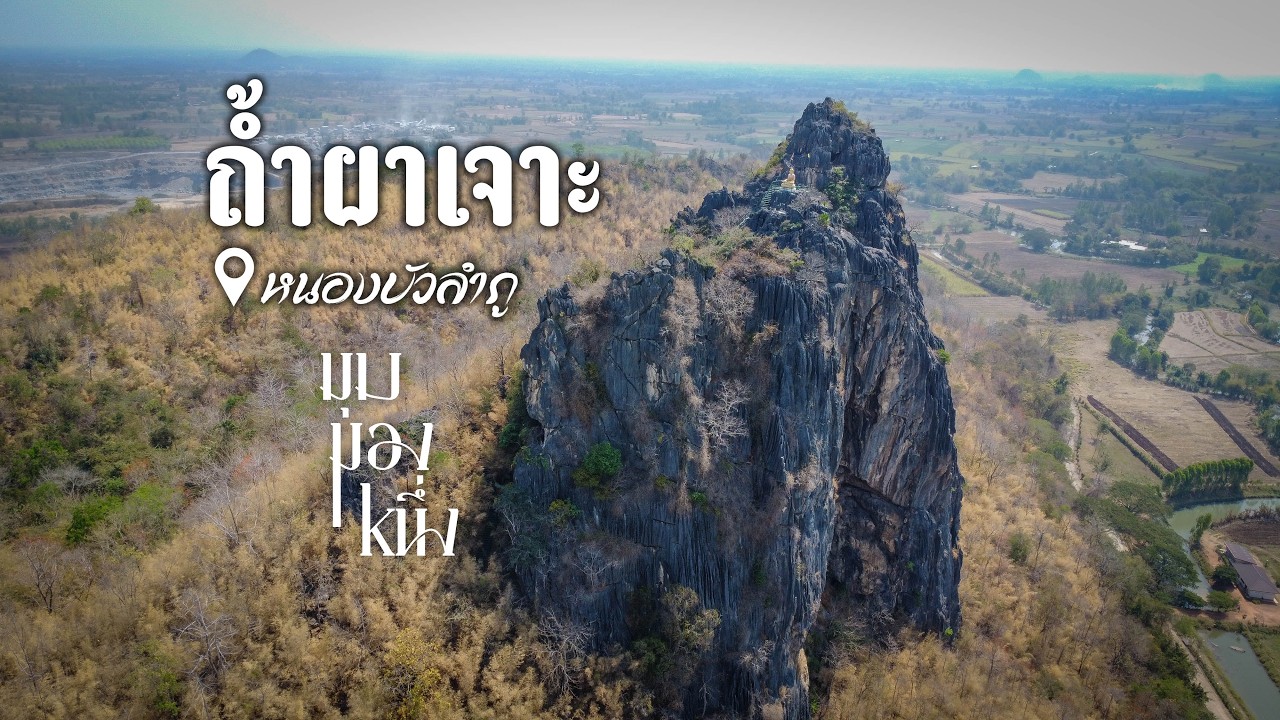
Tham Pha Cho Cave in Nong Bua Lamphu is a distinctive natural cave-and-cliff attraction located within Wat Phuttha Banphot at Ban Pha Cho, Moo 2, Thep Khiri Subdistrict, Na Wang District. The site is known for a dramatic limestone cliff that appears to have been naturally pierced through the rock face, creating a large opening in the mountain. With a hilltop Buddha image, a stairway climb, a panoramic viewpoint, and a local temple setting, Tham Pha Cho combines natural scenery, Buddhist devotion, local legend, and rural Isan landscape in one compact but memorable destination.
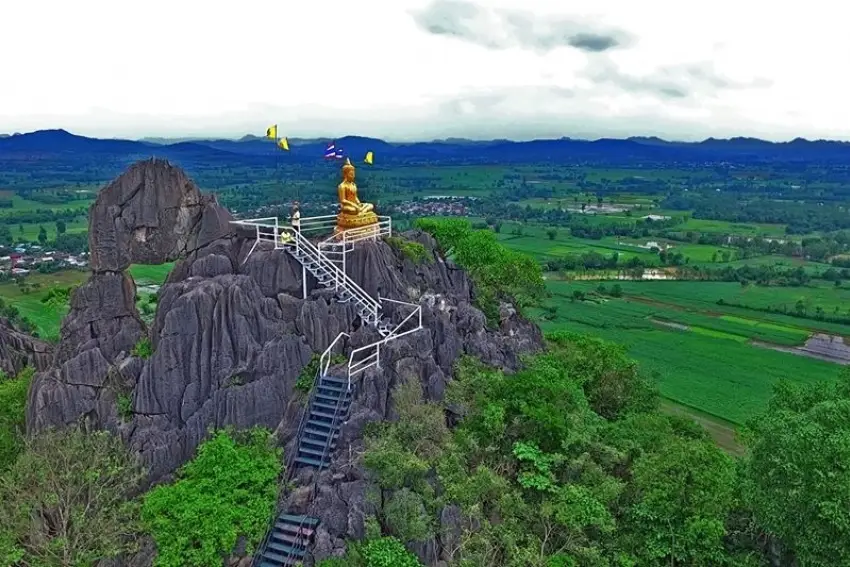
Unlike deep cave systems that are explored mainly from inside the mountain, Tham Pha Cho is best remembered for its open cliff form. The main visual feature is the pierced rock face, which looks like a natural stone window cut through the mountain. From below, the cliff stands above Ban Pha Cho and the surrounding agricultural landscape. From above, visitors can look across Na Wang District, seeing rice fields, village areas, roads, hills, and the open sky of upper northeastern Thailand.
The cave is part of Wat Phuttha Banphot, a local Buddhist temple that serves both the community and travelers. The temple area is the starting point for the climb to the cliff and viewpoint. This connection between temple and mountain is important. Visitors are not entering only a natural rock attraction; they are entering a living religious landscape. For this reason, respectful dress and behavior are expected, especially near the temple grounds and Buddha image at the top.
The Thai name Pha Cho describes the appearance of the site clearly. “Pha” means cliff, while “Cho” suggests an opening, piercing, or natural breach in the rock. The name reflects the way the cliff seems to have been cut through by nature. Over time, weathering, erosion, moisture, heat, and the natural structure of limestone created the opening that gives the place its identity. The name is simple, but it perfectly matches the visual character of the cliff.
The climb is an essential part of visiting Tham Pha Cho. Travelers walk from the temple area up a stairway to the upper viewpoint. Travel sources commonly describe the route as having about 528 steps. The stairway is not extremely long, but it is steep enough to require steady effort. Visitors should walk at a comfortable pace, rest when needed, and avoid rushing. The value of the climb is not only reaching the top, but also experiencing the gradual change from village temple to cliff landscape.
At the top, the viewpoint opens toward a wide rural panorama. The view over Ban Pha Cho and Na Wang District is one of the main rewards of the climb. During the rainy season and early cool season, the rice fields below can appear bright green, creating a strong contrast with the grey limestone cliff. On clear days, the surrounding mountains and sky make the viewpoint especially impressive. This is one of the reasons Tham Pha Cho is often described as one of the scenic and unusual places in Nong Bua Lamphu.
A large Buddha image is enshrined on the upper area, giving the summit a peaceful and sacred atmosphere. Visitors often pay respect before taking in the view. The Buddha image, the rock surface, the stairway, and the open landscape form a visual composition that is both spiritual and scenic. This blend of cliff, temple, and viewpoint is what makes Tham Pha Cho different from a purely natural hiking spot.
The upper rock terrace is an exposed area, so morning is the best time to visit. The air is cooler, the climb is more comfortable, and the light is gentler for photography. Late afternoon can also be beautiful, but visitors should allow enough time to descend before dark. Midday can be hot because the stone surface receives direct sunlight and shade is limited. A hat, water, and comfortable shoes are important for a safe and pleasant visit.
The cave and cliff area includes natural hollows, stone surfaces, and light-shadow contrasts created by the pierced rock form. Some areas feel cave-like, while others are more like a cliff shelter or open rock window. The beauty comes from the way natural light enters through the opening, changing the appearance of the stone throughout the day. Even though it is not a vast cave like Tham Erawan, it has a unique shape that makes it visually memorable.
Local legend adds another layer of meaning to the site. The story often associated with Tham Pha Cho tells of a giant carrying offerings in a basket to enshrine at Phra That Phanom. Along the way, the giant heard that the stupa had already been completed and, in grief, left the basket at this cliff. The abandoned basket became linked with the origin of Pha Cho. Such stories help local communities connect unusual rock formations with cultural memory, belief, and imagination.
This combination of geology and storytelling is one of the strongest features of Tham Pha Cho. Visitors can see the cliff as a natural limestone formation, but they can also understand it as a place interpreted through local folklore. The rock gives the form; the community gives the meaning. This is common in many Isan landscapes, where mountains, caves, stones, and water sources often carry stories that help explain their shape and importance.
Wat Phuttha Banphot is a Maha Nikaya Buddhist temple located at Ban Pha Cho, No. 66, Moo 2, Thep Khiri Subdistrict, Na Wang District. Temple records list the temple as established in 1932 and describe its grounds, religious buildings, monks’ residences, chanting hall, funeral hall, bell towers, kitchen, and other temple facilities. The temple record also lists Phra Khru Banphot Siriwat as the abbot in the available provincial Buddhist database. This gives the cave a clear religious and administrative context.
Because the site belongs to a temple, visitors should behave respectfully. Modest clothing is recommended, and loud behavior should be avoided. Visitors should not climb risky rock sections, scratch or write on the stone, leave trash, or damage the natural surface. The same place functions as a tourist viewpoint, a natural landmark, and a religious site for the local community. Responsible behavior helps preserve all three roles.
The best season to visit is from the late rainy season into the cool season. During this period, the surrounding fields and hills are greener, the air is more comfortable, and the stair climb is easier than in the hot season. The rainy season can make the landscape especially fresh, but visitors should be cautious because stairs and rock surfaces may become slippery. During heavy rain or strong wind, climbing to the exposed upper rock area should be avoided.
Preparation should focus on comfort and safety. Visitors should bring drinking water, a hat, a towel, insect repellent, and shoes with good grip. Heavy bags are not recommended because the stair climb can become tiring. Phones or cameras should be carried securely while climbing. At viewpoints, visitors should take photos carefully and avoid standing near unsafe edges. The upper rock area is scenic but still a natural cliff environment.
Children, seniors, and visitors with health conditions should assess the climb before starting. Although the route is not a long trek, the number of steps and the exposed stone surface can be tiring. Children should stay close to adults, especially on stairs and viewpoint areas. Senior visitors should walk slowly, rest often, and avoid visiting during the hottest part of the day.
Important photo spots include the lower view of the pierced cliff, the stairway, the summit Buddha image, the rock opening, the wide viewpoint over Ban Pha Cho, and the rural landscape of Na Wang District. During the green season, the fields below create some of the most attractive scenery. Morning light is usually soft and suitable for both landscape and temple photography.
Tham Pha Cho can be combined with several nearby attractions in Na Wang District. Wat Tham Erawan is one of the most famous cave temples in the area, known for its large cave, more than 600 steps, and the legend of Nang Phom Hom. Huai Pha Wang Reservoir provides a waterside rest after a climb, with local food and raft-style leisure. Wat Tham Pha Wang, Luang Pu Somwang Rattanamanee, Wat Song Tham Banphot, and Wat Pa Phu Fang Santitham can also be included for travelers who want a temple-and-nature route.
Wat Tham Erawan gives a different cave experience from Tham Pha Cho. While Tham Pha Cho is known for a pierced cliff and a high viewpoint, Tham Erawan is known for a large limestone cave, a Buddha image at the cave entrance, stalactites, stalagmites, skylight openings, and a major local legend. Visiting both helps travelers understand the variety of cave landscapes in Na Wang District.
Huai Pha Wang Reservoir is a practical stop after visiting Tham Pha Cho because it offers a calmer waterside atmosphere. After walking up the stairs and spending time on the exposed rock terrace, travelers can sit near the reservoir, eat local food, or enjoy raft dining. The combination of cliff, cave, temple, and reservoir makes a balanced one-day itinerary in Na Wang.
Food options are mostly located in Na Wang District, Ban Naklang, and Ban Thai Niyom rather than directly on the upper cliff. Nearby choices include Kuai Tiao Yai Phrai Si, Puk Pik Talay Sod Na Wang, Ban Cake Khun Mae Na Wang Branch, Phae Nong Film at Huai Pha Wang Reservoir, and other local restaurants. Visitors should plan meals before or after the climb rather than expecting full food service at the viewpoint.
Accommodation can be arranged in Na Wang District, Na Klang District, or Nong Bua Lamphu town. Erawan Pool Villa is a nearby option in Na Wang, while Pialo Resort in Na Klang works well for travelers continuing along the Udon-Loei route. Travelers who prefer town facilities, markets, and more dining options can stay in Nong Bua Lamphu town at hotels such as Ruean Chor Fah Hotel, Rungrod Grand Hotel, or Nongbua Garden View.
For foreign travelers, Tham Pha Cho offers a clear view of upper Isan’s quieter travel character. It is not a heavily commercial attraction, but a local cave temple where geology, Buddhist devotion, farmland, village life, and folklore meet. This makes it especially valuable for travelers who want to explore Thailand beyond major beach provinces and well-known city temples.
A complete visit should begin at Wat Phuttha Banphot, where visitors can prepare for the climb and observe the temple atmosphere. From there, they can walk up the stairway slowly, rest along the route, pay respect to the Buddha image at the top, and enjoy the viewpoint. After descending, they can continue to another attraction in Na Wang or stop for food. This sequence makes the trip smooth and allows the site to be experienced as both a temple and a natural viewpoint.
Visitors should avoid littering, making loud noise, damaging rock surfaces, climbing unsafe areas, or taking risky photographs near cliff edges. Tham Pha Cho is beautiful because of its natural formation and local setting. Protecting that simplicity is important. Careful and respectful travel helps keep the cave, cliff, and temple valuable for the community and future visitors.
Overall, Tham Pha Cho Cave in Nong Bua Lamphu is an excellent destination for travelers who enjoy natural rock formations, short stair climbs, Buddhist hilltop scenery, and panoramic rural views. Its main highlights are the naturally pierced cliff, the summit Buddha image, the stairway, the 360-degree viewpoint, the local legend, and its connection with Wat Phuttha Banphot. For travelers exploring Na Wang District, Tham Pha Cho is one of the strongest places to include on the route.
Getting There from Nong Bua Lamphu town is most convenient by private car. Take Highway 210 toward Na Wang District. Tham Pha Cho is about 40 km from the town area. When reaching Ban Pha Cho, turn left toward Wat Phuttha Banphot for about 500 meters. Park at the temple area and walk up the stairway to the upper viewpoint. A self-drive trip is recommended because the cave can be combined easily with Wat Tham Erawan, Huai Pha Wang Reservoir, Wat Tham Pha Wang, and other attractions in Na Wang District.
| Name | Tham Pha Cho Cave / Wat Phuttha Banphot |
| Location | Moo 2, Ban Pha Cho, Thep Khiri Subdistrict, Na Wang District, Nong Bua Lamphu Province |
| Address | Wat Phuttha Banphot, No. 66, Moo 2, Ban Pha Cho, Thep Khiri Subdistrict, Na Wang District, Nong Bua Lamphu Province 39170 |
| Coordinates | 17.3183331, 102.1179133 |
| Highlights | Naturally pierced limestone cliff, stairway climb of about 528 steps, hilltop Buddha image, panoramic viewpoint over Na Wang District, and local legend connected with Phra That Phanom |
| History | Tham Pha Cho is located within Wat Phuttha Banphot, a community temple established in 1932. The site functions as both a natural attraction and a Buddhist place of worship in Ban Pha Cho |
| Name Origin | The name refers to the cliff that appears to have been pierced through by nature, creating a large opening in the rock face over time |
| Distinctive Features | Unusual limestone cliff, large rock opening, exposed upper rock terrace, 360-degree viewpoint, hilltop Buddha image, and a stairway route suitable for active visitors |
| Travel Information | From Nong Bua Lamphu town, take Highway 210 toward Na Wang District for about 40 km, then turn left into Wat Phuttha Banphot for about 500 meters before walking up the stairway to the viewpoint |
| Current Status | Open as a natural attraction, temple area, and scenic viewpoint in Na Wang District |
| Open Days | Daily |
| Opening Hours | 06.00 – 18.00 |
| Facilities | Temple grounds, parking area, stairway to the cliff, resting points, viewpoint, hilltop Buddha image, toilets in the temple area, and basic temple facilities |
| Main Areas / Zones | 1. Wat Phuttha Banphot courtyard and starting point 2. Stairway zone with about 528 steps 3. Resting and viewpoint points along the route 4. Natural pierced-cliff and cave zone 5. Hilltop Buddha image zone 6. Rock terrace and Na Wang panorama zone 7. Ban Pha Cho community-route zone |
| Caretaker / Related Organization | Wat Phuttha Banphot under the Maha Nikaya Buddhist order, together with Thep Khiri Subdistrict Administrative Organization, Na Wang District, Nong Bua Lamphu Province |
| Abbot / Temple Administration Record | Phra Khru Banphot Siriwat |
| Nearby Tourist Attractions | 1. Wat Tham Erawan, Wang Thong Subdistrict, about 15 km 2. Huai Pha Wang Reservoir, Wang Thong Subdistrict, about 16 km 3. Luang Pu Somwang Rattanamanee at Wat Tham Pha Wang, about 17 km 4. Wat Song Tham Banphot, Ban Wang Samran, about 18 km 5. Wat Pa Phu Fang Santitham, Ban Thai Samakkhi, about 22 km 6. Nong Bua Lamphu town and King Naresuan the Great Shrine, about 40 km |
| Nearby Restaurants | 1. Kuai Tiao Yai Phrai Si, Ban Naklang, Na Wang District, about 7 km, Tel. 062-550-2541 2. Puk Pik Talay Sod Na Wang, Na Wang District Office Market, about 8 km, Tel. 095-761-1961 3. Ban Cake Khun Mae, Na Wang Branch, about 8 km, Tel. 086-401-0575 4. Phae Nong Film, Huai Pha Wang Reservoir, about 18 km, Tel. 089-570-3489 5. Som Tam and Made-To-Order Food Mae Mali, Ban Naklang, Na Wang District, about 9 km, Tel. 088-629-6353 |
| Nearby Accommodations | 1. Erawan Pool Villa, Na Wang District, about 18 km, Tel. 099-138-3446 2. Pialo Resort, Na Klang District, about 22 km, Tel. 089-841-1535 3. Ruean Chor Fah Hotel, Nong Bua Lamphu, about 40 km, Tel. 095-658-5544, 042-311-139 4. Rungrod Grand Hotel, Nong Bua Lamphu, about 40 km, Tel. 093-321-1199 5. Nongbua Garden View, Nong Bua Lamphu, about 40 km, Tel. 089-499-5657 |
Frequently Asked Questions (FAQ)
Q: Where is Tham Pha Cho Cave located?
A: Tham Pha Cho Cave is located within Wat Phuttha Banphot at Ban Pha Cho, Moo 2, Thep Khiri Subdistrict, Na Wang District, Nong Bua Lamphu Province.
Q: What are the opening hours of Tham Pha Cho Cave?
A: The site is open daily from 06.00 to 18.00.
Q: What is the main highlight of Tham Pha Cho Cave?
A: The main highlight is the naturally pierced limestone cliff, together with the stairway climb of about 528 steps, the hilltop Buddha image, and the panoramic view over Na Wang District.
Q: How many steps are there to the viewpoint?
A: The route to the upper viewpoint has about 528 steps and usually takes less than an hour for visitors with normal fitness.
Q: When is the best time to visit Tham Pha Cho Cave?
A: Morning is the best time because the weather is cooler, the light is suitable for photography, and the stair climb is more comfortable than during midday heat.
Q: How can travelers get to Tham Pha Cho Cave?
A: From Nong Bua Lamphu town, take Highway 210 toward Na Wang District. At Ban Pha Cho, turn left into Wat Phuttha Banphot for about 500 meters, then walk up the stairway to the viewpoint.
Q: Is Tham Pha Cho Cave suitable for children and senior travelers?
A: It can be suitable for visitors who can manage a stair climb, but children and senior travelers should be closely supervised and should rest along the way.
Q: What nearby attractions can be visited with Tham Pha Cho Cave?
A: Nearby attractions include Wat Tham Erawan, Huai Pha Wang Reservoir, Wat Tham Pha Wang, Luang Pu Somwang Rattanamanee, Wat Song Tham Banphot, and Wat Pa Phu Fang Santitham.
 Category: ●Nature and Wildlife
 Group: ●Caves
Last Update : 3 MonthAgo
 Last Update : 3 MonthAgo
 Click to Access the Navigation Map GPS

 Art, Culture and Heritage
 Historical Sites and Monuments(4)
 Landmarks and Memorials(1)
 Art, Craft Centres, Tradition(1)
 Museums(3)
 Places of Worship
 Temple(10)
 Other Sacred Sites(6)
 Suburban Living
 Village, Community(3)
 National Parks and Marine Reserves(3)
 Mountain (Doi)(5)
 Dam, Reservoir, Lake(5)
 Waterfalls(1)
Caves(6)
 River, Canal(2)
 Bays and Beaches(1)
 Other natural attractions(3)
 Travel Articles, Recipes
 Travel Review, Food Review(1)


