
lovethailand home >Northeastern Travel Attractions >Nong Bua Lamphu Travel Attractions >Suwan Khuha >Na Si > Tham Suwannakhuha Cave
TL;DR: Tham Suwannakhuha Cave is located at Ban Khuha Phatthana, Moo 7, Na Si Subdistrict, Suwannakhuha District, Nong Bua Lamphu Province, open Daily, hours 08.30 – 16.30.
Tham Suwannakhuha Cave
Open Days: Daily
Opening Hours: 08.30 – 16.30
Tham Suwannakhuha Cave in Nong Bua Lamphu is an important religious, historical, and natural attraction located inside Wat Tham Suwannakhuha at Ban Khuha Phatthana, Moo 7, Na Si Subdistrict, Suwannakhuha District. The cave is known for ancient objects, Buddha images, inscriptions, and cultural memories connected with King Chaiyachetthathirat of Vientiane, one of the most significant rulers in Lan Xang history. For foreign travelers, this cave offers a deeper view of northeastern Thailand beyond temples, markets, and scenic viewpoints. It reveals a landscape where Buddhism, cave worship, Lan Xang culture, local devotion, and natural geology come together in one place.
Wat Tham Suwannakhuha is not simply a temple built beside a cave. The cave itself is part of the temple’s spiritual identity. The natural chamber functions as a cave vihara, a sacred hall formed by rock, shadow, air, and religious objects. Visitors entering the temple area can immediately sense the relationship between the mountain and the monastery. The cave, the Buddha images, the old inscriptions, the temple grounds, and the surrounding landscape create an atmosphere that feels both historical and devotional.
The name Suwannakhuha has a meaningful structure. “Suwanna” refers to gold, prosperity, or sacred value, while “khuha” means cave or cavern. Together, the name suggests a precious cave, a sacred cavern, or a spiritually valuable rock chamber. This meaning fits the place well because the cave is not treated as an ordinary natural hollow. It is a revered religious space containing ancient objects, sacred images, and memories preserved by the local community.
One of the most important features of Tham Suwannakhuha is Luang Pho Phra Chaiyachettha, a revered Buddha image associated with King Chaiyachetthathirat of Vientiane. King Chaiyachetthathirat played an important role in the history of Lan Xang, especially in relation to Buddhism, religious construction, and cultural influence across the Mekong region. The connection between his name and Tham Suwannakhuha gives the cave a historical depth that goes beyond a local temple visit.
The Buddha image inside the cave is associated with Lan Xang artistic tradition, especially the Naga-protected Buddha form. In Buddhist symbolism, the Naga represents protection, sacred power, and the sheltering of the Buddha. In the cultural world of the Mekong region, Naga imagery also carries strong local meaning. This makes the Buddha image at Tham Suwannakhuha especially significant for understanding the religious and artistic links between northeastern Thailand and Laos.
Inside the cave, visitors can see several types of ancient objects and religious remains. These include stone inscriptions, wooden Buddha images, stone Buddha images, stucco Buddha images, and other sacred objects connected with the long use of the cave as a religious place. Each object contributes to the story of the temple, the community, and the wider Buddhist history of the region. The cave is therefore not only a place for worship, but also a living historical archive.
The cave chamber has a distinctive natural form. It is relatively spacious, with a fairly level floor and a curved ceiling that resembles an overturned boat. This shape makes it suitable for use as a cave vihara. The natural rock environment gives the interior a calm and weighty atmosphere. Instead of relying on decorative grandeur, the cave creates a sacred feeling through stone, age, shadow, and the presence of old religious objects.
Walking inside Tham Suwannakhuha is a slow experience. As visitors move from the brighter entrance into the cooler cave interior, the eye gradually adjusts to the space. Details of Buddha images, stone surfaces, inscriptions, and religious objects become more visible. The beauty of the cave does not come from dramatic lighting or artificial decoration. It comes from the stillness of the rock chamber, the accumulated devotion of generations, and the sense that the place has been used for worship for a very long time.
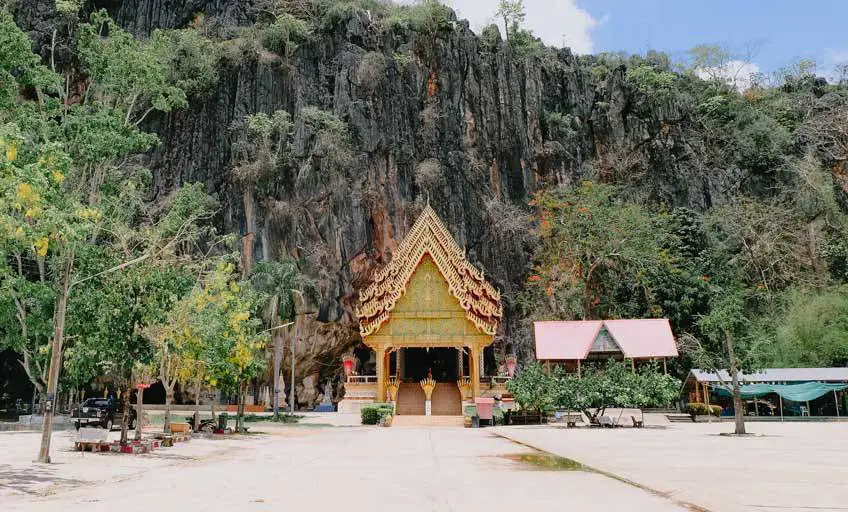
The entrance area of the cave shows clearly how the temple and the natural landscape are connected. The cave is not a separate tourist object. It forms the heart of the religious space. Buildings and worship areas around the cave are arranged in relation to the natural opening, making the cave a central part of the temple’s identity. This relationship between built space and natural stone is one of the main reasons the site feels so distinctive.
Wat Tham Suwannakhuha is also connected with local traditions, especially the Bun Khao Chi festival and ceremonies honoring King Chaiyachetthathirat. These annual traditions reflect the community’s devotion to Luang Pho Phra Chaiyachettha, the temple, and the cultural memory of the Lan Xang ruler. Villagers bring food, agricultural products, and offerings to the temple, turning the site into a center of community life as well as a historical and religious destination.
For travelers interested in Lan Xang history, Tham Suwannakhuha deserves careful attention. The site helps show that Lan Xang cultural influence was not limited to Vientiane or the immediate Mekong riverbanks. Its Buddhist, artistic, and cultural connections extended into what is now Nong Bua Lamphu Province. Visiting the cave helps foreign readers understand Isan as a region of layered cultural connections, not merely as a modern administrative part of Thailand.
The cave is suitable for several types of visitors. Pilgrims come to pay respect to the Buddha images. History travelers come to understand Lan Xang connections. Cultural travelers come to see inscriptions, local belief, and temple traditions. Nature travelers come to experience the atmosphere of a cave temple. This combination makes Tham Suwannakhuha a strong destination for travelers who want a meaningful and quiet cultural experience.
Because the site is a temple, visitors should dress respectfully. Shoulders and knees should be covered as much as possible, and clothing should be modest. Inside the cave, visitors should speak quietly, avoid touching ancient objects, avoid climbing near Buddha images, and move with care. The cave is both a sacred space and a heritage site, so respectful behavior is essential.
Ancient objects inside the cave should be viewed carefully. They should not be touched, moved, scratched, or leaned against. Stone inscriptions and old religious objects can be damaged by even small careless actions. Photography should also be done respectfully, especially near worship areas. The purpose of visiting is not only to take pictures, but to understand and respect the cultural value of the place.
The best time to visit is from morning to early afternoon. During this period, visitors have enough time to explore the temple area, pay respect inside the cave, and continue to nearby attractions if desired. Late afternoon visits should be planned carefully because cave interiors and temple pathways may become dimmer before sunset. Arriving early also creates a calmer experience and makes travel easier.
Visitors should wear comfortable footwear suitable for temple grounds, stone surfaces, and uneven areas. Families traveling with children should keep them close, especially inside the cave. Senior visitors can enjoy the site, but should move slowly and rest when needed. The cave environment is cool and shaded, but some areas may have steps, stone surfaces, or changes in floor level.
Tham Suwannakhuha is also a good place to learn about Lan Xang-style Buddhist art. The Naga-protected Buddha image, the form of the principal image, and the local reverence for King Chaiyachetthathirat show how Buddhist art in northeastern Thailand is deeply linked with the wider Mekong cultural world. The temple helps foreign travelers see that Thai Buddhist art is not uniform across the country, but varies according to region, history, and cultural exchange.
Stone inscriptions in the temple area are another important feature. They preserve information connected with religious dedication, land, village names, and the relationship between communities and the temple. Such inscriptions are valuable because they provide direct historical evidence. They connect local memory with written records and help place Wat Tham Suwannakhuha within the broader history of Buddhism in the Lan Xang cultural region.
The temple grounds contain many caves and cave-like spaces, including larger and smaller chambers. Some are connected with worship, while others contribute to the natural character of the area. This variety gives the temple a layered atmosphere. Visitors who appreciate cave temples will find that Tham Suwannakhuha has more depth than a single shrine or a simple roadside temple.
Visitors should stay within areas that are open and safe. Natural caves may include narrow spaces, dim areas, uneven floors, moisture, or restricted sections. Entering unknown cave areas without guidance is not recommended. Respecting the boundaries of the site helps protect both visitors and the cave environment.
Getting to Wat Tham Suwannakhuha is most convenient by private car. From Nong Bua Lamphu, take Highway 210 on the Nong Bua Lamphu – Wang Saphung route, then turn right onto Highway 2097 toward Suwannakhuha District. Continue along Phra Chaiyachet Road for about 1 km to Ban Dong Yang Na Ta Laeo School, then turn right and continue for about 4 km to reach the temple. This route is practical for self-drive travelers who want to connect the cave with nearby cultural and historical sites.
The Phra Chaiyachetthathirat City Pillar Shrine in Suwannakhuha District is one of the nearby places that fits naturally with a visit to Tham Suwannakhuha. Both sites are connected with the memory of King Chaiyachetthathirat. Visiting the shrine before or after the cave helps travelers understand how the king’s name remains important in the local cultural landscape.
Phu Pha Ya archaeological site in Dong Mafai Subdistrict is another meaningful nearby attraction for those interested in ancient history. While Tham Suwannakhuha reflects Buddhist and Lan Xang history, Phu Pha Ya adds a prehistoric dimension through rock-art evidence and archaeological remains. Together, the two places create a richer historical route in Nong Bua Lamphu.
Phu Phra Bat Historical Park in Udon Thani Province can also be combined with this route for travelers with more time. Although it is located in another province, it shares a broader landscape of sandstone formations, sacred sites, and cultural traces. A route that connects Tham Suwannakhuha with Phu Phra Bat gives foreign travelers a strong introduction to the cultural geography of upper Isan.
Restaurants near Tham Suwannakhuha are found in Na Si Subdistrict, Suwannakhuha town, and nearby local communities. Travelers can plan meals before or after visiting the cave. Options in the wider area include Khrua Khun Toi, Nat Phop Restaurant, Odin Cafe Suwannakhuha, Mae Lai Noodle and Chicken Rice, and Khrua Nong Kaem. Planning food stops in advance is useful, especially for families or groups.
Accommodation options are available in Suwannakhuha District, Nam Som District in Udon Thani Province, and Ban Phue District. Staying closer to Suwannakhuha is practical for travelers who want to focus on the cave and nearby cultural route, while staying in Nam Som or Ban Phue can work well for those continuing toward Phu Phra Bat or other upper-Isan destinations. The best choice depends on the next day’s travel plan.
For foreign travelers, Tham Suwannakhuha provides an important perspective on Thailand beyond mainstream routes. It shows how northeastern Thailand has long been connected with Laos, Lan Xang, Buddhism, inscriptions, cave worship, and community festivals. The site is quiet, culturally rich, and deeply local. It is best appreciated by travelers who want to understand places rather than simply pass through them.
A complete visit should allow at least 1 – 2 hours. This gives enough time to pay respect to the Buddha images, observe the cave interior, see the old objects, and walk through the temple area without rushing. Visitors with a strong interest in history, art, or archaeology may want to spend more time reading details, observing forms, and connecting the cave with the larger history of Lan Xang and the Mekong region.
Visitors should avoid making loud noise, touching Buddha images or ancient objects, climbing on cave walls, leaving trash, or behaving casually in worship areas. Tham Suwannakhuha is both a temple and a historical site. Keeping the atmosphere calm and clean helps preserve the dignity of the place and supports the local community that continues to care for it.
Overall, Tham Suwannakhuha Cave in Nong Bua Lamphu is a valuable destination where nature, Buddhism, Lan Xang history, local tradition, and cave geology meet. Its highlights include the cave vihara, Luang Pho Phra Chaiyachettha, Naga-protected Buddha imagery, ancient objects, inscriptions, and the ongoing cultural memory of King Chaiyachetthathirat. For travelers seeking a deeper and more thoughtful journey through Isan, Wat Tham Suwannakhuha is one of the most meaningful places to include on the route.
Getting There is most convenient by private car. Take Highway 210 on the Nong Bua Lamphu – Wang Saphung route, then turn right onto Highway 2097 toward Suwannakhuha District. Continue along Phra Chaiyachet Road for about 1 km until reaching Ban Dong Yang Na Ta Laeo School, then turn right and continue for about 4 km to Wat Tham Suwannakhuha. This route also allows travelers to connect the cave with the Phra Chaiyachetthathirat City Pillar Shrine, Phu Pha Ya archaeological site, Phu Phra Bat Historical Park, and other cultural attractions in the upper-Isan region.
| Name | Tham Suwannakhuha Cave / Wat Tham Suwannakhuha |
| Location | Ban Khuha Phatthana, Moo 7, Na Si Subdistrict, Suwannakhuha District, Nong Bua Lamphu Province |
| Address | Wat Tham Suwannakhuha, Ban Khuha Phatthana, Moo 7, Na Si Subdistrict, Suwannakhuha District, Nong Bua Lamphu Province 39270 |
| Coordinates | 17.607856, 102.282550 |
| Highlights | Natural cave vihara, Luang Pho Phra Chaiyachettha, Naga-protected Buddha image, ancient objects, stone inscriptions, and Lan Xang cultural heritage |
| History | An old cave temple in Suwannakhuha District connected with Lan Xang Buddhist history and King Chaiyachetthathirat, containing caves, ancient objects, inscriptions, and old Buddha images |
| Name Origin | “Suwanna” means gold or sacred value, while “khuha” means cave, giving the name the meaning of a precious or sacred cave |
| Distinctive Features | Natural limestone cave with a relatively level floor and a curved ceiling resembling an overturned boat, used as a cave vihara with Buddha images and ancient objects inside |
| Travel Information | Take Highway 210 on the Nong Bua Lamphu – Wang Saphung route, turn right onto Highway 2097 toward Suwannakhuha District, continue along Phra Chaiyachet Road for about 1 km to Ban Dong Yang Na Ta Laeo School, then turn right for about 4 km |
| Current Status | Open as a temple, worship site, and historical-cultural attraction in Suwannakhuha District |
| Open Days | Daily |
| Opening Hours | 08.30 – 16.30 |
| Admission Fee | Free Admission |
| Facilities | Temple grounds, cave vihara, worship areas, parking area, toilets within the temple area, and basic facilities for pilgrims and visitors |
| Main Areas / Zones | 1. Cave entrance and cave vihara zone 2. Luang Pho Phra Chaiyachettha worship zone 3. Buddha image and ancient-object zone 4. Stone inscription and heritage-evidence zone 5. Smaller cave zone within the temple grounds 6. Temple courtyard and Bun Khao Chi ceremonial area |
| Caretaker / Related Organization | Wat Tham Suwannakhuha under the Maha Nikaya Buddhist order, together with local authorities in Suwannakhuha District, Nong Bua Lamphu Province |
| Abbot / Temple Administration Record | Temple-history records list Phra Khru Worakhet Phithak Aphakaro as abbot from 1984 onward |
| Main Contact Number | Wat Tham Suwannakhuha, Tel. 092-325-4925 |
| Nearby Tourist Attractions | 1. Phra Chaiyachetthathirat City Pillar Shrine, Suwannakhuha District, about 6 km 2. Suwannakhuha Municipal Market and District Center, about 6 km 3. Phu Pha Ya Archaeological Site, Dong Mafai Subdistrict, about 25 km 4. Phu Phra Bat Historical Park, Udon Thani Province, about 40 km 5. Erawan Cave Temple, Na Wang District, about 55 km 6. King Naresuan the Great Shrine, Nong Bua Lamphu Province, about 70 km |
| Nearby Restaurants | 1. Khrua Khun Toi, Na Si Subdistrict, Suwannakhuha District, about 4 km, Tel. 061-579-8322 2. Nat Phop Restaurant, Phra Chaiyachet Road, Suwannakhuha District, about 6 km, Tel. 087-640-8158 3. Odin Cafe Suwannakhuha, about 7 km, Tel. 091-054-4690 4. Mae Lai Noodle and Chicken Rice, Bun Than Subdistrict, about 15 km, Tel. 083-704-5859 5. Khrua Nong Kaem, Ban Khok, Suwannakhuha District, about 22 km, Tel. 087-100-5565 |
| Nearby Accommodations | 1. Tussanee Bansuan Suwankuha, about 6 km, Tel. 086-863-1973 2. Tawee Resort, Nam Som District, Udon Thani Province, about 35 km, Tel. 092-956-2908 3. Phu Pha Dao Resort, Nam Som District, Udon Thani Province, about 36 km, Tel. 089-573-0965 4. Wuttichok Hotel, Nam Som District, Udon Thani Province, about 38 km, Tel. 062-676-4848 5. Oonrak Resort, Ban Phue District, Udon Thani Province, about 40 km, Tel. 061-196-9897 |
Frequently Asked Questions (FAQ)
Q: Where is Tham Suwannakhuha Cave located?
A: Tham Suwannakhuha Cave is located inside Wat Tham Suwannakhuha at Ban Khuha Phatthana, Moo 7, Na Si Subdistrict, Suwannakhuha District, Nong Bua Lamphu Province.
Q: What are the opening days and hours?
A: The cave temple is open daily from 08.30 to 16.30.
Q: Is there an admission fee?
A: Admission is free.
Q: What is the main highlight of Tham Suwannakhuha?
A: The main highlights are the natural cave vihara, Luang Pho Phra Chaiyachettha, the Naga-protected Buddha image, ancient objects, stone inscriptions, and Lan Xang historical connections.
Q: How is Tham Suwannakhuha connected with King Chaiyachetthathirat?
A: The cave contains a revered Buddha image and local historical memory connected with King Chaiyachetthathirat of Vientiane, an important Lan Xang ruler associated with Buddhism and religious art in the Mekong region.
Q: How can travelers get to Wat Tham Suwannakhuha?
A: From Nong Bua Lamphu, take Highway 210 toward Wang Saphung, turn right onto Highway 2097 toward Suwannakhuha District, continue along Phra Chaiyachet Road for about 1 km to Ban Dong Yang Na Ta Laeo School, then turn right and continue for about 4 km.
Q: What should visitors wear?
A: Visitors should dress respectfully because the site is an active Buddhist temple. Modest clothing is recommended, and visitors should speak quietly inside the cave.
Q: What nearby attractions can be visited with Tham Suwannakhuha?
A: Nearby attractions include the Phra Chaiyachetthathirat City Pillar Shrine, Phu Pha Ya Archaeological Site, Phu Phra Bat Historical Park, Erawan Cave Temple, and King Naresuan the Great Shrine in Nong Bua Lamphu.
 Category: ●Nature and Wildlife
 Group: ●Caves
Last Update : 3 MonthAgo
 Last Update : 3 MonthAgo
 Click to Access the Navigation Map GPS
Tham Suwannakhuha Cave Map

 Art, Culture and Heritage
 Historical Sites and Monuments(4)
 Landmarks and Memorials(1)
 Art, Craft Centres, Tradition(1)
 Museums(3)
 Places of Worship
 Temple(10)
 Other Sacred Sites(6)
 Suburban Living
 Village, Community(3)
 National Parks and Marine Reserves(3)
 Mountain (Doi)(5)
 Dam, Reservoir, Lake(5)
 Waterfalls(1)
Caves(6)
 River, Canal(2)
 Bays and Beaches(1)
 Other natural attractions(3)
 Travel Articles, Recipes
 Travel Review, Food Review(1)


