
lovethailand home >Northeastern Travel Attractions >Nakhon Ratchasima Travel Attractions >Muang Nakhon Ratchasima >Ban Koh > Vongchavalitkul University
TL;DR: Vongchavalitkul University, Nakhon Ratchasima attractions : University, Private University.
Vongchavalitkul University
Open Days: Monday – Friday (Administrative Offices; Excluding Public Holidays and University-Announced Holidays)
Opening Hours: 09:00 – 18:00 (General Contact Hours Published on the University Website; Some Departments Have Different Service Hours)
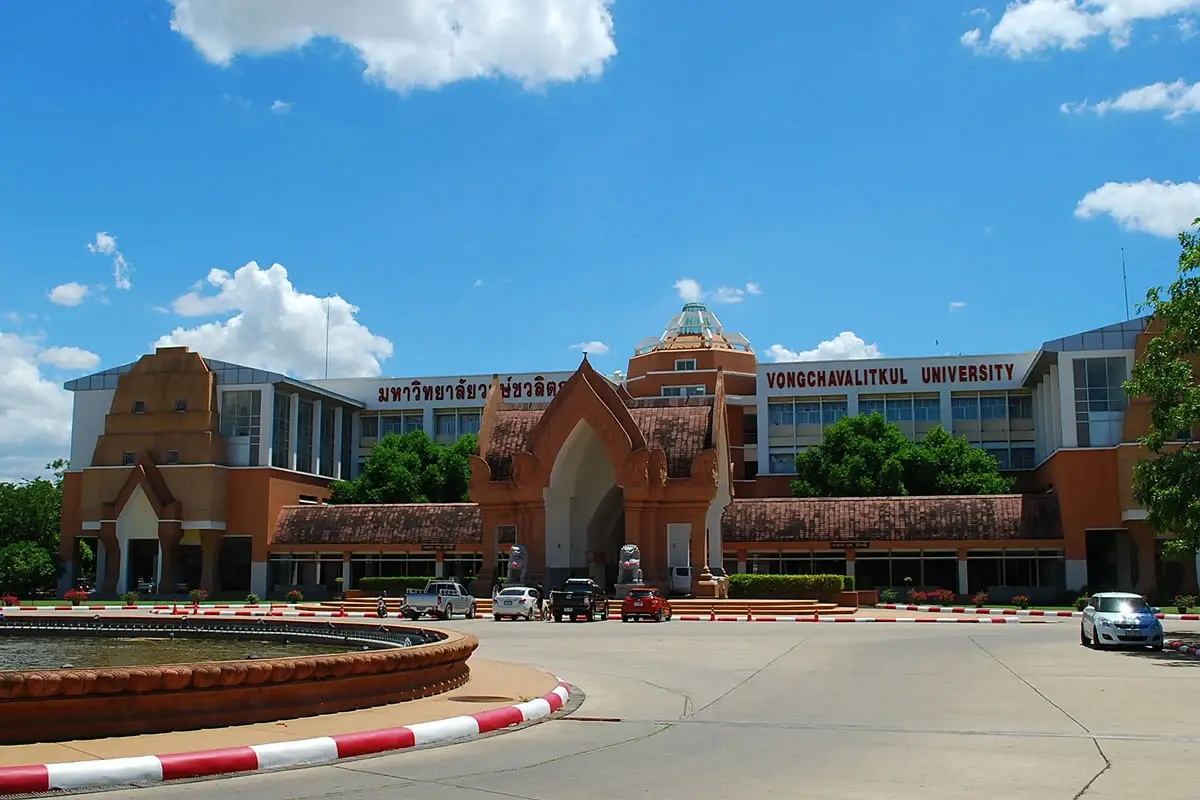
Vongchavalitkul University (VU) is the first private university established in northeastern Thailand. It is located at 84 Moo 4, Mittraphap–Nong Khai Road, Ban Ko Subdistrict, Mueang Nakhon Ratchasima District, Nakhon Ratchasima 30000, Thailand. The institution was founded on March 2, 1984, by Mr. Mook Vongchavalitkul, the original license holder, with Mrs. Pranee Vongchavalitkul serving as its first rector. Initially known as Vongchavalitkul College, it began with two faculties, Law and Business Administration, before receiving university status in 1994. By 2026, it had developed into a private university comprising eight faculties: Business Administration, Law, Communication Arts, Education, Engineering and Architecture, Nursing, Public Health, and Medicine. The introduction of a six-year Doctor of Medicine program in the 2026 academic year represented an important expansion into medical education. Guided by the philosophy of Ethics Leading Wisdom, the university emphasizes practical professional education, innovation, research, and academic services to the community.
The importance of Vongchavalitkul University lies in its pioneering role in the development of private higher education in northeastern Thailand. During the early 1980s, opportunities for university study were still relatively limited for many people in regional provinces. Establishing a private higher education institution in Nakhon Ratchasima created additional choices for students and working adults seeking degree-level qualifications without necessarily moving to Bangkok or another distant region.
The university is situated in Ban Ko Subdistrict, Mueang Nakhon Ratchasima District, along the important Mittraphap–Nong Khai transport corridor. Its location provides connections with residential communities, businesses, shopping centers, hotels, and the wider road network serving Korat. Accessibility is particularly significant for students traveling from surrounding districts and nearby provinces, as well as for working adults attending university programs.
In the wider context of Nakhon Ratchasima's development, the creation of a private university formed part of the city's increasing economic and educational diversity. Public higher education institutions and vocational colleges had already contributed to regional workforce development, while Vongchavalitkul University introduced additional opportunities for students to pursue legal, business, and professional studies within the province.
The university's history began with the educational vision of Mr. Mook Vongchavalitkul and Mrs. Pranee Vongchavalitkul. On March 2, 1984, permission was granted to establish Vongchavalitkul College. Mr. Mook was the official license holder, while Mrs. Pranee became the institution's first rector. Their leadership provided the foundation for an educational organization that would develop significantly over the following decades.
The name Vongchavalitkul reflects the family name of the institution's founders and has remained part of its identity since the establishment of the college. Retaining the name after the institution became a university expresses continuity between the founders' original educational ambitions and the university's present-day mission.
During the 1984 academic year, Vongchavalitkul College began offering bachelor's degree education through two faculties: the Faculty of Law and the Faculty of Business Administration. These academic fields were relevant to the increasing demand for professionals in law, organizational management, commerce, and business operations as economic activity in northeastern Thailand continued to expand.
Legal education was important because it provided knowledge relevant to the justice system, public administration, individual rights, and commercial activities. Business education, meanwhile, prepared students for work in finance, management, and organizational operations. Together, the two original faculties established an academic foundation that remains important to the university today.
Throughout its first decade, Vongchavalitkul College developed its curricula, administration, academic staff, and educational facilities to meet higher education standards. Its expansion reflected both the needs of students seeking professional qualifications and the changing economy of Nakhon Ratchasima, where commercial and service-sector activities were becoming increasingly important.
By the 1993 academic year, the college council considered that the institution had developed its academic and administrative responsibilities sufficiently to seek a change of status from college to university. The proposed transformation was an important milestone for private higher education in northeastern Thailand because it demonstrated the institution's capacity to meet broader university-level responsibilities.
On October 10, 1994, official permission was granted for Vongchavalitkul College to change its institutional category and become Vongchavalitkul University. A formal ceremony for the presentation of the university license followed on November 15, 1994. These dates refer to different events: the former marks the granting of permission, while the latter marks the official presentation ceremony.
The transition to university status allowed the institution to expand its role in higher education, research, academic services, and cultural preservation. It also provided a foundation for postgraduate education and the development of specialist professional programs that emerged in subsequent years.
It is therefore important to distinguish the institution's original establishment in 1984 from its transition to university status in 1994. In 2026, Vongchavalitkul University marked 42 years since its founding and 32 years since becoming a university. March 2 remains its official institutional anniversary.
Mr. Mook Vongchavalitkul and Mrs. Pranee Vongchavalitkul occupy central places in the university's history. Mr. Mook initiated the institution and held the founding license, while Mrs. Pranee led its early academic administration. Mr. Mook also played an important role in establishing the university's Arts and Cultural Center, originally intended as a venue for student artistic activities and the promotion of regional cultural heritage.
The development of the Arts and Cultural Center illustrates the founders' belief that a university should do more than provide professional qualifications. It should also contribute to the preservation and communication of local cultural knowledge. This approach connects Vongchavalitkul University with the history and distinctive identity of Nakhon Ratchasima, a city with a rich heritage and enduring local traditions.
Mrs. Pranee Vongchavalitkul was instrumental in the university's early administration and later became Rector Emerita. The contributions of both founders established a lasting connection between the Vongchavalitkul family, successive generations of educators, and the institution's mission of providing higher education to the region.
In 2026, Assistant Professor Dr. Nattawat Vongchavalitkul served as Rector of Vongchavalitkul University. The university continued to operate eight faculties while developing academic programs, research, and partnerships with businesses, government organizations, and educational institutions in Thailand and abroad.
On March 9, 2026, the university held an event marking its 42nd anniversary. University leaders, lecturers, staff members, students, and alumni participated in activities celebrating the institution's development. The occasion provided an opportunity to commemorate its founding and recognize more than four decades of contributions to higher education.
The university's guiding philosophy is expressed in Thai as Chariyatham Nam Panya, meaning Ethics Leading Wisdom. It emphasizes the importance of combining academic knowledge with moral responsibility. Graduates are encouraged to be knowledgeable, honest, hardworking, patient, adaptable, and responsible in their professional and personal lives.
The educational philosophy also highlights lifelong learning, innovative teaching methods, and strong collaborative networks. The university aims to prepare students of different ages for professional work through practical skills and continuous development, while maintaining ethical principles in the application of knowledge.
Its organizational identity emphasizes being practical, honest, and hardworking, while its distinctive institutional character is expressed through the concept Think Beyond: Achievement, commonly translated from the Thai phrase Khit Lam Tham Dai. These principles encourage creativity, experimentation, and the ability to transform ideas into useful outcomes.
The university emblem is circular, containing 16 connected curved sections around the interior. The Thai university name appears above, with VONGCHAVALITKUL UNIVERSITY written below. At its center are representations of Thao Suranari Monument and Chumphon Gate, with stylized clouds in the background. The phrase Ethics Leading Wisdom appears beneath these elements.
The use of Thao Suranari Monument and Chumphon Gate in the emblem reflects the university's connection with Nakhon Ratchasima. Thao Suranari, affectionately known as Ya Mo, is a revered historical figure among the people of Korat, while Chumphon Gate is an important historic landmark. Together, the two symbols communicate the university's regional identity and historical roots.
The official university color is orange, symbolizing intellectual excellence and prosperity. Its symbolic tree is the African Tulip Tree, scientifically known as Spathodea campanulata. The tree produces clusters of bright orange-red flowers and has become an important feature of the university's institutional identity. The name Khae Saet also appears in university facilities, including the Khae Saet Meeting Room.
The university campus contains academic and supporting buildings of various types. Its long-term strategic plan identifies a site of approximately 103 rai, with important facilities including the Mook–Pranee Building, Saeng Song Panya Building, Khwan Kaew Building, engineering practice facilities, the Arts and Cultural Center, Vongchavalitkul Auditorium, Vongchavalitkul Indoor Stadium, and Mook Vongchavalitkul Sports Ground.
The Mook–Pranee Building is an important administrative facility used for university offices, coordination, and public services. Its admissions and educational information services have been located within the building, making it an important destination for prospective students, parents, and visitors who need to contact the university.
The Saeng Song Panya Building is another major structure documented in the university's campus information. Khwan Kaew Building supports educational and faculty activities. In 2026, its Khae Saet Meeting Room was used for a badge, nameplate, and professional coat presentation ceremony for students of the Faculty of Public Health.
Vongchavalitkul Auditorium is an important venue for university ceremonies, conferences, and events involving large groups. On July 9, 2026, the university held its annual Wai Khru teacher appreciation ceremony there, bringing together students and academic staff from different faculties and levels of study.
Vongchavalitkul Indoor Stadium supports indoor sports and large university activities, while Mook Vongchavalitkul Sports Ground accommodates outdoor activities. These facilities contribute to student recreation, physical wellbeing, and community events. They are also important photographic locations during graduation celebrations.
The engineering practice building provides space for technical instruction involving equipment, machinery, and practical engineering processes. Students can connect academic principles with hands-on training in facilities suited to their disciplines. Such practical learning environments form an important part of the university's commitment to producing professionally capable graduates.
The Faculty of Law's mock courtroom is another distinctive teaching facility. It allows students to practice courtroom procedures through simulated legal cases and understand the roles of judges, lawyers, prosecutors, and other participants in the justice system. These exercises help develop legal reasoning, communication, and the practical application of legal knowledge.
The university's library and reading spaces support academic study, research, and examination preparation. Digital services such as E-Learning and student information systems provide additional support for teaching and academic administration. These facilities help students access learning materials and manage educational activities efficiently.
The university also provides an accommodation option known as VU Place, associated with student housing close to the academic campus. Such accommodation is useful for students arriving from other provinces or seeking to reduce commuting time. Room arrangements, accommodation policies, and services are administered according to the relevant university regulations.
Vongchavalitkul University's Arts and Cultural Center is a significant educational destination connected with the founding vision of Mr. Mook Vongchavalitkul. The center was originally established to display student artwork and promote regional arts and culture. It was later developed into a living museum known as Siam Korat Niramit, designed to communicate important stories from the history of Nakhon Ratchasima.
Exhibitions at Siam Korat Niramit include the historical legacy of Thao Suranari, one of Korat's most respected figures. The center also features a reconstruction of Mr. Mook Vongchavalitkul's original office, offering visitors an opportunity to connect the story of the university's founder with the broader cultural history of the province.
The transformation of the Arts and Cultural Center into a living museum reflects an approach to cultural education that emphasizes experience and interpretation rather than simply displaying information. In 2024, the university welcomed members of the Teng Clan Association of Thailand for an exclusive preview during the museum's development and publicized a formal opening schedule later that year.
The cultural center also illustrates the relationships between Korat's local traditions and Thai-Chinese communities. During visiting programs, the university has presented cultural performances and local food, creating opportunities for guests to experience the province's multicultural heritage.
The Faculty of Business Administration is one of the university's original academic faculties and remains important today. In the 2026 academic year, the university published undergraduate programs in Accounting, Management and Entrepreneurship, Marketing, Tourism Industry, Digital Business Technology, Logistics and Supply Management, and Chinese Business Innovation. It also listed master's and doctoral programs in Business Administration.
Modern business education requires the integration of finance, accounting, management, strategic planning, digital marketing, and data analysis. Programs in Digital Business Technology and Chinese Business Innovation reflect the university's response to the digital economy, international trade, and the growing importance of Chinese-language communication in business.
The Faculty of Law is another original faculty dating to the institution's first academic year. It offers a Bachelor of Laws program and a Bachelor of Public Administration program focusing on government administration, local governance, and public management technology. Selected study formats include regular weekday classes and Block Course arrangements, which can accommodate working learners.
Legal education develops an understanding of rights, responsibilities, civil and criminal law, public law, and judicial procedures. Public Administration prepares students to understand government organizations, local administrative systems, and technology used in public services. Both disciplines contribute to the development of effective administration and a society based on justice and responsible governance.
The Faculty of Communication Arts provides education in communication, media production, content planning, and creative industries. Studying communication in the digital era requires an understanding of audiences, storytelling, production technologies, and the ethical responsibilities associated with creating and distributing information.
Communication Arts also has applications in business, tourism, and cultural heritage. Effective media production can communicate the stories of local communities and historical attractions through photography, video, and digital platforms. Practical communication skills are therefore relevant across many sectors of the contemporary economy.
The Faculty of Education prepares teachers and education professionals. For the 2026 academic year, the university listed undergraduate fields in General Science Teaching, English, Elementary Education, Early Childhood Education, and Chinese Language Teaching, together with postgraduate programs in Curriculum and Instruction, Educational Administration, and Educational Management Innovation.
Teacher education combines academic subject knowledge with teaching methods, educational psychology, curriculum planning, and student assessment. The faculty also supports the professional development of practicing educators and school administrators through postgraduate education and specialist training programs.
The Faculty of Engineering and Architecture provides academic programs related to Electrical Engineering, Civil Engineering, Engineering Management and Logistics, Mechanical Engineering, and Computer Science. In the 2026 academic year, the university also listed postgraduate study in Engineering Management.
Engineering education focuses on developing the ability to analyze technical problems, design solutions, and apply scientific principles. Practical training in laboratories and engineering facilities helps students understand the operation of electrical systems, machinery, construction processes, industrial management, and computing technologies.
The Faculty of Engineering has also provided training in solar energy systems through a dedicated solar technology learning center. Workshops have covered the design, installation, and maintenance of solar power equipment, demonstrating the university's role in transferring technological knowledge to professionals and interested members of the public.
The Faculty of Nursing prepares students for professional nursing practice through its Bachelor of Nursing Science program. Academic education combines health sciences, patient care, professional ethics, and practical nursing skills. Clinical training and collaboration with healthcare organizations are important components of preparing nurses to provide safe and effective care.
The university also offers specialist nursing education for professionals who are already practicing. In the 2026 academic year, the Faculty of Nursing advertised the fourth cohort of its specialized training program in Nursing Administration. The program was designed to improve professional knowledge, management skills, and leadership in nursing services.
The Faculty of Public Health provides bachelor's degree education in Community Public Health and Occupational Health and Safety, along with a Master of Public Health program. Its educational activities cover health promotion, disease prevention, community health management, and workplace safety.
Public health education is relevant to a society that must support people of different ages, from children and working adults to older populations. Skills in health communication, risk assessment, and community collaboration prepare students to address practical healthcare challenges. In 2026, the faculty also participated in activities supporting older people's wellbeing and professional student development.
The Faculty of Medicine represents one of the university's most significant recent developments. In January 2026, the university announced the recognition of its new six-year Doctor of Medicine program by the Medical Council of Thailand and publicized admissions for the 2026 academic year. This development marked an expansion of Vongchavalitkul University's role in health sciences and medical workforce development.
Medical education is closely connected with the university's emphasis on ethics and social responsibility. Physicians require advanced scientific knowledge together with compassion, sound professional judgment, and a commitment to patient safety. The new program therefore represents both an academic undertaking and a long-term responsibility for professional education.
In 2026, the Faculty of Medicine arranged hospital visits and academic cooperation with healthcare institutions to introduce students to medical workplaces from the early stages of their education. Activities included visits to P. Phaet 1 and P. Phaet 2 Hospitals in August, as well as coordination with community hospitals in Khon Kaen Province.
The Faculty of Medicine also supports an Addiction Science Center, which develops knowledge, research, and academic networks related to addiction and public health. The center contributes to the exchange of evidence-based knowledge and collaboration between universities and organizations concerned with community health.
Vongchavalitkul University offers different educational formats, including regular degree programs, Block Course arrangements, short courses, and specialist professional training. Some Block Course programs use weekend schedules, offering opportunities for working adults to continue their education. Short professional courses allow practitioners to develop more focused expertise in their fields.
This variety of educational pathways is consistent with the university's commitment to lifelong learning. Students can consider programs according to their previous qualifications, career objectives, and available study time. Flexible formats are particularly relevant to professionals in Nakhon Ratchasima and other northeastern provinces who wish to strengthen their qualifications without leaving employment.
Research and innovation form another major part of the university's mission. The Office of Research and Academic Services supports scholarly projects and the application of knowledge in society. Research activities draw upon the expertise of different faculties, including engineering, business administration, public health, education, and medicine.
An example of academic services is the university's participation in training concerning the use of digital systems for public problem management. In 2024, university personnel worked with Thailand's National Science and Technology Development Agency to deliver training on the Traffy Fondue platform for government organizations in Nan Province. This activity demonstrated how university expertise in information technology could contribute to better public services.
The university has also developed professional partnerships with legal organizations and health-related institutions. Cooperation with the Lawyers Council of Thailand and other professional bodies supports seminars, learning opportunities, and the exchange of practical experience. These partnerships help connect university teaching with professional practice and the needs of society.
Arts and cultural activities remain an important aspect of university life. Institutional anniversary celebrations, Wai Khru ceremonies, traditional Thai activities, and cultural programs help students engage with the heritage of their region while gaining experiences beyond academic coursework.
The Wai Khru ceremony for the 2026 academic year took place on July 9, 2026, at Vongchavalitkul Auditorium. Dr. Wichai Khattiyawittayakun, Chairman of the University Council, presided over the ceremony, joined by Rector Assistant Professor Dr. Nattawat Vongchavalitkul, academic staff, and students from different faculties. The event expressed respect and gratitude toward teachers.
The ceremony included Buddhist observances, expressions of gratitude to teachers, the recitation of traditional verses, a performance of a verse honoring teachers, the song Phra Khun Thi Sam, the Pajara recitation, and offerings of flowers, incense, and candles by student representatives. A ceremonial tray competition encouraged teamwork and creativity among the participating students.
Wai Khru is culturally significant because it recognizes those who pass knowledge and skills to younger generations. The ceremonial offerings symbolize respect, dedication, and the pursuit of wisdom. Preparing the trays also gives students opportunities to practice planning, responsibility, artistic design, and cooperation.
On July 21, 2026, the Faculty of Public Health held a badge and nameplate presentation ceremony and presented laboratory coats and workshop uniforms to students at Khae Saet Meeting Room in Khwan Kaew Building. The event was associated with preparation for professional study and practical training, emphasizing responsibility and the ethical standards relevant to public health professions.
The university promotes student clubs and extracurricular activities, including practical English communication, board games, and social entrepreneurship initiatives. These activities allow students to develop communication, teamwork, creative thinking, and problem-solving skills while building friendships across academic disciplines.
Sports and wellness are also part of student life. Indoor and outdoor sports facilities provide opportunities for exercise, recreation, and organized university events. The stadium and activity grounds also become important gathering places during major occasions and graduation celebrations.
Vongchavalitkul University contributes to the surrounding community through academic services, public events, professional collaboration, and relationships with local businesses. The presence of students and staff also supports restaurants, accommodation providers, shops, and services in Ban Ko and the wider Nakhon Ratchasima urban area.
For visitors interested in educational tourism, Vongchavalitkul University provides insights into the history of private higher education in northeastern Thailand. Its cultural center and exhibitions concerning Thao Suranari and Korat's history are particularly relevant to visitors interested in the region's heritage. Organized visits to specialist facilities, laboratories, and academic departments should be arranged through the responsible units.
Historical and cultural attractions in Nakhon Ratchasima that can be combined with a university visit include Wat Sala Loi, Thao Suranari Monument, Chumphon Gate, Maha Viravong National Museum, and Wat Phra Narai Maharat. These destinations introduce visitors to the province's religious traditions, historical development, and local identity, especially the story of Thao Suranari, who is represented in the university emblem.
For practical convenience, visitors may also use shopping and service facilities along Mittraphap Road, including Central Korat, as places to eat, shop, or purchase everyday necessities. These services can be useful for parents and students visiting the university from other provinces.
Getting There Vongchavalitkul University is located at 84 Moo 4, Mittraphap–Nong Khai Road, Ban Ko Subdistrict, Mueang Nakhon Ratchasima District, Nakhon Ratchasima 30000, Thailand. Drivers traveling from Bangkok can use Highway 1 through Saraburi before joining Highway 2, Mittraphap Road, toward Nakhon Ratchasima. From there, they can continue along the Mittraphap–Nong Khai corridor toward Ban Ko, following the university's exact position on a navigation service.
Visitors traveling from other districts of Nakhon Ratchasima or neighboring provinces can use the main road network connecting with Mittraphap Road before continuing toward Ban Ko Subdistrict. Entering the full name Vongchavalitkul University into a navigation service helps distinguish it from other universities in Korat.
Public transportation options include interprovincial buses serving Nakhon Ratchasima and train services to Nakhon Ratchasima Railway Station. Visitors can continue to the university by hired vehicle or local transport. It is advisable to confirm the exact faculty, office, or auditorium before departure because university buildings and services are distributed across the campus.
The university website lists general weekday contact hours from 09:00 to 18:00, although admissions offices and certain faculties have their own service schedules. Prospective students can contact the admissions office in the Mook–Pranee Building or call +66 44 009 711. Program details and application information are also available through the official website, www.vu.ac.th.
Visitors should plan according to the purpose of their visit. Those attending admissions appointments or collecting academic documents should use the service hours of the relevant office. Study visits to the cultural center, mock courtroom, engineering laboratories, and health science training facilities should be arranged in advance with the responsible departments to ensure appropriate and safe access.
In summary, Vongchavalitkul University is an important institution in the history of private higher education in northeastern Thailand. Established as Vongchavalitkul College on March 2, 1984, by Mr. Mook and Mrs. Pranee Vongchavalitkul, it became a university in 1994 and expanded to eight faculties by 2026. Its academic work now encompasses law, business administration, engineering, communication, education, nursing, public health, and medicine. The university continues to develop professional education and innovation while maintaining the philosophy of Ethics Leading Wisdom and strong connections with the history, cultural heritage, and communities of Nakhon Ratchasima.
Vongchavalitkul University Summary Table
| University Name | Vongchavalitkul University |
| Thai Name | มหาวิทยาลัยวงษ์ชวลิตกุล |
| Abbreviation | VU |
| University Type | The First Private University Established in Northeastern Thailand |
| Address | 84 Moo 4, Mittraphap–Nong Khai Road, Ban Ko Subdistrict, Mueang Nakhon Ratchasima District, Nakhon Ratchasima 30000, Thailand |
| Campus Land Area | Approximately 103 Rai, According to the University's Strategic Plan |
| Original Establishment Date | March 2, 1984 |
| Former Name | Vongchavalitkul College |
| Permission to Become a University | October 10, 1994 |
| University License Presentation Ceremony | November 15, 1994 |
| Institutional Age in 2026 | 42 Years since Founding; 32 Years since Receiving University Status |
| Founders and Important Figures | Mr. Mook Vongchavalitkul, Original License Holder, and Mrs. Pranee Vongchavalitkul, First Rector |
| Rector in 2026 | Assistant Professor Dr. Nattawat Vongchavalitkul |
| Chairman of the University Council in 2026 | Dr. Wichai Khattiyawittayakun |
| University Philosophy | Ethics Leading Wisdom |
| Organizational Identity | Practical, Honest, and Hardworking |
| Distinctive Character | Think Beyond: Achievement |
| University Color | Orange |
| University Tree | African Tulip Tree (Spathodea campanulata) |
| University Emblem | Circular Emblem Featuring Thao Suranari Monument, Chumphon Gate, and the Philosophy Ethics Leading Wisdom |
| Faculties | 1. Faculty of Business Administration 2. Faculty of Law 3. Faculty of Communication Arts 4. Faculty of Education 5. Faculty of Engineering and Architecture 6. Faculty of Nursing 7. Faculty of Public Health 8. Faculty of Medicine |
| Education Levels | Bachelor's Degrees, Master's Degrees, Doctoral Degrees, and Selected Professional Certificate and Specialist Training Programs |
| Academic Strengths | Law and Public Administration, Business Administration, Engineering, Communication Arts, Education, Nursing, Public Health, and Medicine |
| Important Campus Facilities | 1. Mook–Pranee Building 2. Saeng Song Panya Building 3. Khwan Kaew Building 4. Arts and Cultural Center and Siam Korat Niramit 5. Vongchavalitkul Auditorium 6. Vongchavalitkul Indoor Stadium 7. Mook Vongchavalitkul Sports Ground 8. Mock Courtroom 9. Engineering Practice Building 10. Solar Energy Learning Center |
| University Traditions and Activities | 1. University Anniversary Celebrations in March 2. Wai Khru Teacher Appreciation Ceremony 3. Ceremonial Tray Design Competition 4. Professional Badge and Coat Ceremonies for Health Science Students 5. Sports and Student Development Activities 6. Cultural Preservation and Academic Service Programs |
| General Contact Hours | Monday – Friday, 09:00 – 18:00, as Published on the University Website; Departmental Hours May Vary |
| Visitor Arrangements | Administrative Offices and Public University Events Are Accessible According to Their Schedules; Specialist Study Visits Require Prior Coordination |
| Facilities | Academic Buildings, Laboratories, Library, Meeting Rooms, Auditoriums, Indoor and Outdoor Sports Facilities, VU Place Student Accommodation, and Parking Areas |
| Getting There | By Private Car via Mittraphap–Nong Khai Road toward Ban Ko, or by Bus and Train to Nakhon Ratchasima Followed by Local Transport |
| Attractions and Cultural Learning Sites in Korat | 1. Siam Korat Niramit Cultural Center, on Campus 2. Wat Sala Loi 3. Thao Suranari Monument and Suan Rak Park 4. Chumphon Gate 5. Maha Viravong National Museum 6. Wat Phra Narai Maharat |
| Restaurants in Ban Ko and Central Korat | 1. Larb Nua Korat, Ban Ko, Tel. +66 97 341 4751 2. Kap Thong Korean BBQ, Soi Suranarai 13, Tel. +66 61 065 5615 3. To The Wild Cafe & Bar, Ban Ko, Tel. +66 91 019 8521 4. Cofftail Café, Suranarai Road, Ban Ko, Tel. +66 91 334 9588 5. Ban Viharn Restaurant, Changphuak Road, Tel. +66 99 449 7989 |
| Accommodation in Ban Ko and Central Korat | 1. Oasis Villa, Behind the University, Tel. +66 87 870 2084 2. Sukkhamas Pirom Hotel, Ban Ko, Tel. +66 96 886 4969 3. Shiba Room Central Korat, Mittraphap Road, Tel. +66 98 914 4285 4. Centara Korat, Mittraphap Road, Tel. +66 44 251 234 5. Viva Central Korat, 30 Kanya Area, Tel. +66 65 993 5999 |
| Main University Telephone | +66 44 009 711 |
| Admissions Telephone | +66 44 009 711, Press 1 |
| Faculty of Medicine Telephone | +66 44 009 711, Extension 120 |
| University Email | vong@vu.ac.th |
| Official Website | https://www.vu.ac.th/ |
| Current Status | Operating Private University in Nakhon Ratchasima with Eight Academic Faculties in 2026 |
Vongchavalitkul University Academic Programs, Academic Year 2026
| Faculty of Business Administration | Bachelor's Degrees 1. Accounting 2. Management and Entrepreneurship 3. Marketing 4. Tourism Industry 5. Digital Business Technology 6. Logistics and Supply Management 7. Chinese Business Innovation Master's Degree 1. Master of Business Administration Doctoral Degree 1. Doctor of Philosophy in Business Administration |
| Faculty of Law | Bachelor's Degrees 1. Bachelor of Laws in Law 2. Bachelor of Public Administration in Local Government and Public Management Technology |
| Faculty of Communication Arts | Bachelor's Degree 1. Bachelor of Communication Arts in Communication Arts |
| Faculty of Education | Bachelor's Degrees 1. General Science Teaching 2. English 3. Elementary Education 4. Early Childhood Education 5. Chinese Language Teaching Master's Degrees 1. Curriculum and Instruction 2. Educational Administration 3. Educational Management Innovation Doctoral Degree 1. Educational Administration |
| Faculty of Engineering and Architecture | Bachelor's Degrees 1. Electrical Engineering 2. Civil Engineering 3. Engineering Management and Logistics 4. Mechanical Engineering 5. Computer Science Master's Degree 1. Engineering Management Doctoral Degree 1. Engineering Management |
| Faculty of Nursing | Bachelor's Degree 1. Bachelor of Nursing Science Specialist Professional Training 1. Specialized Nursing Program in Nursing Administration, Fourth Cohort, Academic Year 2026 |
| Faculty of Public Health | Bachelor's Degrees 1. Bachelor of Public Health in Community Public Health 2. Bachelor of Science in Occupational Health and Safety Master's Degree 1. Master of Public Health |
| Faculty of Medicine | Undergraduate Professional Degree 1. Doctor of Medicine, Six-Year Program, New Curriculum 2026 |
Frequently Asked Questions (FAQ)
Q: Where is Vongchavalitkul University located?
A: It is located at 84 Moo 4, Mittraphap–Nong Khai Road, Ban Ko Subdistrict, Mueang Nakhon Ratchasima District, Nakhon Ratchasima 30000, Thailand.
Q: When was Vongchavalitkul University established?
A: It was founded on March 2, 1984, as Vongchavalitkul College. Permission to change its status to a university was granted on October 10, 1994, followed by an official license presentation ceremony on November 15, 1994.
Q: Who founded Vongchavalitkul University?
A: Mr. Mook Vongchavalitkul was the original institutional license holder, while Mrs. Pranee Vongchavalitkul served as the first rector. Both were central figures in the university's establishment and development.
Q: Is Vongchavalitkul University a public or private institution?
A: It is a private university and is recognized as the first private university established in northeastern Thailand.
Q: How many faculties does Vongchavalitkul University have in 2026?
A: It has eight faculties: Business Administration, Law, Communication Arts, Education, Engineering and Architecture, Nursing, Public Health, and Medicine.
Q: Does Vongchavalitkul University offer a medical degree?
A: Yes. The university introduced a six-year Doctor of Medicine program, with the new 2026 curriculum receiving recognition from the Medical Council of Thailand and admissions publicized for the 2026 academic year.
Q: What are the main places of interest within Vongchavalitkul University?
A: Notable facilities include the Arts and Cultural Center and Siam Korat Niramit, Mook–Pranee Building, Vongchavalitkul Auditorium, Vongchavalitkul Indoor Stadium, the mock courtroom, and professional practice facilities.
Q: Can members of the public visit Vongchavalitkul University?
A: Visitors may contact university offices and attend events open to the public. Visits to the cultural center, laboratories, and specialist professional training facilities should be arranged in advance with the responsible departments.
 Category: ●University
 Group: ●Private University
Last Update : 6 DayAgo
 Last Update : 6 DayAgo
 Click to Access the Navigation Map GPS
Vongchavalitkul University Map
Recommend

 Art, Culture and Heritage
 Historical Sites and Monuments(20)
 Landmarks and Memorials(5)
 Art, Craft Centres, Tradition(7)
 Museums(6)
 Art Gallery(1)
 Educational Places
 Educational Gardens, Farm(4)
 Public university(1)
 Autonomous Universities(2)
 Rajamangala University of Technology(2)
 Rajabhat University(1)
Private University(1)
 Places of Worship
 Temple(29)
 Mosque(1)
 Other Sacred Sites(6)
 Research and Development
 Royal Project(3)
 Suburban Living
 Village, Community(6)
 Local Market(4)
 Floating Market(1)
 Nature and Wildlife
 National Parks and Marine Reserves(3)
 Mountain (Doi)(5)
 Dam, Reservoir, Lake(8)
 Waterfalls(9)
 Hot Springs(1)
 Caves(2)
 Flower Field(1)
 River, Canal(8)
 Bays and Beaches(2)
 Other natural attractions(3)
 Entertainment and Agricultural
 Zoos and Aquariums(2)
 Animal camps and shows(1)
 Farms, Parks and Ecotourism(21)
 Waterpark(4)
 Outdoor and Adventure Activities(6)
 Shopping
 Shopping and Night Market(2)
 Travel Articles, Recipes
 Travel Review, Food Review(6)


