
lovethailand home >Northeastern Travel Attractions >Nakhon Ratchasima Travel Attractions >Muang Nakhon Ratchasima >Nai Muang > Rajamangala University of Technology Isan (Nakhon ..
TL;DR: Rajamangala University of Technology Isan (Nakhon Ratchasima Center), Nakhon Ratchasima attractions : University, Rajamangala University of Technology.
Rajamangala University of Technology Isan (Nakhon Ratchasima Center)
Open Days: Monday – Friday (Administrative Offices; Excluding Public Holidays and University-Announced Holidays)
Opening Hours: 08:30 – 16:30 (Administrative Office Hours)
Rajamangala University of Technology Isan (Nakhon Ratchasima Center), commonly known as RMUTI, is a public university specializing in professional education, science, technology, engineering, business administration, creative arts, railway systems and transportation, and agricultural innovation. Its main administrative center is located at 744 Suranarai Road, Nai Mueang Subdistrict, Mueang Nakhon Ratchasima District, Nakhon Ratchasima 30000, Thailand. The institution traces its origins to Northeastern Technical College, Nakhon Ratchasima, which began teaching on June 5, 1956. It subsequently became a campus of Rajamangala Institute of Technology before receiving university status under the Rajamangala University of Technology Act B.E. 2548 (2005). Today, the Nakhon Ratchasima Center comprises six major faculties and one academic institute, with additional educational facilities at Nong Rawiang.
The university occupies an important place in the educational history of Nakhon Ratchasima and northeastern Thailand. What began as an advanced technical and vocational college gradually evolved into an institution offering degree-level education across a wide range of professional disciplines. Over several decades, it has prepared technicians, engineers, business professionals, accountants, designers, and other skilled graduates for the regional economy. In 2026, the institution celebrated 70 years of educational heritage, counted from the opening of its original technical college.
The main university site is situated along Suranarai Road, an important route in Nakhon Ratchasima city. The surrounding area contains educational institutions, residential neighborhoods, shops, commercial buildings, and transport connections serving different parts of Korat. This urban location gives students and staff convenient access to everyday services. The university also operates the Nong Rawiang Education Center, which provides additional space for specialized education, research, and practical training.
Historically, the land around the original institution was known as Thung Takorai because of the large number of takor trees growing in the area. The name Takorai became closely associated with the school's identity and its alumni, particularly through the expression Techno Takorai. Although the institution has changed its official name and legal status several times, the historic nickname remains meaningful to former students and symbolizes the university's long-established roots in technical education.
The institution was originally established in 1956 as Northeastern Technical College, Nakhon Ratchasima, under the Department of Vocational Education of the Ministry of Education. It was designed to provide advanced vocational and technical education for both male and female students. Its establishment reflected the increasing demand for skilled workers, technicians, and administrative personnel during a period of national infrastructure expansion and economic development. Nakhon Ratchasima was particularly suitable for such a college because of its position as a major commercial and transportation center of the Northeast.
Teaching began on June 5, 1956, using a wooden building belonging to Nakhon Ratchasima Technical School. The college initially offered education in accounting and secretarial work, construction, and carpentry. It started with 90 students and seven teachers under its first director, Mr. Sa-ngiam Watthanatham. These modest beginnings illustrate how the institution gradually expanded from a small vocational college into a major university of applied science and professional education.
On July 26, 1956, a foundation-stone ceremony was held for the college's first purpose-built teaching facility. The event marked an important transition from temporary classrooms to permanent educational infrastructure. As the institution grew, new teaching buildings, workshops, equipment, and specialist facilities were developed. This expansion reflected the increasing importance of technical education in preparing skilled workers for Thailand's growing industrial and construction sectors.
During the years following 1957, the college expanded its academic offerings, teaching staff, buildings, and training resources. Education in industrial production, mechanical technology, electrical work, construction, and business administration became increasingly relevant as the country's economy developed. The college's programs were designed to meet the needs of students seeking professional qualifications as well as the demand for skilled personnel in government agencies and private enterprises.
A major institutional change took place on February 27, 1975, with the establishment of the College of Technology and Vocational Education. The institution in Nakhon Ratchasima became part of that system as its Northeastern Technical Campus. This transition strengthened its connection with Thailand's national network of technological and vocational education and provided an important foundation for the later development of degree-level programs.
The College of Technology and Vocational Education period was particularly important for creating stronger pathways from vocational qualifications into higher education. Students who completed higher vocational diplomas could increasingly pursue advanced professional studies. This educational philosophy later became a defining feature of the Rajamangala universities, which emphasize applied knowledge, technical competence, and the development of graduates with practical professional skills.
On September 15, 1988, King Bhumibol Adulyadej bestowed the name Rajamangala Institute of Technology upon the College of Technology and Vocational Education and granted permission to use the royal insignia and the Great Crown of Victory as official symbols. The institution in Nakhon Ratchasima subsequently became Rajamangala Institute of Technology, Northeastern Campus, Nakhon Ratchasima. This historic name remains familiar to many generations of alumni and appears in documents relating to the institution's earlier years.
The name Rajamangala has particular historical and symbolic significance. It expresses the idea of royal auspiciousness and reflects the institution's association with the royally bestowed name and emblem. These shared symbols helped unite the different campuses of the former Rajamangala Institute of Technology and have continued to represent institutional pride among students, staff, and alumni.
Another major transformation took place in 2005 with the enactment of the Rajamangala University of Technology Act B.E. 2548. The legislation was published in the Royal Gazette on January 18, 2005, establishing nine separate Rajamangala Universities of Technology in place of the former national institute. Rajamangala University of Technology Isan became one of these nine public universities.
The transition to university status in 2005 allowed RMUTI to develop its own administrative and academic framework under the law. Its mission included professional higher education, applied research, academic services, professional teacher development, and the preservation of arts and culture. The change therefore involved much more than adopting a new name. It marked the development of a university with responsibility for advanced vocational education and applied knowledge across northeastern Thailand.
Two dates are particularly important when explaining the institution's history. June 5, 1956, marks the beginning of teaching at the original Northeastern Technical College, while 2005 marks the establishment of Rajamangala University of Technology Isan in its modern legal form. The earlier date represents the longevity of the institution's educational heritage, while the latter refers specifically to its current university status.
Rajamangala University of Technology Isan has its central administration in Nakhon Ratchasima and operates educational campuses in Khon Kaen, Sakon Nakhon, and Surin. Its organizational information also includes the proposed Roi Et campus in the Thung Kula Rong Hai area. These locations have different academic faculties, programs, and facilities. Prospective students should therefore distinguish the Nakhon Ratchasima Center from the university's other campuses when reviewing admissions information.
At the Nakhon Ratchasima Center, academic education is organized through the Faculty of Business Administration, Faculty of Sciences and Liberal Arts, Faculty of Engineering and Technology, Faculty of Architecture and Creative Arts, Faculty of Railway Systems and Transportation, Faculty of Agricultural Innovation and Technology, and Institute of Interdisciplinary Studies. These units reflect the evolution of the original technical college into a university supporting diverse professional and technological fields.
In 2026, Associate Professor Dr. Kosit Sriphuthorn served as Rector of Rajamangala University of Technology Isan. The university held an official ceremony acknowledging his royal appointment on January 16, 2026. Under the university's leadership, institutional priorities included practice-oriented education, curriculum development in response to industry needs, technological innovation, academic collaboration, and the development of communities throughout northeastern Thailand.
The university's principal emblem developed from the insignia of Rajamangala Institute of Technology. Important elements include the royal insignia, the Great Crown of Victory, and the numeral nine, representing King Rama IX. A curved panel beneath the circular emblem carries the university's name and decorative motifs symbolizing prosperity and auspiciousness. The emblem reflects the institution's history and its connection with Thailand's monarchy.
The university's official color is orange, a distinctive feature of its identity and student traditions. Its symbolic flower is the African Tulip, known in Thai as Dok Khae Saet, which produces clusters of bright reddish-orange, bell-shaped flowers. The flower is closely associated with the university community and appears in the names of student cohorts, welcoming ceremonies, and university communications.
The university's floral symbol combines the five-petaled Khae Saet flower with a stylized letter U representing University. Its design also incorporates lines inspired by the khaen, a traditional northeastern Thai bamboo mouth organ. The five petals and five lines originally represented institutional unity among the university's campuses. The incorporation of the khaen connects the emblem with the cultural heritage of northeastern Thailand.
RMUTI has a principal Buddha image named Phra Phuttha Noppharat Sattha Sima Mongkhon Phisut, which holds ceremonial and spiritual significance for the university community. University activities have included ceremonies paying respect to the image on important occasions, such as the beginning of a new calendar year. These observances reflect the relationship between education and Buddhist traditions in Thai institutional life.
The Faculty of Business Administration continues one of the oldest academic traditions of the original technical college, particularly in accounting, secretarial studies, management, and business education. Today, its academic fields include accounting, management, marketing, finance, and business information systems. Students develop knowledge in organizational management, financial planning, information analysis, marketing strategy, and the application of digital technology to business operations.
The faculty's emphasis on applied business education is relevant to both commercial organizations and entrepreneurs. Accounting and finance can support business planning, while marketing and information systems provide tools for reaching customers and managing operational information. Its combination of vocational and degree-level pathways in selected fields also allows students with prior professional qualifications to continue developing their expertise.
The Faculty of Sciences and Liberal Arts offers education across applied sciences, technology, languages, tourism, and subjects related to human wellbeing. Its academic fields include English for Communication, Tourism and Hospitality, Logistics Technology, Computer Science, Mass Communication Technology, Materials Science and Innovation, and Sports and Health Science. The breadth of these disciplines enables students to develop technical capabilities alongside communication, analysis, and service-related skills.
Languages and tourism are especially relevant to Nakhon Ratchasima, which serves as a transportation gateway to northeastern Thailand and has numerous historic, natural, and cultural attractions. Meanwhile, science and technology programs support analytical skills, technical applications, and innovation in production and services. This combination reflects the university's commitment to both technological and human-centered professional education.
The Faculty of Engineering and Technology is a major center for the institution's longstanding expertise in technical and industrial education. Its disciplines include Mechanical Engineering, Electrical Engineering, Civil Engineering, Computer Engineering, Industrial Engineering, Mechatronics Engineering, Electronics Engineering, Survey Engineering, Materials Engineering, and Refrigeration and Air Conditioning Engineering. Teaching emphasizes technical design, experimentation, practical skills, and the application of engineering principles to industrial processes.
Engineering education requires the integration of mathematical and scientific theory with practical work in laboratories and workshops. Specialized training facilities help students gain experience with equipment, systems, and processes relevant to professional employment. The faculty's expertise also extends to modern manufacturing, automation, machinery control, and technologies used in contemporary industry.
The Faculty of Architecture and Creative Arts provides education in architecture, design, and the creative disciplines. Its academic areas include Architecture, Visual Arts, Visual Communication Design, Multimedia Technology, and Industrial Design. These programs combine creativity with technical knowledge and the use of design tools to develop work that responds to functional, aesthetic, and social requirements.
Architecture and creative arts are particularly relevant to the identity of Nakhon Ratchasima, a city with a distinctive historical landscape, local craftsmanship, and architectural heritage. Students can explore design in relation to real communities, historical spaces, communication, and the development of products inspired by regional culture.
The Faculty of Railway Systems and Transportation represents the university's response to changing workforce demands in modern transportation. Its academic fields include Railway Systems Engineering, Aircraft Maintenance Engineering, Railway Operations Management, and Innovation in Urban and Transit-Oriented Development. These disciplines are connected with transportation infrastructure, technical safety, operational management, and the relationship between transport systems and urban development.
The faculty offers opportunities for students interested in Thailand's developing railway and transportation industries. Its subject areas relate to engineering systems, maintenance, railway operations, and urban planning around mass-transit stations. The faculty operates in the Nong Rawiang Education Center, where specialized practical training and academic facilities support its educational mission.
The Faculty of Agricultural Innovation and Technology was established on March 24, 2023, with important educational facilities at Nong Rawiang. Its academic work focuses on agricultural innovation and technology, including crop science, animal science, and food science and technology. The faculty also offers postgraduate education in animal science. Its development reflects the importance of introducing new knowledge and technology to agriculture, which remains a significant part of the regional economy.
Modern agricultural education extends beyond traditional crop cultivation and livestock production. It also involves food processing, quality control, resource management, product development, and technological innovation designed to improve production efficiency. Laboratories and practical facilities at Nong Rawiang help students connect theoretical knowledge with agricultural operations, research, and professional applications.
The Institute of Interdisciplinary Studies supports educational activities that integrate knowledge across different disciplines. Its role reflects the university's emphasis on professional development and the combination of skills relevant to changing technologies and employment requirements. Interdisciplinary approaches are particularly useful when practical problems require expertise from more than one field.
The Nong Rawiang Education Center is another major educational location operated by RMUTI in Nakhon Ratchasima Province. It is located in Nong Rawiang Subdistrict, Mueang Nakhon Ratchasima District. Academic units associated with the center include the Faculty of Railway Systems and Transportation and the Faculty of Agricultural Innovation and Technology. The location supports educational activities that benefit from additional space and specialized practical infrastructure.
Visitors intending to study or contact departments at Nong Rawiang should use the center's location rather than relying solely on the main university address at 744 Suranarai Road. Different faculties and activities may be based at separate sites. Checking the exact destination is therefore especially important for applicants, parents, conference participants, and professional visitors.
Research and innovation form an important part of RMUTI's mission. The Research and Development Institute supports academic projects and the creation of new knowledge. Research activities can draw upon the university's strengths in engineering, industrial technology, agriculture, design, business administration, and transportation systems, with practical applications that support industrial development and address social and economic challenges.
One important area of development is electric vehicle technology and advanced skills for automotive and transportation industries. In 2026, the university presented progress on its electric vehicle development strategy within the wider Rajamangala university network. Such initiatives respond to changes in transportation, energy use, manufacturing systems, and the technical workforce required by modern industry.
The university also develops partnerships with companies and educational institutions in Thailand and abroad, particularly in fields connected with railway technology, transportation, and industrial engineering. Professional exchanges and training programs allow academic staff and students to learn about contemporary industrial practices and technologies used by international partners.
Community academic services are another important aspect of the university's public role. RMUTI has units supporting technology transfer, small and medium-sized enterprise development, professional training, and academic consultation. Such activities allow businesses, local organizations, and members of the public to access expertise that can be applied to real economic and community needs.
The Office of Academic Resources and Information Technology supports teaching, study, and research through library resources, information services, and digital systems. Access to electronic databases and online learning platforms helps students and academic staff locate information, develop knowledge, and complete academic work efficiently.
The Office of Academic Promotion and Registration is particularly important to students and prospective applicants. Its responsibilities include admissions, registration, academic records, verification of graduation, and the coordination of academic standards and services. Visitors can contact the registration unit on the second floor of Building 35 at the Nakhon Ratchasima Center. The registration telephone is +66 44 233 000, extensions 2751 to 2758.
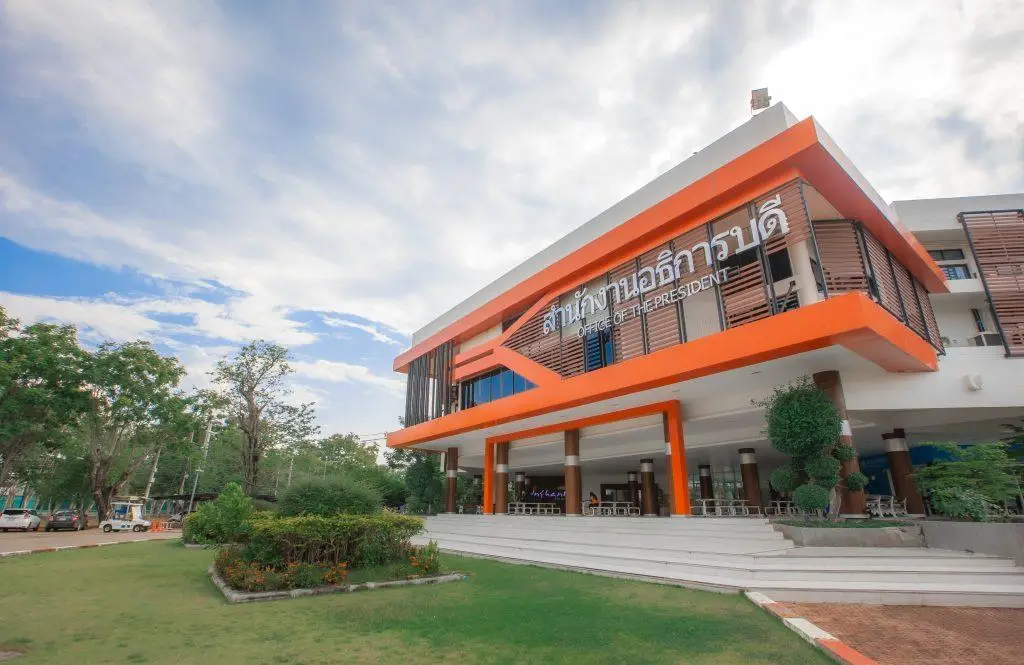
Important places within the Nakhon Ratchasima campus include the Office of the President, Khuru Sammanakhan Building, Watanyu Na Thalang Auditorium, Building 26 Innovation Ecosystem, the library and information services facilities, and the main sports ground. These locations are used for academic work, practical training, meetings, student activities, and selected public events. Visitors interested in laboratories or specialized workshops should make arrangements with the responsible academic units before entering restricted facilities.
The Innovation Ecosystem building is an example of a campus venue used for student learning and creative activities. In the 2026 academic year, the university organized a Wai Khru ceremonial tray design competition in the building. The activity encouraged students from different disciplines to apply creativity, teamwork, and design skills to an important Thai cultural tradition.
The Wai Khru ceremony remains an important tradition at Rajamangala University of Technology Isan. On July 15, 2026, the university held its annual ceremony under the theme Pranot Chit Wantha Mala Bucha Khru at Watanyu Na Thalang Auditorium. Activities included the ceremonial presentation of the university emblem, Buddhist chanting, student pledges, offerings of flowers and incense, and the presentation of awards and scholarships. The ceremony expressed gratitude to teachers while reinforcing ethical values and relationships within the university community.
A ceremonial tray competition was organized ahead of the main Wai Khru event in 2026. Students from different faculties collaborated on flower and incense trays, with categories recognizing beauty and creativity. Preparing these ceremonial items required planning, shared responsibility, design skills, and understanding of Thai educational customs, making the activity a practical expression of cultural learning.
Freshman welcoming activities in the 2026 academic year were especially significant because they coincided with the 70th anniversary of the institution's original establishment. On June 27, 2026, the university organized its First Steps to RMUTI celebration for students of the 22nd Khae Saet cohort and the 71st Takorai generation. The occasion combined student activities, cultural performances, and ceremonies expressing pride in the institution's history.
One of the most distinctive welcoming traditions is passing through the Khae Saet arch, symbolizing a new student's entry into the university community. In 2026, the arch incorporated the orange flowers associated with RMUTI, northeastern Thai ceremonial decorations, silk patterns, and imagery of Khuru Sammanakhan Building. The design celebrated the university's 70-year educational heritage while highlighting local cultural identity.
The welcoming program also included a traditional Bai Sri Su Khwan blessing ceremony and wrist-string tying. These northeastern Thai customs are intended to offer encouragement, blessings, and a sense of belonging to new students. They also create meaningful connections between incoming students, senior students, teachers, and university staff.
The traditional football competition between Rajamangala University of Technology Isan and Nakhon Ratchasima Rajabhat University is another significant part of local educational culture. Its origins can be traced to football matches involving teachers in 1958, before it developed into a recurring student competition between the two institutions. On February 21, 2026, RMUTI hosted the 55th edition of the traditional match at its main sports ground.
The football tradition is about more than sporting results. It strengthens relationships among students, alumni, staff, and residents of Nakhon Ratchasima. Parades, cheering activities, performances, and inter-university participation contribute to a sense of community and shared history. The event has become a long-running expression of friendship between two important educational institutions in Korat.
For visitors interested in educational tourism, Rajamangala University of Technology Isan provides an opportunity to explore the history of vocational and technical education in Thailand. The institution's development from a small technical college into a university illustrates changing approaches to professional training, applied research, and technological education. Organized study visits can also focus on engineering facilities, industry-oriented education, innovation, and community services.
The Nakhon Ratchasima Center can be combined with visits to historical and cultural landmarks in Korat, including Thao Suranari Monument, Chumphon Gate, Wat Sala Loi, the City Pillar Shrine, and Maha Viravong National Museum. These places provide insights into local history, religious traditions, urban development, and regional heritage, complementing a visit focused on the city's educational development.
Getting There Rajamangala University of Technology Isan (Nakhon Ratchasima Center) is located at 744 Suranarai Road, Nai Mueang Subdistrict, Mueang Nakhon Ratchasima District, Nakhon Ratchasima 30000, Thailand. Drivers can reach central Nakhon Ratchasima via Mittraphap Road and other major highways before following city roads to Suranarai Road. Those traveling from Bangkok can use Highway 1 through Saraburi and Highway 2 toward Nakhon Ratchasima before continuing to the university.
Public transportation options include interprovincial buses serving Nakhon Ratchasima and train services to Nakhon Ratchasima Railway Station. Visitors can continue to the university by hired vehicle or local transport. Because Suranarai Road serves several educational institutions and surrounding communities, checking traffic conditions and the precise destination before departure is advisable.
Visitors contacting the Faculty of Railway Systems and Transportation or the Faculty of Agricultural Innovation and Technology should pay particular attention to the Nong Rawiang Education Center, which is separate from the main campus on Suranarai Road. Admissions and academic records inquiries can be directed to the Office of Academic Promotion and Registration in Building 35, second floor, by calling +66 44 233 067 or the main university number, +66 44 233 000.
Administrative and registration offices generally operate Monday through Friday from 08:30 to 16:30, excluding public holidays and holidays announced by the university. These hours refer to administrative services rather than the opening and closing times of the entire campus. Teaching buildings, libraries, workshops, sports facilities, and event venues may follow separate schedules according to their activities.
In summary, Rajamangala University of Technology Isan's Nakhon Ratchasima Center represents an important chapter in Thailand's history of vocational and higher education. Established as Northeastern Technical College on June 5, 1956, it developed through the College of Technology and Vocational Education and Rajamangala Institute of Technology periods before becoming part of the newly established university in 2005. The institution continues to emphasize practical professional education while expanding into engineering, railway systems, agriculture, business, design, and other modern disciplines. Its academic activities, research, community partnerships, and long-standing student traditions make it a significant educational and cultural institution in Nakhon Ratchasima Province.
Rajamangala University of Technology Isan (Nakhon Ratchasima Center) Summary Table
| University Name | Rajamangala University of Technology Isan (Nakhon Ratchasima Center) |
| Thai Name | มหาวิทยาลัยเทคโนโลยีราชมงคลอีสาน (ศูนย์กลางนครราชสีมา) |
| Abbreviation | RMUTI |
| University Type | Public University Specializing in Professional and Technological Education |
| Address | 744 Suranarai Road, Nai Mueang Subdistrict, Mueang Nakhon Ratchasima District, Nakhon Ratchasima 30000, Thailand |
| Original Institution Opened | June 5, 1956 |
| University Established | 2005, under the Rajamangala University of Technology Act B.E. 2548 |
| Educational Heritage in 2026 | 70 Years since the Original College Began Teaching |
| Former Names | 1. Northeastern Technical College, Nakhon Ratchasima 2. College of Technology and Vocational Education, Northeastern Technical Campus 3. Rajamangala Institute of Technology, Northeastern Campus, Nakhon Ratchasima |
| Important Founding Figure | Mr. Sa-ngiam Watthanatham, First Director of the Northeastern Technical College |
| Rector in 2026 | Associate Professor Dr. Kosit Sriphuthorn |
| University Color | Orange |
| University Tree and Flower | African Tulip Tree and Khae Saet Flower |
| Principal Buddha Image | Phra Phuttha Noppharat Sattha Sima Mongkhon Phisut |
| Educational Philosophy | Preparing Skilled Professionals for Employment through Technological Expertise and Practice-Oriented Learning |
| Faculties and Institute at Nakhon Ratchasima | 1. Faculty of Business Administration 2. Faculty of Sciences and Liberal Arts 3. Faculty of Engineering and Technology 4. Faculty of Architecture and Creative Arts 5. Faculty of Railway Systems and Transportation 6. Faculty of Agricultural Innovation and Technology 7. Institute of Interdisciplinary Studies |
| Other University Campuses | Khon Kaen, Sakon Nakhon, Surin, and the Proposed Roi Et Campus at Thung Kula Rong Hai |
| Additional Educational Location | Nong Rawiang Education Center, Nong Rawiang Subdistrict, Mueang Nakhon Ratchasima District |
| Academic Strengths | Engineering and Technology, Business Administration, Applied Sciences, Architecture and Creative Arts, Railway Systems and Transportation, Agricultural Innovation |
| Campus Facilities | Office of the President, Khuru Sammanakhan Building, Watanyu Na Thalang Auditorium, Building 26 Innovation Ecosystem, Library and Information Services, Main Sports Ground, and Nong Rawiang Education Center |
| University Traditions | Wai Khru Ceremony, Khae Saet Arch Tradition, Freshman Bai Sri Su Khwan Ceremony, Traditional Football Match with Nakhon Ratchasima Rajabhat University, and Techno Takorai Heritage Activities |
| Administrative Open Days | Monday – Friday, Excluding Public Holidays and University-Announced Holidays |
| Administrative Opening Hours | 08:30 – 16:30 |
| Facilities | Teaching Buildings, Laboratories, Workshops, Library, Auditoriums, Sports Facilities, Student Accommodation, and Parking Areas |
| Getting There | Private Car via Mittraphap Road and Suranarai Road, or Interprovincial Bus and Train to Nakhon Ratchasima followed by Local Transport |
| Attractions in Nakhon Ratchasima City | 1. Wat Sala Loi 2. Thao Suranari Monument 3. Chumphon Gate 4. Nakhon Ratchasima City Pillar Shrine 5. Maha Viravong National Museum |
| Restaurants in the Suranarai Road and City Areas | 1. Tum Thai Baan E-San, Suranarai Road, Tel. +66 95 610 6599 2. Suan Mon Mookata, Soi 30 Kanya, Tel. +66 62 242 6659 3. Come Eat Sushi Korat, Suranarai Road, Tel. +66 98 665 5465 4. Monkey Bar/Restaurant Korat, Suranaree Road, Tel. +66 65 073 2416 5. Sor Rueng Restaurant, Suranaree Road, Tel. +66 81 185 4040 |
| Hotels in the Suranarai Road and City Areas | 1. The Imperial Hotel and Convention Centre Korat, Suranarai Road, Tel. +66 44 256 629 2. Qlosest Hotel, Soi Suranarai 11 Area, Tel. +66 61 425 4289 3. Ploy Pavilion, Suranarai Road Area, Tel. +66 88 580 7091 4. Zenith Residence Hotel, Mittraphap Road, Tel. +66 93 323 7096 5. HOP INN Nakhon Ratchasima City Center, Tel. +66 2 080 2222 |
| Main Telephone | +66 44 233 000 |
| Academic Promotion and Registration Telephone | +66 44 233 067 |
| Official Website | https://www.rmuti.ac.th/ |
| Current Status | Operating Public University and Central Administrative Location of Rajamangala University of Technology Isan |
Rajamangala University of Technology Isan (Nakhon Ratchasima Center) Academic Programs, Academic Year 2026
| Faculty of Business Administration | Bachelor's Degrees 1. Accounting 2. Management 3. Marketing 4. Finance 5. Business Information Systems Master's Degree 1. Master of Business Administration Higher Vocational Diplomas 1. Accounting 2. Marketing |
| Faculty of Sciences and Liberal Arts | Academic Fields Listed in Faculty Information 1. Tourism and Hospitality 2. English for Communication 3. Applied Physics 4. Chemistry 5. Bioproduct Technology 6. Dairy and Beverage Product Technology 7. Logistics Technology 8. Computer Science 9. Mass Communication Technology 10. Materials Science and Innovation 11. Sports and Health Science 12. Applied Statistics |
| Faculty of Engineering and Technology | Degree-Level Academic Fields 1. Industrial Engineering 2. Materials Engineering 3. Survey Engineering 4. Civil Engineering 5. Electronics Engineering 6. Electrical Engineering 7. Telecommunications Engineering 8. Computer Engineering 9. Postharvest and Processing Engineering 10. Automotive Engineering 11. Mechatronics Engineering 12. Agricultural Machinery Engineering 13. Mechanical Engineering 14. Refrigeration and Air Conditioning Engineering Higher Vocational Education 1. Technical and Industrial Technology Programs |
| Faculty of Architecture and Creative Arts | Degree-Level Academic Fields 1. Architecture 2. Interior Architecture 3. Visual Arts 4. Visual Communication Design 5. Multimedia Technology 6. Industrial Design |
| Faculty of Railway Systems and Transportation | Degree-Level Academic Fields 1. Railway Systems Engineering 2. Aircraft Maintenance Engineering 3. Railway Operations Management 4. Innovation in Urban and Transit-Oriented Development |
| Faculty of Agricultural Innovation and Technology | Higher Vocational Diplomas 1. Crop Science 2. Animal Science Bachelor's Degrees 1. Crop Science 2. Animal Science 3. Food Science and Technology Master's Degree 1. Animal Science Doctoral Degree 1. Animal Science |
| Institute of Interdisciplinary Studies | Interdisciplinary Academic Unit The institute supports integrated education, interdisciplinary learning, and professional skills development at the Nakhon Ratchasima Center. |
Frequently Asked Questions (FAQ)
Q: Where is Rajamangala University of Technology Isan's Nakhon Ratchasima Center located?
A: It is located at 744 Suranarai Road, Nai Mueang Subdistrict, Mueang Nakhon Ratchasima District, Nakhon Ratchasima 30000, Thailand. The university also has an educational center in Nong Rawiang.
Q: What are the opening days and hours of Rajamangala University of Technology Isan?
A: The main administrative and registration offices generally operate Monday through Friday, from 08:30 to 16:30, excluding public holidays and university-announced holidays.
Q: When was Rajamangala University of Technology Isan established?
A: Its history began with Northeastern Technical College, which started teaching on June 5, 1956. Rajamangala University of Technology Isan was established in its present university form under legislation enacted in 2005.
Q: Is Rajamangala University of Technology Isan the same institution as the former Northeastern Technical College?
A: Yes. The present Nakhon Ratchasima Center developed from the original Northeastern Technical College through several institutional and legal transformations.
Q: How many faculties and institutes are located at the Nakhon Ratchasima Center?
A: The center comprises six major faculties and one academic institute, covering business, sciences and liberal arts, engineering, architecture and creative arts, railway systems and transportation, agricultural innovation, and interdisciplinary studies.
Q: What is Rajamangala University of Technology Isan known for?
A: RMUTI is known for practical professional education, particularly engineering, industrial technology, business administration, transportation systems, creative arts, and agricultural innovation.
Q: Is the Nong Rawiang Education Center located on Suranarai Road?
A: No. Nong Rawiang is a separate educational location in Nong Rawiang Subdistrict, Mueang Nakhon Ratchasima District, used by selected academic faculties and specialist programs.
Q: Can members of the public visit the university?
A: Visitors can contact administrative offices and attend events open to the public. Access to laboratories, technical workshops, and restricted research facilities requires prior permission from the responsible academic units.
 Category: ●University
 Group: ●Rajamangala University of Technology
Last Update : 6 DayAgo
 Last Update : 6 DayAgo
 Click to Access the Navigation Map GPS
Rajamangala University of Technology Isan (Nakhon Ratchasima Center) Map
Recommend

 Art, Culture and Heritage
 Historical Sites and Monuments(20)
 Landmarks and Memorials(5)
 Art, Craft Centres, Tradition(7)
 Museums(6)
 Art Gallery(1)
 Educational Places
 Educational Gardens, Farm(4)
 Public university(1)
 Autonomous Universities(2)
Rajamangala University of Technology(2)
 Rajabhat University(1)
 Private University(1)
 Places of Worship
 Temple(29)
 Mosque(1)
 Other Sacred Sites(6)
 Research and Development
 Royal Project(3)
 Suburban Living
 Village, Community(6)
 Local Market(4)
 Floating Market(1)
 Nature and Wildlife
 National Parks and Marine Reserves(3)
 Mountain (Doi)(5)
 Dam, Reservoir, Lake(8)
 Waterfalls(9)
 Hot Springs(1)
 Caves(2)
 Flower Field(1)
 River, Canal(8)
 Bays and Beaches(2)
 Other natural attractions(3)
 Entertainment and Agricultural
 Zoos and Aquariums(2)
 Animal camps and shows(1)
 Farms, Parks and Ecotourism(21)
 Waterpark(4)
 Outdoor and Adventure Activities(6)
 Shopping
 Shopping and Night Market(2)
 Travel Articles, Recipes
 Travel Review, Food Review(6)


