
lovethailand home >Northeastern Travel Attractions >Nakhon Ratchasima Travel Attractions >Pak Thong Chai >Takhop > Jim Thompson Farm
TL;DR: Jim Thompson Farm, Nakhon Ratchasima attractions : Entertainment and Agricultural, Farms, Parks and Ecotourism.
Jim Thompson Farm
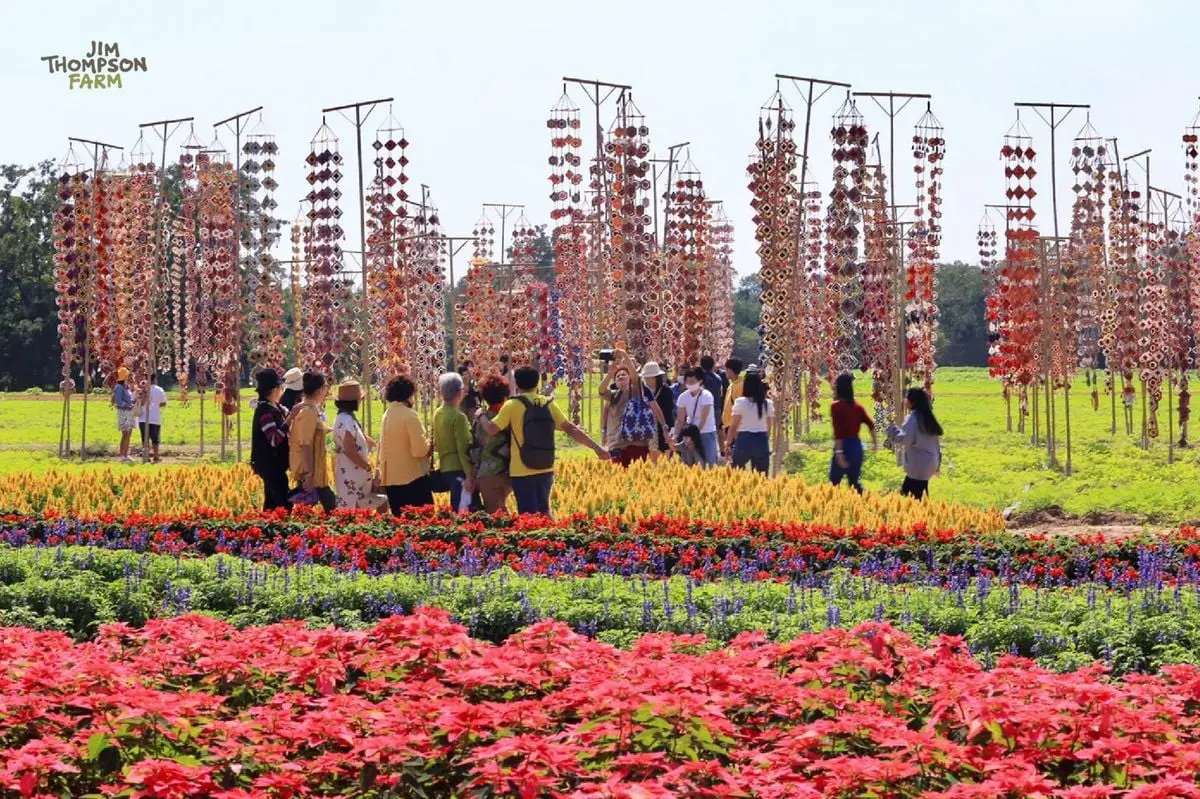
Open Days: The main Farm Tour paused in 2025 and will return in December 2026
Opening Hours: According to the official schedule of each annual Farm Tour edition
Jim Thompson Farm in Nakhon Ratchasima is one of Thailand’s most distinctive seasonal destinations for agricultural tourism, Isan culture, silk heritage, and winter flower landscapes. Located at the foot of Khao Phaya Prap in Takhob Subdistrict, Pak Thong Chai District, Nakhon Ratchasima Province, the farm is surrounded by a beautiful rural landscape, with Lam Samlai Reservoir on the western side and Khao Phaya Prap on the eastern side. Unlike ordinary tourist attractions that open every day throughout the year, Jim Thompson Farm operates its main Farm Tour as a seasonal event. The main Farm Tour paused in 2025 and is scheduled to return in December 2026 with a new format.
The farm is best known for combining nature, modern agriculture, Thai silk heritage, Isan culture, open-air art, and community-based learning across more than 600 rai of land. During the Farm Tour season, visitors can explore flower fields, cosmos fields, pumpkin displays, vegetable gardens, silkworm learning areas, Isan Village, Jim Village, and Jim Market. These zones make the farm more than a flower-photo destination. It is a place where visitors can understand how agriculture, craft, landscape, food, and rural culture are connected in northeastern Thailand.
The significance of Jim Thompson Farm is closely tied to Pak Thong Chai, a district long associated with Thai silk. This location gives the farm a strong cultural foundation. Silk is not presented only as a finished product sold in shops, but as a living process connected to mulberry plants, silkworms, cocoons, thread, dyeing, weaving, design, and community craftsmanship. For both Thai and international visitors, the farm offers a clear and memorable way to understand that Thai silk is not simply a luxury fabric; it is the result of agriculture, patience, skill, and cultural continuity.
The name Jim Thompson is internationally associated with Thai silk. At the farm in Pak Thong Chai, that identity is brought back to the source of the material and the rural communities that support silk production. Visitors can see the connection between mulberry cultivation, silkworm care, natural fibers, weaving processes, and the cultural identity of Isan. This makes the farm particularly meaningful for foreign travelers who want to understand Thai silk beyond museum displays or retail stores. The experience brings the story of silk into the landscape where plants, insects, farmers, craftspeople, and designers all play a role.
The Farm Tour route is usually organized into several major zones. The first impression often comes from the cosmos fields and organic vegetable gardens. Pink cosmos flowers and seasonal blooms create wide, colorful views, while vegetable plots show the agricultural side of the farm. This area is popular for photography, but it also demonstrates how a working farm can be designed as a learning landscape. The beauty of the fields comes from planning, planting cycles, care, and timing, not from decoration alone.
The pumpkin field and flower maze are among the most memorable parts of Jim Thompson Farm. Bright orange pumpkins are arranged across the landscape, creating a playful contrast with flower fields and surrounding hills. Families and children often spend a long time in this zone because it is fun, colorful, and visually unique. The flower maze adds movement to the experience, allowing visitors to walk through designed paths, discover viewpoints, and take photographs from different angles. It turns sightseeing into a more active experience.
Isan Village is one of the most culturally important zones of the farm. It is not only a display of traditional houses, but also a space that presents the way of life, beliefs, seasonal customs, and local knowledge of northeastern Thailand. Visitors may encounter stories related to Isan houses, rural tools, Bun Khun Lan, candle-making traditions, water-related rituals, flower-tree processions, and photographs that preserve memories of Isan communities. This zone gives depth to the farm visit by connecting tourism with real cultural identity.
Jim Village is the zone most directly connected with silk. Visitors can learn about the life cycle of silkworms, from eggs to larvae, cocoons, and silk thread. A piece of silk begins with small living creatures and careful care. Seeing this process helps visitors appreciate the value of natural fibers and the precision behind sericulture. For many foreign travelers, this is one of the most educational parts of the farm because it explains Thai silk in a way that is visual, practical, and easy to understand.
Beyond silkworms, Jim Village also connects to weaving, dyeing, and textile production. Weaving requires skill, rhythm, concentration, and deep knowledge of thread. Dyeing and fabric printing require color understanding and design. When visitors see these processes in the farm setting, the value of silk becomes clearer. A silk scarf, dress, or home textile is no longer just a beautiful object; it becomes the final expression of agriculture, craft, time, and cultural memory.
Jim Market is usually the final lively zone of the Farm Tour. It gathers farm produce, vegetables, fruit, potted flowers, local food, souvenirs, silk products, and farm-related goods. Many visitors enjoy shopping here because it connects the experience of walking through the farm with tangible products they can take home. Jim Market is therefore not just an exit shop. It is a space where agricultural and community-based economies become part of the travel experience.
The natural setting of Jim Thompson Farm is one of its greatest strengths. The land lies between Lam Samlai Reservoir and Khao Phaya Prap, creating a wide rural landscape with water, hills, fields, and open skies. On clear days, visitors can see the mountain line behind flower fields and agricultural plots. This relationship between land, water, and farming gives the place a strong sense of depth and makes it different from ordinary flower gardens.
During Farm Tour seasons, visitors generally move through the farm by agricultural tram or shuttle service. This is important because the farm covers more than 600 rai. The vehicle system allows families, elderly visitors, and groups to reach different zones comfortably. Visitors can get off at designated stops, walk, take photographs, join activities, and continue to the next area. This organized route helps the farm handle large numbers of seasonal visitors while keeping the experience manageable.
For families, Jim Thompson Farm offers direct learning experiences for children. Children can see pumpkins, flowers, silkworms, vegetable plots, Isan houses, and outdoor spaces in one visit. Hay areas and open spaces allow children to move, observe, ask questions, and enjoy the farm environment. Instead of learning about plants and insects only from books, children can experience them in a real agricultural landscape.
For cultural travelers, the farm offers a meaningful way to learn about Isan. Pak Thong Chai and Nakhon Ratchasima are part of a region with strong traditions in silk, food, language, music, seasonal rituals, and local craftsmanship. Walking through Isan Village and the silk-learning zones allows visitors to understand the region through images, structures, activities, and real materials. The culture is presented in a form that is accessible to visitors of many ages and nationalities.
For international travelers, Jim Thompson Farm presents Thailand from a perspective different from beaches, temples, or large cities. Visitors see rural Isan, agricultural life, silk heritage, traditional houses, flower fields, and farm management in a Thai context. The experience is especially valuable for travelers who want to understand the origin of Thai silk and the agricultural landscape behind it. It also gives foreign visitors a richer understanding of Thai rural culture and seasonal travel.
In 2025, the main Farm Tour paused while the farm prepared a revised format. The Farm Tour is scheduled to return in December 2026. This current status is important because the farm is not a daily walk-in attraction and does not operate every month. It is a seasonal event, and visitors should plan around the official annual announcement. Travel plans, tickets, activity zones, dates, and opening hours must follow the Farm Tour edition of that year.
Admission fees depend on each year’s event format and ticketing system. For the 2024 Farm Tour, Early Bird tickets started at 90 baht for children and seniors, 150 baht for adults on weekdays, and 200 baht for adults on weekends. For the 2026 edition, ticket prices should follow the official announcement issued during that year’s ticket sales period, as event format, dates, special privileges, and conditions may change.
Getting There from Nakhon Ratchasima city requires traveling toward Pak Thong Chai District and continuing to Takhob Subdistrict near Khao Phaya Prap. The farm is about 25 km from Pak Thong Chai District. Private car, hired van, or organized tour transport is the most convenient option because the farm is located in a rural area and seasonal access depends on the Farm Tour schedule. Travelers from Bangkok can take Mittraphap Road to Nakhon Ratchasima, then continue toward Pak Thong Chai and Takhob.
A visit to Jim Thompson Farm is best planned as a full-day trip. The area is large, and each zone requires time for walking, learning, photography, and rest. Visitors who arrive early during the Farm Tour season have more time to use the tram service and explore the farm without rushing. Families with children or elderly travelers should bring hats, umbrellas, drinking water, and comfortable walking shoes because many areas are outdoors.
The best travel period is the cool season from late year to early year, which is the traditional Farm Tour period. The weather is generally more suitable for outdoor walking than the hot season, and flower fields look especially attractive in winter light. However, the actual opening dates must follow the official annual announcement because the farm is not open throughout the entire travel season.
Nearby attractions that can be combined with Jim Thompson Farm include Lam Samlai Reservoir, Khao Phaya Prap, Lam Phra Phloeng Dam, Pak Thong Chai silk community, Wat Na Phra That, Nakhon Ratchasima Zoo, and Dan Kwian Pottery Village. For a one-day route, visitors can make the farm the main destination and add a silk community stop or a local restaurant in Pak Thong Chai. For an overnight trip, travelers can continue toward Wang Nam Khiao, Pak Chong, or Khao Yai depending on their itinerary.
Food options near the farm include local restaurants, Pak Thong Chai restaurants, cafés, and family-style dining places along the route toward Lam Phra Phloeng and Pak Thong Chai town. Popular practical stops include Kam Thong Restaurant in Pak Thong Chai, Takhob Bar, Permsuk Resort and Cafe, restaurants in Pak Thong Chai town, and local eateries along the main roads. During Farm Tour periods, visitors should allow time for meals because many people leave the farm around similar hours.
Accommodation can be chosen according to the travel plan. Visitors who want to stay closer to the farm can look around Takhob, Pak Thong Chai, or the Lam Phra Phloeng area. Those who prefer city services can stay in Nakhon Ratchasima city. Travelers who want a more nature-focused trip can stay in Wang Nam Khiao or Khao Yai. Since Jim Thompson Farm is located away from the city center, having a private car makes the trip much easier.
Good visitor manners are important at the farm. Visitors should walk only on designated routes, avoid stepping into flower fields or crop plots, avoid picking flowers or produce without permission, keep the area clean, and follow the farm’s tram and activity system. The landscapes take months of planting and care, and responsible behavior helps preserve the farm for other visitors.
Jim Thompson Farm is suitable for many types of travelers: families, students, nature lovers, photographers, silk enthusiasts, cultural travelers, and international visitors who want to understand rural Thailand. Its attraction is not limited to flowers. Its deeper value lies in the way nature, agriculture, silk, Isan culture, local food, craft, and community identity come together in one large seasonal destination.
When the Farm Tour returns in December 2026, Jim Thompson Farm will remain one of Nakhon Ratchasima’s key winter travel destinations. With its large landscape, silk heritage, Isan cultural storytelling, and dramatic natural surroundings, the farm rewards travelers who plan ahead and allow enough time. The best experience comes not from rushing through photo spots, but from walking slowly, learning the stories, observing the landscape, and understanding how people, plants, animals, craft, and community are connected in this remarkable farm.
| Name | Jim Thompson Farm |
| Location | At the foot of Khao Phaya Prap, Takhob Subdistrict, Pak Thong Chai District, Nakhon Ratchasima Province |
| Address | Jim Thompson Farm, Takhob Subdistrict, Pak Thong Chai District, Nakhon Ratchasima 30150, Thailand |
| Highlights | A seasonal agricultural and Isan cultural farm of more than 600 rai, featuring flower fields, pumpkin displays, organic vegetable plots, Isan Village, Jim Village, silk-learning zones, and Jim Market |
| History / Importance | A Jim Thompson farm connected to mulberry cultivation, sericulture, Thai silk, agriculture, Isan culture, and educational tourism in Pak Thong Chai District |
| Name Origin | Named after the Jim Thompson brand, internationally associated with the revival and promotion of Thai silk |
| Distinctive Features | A seasonal Farm Tour destination with a large natural landscape, Lam Samlai Reservoir on the west, Khao Phaya Prap on the east, and tram-based touring inside the farm |
| Travel Information | From Pak Thong Chai District, continue to Takhob Subdistrict for about 25 km. Private car, hired van, or organized transport is recommended. |
| Current Status | The main Farm Tour paused in 2025 and will return in December 2026 |
| Open Days | The main Farm Tour paused in 2025 and will return in December 2026 |
| Opening Hours | According to the official schedule of each annual Farm Tour edition |
| Fees | Ticket prices for the 2026 edition will follow the official Jim Thompson Farm announcement during the annual ticket sales period |
| Facilities | Farm tram service, photo points, food and beverage areas, Jim Market, souvenir areas, agricultural produce, silk products, and rest points available according to each Farm Tour edition |
| Main Areas / Zones | Cosmos field and organic vegetable plots, pumpkin field and flower maze, Isan Village, Jim Village, Jim Market, silkworm and silk-production learning areas, and open-air art spaces in selected editions |
| Caretaker | Jim Thompson Farm under The Thai Silk Company Limited |
| Main Contact Number | 02-216-7368, 085-660-7336, 044-373-116 |
| Official Website / Official Page | Jim Thompson Farm official website and Jim Thompson Farm Tour official page |
| Nearby Tourist Attractions | 1. Lam Samlai Reservoir, about 1 km 2. Khao Phaya Prap, about 2 km 3. Lam Phra Phloeng Dam, about 25 km 4. Pak Thong Chai Silk Village, about 25 km 5. Wat Na Phra That, Pak Thong Chai, about 30 km 6. Nakhon Ratchasima Zoo, about 50 km 7. Dan Kwian Pottery Village, about 55 km |
| Nearby Restaurants | 1. Takhob Bar, about 10 km 2. Permsuk Resort / Permsuk Cafe, about 15 km, Tel. 087-872-3273 3. Kam Thong Restaurant Pak Thong Chai, about 23 km, Tel. 044-442602, 080-335-4273 4. Fong Win Made-to-Order Restaurant at Pak Thong Chai, about 28 km, Tel. 087-855-4319 5. Restaurants in Pak Thong Chai town, about 28 km 6. Local restaurants along the Lam Phra Phloeng route, about 25 km |
| Nearby Accommodations | 1. Permsuk Resort / Permsuk Cafe, about 15 km, Tel. 087-872-3273 2. Sup Thong Chai Resort, about 25 km, Tel. 099-496-2649 3. The Frog Cabana Resort, about 28 km, Tel. 088-146-3666 4. O-Home Resort Pak Thong Chai, about 30 km, Tel. 089-717-8731 5. The Symphony Resort Wangnankaew, about 35 km, Tel. 097-181-3785 6. Accommodations in Nakhon Ratchasima city, about 65 km |
Frequently Asked Questions (FAQ)
Q: Is Jim Thompson Farm open all year round?
A: No. Jim Thompson Farm is a seasonal Farm Tour destination. The main Farm Tour paused in 2025 and will return in December 2026.
Q: Where is Jim Thompson Farm located?
A: It is located in Takhob Subdistrict, Pak Thong Chai District, Nakhon Ratchasima Province, at the foot of Khao Phaya Prap near Lam Samlai Reservoir.
Q: What can visitors see at Jim Thompson Farm?
A: Visitors can see flower fields, cosmos fields, pumpkin displays, organic vegetable plots, Isan Village, Jim Village, Jim Market, and silk-learning zones from silkworms to weaving.
Q: How much is the admission fee for Jim Thompson Farm?
A: Ticket prices depend on each year’s Farm Tour edition. Prices for the 2026 edition will follow the official announcement during the ticket sales period.
Q: How do travelers get to Jim Thompson Farm?
A: From Pak Thong Chai District, continue to Takhob Subdistrict for about 25 km. Private car, hired van, or organized transport is the most convenient option.
Q: Is Jim Thompson Farm suitable for children and families?
A: Yes. The farm is suitable for families because it has outdoor spaces, flower fields, pumpkin displays, silkworm learning areas, vegetable gardens, Isan cultural zones, and family-friendly seasonal activities.
Q: What nearby attractions can be visited with Jim Thompson Farm?
A: Nearby attractions include Lam Samlai Reservoir, Khao Phaya Prap, Lam Phra Phloeng Dam, Pak Thong Chai Silk Village, Wat Na Phra That, Nakhon Ratchasima Zoo, and Dan Kwian Pottery Village.
 Category: ●Entertainment and Agricultural
 Group: ●Farms, Parks and Ecotourism
Last Update : 2 MonthAgo
 Last Update : 2 MonthAgo
 Click to Access the Navigation Map GPS
Jim Thompson Farm Map
Gellery
Recommend

 Art, Culture and Heritage
 Historical Sites and Monuments(20)
 Landmarks and Memorials(5)
 Art, Craft Centres, Tradition(7)
 Museums(6)
 Art Gallery(1)
 Educational Places
 Educational Gardens, Farm(4)
 Places of Worship
 Temple(29)
 Mosque(1)
 Other Sacred Sites(6)
 Research and Development
 Royal Project(3)
 Suburban Living
 Village, Community(6)
 Local Market(4)
 Floating Market(1)
 Nature and Wildlife
 National Parks and Marine Reserves(3)
 Mountain (Doi)(5)
 Dam, Reservoir, Lake(8)
 Waterfalls(9)
 Hot Springs(1)
 Caves(2)
 Flower Field(1)
 River, Canal(8)
 Bays and Beaches(2)
 Other natural attractions(3)
 Zoos and Aquariums(1)
 Animal camps and shows(1)
Farms, Parks and Ecotourism(21)
Animal camps and shows(1)
Farms, Parks and Ecotourism(21)
 Waterpark(2)
 Outdoor and Adventure Activities(6)
 Shopping
 Shopping and Night Market(2)
 Travel Articles, Recipes
 Travel Review, Food Review(5)


