
lovethailand home >Northeastern Travel Attractions >Khon Kaen Travel Attractions >Khao Suan Kwang >Dong Muang Aem > Dong Mueang Am Ancient City
TL;DR: Dong Mueang Am Ancient City is located at Ban Dong Mueang Am, Dong Mueang Am Subdistrict, Khao Suan Kwang District, Khon Kaen Province, open Daily, hours 08.00 – 17.00.
Dong Mueang Am Ancient City
Open Days: Daily
Opening Hours: 08.00 – 17.00
Dong Mueang Am Ancient City in Khon Kaen Province is one of the most important ancient settlement landscapes in northeastern Thailand. Located at Ban Dong Mueang Am, Dong Mueang Am Subdistrict, Khao Suan Kwang District, this ancient city preserves traces of a very large early historic community with moats, earthen embankments, laterite structural remains, pottery fragments, archaeological objects, and a significant inscription dating to around the 12th Buddhist century. For foreign travelers interested in Dvaravati culture, early Khmer influence, ancient urban planning, and local heritage, Dong Mueang Am offers a meaningful cultural experience beyond the more familiar tourist attractions of Khon Kaen.
Dong Mueang Am is not only a museum site. It is an ancient city that can still be understood through the landscape. The settlement measures approximately 2,400 meters from east to west and about 2,000 meters from north to south. It has a large moat and earthen embankment system, with 1 moat and 1 embankment in general, while the western side has 1 moat and 2 embankments. This scale makes Dong Mueang Am one of the largest known ancient community landscapes in the region and a strong example of early urban organization on the Khorat Plateau.
The name “Dong Mueang Am” reflects local memory. In Thai and Isan usage, “dong” can refer to a wooded or forested area, while “mueang” means town or city. The name therefore preserves the idea that this place was once an ancient town hidden within or associated with a wooded landscape. Archaeological evidence confirms that the name is not just a village label. The moats, embankments, pottery, laterite remains, and inscription show that this area was once a major settlement with political, religious, and cultural significance.
The ancient city stands on relatively raised ground surrounded by agricultural land and present-day communities. This kind of location was practical for ancient settlement. Raised ground reduced the risk of flooding, while nearby water sources and farmland supported agriculture, daily life, and ritual activity. The large moat system indicates that people in the past understood water management and landscape planning. The moat may have helped with drainage, water storage, boundary-making, and symbolic separation between the inner city and the surrounding landscape.
The most important artifact connected with Dong Mueang Am is the Wat Si Mueang Am inscription, also known as the inscription of King Mahendravarman or Chitrasena. The inscription is written in Pallava script and Sanskrit. It has 3 surviving lines and dates to around the 12th Buddhist century. Its text refers to King Chitrasena, who took the royal name Sri Mahendravarman after his consecration, and mentions the creation of a Shiva linga in the Shaivite tradition. This makes the inscription a key historical source for understanding early Chenla influence and Brahmanical-Hindu worship in the Chi and Mun river basins.
King Chitrasena, or Sri Mahendravarman, was an important figure in the early history of the Chenla kingdom. Inscriptions associated with him have been found in several locations across northeastern Thailand and Laos. These inscriptions show the spread of political power, religious symbolism, and Sanskrit epigraphic culture into the Khorat Plateau during the early historic period. The Wat Si Mueang Am inscription is therefore not only a local object; it connects Dong Mueang Am with wider regional history and the early development of Khmer-related political culture.
Although the inscription is related to Brahmanical-Hindu Shaivism, Dong Mueang Am as a whole also reflects cultural layers associated with the Dvaravati period and later Lopburi-related developments. Archaeological objects found in the area include plain pottery, cord-marked pottery, ancient jars, water vessels, terracotta votive tablets, and various fragments of daily-use objects. These finds suggest that the ancient city was not only a ritual center but also a large living community with domestic activities, craft traditions, food preparation, storage practices, and religious life.
Dong Mueang Am can be understood as a layered cultural landscape. The first layer is the large moated ancient city. The second layer is the archaeological evidence found across the site. The third layer is the religious and political meaning of the Sanskrit inscription. The fourth layer is the present-day community that continues to live in and around the ancient city. This combination makes the site especially valuable because it does not separate the past from the present. Instead, the ancient city survives within a living village environment.
The Dong Mueang Am Ancient History Museum is located inside Wat Si Mueang Am at Ban Dong Mueang Am, Mu 1, Dong Mueang Am Subdistrict, Khao Suan Kwang District, Khon Kaen Province. It is the best starting point for any visit. The museum was established in 1997 through local effort by the temple, community, and Dong Mueang Am Subdistrict Administrative Organization. Its purpose is to preserve and display archaeological objects found in the ancient city area, allowing residents and visitors to learn about the history of the place directly from local evidence.
Highlights of the museum include the Wat Si Mueang Am inscription, ancient pottery, jars, water vessels, terracotta votive tablets, and other objects discovered around the ancient city. Many items were found by villagers during farming activities such as ploughing fields or clearing land. Some objects are fragmented, but even broken pieces are historically valuable. Each fragment helps reveal how people lived, stored water, prepared food, practiced religion, and interacted with their environment.
The creation of the museum also shows how local communities can protect their own heritage. In the past, villagers sometimes kept ancient objects at home after discovering them by chance. Some people felt uneasy because old objects were believed to be connected with spirits or sacred forces. When the museum was established inside the temple, villagers had a trusted place to donate and preserve these objects. This transformed private discoveries into public knowledge and helped keep the history of Dong Mueang Am within the community.
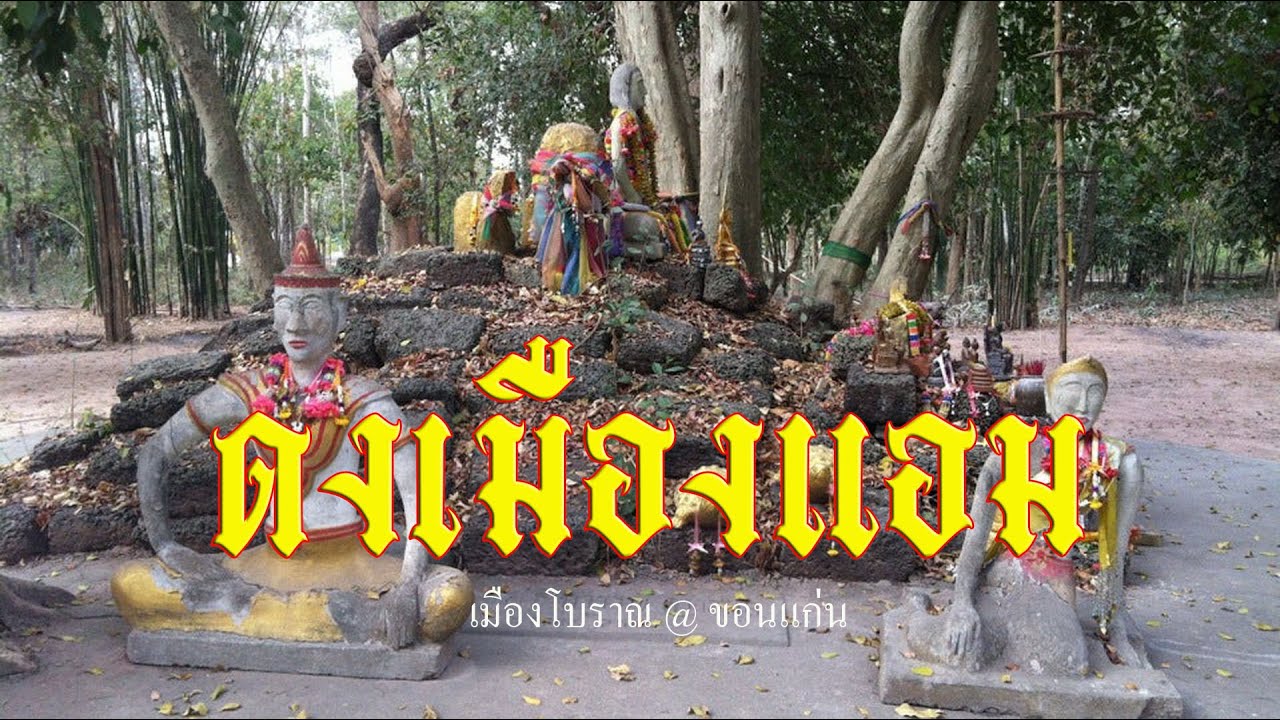
Another important feature is the laterite structural base known locally as Ku Dong Mueang Am. In northeastern Thailand, the word “ku” is commonly used for ancient sacred remains or religious structures. The laterite base indicates that an important building once stood within the ancient city area. Although the structure is no longer complete, the surviving remains help visitors imagine that Dong Mueang Am was not simply a residential settlement. It also had sacred or formal spaces connected with worship, authority, or community ritual.
The moats and earthen embankments are among the most important features of the ancient city. They show that Dong Mueang Am was planned on a large scale. Building such a landscape required labor, organization, and long-term social cooperation. The moat may have collected water, controlled floods, marked boundaries, and helped define the identity of the settlement. The embankments functioned as raised boundaries and may have also carried symbolic meaning, separating the inner settlement from the surrounding agricultural landscape.
The rounded rectangular shape of Dong Mueang Am reflects adaptation to natural terrain. Ancient cities were rarely built as perfect geometric forms. Their boundaries often followed the landscape, water flow, and practical needs of the community. The rounded corners of Dong Mueang Am make the city plan feel organic rather than rigid. This layout reveals a practical understanding of land, water, and settlement organization in early northeastern Thailand.
A good visit should begin at the museum inside Wat Si Mueang Am. Visitors should first view the inscription and artifacts to understand the historical background. After that, they can explore the surrounding community landscape to understand the scale of the ancient city. The most meaningful experience comes from combining museum knowledge with the real landscape of moats, embankments, fields, temple grounds, and village life. Dong Mueang Am is not a single-building attraction; it is a large ancient city landscape that must be read as a whole.
Wat Si Mueang Am plays an important role as both a Buddhist temple and a heritage center. Because the museum is located inside the temple, visitors should dress respectfully and behave politely. The temple setting also helps explain how local heritage is often preserved in Thailand. Temples are trusted community spaces where sacred objects, old inscriptions, and local historical materials can be kept close to the people who value them.
In terms of religious history, the inscription is especially important because it refers to the creation of a Shiva linga. A Shiva linga is a sacred symbol of Shiva in Hindu Shaivism. In early Southeast Asian political culture, the dedication of a linga could be connected with royal authority, victory, and religious legitimacy. The inscription therefore reveals how religion and power were closely linked in the early historic period. Dong Mueang Am was part of a world where rulers used sacred objects and inscriptions to express authority across landscapes.
In the Dvaravati context, Dong Mueang Am helps illustrate the development of large early cities in northeastern Thailand. Many Dvaravati-related settlements had moats and embankments, pottery traditions, Buddhist and Brahmanical influences, and connections with other communities. Dong Mueang Am stands out because of its large size and important inscription. It helps explain how local settlements on the Khorat Plateau participated in regional cultural change during the early historic period.
The later Lopburi and Khmer-related layers of the region also make Dong Mueang Am important for understanding cultural transition. The site helps bridge the historical space between Dvaravati communities and later Khmer-influenced monuments such as Ku Praphachai, Ku Kaew, and Prasat Pueai Noi in Khon Kaen. Dong Mueang Am shows that the region was already connected to wider political and religious currents before the construction of many later Khmer sanctuaries.
For general travelers, Dong Mueang Am is a quiet and authentic destination. It is not a large commercialized tourist attraction, but its value is deep. Visitors can see a community museum, an important inscription, ancient objects, a temple, and the landscape of a large ancient city. The experience is slower and more reflective than visiting a highly developed attraction. It is best suited for travelers who want to understand local history, not just take quick photos.
The best time to visit is in the morning or afternoon, when the weather is more comfortable and the museum can be visited without rushing. Groups, students, and researchers should contact the museum or Dong Mueang Am Subdistrict Administrative Organization in advance. This is especially useful if visitors want local guidance or deeper explanation of the inscription, museum displays, and ancient city landscape.
Visitors should not touch the inscription or museum objects, and they should not remove pottery fragments, stones, or any objects found in the landscape. Even small fragments may be archaeologically important. Climbing on ancient remains, damaging embankments, or littering should also be avoided. Dong Mueang Am is a community heritage site, so respectful behavior protects both the archaeological record and the dignity of the village.
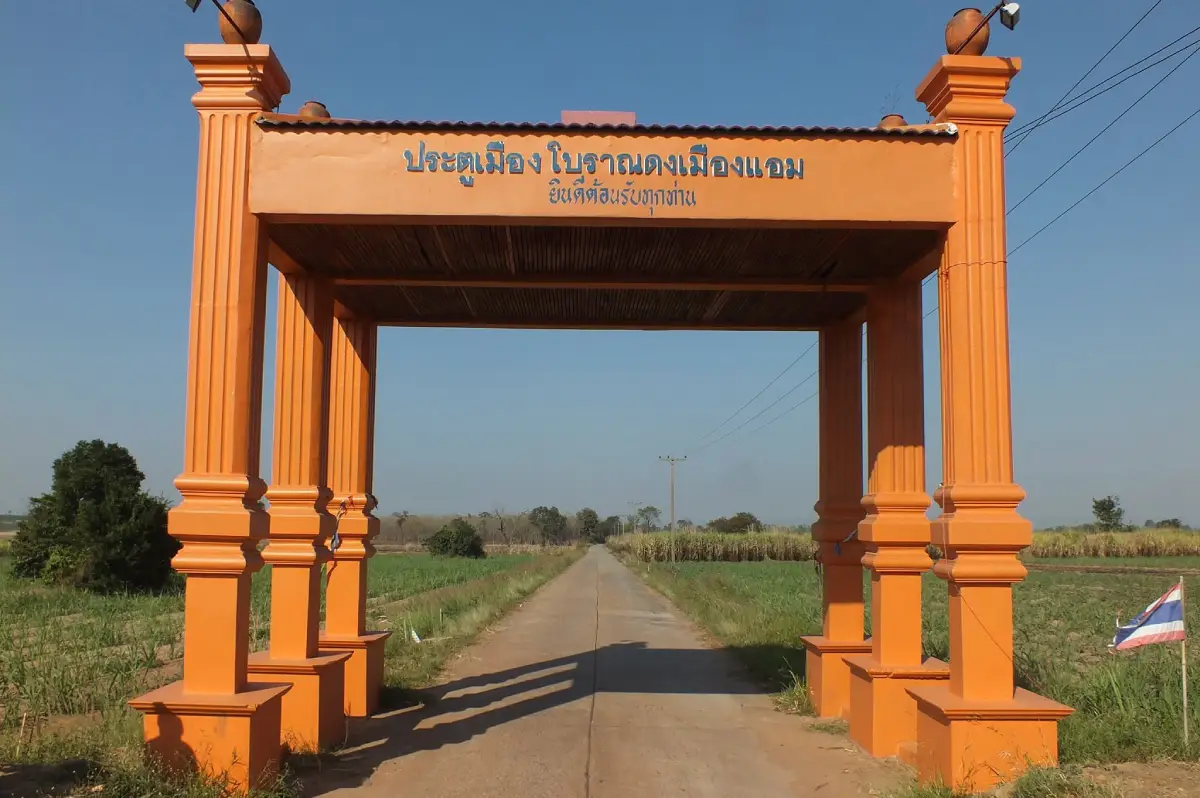
Getting There from Khon Kaen city is straightforward by private car. Take Highway 2, also known as Mittraphap Road, on the Khon Kaen–Udon Thani route for about 40 kilometers. In Khao Suan Kwang District, look for the Dong Mueang Am entrance arch on the left side. Turn in and continue along the local road for about 4 kilometers to reach Wat Si Mueang Am and the Dong Mueang Am Ancient History Museum. Private car travel is the most convenient because visitors can also stop at Khao Suan Kwang grilled chicken restaurants, Khon Kaen Zoo, waterfalls, and nearby natural attractions.
Travelers using public transport can take a bus or van that passes through Khao Suan Kwang on the Khon Kaen–Udon Thani route, then arrange local transport into Ban Dong Mueang Am. Since the museum is several kilometers from the main road, visitors should plan the return trip in advance. Families or travelers who want to explore the wider area should use a private vehicle.
Dong Mueang Am works well as a half-day trip from Khon Kaen city or as part of a full-day Khao Suan Kwang route. A good itinerary is to visit the museum and Wat Si Mueang Am in the morning, then stop for Khao Suan Kwang grilled chicken along Mittraphap Road, and continue to Khon Kaen Zoo or nearby waterfalls in the afternoon. This route combines archaeology, local food, community culture, and nature in one trip.
For travelers interested in a broader historical route, Dong Mueang Am can be connected with Non Mueang Ancient City in Chum Phae, Ku Praphachai in Nam Phong, Ku Kaew in Mueang Khon Kaen, and Prasat Pueai Noi in Pueai Noi District. Each site represents a different layer of Khon Kaen history. Together, they show that Khon Kaen is not only a modern provincial center but also a region with deep archaeological and cultural roots.
Today, Dong Mueang Am remains important not only as a tourist site but also as a local learning resource. The museum allows students and villagers to understand that their community has a long and meaningful past. It helps local people take pride in their heritage and helps visitors see the depth of history hidden behind a rural landscape. This is one of the strongest reasons to visit Dong Mueang Am: it shows how ancient history continues to live inside a present-day community.
In summary, Dong Mueang Am Ancient City is a highly valuable archaeological and cultural destination in Khao Suan Kwang District, Khon Kaen Province. Its large moated city plan, earthen embankments, Wat Si Mueang Am inscription, pottery, terracotta votive tablets, laterite remains, community museum, temple setting, and living village landscape all make it an important place for understanding early northeastern Thai history. A visit here is not just a museum stop; it is a journey into more than a thousand years of settlement, religion, political memory, and community heritage on the Khorat Plateau.
| Name | Dong Mueang Am Ancient City |
| Location | Ban Dong Mueang Am, Dong Mueang Am Subdistrict, Khao Suan Kwang District, Khon Kaen Province |
| Address | Dong Mueang Am Ancient History Museum, Wat Si Mueang Am, Mu 1, Ban Dong Mueang Am, Dong Mueang Am Subdistrict, Khao Suan Kwang District, Khon Kaen 40280, Thailand |
| Reference Coordinates | 16.850548, 102.870473 |
| Place Type | Ancient city / Ancient community / Archaeological site / Local museum inside a temple |
| Highlights | Large ancient moated city with earthen embankments, the Wat Si Mueang Am inscription, archaeological objects, pottery, terracotta votive tablets, and laterite structural remains known as Ku Dong Mueang Am |
| History | An important early historic settlement dating around the 12th Buddhist century, with cultural development from Dvaravati to Lopburi-related periods and a major inscription associated with Sri Mahendravarman or Chitrasena of Chenla |
| Name Origin | “Dong” suggests a wooded or forested area, while “Mueang” means town or city, preserving local memory that this place was once a major ancient settlement |
| Ancient City Plan | Rounded rectangular ancient city, approximately 2,400 meters east–west and 2,000 meters north–south, with 1 moat and 1 earthen embankment generally, and 1 moat plus 2 embankments on the western side |
| Key Evidence | Wat Si Mueang Am inscription in Pallava script and Sanskrit, Mahendravarman inscription, ancient pottery, jars, water vessels, terracotta votive tablets, plain pottery, cord-marked pottery, and laterite building remains |
| Travel Information | From Khon Kaen city, take Highway 2 or Mittraphap Road toward Udon Thani for about 40 km. In Khao Suan Kwang District, turn left at the Dong Mueang Am entrance arch and continue about 4 km to Wat Si Mueang Am and the museum. |
| Current Status | Open to visitors as a historical, archaeological, and community museum site inside Wat Si Mueang Am |
| Open Days | Daily |
| Opening Hours | 08.00 – 17.00 |
| Admission Fee | No admission fee |
| Facilities | Local museum, artifact display cases, temple grounds, parking area, worship area, pavilion, and community access route within Ban Dong Mueang Am |
| Main Areas / Zones | 1. Dong Mueang Am Ancient History Museum 2. Wat Si Mueang Am 3. Wat Si Mueang Am Inscription Display Area 4. Pottery And Artifact Display Zone 5. Laterite Structural Remains / Ku Dong Mueang Am 6. Ancient Moat And Earthen Embankment Landscape 7. Ban Dong Mueang Am, Ban Non Phueng, And Ban Dong Rueang Community Context 8. Agricultural Landscape Of The Ancient City Area |
| Abbot / Caretaker | Phra Athikan Khamphang Jaruwanno, Abbot of Wat Si Mueang Am Co-Caretakers: Wat Si Mueang Am, Dong Mueang Am Subdistrict Administrative Organization, and relevant art / archaeological conservation agencies |
| Main Contact Number | Dong Mueang Am Ancient History Museum Tel. 04-304-0097 Dong Mueang Am Subdistrict Administrative Organization Tel. 043-040-097 |
| Official Website / Official Page | Dong Mueang Am Subdistrict Administrative Organization and the Sirindhorn Anthropology Centre museum database |
| Nearby Tourist Attractions | 1. Dong Mueang Am Ancient History Museum, about 0 km 2. Ku Dong Mueang Am / Laterite Base Inside Wat Si Mueang Am, about 0 km 3. Khon Kaen Zoo, Khao Suan Kwang District, about 17 km 4. Than Sawan Waterfall, Khao Suan Kwang District, about 18 km 5. Ba Luang Waterfall, about 28 km 6. Ubolratana Dam, about 38 km 7. Bang Saen 2 And Hat Chom Thong, about 40 km |
| Nearby Restaurants | 1. Kai Yang Wanna Khao Suan Kwang, about 11 km, Tel. 043-449-024, 081-965-5484 2. Wan Kai Yang Khao Suan Kwang, about 11 km, Tel. 099-456-3298, 099-369-5526 3. Kai Yang Fon Thip Khao Suan Kwang, about 11 km 4. Kai Yang Je Tiang Khao Suan Kwang, about 12 km 5. Local Restaurants Along Mittraphap Road In Khao Suan Kwang, about 11–13 km 6. Kai Yang Rabeab Khao Suan Kwang, Khon Kaen City Branch, about 55 km, Tel. 043-243-413, 081-662-3851 |
| Nearby Accommodations | 1. Amp In Resort Khao Suan Kwang, about 11 km, Tel. 061-282-4891, 098-625-7981 2. Phu Suan Kwang Resort And Camping, Khon Kaen Zoo Area, about 17 km, Tel. 096-760-7164, 098-585-9408 3. Khon Kaen Zoo Accommodation, about 17 km, Tel. 096-438-8571 4. Varee Valley Resort And Restaurant, Ubolratana District, about 38 km, Tel. 089-777-1400 5. Ban Chom Dao Resort, Ubolratana Dam Area, about 39 km, Tel. 094-296-4798 6. Khiao Sot Resort, Ubolratana District, about 42 km, Tel. 085-407-0465 |
Frequently Asked Questions (FAQ)
Q: Where is Dong Mueang Am Ancient City located?
A: Dong Mueang Am Ancient City is located at Ban Dong Mueang Am, Dong Mueang Am Subdistrict, Khao Suan Kwang District, Khon Kaen Province. The local museum is inside Wat Si Mueang Am.
Q: Why is Dong Mueang Am Ancient City important?
A: It is a very large ancient moated city with earthen embankments and an important Pallava-script Sanskrit inscription connected with King Chitrasena or Sri Mahendravarman in the 12th Buddhist century.
Q: What can visitors see at Dong Mueang Am?
A: Visitors can see the Dong Mueang Am Ancient History Museum, the Wat Si Mueang Am inscription, pottery, terracotta votive tablets, archaeological objects, laterite remains, and the surrounding ancient city landscape.
Q: What is the Wat Si Mueang Am inscription about?
A: The inscription mentions King Chitrasena, who took the name Sri Mahendravarman, and refers to the creation of a Shiva linga in the Shaivite tradition. It is an important source for early Chenla influence in northeastern Thailand.
Q: Is there an admission fee?
A: No. The Dong Mueang Am Ancient History Museum does not charge an admission fee and is open daily from 08.00 to 17.00.
Q: How can travelers get to Dong Mueang Am from Khon Kaen city?
A: Take Highway 2 or Mittraphap Road toward Udon Thani for about 40 km. In Khao Suan Kwang District, turn left at the Dong Mueang Am entrance arch and continue about 4 km to Wat Si Mueang Am.
Q: What nearby places can be combined with Dong Mueang Am?
A: Travelers can combine Dong Mueang Am with Khon Kaen Zoo, Than Sawan Waterfall, Ba Luang Waterfall, Ubolratana Dam, Bang Saen 2, and local Khao Suan Kwang grilled chicken restaurants.
Q: What should visitors keep in mind when visiting Dong Mueang Am?
A: Visitors should dress respectfully because the museum is inside a temple, avoid touching or moving artifacts, avoid collecting pottery fragments or stones, and respect the local community and temple area.
 Category: ●Art, Culture and Heritage
 Group: ●Historical Sites and Monuments
Last Update : 4 MonthAgo
 Last Update : 4 MonthAgo
 Click to Access the Navigation Map GPS
Dong Mueang Am Ancient City Map
Recommend
 Historical Sites and Monuments(7)
 Landmarks and Memorials(3)
 Art, Craft Centres, Tradition(2)
 Museums(4)
 Educational Places
 Museum for Study(2)
 Places of Worship
 Temple(27)
 Other Sacred Sites(5)
 Suburban Living
 Village, Community(3)
 Local Market(1)
 Nature and Wildlife
 National Parks and Marine Reserves(5)
 Mountain (Doi)(1)
 Dam, Reservoir, Lake(4)
 Waterfalls(8)
 Caves(9)
 River, Canal(10)
 Bays and Beaches(3)
 Islands(1)
 Other natural attractions(5)
 Entertainment and Agricultural
 Zoos and Aquariums(2)
 Animal camps and shows(2)
 Farms, Parks and Ecotourism(7)
 Waterpark(3)
 Travel Articles, Recipes
 Travel Review, Food Review(1)


