
lovethailand home >Northeastern Travel Attractions >Khon Kaen Travel Attractions >Muang Khon Kaen >Nai Muang > Khon Kaen Postal Museum
TL;DR: Khon Kaen Postal Museum is located at 2nd Floor, Khon Kaen Post Office, Klang Mueang Road, Nai Mueang Subdistrict, Mueang Khon Kaen District, Khon Kaen Province, open Monday – Friday, hours 08.30 – 16.30.
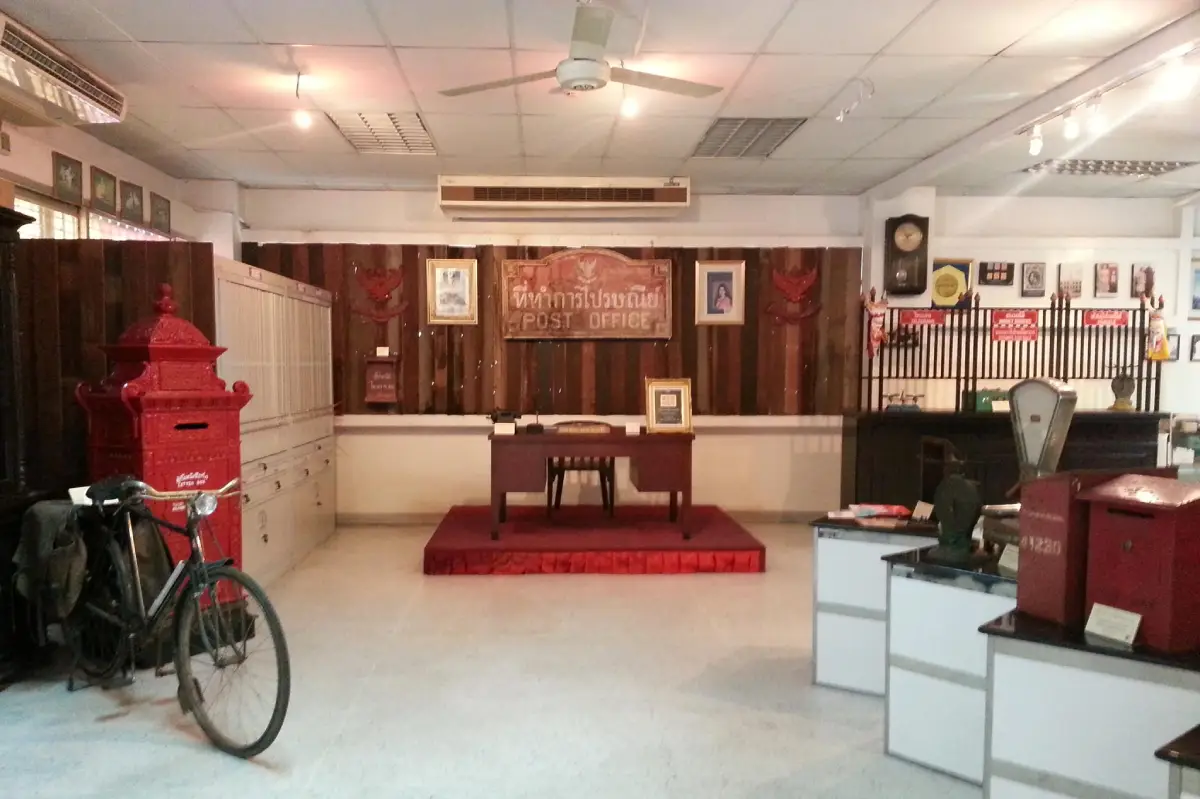
Khon Kaen Postal Museum
Open Days: Monday – Friday
Opening Hours: 08.30 – 16.30
Khon Kaen Postal Museum, also known as Khon Kaen Philatelic Museum, is a small but meaningful learning space located on the 2nd floor of Khon Kaen Post Office on Klang Mueang Road, Nai Mueang Subdistrict, Mueang Khon Kaen District, Khon Kaen Province. Although it is not a large museum, it offers valuable insight into the history of Thai postal services, postage stamps, written communication, and the culture of stamp collecting.
This museum is suitable for visitors who want to explore a quieter and more educational side of Khon Kaen city. It is especially interesting for history lovers, stamp collectors, students, families, and travelers who want to discover a small cultural attraction in the city center. Inside, the museum presents the history of postal services, the world’s first postage stamp, types of stamps, stamp collecting tools such as stamp tongs, magnifying glasses, perforation gauges, and stamp mounts, as well as stories about Thai and international stamps.
What makes Khon Kaen Postal Museum interesting is the way it turns a small object like a stamp into an entry point for much larger stories. A single stamp can reflect a country, a historical figure, an important event, art, technology, transportation, belief, tradition, nature, animals, plants, and the identity of a particular period. Looking at stamps in a museum is therefore not only about viewing collectibles; it is a way of reading history through carefully designed miniature images.
The museum is located inside an active post office building, which adds meaning to the visit. Visitors can experience the atmosphere of a working postal service while also learning about the history of postal communication and philately upstairs. This connection between the functioning post office and the museum allows visitors to see the continuity between past and present forms of communication.
Before mobile phones, instant messaging, and email became part of everyday life, letters, postcards, money orders, parcels, and other postal services played a major role in connecting people. Letters carried family news, personal feelings, business documents, official communication, and messages between communities. Studying postal history is therefore a way to understand how people communicated across distance before the digital age.
The world’s first postage stamp is one of the most attractive topics for visitors because it helps explain the beginning of the modern postage system. A stamp is not only proof that postage has been paid; it also represents public service management, state communication systems, and the relationship between citizens and postal authorities. Once stamps became widely used around the world, they also created a culture of collecting, studying, and preserving postal history.
The museum also helps visitors understand different types of stamps. Some stamps are used for ordinary postal service, while others are issued as commemorative stamps for important occasions. There are stamps featuring national figures, places, cultural heritage, festivals, natural subjects, diplomatic relations, and special anniversaries. Learning about these categories helps visitors see that stamps serve both practical and cultural purposes.
The stamp collecting tools on display are especially useful for visitors who are new to philately. Stamp tongs are used to handle stamps without damaging them with fingerprints. Magnifying glasses allow collectors to observe small details, printing marks, colors, letters, and paper quality. Perforation gauges help measure the perforated edges of stamps, while stamp mounts protect stamps from moisture, dust, and direct contact. These tools show that stamp collecting requires patience, care, and specialized knowledge.
For people who have never collected stamps before, the museum helps explain why stamps can be valuable beyond their face value. Some stamps are valuable because they are rare. Some are important because of the historical period they represent. Some are appreciated for design, printing technique, or emotional memory. Others become meaningful because they form part of a complete collection. Philately is therefore both a hobby and a form of cultural preservation.
The Thai stamp section allows visitors to see how Thai postage stamps developed from earlier periods to the present. Many Thai stamps present the monarchy, national figures, royal ceremonies, cultural heritage, temples, nature, wildlife, flowers, fruit, sports, and international relations. Together, these stamps form a small visual archive of Thai identity and national memory.
The international stamp section gives visitors a broader perspective on how different countries use stamps to represent themselves. Stamps from various countries often show architecture, leaders, royal families, local animals, festivals, technologies, and world events. Comparing Thai and foreign stamps helps visitors see stamps as a visual language that can communicate across borders.
Another charming feature is the display of artwork made from many stamps. This type of work shows that stamps are not only collectible items but can also become creative materials. Using many stamps to create a new image requires careful selection of color, size, detail, and composition. Stamp artwork therefore connects collecting with visual art in an engaging way.
Khon Kaen Postal Museum is also useful for children and young visitors because it helps explain communication before the digital era. Children who grow up with smartphones may not be familiar with writing letters, attaching stamps, dropping envelopes into post boxes, or waiting for mail to arrive. A visit to the museum helps them understand how much time, care, and intention people once placed into written communication.
For older visitors, the museum can be a place of memory. Many people remember writing letters to family members, sending postcards to friends, using postal money orders, mailing parcels, or collecting stamps during childhood. Seeing old stamps and postal materials may bring back personal memories of a slower but more intimate age of communication.
For travelers interested in urban history, Khon Kaen Postal Museum can be included as a small stop in a city-center walking route. It is located on Klang Mueang Road, close to important areas such as Khon Kaen City Pillar Shrine, the Treasury Museum Khon Kaen, local restaurants, older hotels, and commercial districts. This makes the museum easy to combine with other attractions in the city.
The atmosphere of the museum is simple and quiet, suitable for slow learning. Visitors should take time to read labels, look closely at stamps, observe the collecting tools, and follow the story of postal communication. Although the museum does not require a long visit, careful observation reveals how each display connects with communication history and everyday life.
The main display areas can be understood as several zones. These include the permanent exhibition on postal history and philately, the Thai stamp section, the world’s first stamp and important stamp section, the stamp category section, the stamp collecting tools section, the discovery corner for learning about stamps, the magnifying-glass corner for observing stamp details, an activity corner, a small library, and an area related to stamp sales or philatelic services depending on current operation.
The stamp collecting tools section is particularly worth attention because it explains the correct way to care for stamps. Stamps are delicate paper objects with ink, adhesive, perforations, and surfaces that can be damaged if handled carelessly. Collectors therefore use special tools and avoid moisture, sunlight, dust, and direct hand contact. This basic knowledge helps visitors understand that stamp collecting is closely related to the preservation of printed heritage.
The world’s first stamp section introduces the origin of the modern postal payment system. With postage stamps, senders could attach a prepaid stamp to a letter, making postal fees clearer and more systematic. This method spread internationally and turned the stamp into an object with practical, historical, and collectible value.
The Thai stamp section shows how Thailand has used stamps to record national stories over time. Thai stamps have been issued for royal occasions, cultural traditions, national events, diplomacy, wildlife, flowers, sports, and many other themes. Visitors can use stamps as a starting point for learning about Thai history, society, and culture in a concrete and visual way.
Rotating displays and activity areas help keep the museum alive. These may relate to special occasions, newly issued stamps, stamp collecting activities, or specific themes in postal history. Such activities make the museum useful not only for casual visitors but also for students and collectors in the region.
Khon Kaen Postal Museum is also part of Thailand’s wider network of philatelic museums. It does not only preserve objects; it also helps share knowledge about communication, postal service, telecommunications, and stamp collecting at a regional level. Since Khon Kaen is a major city in Northeastern Thailand, this museum plays a useful role in bringing postal and philatelic knowledge to the local public.
Getting There is convenient because the museum is located on Klang Mueang Road in central Khon Kaen. Visitors can travel by private car, taxi, local transport, or ride-hailing service. From Khon Kaen Railway Station or the bus terminal, it is not far to reach the post office area. Travelers staying in the city center can easily include the museum as part of a walking or short city route.
From Khon Kaen Airport, visitors can take a taxi or hired car into the city and continue to Klang Mueang Road. Those planning a city route can visit Khon Kaen Postal Museum together with the Treasury Museum Khon Kaen, Khon Kaen City Pillar Shrine, Bueng Kaen Nakhon, Hong Moon Mung Khon Kaen City Museum, or Wat Nong Waeng and Phra Mahathat Kaen Nakhon.
Because the museum is located inside the post office, visitors should plan their visit on Monday to Friday during museum operating hours and avoid public holidays. Admission is free, making it suitable for a short educational stop before or after other activities in the city. Groups should contact the museum in advance for smoother coordination.
The best time to visit is in the morning or early afternoon, allowing enough time to continue to other city attractions afterward. Most visitors may spend around 45 minutes to 1 hour inside, while those interested in stamps or postal history may want to stay longer and examine the details more carefully.
Families visiting with children can make the experience more engaging by asking children to observe pictures, numbers, countries, animals, buildings, and text on the stamps. This turns the visit into an interactive learning activity rather than simply walking past display cases.
For beginner collectors, the museum is a useful starting point. Visitors can learn how stamps are stored, why collectors use tongs and magnifying glasses, how perforations are measured, and why paper condition, color, and completeness matter. Even basic knowledge can make stamp collecting more meaningful.
As a city attraction, Khon Kaen Postal Museum adds depth to a trip in central Khon Kaen. It is different from shopping malls, restaurants, and temples because it tells the story of a public service that once shaped daily communication. Learning about postal history helps visitors understand how people, cities, and communities exchanged messages before instant digital communication.
The museum is also suitable for visitors who enjoy quiet and uncrowded places. It is not a large tourist attraction, but that is part of its charm. Visitors can look closely, learn slowly, and appreciate small historical objects that are easy to overlook in everyday life.
Visitors should not touch displayed objects, open cases, or handle stamps without permission. Flash photography should be avoided where it may affect documents or printed materials. Following museum rules helps preserve these delicate objects for future visitors.
Facilities are connected with the post office and the indoor museum space. The site includes postal service areas, exhibition rooms, a small library, an activity corner, and contact points for visitor information. Since the museum is in the city center, visitors should plan parking according to local conditions and can easily continue to nearby restaurants, cafes, hotels, and attractions.
Nearby restaurants include local food shops, Isan restaurants, casual Thai restaurants, cafes, and city-center dining spots. The advantage of the location is that it sits close to commercial areas and many hotels. Visitors can easily eat before or after visiting the museum, but restaurant opening hours should be checked on the travel date.
Nearby accommodations are available along Klang Mueang Road, Si Chan Road, Na Mueang Road, and other parts of central Khon Kaen. Staying in the city center makes it easy to visit the museum, Khon Kaen City Pillar Shrine, the Treasury Museum, local restaurants, and other attractions. Travelers who plan to continue to Khon Kaen University or the airport may also choose accommodation along Mittraphap Road or Si Chan Road.
In summary, Khon Kaen Postal Museum is a small but valuable educational attraction in the heart of Khon Kaen city. It introduces visitors to Thai postal history, the world’s first postage stamp, types of stamps, stamp collecting tools, and the connection between communication and everyday life. With free admission, a convenient location, and meaningful displays, it is a worthwhile stop for travelers who want to discover a quieter and more thoughtful side of Khon Kaen.
| Name | Khon Kaen Postal Museum / Khon Kaen Philatelic Museum |
| Location | 2nd Floor, Khon Kaen Post Office, Klang Mueang Road, Nai Mueang Subdistrict, Mueang Khon Kaen District, Khon Kaen Province |
| Address | Khon Kaen Post Office, Klang Mueang Road, Nai Mueang Subdistrict, Mueang Khon Kaen District, Khon Kaen 40000 |
| Highlights | A learning space about Thai postal history, postage stamps, the world’s first stamp, Thai and international stamps, stamp collecting tools, and stamp artwork |
| History | Part of Thailand’s philatelic museum network, established to share knowledge about postal services and postage stamps at a regional level |
| Name Origin | Named after its main focus: Thai postal history, stamps, and philately |
| Distinctive Features | A compact museum inside an active post office, suitable for learning about communication, letters, stamps, and stamp collecting culture |
| Travel Information | Located on Klang Mueang Road in central Khon Kaen; accessible by private car, taxi, local transport, or ride-hailing service |
| Current Status | Open |
| Open Days | Monday – Friday; closed on Saturday, Sunday, and public holidays |
| Opening Hours | 08.30 – 16.30 |
| Fees | Free admission |
| Facilities | Indoor exhibition area, activity corner, small library, postal service area, and visitor contact channels |
| Main Areas / Zones | 1. Permanent Exhibition On Postal History And Philately 2. Thai Stamps From Past To Present 3. World’s First Stamp And Important Stamps 4. Types Of Stamps 5. Stamp Collecting Tools, Including Tongs, Magnifying Glasses, Perforation Gauges, And Stamp Mounts 6. Stamp Discovery Corner And Magnifying-Glass Learning Corner 7. Activity Corner, Small Library, And Stamp-Related Service Area |
| Postal History And Stamp Collecting | The museum presents Thai postal history, the world’s first stamp, types of stamps, Thai and international stamps, rare stamps, original stamp artwork, stamp artwork made from many stamps, and collecting tools that help visitors understand how stamps are studied and preserved |
| Caretaker | Khon Kaen Post Office / Thai postal government-related agency |
| Main Contact Number | Khon Kaen Philatelic Museum, Tel. 0 4323 4650 Khon Kaen Post Office, Tel. 088-987-8953, 088-987-8954 |
| Official Website / Official Page | Khonkaen Stamp Museum page and Khon Kaen Post Office page |
| Nearby Tourist Attractions | 1. Treasury Museum Khon Kaen, about 1 km 2. Khon Kaen City Pillar Shrine, about 1 km 3. Central Khon Kaen, about 2 km 4. Bueng Kaen Nakhon, about 3 km 5. Hong Moon Mung Khon Kaen City Museum, about 4 km 6. Wat Nong Waeng And Phra Mahathat Kaen Nakhon, about 5 km 7. Ton Tann Market, about 6 km |
| Nearby Restaurants | 1. Den Thai Hia Hui, Klang Mueang Road, about 0.5 km, Tel. 086-996-6691 2. Kai Yang Rabiab Khao Suan Kwang, City Branch, about 1 km, Tel. 043-243-413 3. Cham Charm Kitchen, Si Chan Road, about 2 km, Tel. 064-858-9988 4. PLEASE.KKC, Si Chan Road, about 2 km, Tel. 099-246-6196 5. Krua Supanniga By Khun Yai, about 3 km 6. Restaurants Around Bueng Kaen Nakhon, about 3 km |
| Nearby Accommodations | 1. Piman Garden Boutique Hotel, about 1 km, Tel. 0 43-334111, 089-2767111 2. Roma Hotel, about 1 km, Tel. 043-334-444 3. Khon Kaen Hotel, about 1 km, Tel. 043-245999 4. Grand Leo Hotel, about 2 km, Tel. 043-227745-9 5. Kosa Hotel Khon Kaen, about 2 km, Tel. 043-320-320 6. Charoen Thani Khon Kaen Hotel, about 2 km |
Frequently Asked Questions (FAQ)
Q: Where is Khon Kaen Postal Museum located?
A: It is located on the 2nd floor of Khon Kaen Post Office on Klang Mueang Road, Nai Mueang Subdistrict, Mueang Khon Kaen District, Khon Kaen Province.
Q: What are the opening days and opening hours?
A: The museum is open Monday to Friday from 08.30 to 16.30 and is closed on Saturday, Sunday, and public holidays.
Q: Is there an admission fee?
A: No. Admission is free.
Q: What can visitors see inside Khon Kaen Postal Museum?
A: Visitors can see displays about postal history, the world’s first stamp, Thai and international stamps, types of stamps, rare stamps, original stamp artwork, stamp artwork, and collecting tools such as tongs, magnifying glasses, perforation gauges, and stamp mounts.
Q: Who should visit this museum?
A: It is suitable for students, families, stamp collectors, visitors interested in postal history, and travelers looking for a small educational attraction in central Khon Kaen.
Q: How long does a visit usually take?
A: Most visitors spend around 45 minutes to 1 hour. Visitors interested in stamp details or postal history may spend longer.
Q: How can visitors get there?
A: Visitors can travel by private car, taxi, local transport, or ride-hailing service by setting the destination to Khon Kaen Post Office on Klang Mueang Road.
Q: What nearby attractions can be visited on the same trip?
A: Nearby attractions include Treasury Museum Khon Kaen, Khon Kaen City Pillar Shrine, Central Khon Kaen, Bueng Kaen Nakhon, Hong Moon Mung Khon Kaen City Museum, Wat Nong Waeng, and Ton Tann Market.
Tel : 043271193
 Tel : 043271193
 Category: ●Art, Culture and Heritage
 Group: ●Museums
Last Update : 4 MonthAgo
 Last Update : 4 MonthAgo
 Click to Access the Navigation Map GPS
Khon Kaen Postal Museum Map
Recommend

 Historical Sites and Monuments(7)
 Landmarks and Memorials(3)
 Art, Craft Centres, Tradition(2)
Museums(4)
 Educational Places
 Museum for Study(2)
 Places of Worship
 Temple(27)
 Other Sacred Sites(5)
 Suburban Living
 Village, Community(3)
 Local Market(1)
 Nature and Wildlife
 National Parks and Marine Reserves(5)
 Mountain (Doi)(1)
 Dam, Reservoir, Lake(4)
 Waterfalls(8)
 Caves(9)
 River, Canal(10)
 Bays and Beaches(3)
 Islands(1)
 Other natural attractions(5)
 Entertainment and Agricultural
 Zoos and Aquariums(2)
 Animal camps and shows(2)
 Farms, Parks and Ecotourism(7)
 Waterpark(3)
 Travel Articles, Recipes
 Travel Review, Food Review(1)


