
lovethailand home >Northeastern Travel Attractions >Kalasin Travel Attractions >Sahasakan >Non Buri > Thepsuda Bridge (Sirintorn Bridge)
TL;DR: Thepsuda Bridge (Sirintorn Bridge) is located at Across Lam Pao Reservoir, connecting Laem Non Wiset in Non Buri Subdistrict, Sahatsakhan District, with Nong Bua Subdistrict, Nong Kung Si, open Daily, hours 24 Hours.
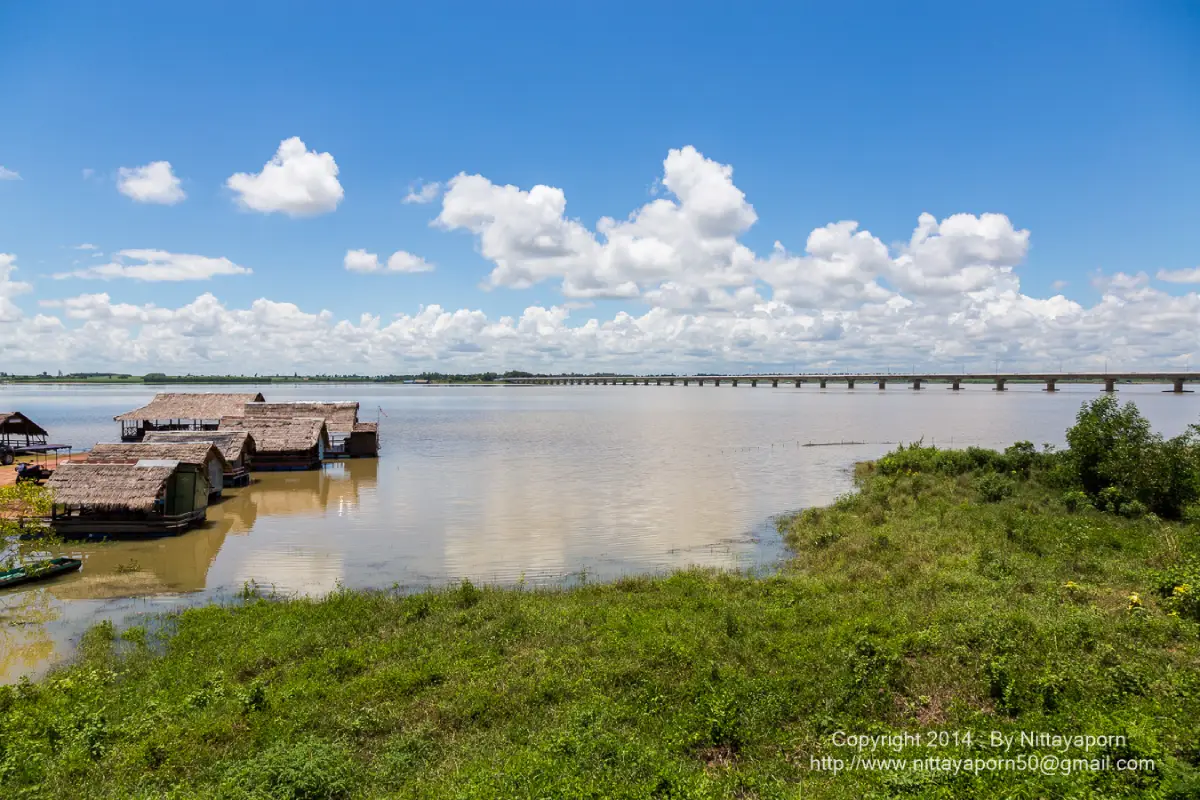
Thepsuda Bridge (Sirintorn Bridge)
Open Days: Daily
Opening Hours: 24 Hours
Thepsuda Bridge, also known as Sirindhorn Bridge in Kalasin Province, is one of the most important landmarks across Lam Pao Reservoir and one of the most scenic road bridges in northeastern Thailand. Stretching across the wide freshwater surface of Lam Pao Dam, the bridge connects Laem Non Wiset in Non Buri Subdistrict, Sahatsakhan District, with Nong Bua Subdistrict in Nong Kung Si District. It is both a practical transport route and a popular viewpoint for travelers who want to experience the open landscape of Kalasin’s largest reservoir.
The bridge is a reinforced concrete structure with 2 traffic lanes and a total length of 2,040 meters. Its long, straight line across Lam Pao Reservoir gives travelers a distinctive feeling of driving through the middle of a vast freshwater landscape. Water stretches on both sides, the horizon opens wide, and the bridge’s repeated pillars and streetlights create a strong visual rhythm. For many visitors, this is one of the most memorable views in Kalasin Province.
Thepsuda Bridge is more than a sightseeing stop. It is an infrastructure project that significantly improved local travel and transport. Before the bridge was built, communities on opposite sides of Lam Pao Reservoir had to travel around the water, which increased travel time and transport costs. The bridge shortened travel between agricultural areas on the western side of the reservoir and economic or industrial areas on the eastern side, making transport more convenient for farmers, traders, residents, and travelers.
The name “Thepsuda Bridge” was graciously granted by Her Royal Highness Princess Maha Chakri Sirindhorn on 22 April 2010. The name gives the bridge a special meaning for the people of Kalasin and connects the structure with royal grace and local pride. Since then, the bridge has become one of the province’s most recognizable modern landmarks, often included in travel routes that combine Lam Pao Reservoir, Sirindhorn Museum, Phu Kum Khao Dinosaur Excavation Site, and other attractions in Sahatsakhan District.
Construction of the bridge began in 2006 with a budget of about 498 million baht and took approximately 3 and a half years to complete. The bridge was designed as a reinforced concrete road bridge with 2 lanes, connecting the Sahatsakhan side and the Nong Kung Si side of Lam Pao Reservoir. Building a long bridge over a large reservoir required careful engineering and became a major transport development project for Kalasin Province.
Geographically, the bridge stands in a highly important area. Lam Pao Reservoir is one of the major water resources of Kalasin and supports agriculture, fisheries, local livelihoods, recreation, and tourism. Before the bridge, the reservoir acted as a natural barrier between communities. After the bridge was built, the same reservoir became a connecting landscape, allowing people and goods to move more efficiently across the region. This makes Thepsuda Bridge meaningful not only as a physical structure but also as a symbol of connection.
The economic benefits of the bridge are especially clear for agricultural transport. The western side of the reservoir, including areas connected to Nong Kung Si and Tha Khantho, is an important agricultural zone. The bridge allows products from these areas to be transported more directly toward Sahatsakhan, Mueang Kalasin, Somdet, Kuchinarai, and other economic areas. A shorter route helps reduce time, fuel use, and transport costs, while improving access to markets, factories, and distribution points.
For local residents, the bridge also improves everyday life. It makes it easier to travel for work, education, hospital visits, administrative services, trade, and family connections across districts. A bridge of this kind is therefore not only a road project. It is a daily-life route that reduces distance between people, services, and opportunities. This is one of the reasons the bridge is highly valued by communities around Lam Pao Reservoir.
As a tourist destination, Thepsuda Bridge offers a different experience from temples, museums, or historical sites. Visitors come here for the open water view, the long bridge perspective, the reflection of sunlight on the reservoir, and the peaceful atmosphere of Lam Pao Dam. Late afternoon is especially popular because the warm light of sunset creates beautiful colors on the water surface. This makes the bridge a favorite stop for photography, scenic driving, and short rest stops during a Kalasin trip.
The bridge is suitable for many types of travelers. Photographers enjoy its strong lines and sunset atmosphere. Families can stop by while visiting Sirindhorn Museum or Phu Kum Khao Dinosaur Excavation Site. Road-trip travelers can include it as part of a scenic drive around Lam Pao Reservoir. Visitors interested in local life can continue to nearby floating restaurants, raft services, and riverside communities around the reservoir.
The tourism value of Thepsuda Bridge is closely connected with Lam Pao Reservoir. Around the reservoir, visitors can find restaurants, raft dining, local fishing scenery, viewpoints, and relaxing waterside areas. The bridge makes it easier to connect these experiences with major attractions in Sahatsakhan and Nong Kung Si. A common travel plan is to visit Sirindhorn Museum and Phu Kum Khao in the morning, then continue to Thepsuda Bridge in the afternoon for scenery, food, and sunset photography.
The visual charm of the bridge lies in its wide and open feeling. When driving across the bridge, visitors can see water on both sides, rows of streetlights, and the changing sky above the reservoir. In some seasons, small boats, rafts, or fishing activity can be seen in the distance. The view feels spacious but calm, which is why many travelers remember this bridge as one of the most peaceful landmarks in Kalasin.
Safety is important when visiting Thepsuda Bridge. The bridge is an active road used by vehicles. Visitors should not stop cars in unsafe areas, block traffic, stand in the driving lanes, or walk into risky spots for photographs. The safest way to enjoy the view is from the bridge approaches, nearby roadside viewpoints, or areas where stopping is permitted without disturbing traffic. Travelers should treat the bridge primarily as a road and enjoy it responsibly.
The best visiting times are morning and late afternoon. In the morning, the atmosphere is quieter and the light is soft. In the late afternoon, the sunset over Lam Pao Reservoir creates excellent conditions for photography. During the rainy season or windy periods, travelers should check the weather because the bridge and reservoir area are open landscapes where wind can feel stronger than in town. In the cool season, the weather is often pleasant for scenic driving and outdoor photography.
The Sahatsakhan side of the bridge connects conveniently with several major Kalasin attractions. Sirindhorn Museum and Phu Kum Khao Dinosaur Excavation Site are among the province’s most important educational destinations. Phu Sing Buddhist Site, Wat Phuttha Nimit Phu Khao, Dok Ket Beach, and other Lam Pao Reservoir recreation areas are also within easy reach. This makes Thepsuda Bridge a useful connecting point for travelers who want to explore both cultural and natural attractions in the same day.
A practical full-day itinerary can begin in Kalasin city in the morning. Travelers can drive to Sahatsakhan District and spend 2 to 3 hours at Sirindhorn Museum and Phu Kum Khao. After that, they can have lunch at a local restaurant or floating raft around Lam Pao Reservoir. In the late afternoon, they can continue to Thepsuda Bridge for reservoir views and sunset photography before returning to Kalasin city or continuing to other nearby destinations. This route combines science, nature, scenery, and local food in one trip.
For a shorter half-day trip, visitors can combine Thepsuda Bridge with Phu Sing Buddhist Site and nearby reservoir dining. Start with a visit to Phu Sing for a hilltop religious and scenic experience, continue to the bridge for wide water views, and end the trip at a restaurant or raft service near Lam Pao Reservoir. This route is easy to manage and suitable for families, small groups, and travelers who prefer a relaxed pace.
Thepsuda Bridge also plays a role in developing Lam Pao Reservoir as a major tourism area. The reservoir has long been important for water storage, agriculture, and fisheries. With the bridge and improved road access, the area gained stronger tourism potential. Activities such as raft dining, scenic driving, sunset photography, local food stops, and linked trips to dinosaur attractions became easier to organize. As a result, the reservoir landscape became more accessible to visitors.
For local businesses, the bridge helps distribute tourism movement more widely. Restaurants, accommodations, raft services, and small community businesses around the reservoir can benefit from travelers who use the bridge route. At the same time, residents use the bridge for trade, work, transport, and daily travel. The bridge therefore supports both everyday life and tourism development.
From an infrastructure perspective, Thepsuda Bridge is an example of a project designed to solve a real geographic problem. The reservoir once separated communities and increased travel distance. The bridge turned that barrier into a route, connecting agricultural areas, economic zones, local roads, and tourist attractions. It is a structure that reduces distance, improves accessibility, and helps create a more complete travel network around Kalasin.
The bridge also has regional significance because it provides another travel option connected with wider transport routes, including routes associated with the East-West Corridor. For general travelers, this may not be immediately visible, but at the provincial development level, the bridge strengthens Kalasin’s position as a connecting area within northeastern Thailand. It improves mobility for people, goods, and tourism between districts and neighboring provinces.
One of the most interesting qualities of Thepsuda Bridge is that it allows visitors to see multiple identities of Kalasin in one journey. Across the reservoir, travelers experience the province’s water landscape. On the Sahatsakhan side, they can learn about dinosaurs and geology at Sirindhorn Museum. In Kalasin city, they can continue to Pong Lang Circle, Phraya Chai Sunthon Monument, temples, local markets, and cultural sites. Crossing the bridge can therefore feel like moving through different layers of Kalasin’s story.
For photography, visitors can choose several viewpoints. From the bridge approach, the long line of the bridge can be captured stretching across the water. From nearby waterside areas or floating raft restaurants, the bridge pillars and deck can be photographed with reflections on the reservoir. From a moving vehicle, the bridge offers the feeling of a road floating through open water. For sunset photos, travelers should arrive early enough to choose a safe location before the light changes.
Visitors traveling with children or elderly family members should plan rest stops at nearby restaurants, raft services, or attractions rather than stopping for a long time on the bridge itself. Because the bridge is an active traffic route, nearby service areas are safer and more comfortable for resting, eating, and taking photos. Using the bridge for scenic driving and the surrounding area for longer stops is the most practical way to enjoy the destination.
Getting There from Kalasin city is straightforward. Take Highway 227 toward Sahatsakhan District for about 32 kilometers, then connect to Rural Road KS 3056 following signs toward Thepsuda Bridge. The route is suitable for private cars, rental cars, and tour vans. From Sahatsakhan, travelers can continue from Sirindhorn Museum or Phu Kum Khao toward the bridge. From Nong Kung Si, the bridge serves as a direct crossing toward Sahatsakhan and Kalasin city.
Travelers without private transport can first travel to Sahatsakhan or Nong Kung Si and then arrange local transport to the bridge. However, private vehicles are the most convenient option because they allow flexible stops around Lam Pao Reservoir, including restaurants, viewpoints, religious sites, and dinosaur-related attractions. For families or groups, hiring a vehicle with a driver from Kalasin city can make the trip smoother and easier to manage.
Thepsuda Bridge is open for traffic and viewing every day, 24 hours a day, with no admission fee. Visitors can drive across and enjoy the view at any time. However, all travelers should obey traffic rules, use appropriate speed, avoid unsafe parking, and respect other road users. The bridge is a public road first and a scenic landmark second, so safe behavior is essential.
In terms of facilities, the bridge itself does not function like a museum or park with a dedicated visitor center. Nearby areas provide restaurants, raft services, accommodations, local communities, and tourist attractions. Visitors should plan their rest stops in advance, especially if they want to eat at a waterside restaurant or book raft services near the bridge. Choosing places with clear public contact information helps make the trip more organized.
The main structural responsibility is associated with the Department of Rural Roads, while surrounding public areas involve local authorities in Sahatsakhan and Nong Kung Si. The proper use and preservation of the bridge therefore depends on road authorities, local communities, and visitors. Travelers should help keep the area clean, avoid littering at the bridge approaches or waterside areas, and avoid activities that create safety risks.
To appreciate Thepsuda Bridge fully, visitors should not rush. It is worth seeing the bridge from a distance before driving across it, then crossing slowly and safely to enjoy the water view, and finally stopping at a safe nearby area for photos or a meal. This approach reveals both sides of the bridge’s identity: a practical transport structure and a beautiful scenic landmark.
For travelers interested in local development, Thepsuda Bridge is a useful example of how one infrastructure project can transform mobility, economy, and tourism. A reservoir that once separated communities became the center of a travel route. A road bridge became a tourism landmark. Agricultural transport improved, local services became more accessible, and travelers gained a new scenic route across one of Kalasin’s most important landscapes.
The memory of visiting Thepsuda Bridge often comes from more than the bridge itself. Travelers remember the feeling of driving across wide water, the open sky, the wind over Lam Pao Reservoir, the golden light of late afternoon, and the calm atmosphere of the local waterside communities. The destination is simple but powerful because it uses the real landscape of Kalasin as its main attraction.
Compared with many other landmarks in the province, Thepsuda Bridge is distinctive because it is both useful and beautiful. Local people use it for travel, trade, and transport, while visitors use it for scenery, photographs, and relaxation. This combination of daily function and tourism value gives the bridge a meaning that goes beyond an ordinary check-in point.
For first-time visitors to Kalasin, Thepsuda Bridge should be included with Sirindhorn Museum and Phu Kum Khao Dinosaur Excavation Site. Together, these destinations present several dimensions of the province: prehistoric fossils, geological learning, local communities, reservoir scenery, and modern infrastructure. For travelers who want both knowledge and natural beauty, this route is one of the most rewarding in Kalasin.
Thepsuda Bridge is therefore more than a bridge across Lam Pao Reservoir. It connects Sahatsakhan and Nong Kung Si. It connects agricultural areas with economic areas. It connects local travel with regional routes. It connects everyday life with tourism. It connects the wide water landscape of Lam Pao with the memories of travelers who pass through Kalasin. Every crossing is not only a movement over water, but also a journey through one of the province’s most important development stories.
For travelers looking for a scenic landmark that represents modern Kalasin, Thepsuda Bridge is one of the best choices. It is free to visit, open all day, easy to include in a travel route, and close to several important attractions. With its long concrete structure, open reservoir views, sunset atmosphere, and practical connection between districts, it remains one of the most meaningful and photogenic landmarks in Kalasin Province.
| Name | Thepsuda Bridge / Sirindhorn Bridge |
| Location | Across Lam Pao Reservoir, connecting Laem Non Wiset in Non Buri Subdistrict, Sahatsakhan District, with Nong Bua Subdistrict, Nong Kung Si District, Kalasin Province |
| Address | Connecting area between Non Buri Subdistrict, Sahatsakhan District, and Nong Bua Subdistrict, Nong Kung Si District, Kalasin Province 46140, Thailand |
| Coordinates | Approximately 16.7128, 103.4587 |
| Highlights | A 2-lane reinforced concrete bridge, 2,040 meters long, crossing Lam Pao Reservoir; one of Kalasin’s best viewpoints for scenic driving, reservoir views, and sunset photography |
| History / Period / Era | Construction began in 2006 with a budget of about 498 million baht and took approximately 3 and a half years. The name “Thepsuda Bridge” was royally granted on 22 April 2010. |
| Name Origin | The name was royally granted by Her Royal Highness Princess Maha Chakri Sirindhorn for this important bridge across Lam Pao Reservoir in Kalasin Province. |
| Distinctive Features | A long bridge stretching across the open water of Lam Pao Reservoir, offering wide views on both sides and especially beautiful scenery in the morning and late afternoon |
| Travel Information | From Kalasin city, take Highway 227 toward Sahatsakhan District for about 32 km, then connect to Rural Road KS 3056 following signs to Thepsuda Bridge. |
| Current Status | Open as a public road bridge and major scenic viewpoint in Kalasin Province |
| Open Days | Daily |
| Opening Hours | 24 Hours |
| Fees | No Admission Fee |
| Facilities | 2-lane road bridge, viewpoints near bridge approaches, nearby restaurants and raft services around Lam Pao Reservoir, and accommodations in Sahatsakhan and Nong Kung Si areas |
| Main Areas / Zones | Main Bridge Across Lam Pao Reservoir 2-Lane Traffic Route Viewpoints And Photo Areas Near Bridge Approaches Laem Non Wiset Area On The Sahatsakhan Side Nong Bua Area On The Nong Kung Si Side Nearby Restaurants, Raft Services, And Waterside Communities |
| Caretaker | Department Of Rural Roads, together with local authorities in Sahatsakhan District and Nong Kung Si District for surrounding public areas |
| Main Contact Number | Kalasin Tourism Information Tel. 043-811620; TAT Khon Kaen Office Tel. 043-227714 |
| Official Website / Official Page | Thailand Tourism Directory, Tourism Authority Of Thailand, And Department Of Rural Roads |
| Nearby Tourist Attractions | 1. Lam Pao Non-Hunting Area, about 1 km 2. Lam Pao Reservoir Raft And Waterside Recreation Area, about 3 km 3. Phu Sing Buddhist Site, about 5 km 4. Sirindhorn Museum, about 7 km 5. Phu Kum Khao Dinosaur Excavation Site / Wat Sakkawan, about 7 km 6. Wat Phuttha Nimit Phu Khao, about 10 km 7. Dok Ket Beach, Lam Pao Dam, about 12 km |
| Nearby Restaurants | 1. Ran Phae Waranporn Thepsuda Bridge, about 1 km, Tel. 082-1107977, 081-3690522, 081-0542724 2. Phae Lam Pao Thara, about 3 km 3. Korayteow Nuea S. Phu Sing, about 5 km 4. Yai Rai Noodle Shop, about 4 km 5. Mangkon Thong Panich, about 3 km |
| Nearby Accommodations | 1. Rich Lam Pao Resort, about 3 km 2. Baan Suan Khwam Hug Resort, about 5 km 3. Sukwan Boutique Home Resort, about 7 km 4. Phupeng House Resort, about 9 km 5. Iyara Resort Kalasin, about 10 km |
Frequently Asked Questions (FAQ)
Q: Where is Thepsuda Bridge located?
A: Thepsuda Bridge crosses Lam Pao Reservoir in Kalasin Province, connecting Laem Non Wiset in Non Buri Subdistrict, Sahatsakhan District, with Nong Bua Subdistrict, Nong Kung Si District.
Q: How long is Thepsuda Bridge?
A: Thepsuda Bridge is 2,040 meters long and is a 2-lane reinforced concrete bridge across Lam Pao Reservoir.
Q: Is there an admission fee for Thepsuda Bridge?
A: No. There is no admission fee because it is a public road bridge. Visitors can drive across and enjoy the view free of charge.
Q: When is the best time to visit Thepsuda Bridge?
A: Morning and late afternoon are the best times. Late afternoon is especially beautiful because sunset light reflects on the water of Lam Pao Reservoir.
Q: Can visitors stop on the bridge to take photos?
A: Visitors should not stop in unsafe areas or block traffic on the bridge. It is better to take photos from safe viewpoints near the bridge approaches or permitted stopping areas.
Q: Is Thepsuda Bridge suitable for families?
A: Yes. It is suitable for scenic driving and can be combined with Sirindhorn Museum, Phu Kum Khao, Phu Sing Buddhist Site, and waterside restaurants around Lam Pao Reservoir. Families should supervise children closely near roads and water.
Q: What nearby attractions can be visited with Thepsuda Bridge?
A: Nearby attractions include Lam Pao Reservoir, Sirindhorn Museum, Phu Kum Khao Dinosaur Excavation Site, Phu Sing Buddhist Site, Wat Phuttha Nimit Phu Khao, and Dok Ket Beach.
Q: Who is responsible for Thepsuda Bridge?
A: The bridge is associated with the Department of Rural Roads, while surrounding public areas are also related to local authorities in Sahatsakhan and Nong Kung Si districts.
 Category: ●Art, Culture and Heritage
 Group: ●Landmarks and Memorials
Last Update : 4 MonthAgo
 Last Update : 4 MonthAgo
 Click to Access the Navigation Map GPS
Thepsuda Bridge (Sirintorn Bridge) Map

 Historical Sites and Monuments(2)
Landmarks and Memorials(3)
 Art, Craft Centres, Tradition(4)
 Museums(3)
 Art Gallery(1)
 Educational Places
 Educational Gardens, Farm(1)
 Places of Worship
 Temple(21)
 Other Sacred Sites(7)
 Suburban Living
 Village, Community(3)
 Nature and Wildlife
 National Parks and Marine Reserves(3)
 Mountain (Doi)(2)
 Dam, Reservoir, Lake(5)
 Waterfalls(4)
 Caves(2)
 River, Canal(3)
 Bays and Beaches(1)
 Other natural attractions(2)
 Entertainment and Agricultural
 Animal camps and shows(1)
 Farms, Parks and Ecotourism(2)
 Travel Articles, Recipes
 Travel Review, Food Review(1)


