
lovethailand home >Northeastern Travel Attractions >Kalasin Travel Attractions >Muang Kalasin >Nuea > Wat Si Bun Rueang
TL;DR: Wat Si Bun Rueang is located at Anunkhanak Road, Kalasin Subdistrict, Mueang Kalasin District, Kalasin Province, open Daily, hours 08.00 – 17.00.
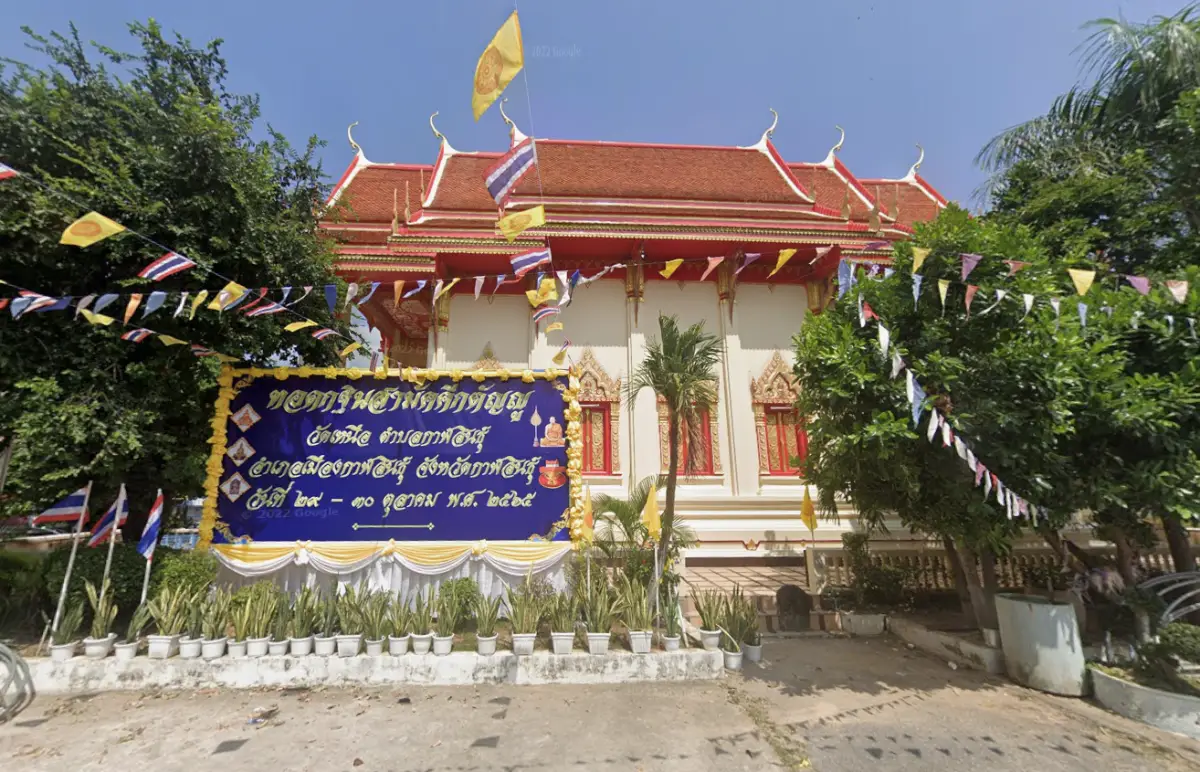
Wat Si Bun Rueang
Open Days: Daily
Opening Hours: 08.00 – 17.00
Wat Si Bun Rueang, also known as Wat Nuea, in Kalasin Province is one of the most historically meaningful temples in Mueang Kalasin. Located on Anunkhanak Road in Kalasin Subdistrict, the temple stands very close to Wat Klang, the royal monastery in the city centre. Wat Si Bun Rueang is especially important because it preserves a number of carved boundary stones from the ancient city of Fa Daet Song Yang, one of the most significant Dvaravati cultural sites in Northeastern Thailand. These sandstone boundary stones, locally known as sema stones, are placed around the ubosot and allow visitors to see early Buddhist art in an active temple setting.
For foreign travelers who want to understand Kalasin beyond its modern city streets and dinosaur-related attractions, Wat Si Bun Rueang offers a direct connection to the province’s ancient Buddhist heritage. Its main highlight is not a large monument or a dramatic landscape, but the presence of old carved stones that carry deep religious and historical meaning. The most admired sema stone is carved with a flying celestial being above a palace-like structure, framed by a double-tiered arch in Dvaravati style. At the lower part of the carving are figures interpreted as a king, a queen, and a prince. This composition makes the stone one of the most visually remarkable pieces preserved at the temple.
The temple’s history is closely connected with the early development of Kalasin town. According to historical information from the Fine Arts Department, Wat Nuea or Wat Si Bun Rueang was built in 1793 by Phraya Chai Sunthon, also known as Chao Somphamit, the founder figure of Kalasin. The temple was established as a residence for Phra Khru Lak Kham, a monk associated with the early religious life of the city. With a history of more than 200 years, Wat Si Bun Rueang is not merely a neighborhood temple but part of the original civic and spiritual structure of Kalasin.
The name Wat Nuea means “northern temple” in Thai. It reflects the temple’s position in the older layout of Kalasin town. Traditional Thai towns often had temples identified by their position, such as Wat Klang for the central temple, Wat Nuea for the northern temple, and Wat Tai for the southern temple. Wat Si Bun Rueang therefore carries both a formal temple name and a local geographical identity. This dual name helps visitors understand how temples functioned as landmarks in older Thai urban communities.
Although the temple stands in the city, it retains the quiet atmosphere of an old local temple. The most important area to explore is the ubosot, or ordination hall. Around it are sandstone sema stones from Fa Daet Song Yang Ancient City. In Buddhist tradition, sema stones mark the sacred boundary of an ordination hall where formal monastic acts take place. Their presence around the ubosot at Wat Si Bun Rueang creates a powerful connection between ancient Buddhist ritual space and the living religious function of a modern temple.
The sema stones preserved here include both plain slabs and carved examples. Their general form is rectangular, tapering toward the top in a shape that resembles a lotus petal. This form is characteristic of many Dvaravati-style boundary stones found in Northeastern Thailand. These stones were not merely decorative objects. They marked sacred space, defined the ritual limits of an ordination area, and expressed Buddhist symbolism through their shape and carved imagery.
The finest carved sema stone at Wat Si Bun Rueang shows a celestial figure flying above a palace structure. The scene is framed by a double-layered arch, sometimes described in Thai as a ruean kaeo arch. Below the main scene are figures of a king, queen, and prince. The composition is important because it brings together several symbolic layers: the heavenly world, royal authority, sacred architecture, and Buddhist belief. For art historians and culturally curious travelers, this single stone provides an accessible introduction to Dvaravati visual language in Isan.
Dvaravati art in Northeastern Thailand has distinctive features when compared with central Thailand. In the Isan region, large sema stones became especially important as markers of sacred Buddhist space. Many were carved with scenes, symbols, celestial beings, stupas, palatial forms, and narrative compositions. Fa Daet Song Yang is one of the best-known ancient sites associated with this tradition. The sema stones at Wat Si Bun Rueang therefore should be understood as part of a wider network of Buddhist culture that once flourished in the Lam Pao and Chi River basins.
Walking around the ubosot slowly is the best way to appreciate the stones. Some carvings may appear worn because of age, weather, and long exposure, but their surviving details are still valuable. Visitors should observe the stone shape, the carving lines, the figures, the architectural motifs, and the way each stone is positioned around the sacred space. These are not simply old stones placed for decoration. They are historical documents carved in sandstone and preserved through the care of local communities over many generations.
The ubosot at Wat Si Bun Rueang remains the spiritual centre of the temple. The sema stones are not displayed in isolation as museum objects; they remain connected with a functioning Buddhist space. This is one of the most meaningful aspects of the temple. Visitors can see how ancient objects continue to live within present-day religious practice. The site therefore offers a rare sense of continuity between Dvaravati heritage, Kalasin’s urban history, and contemporary Thai Buddhism.
Wat Si Bun Rueang has two layers of value. On one level, it is a local temple used for Buddhist worship, merit-making, religious ceremonies, and community life. On another level, it is a cultural heritage site where visitors can encounter Dvaravati sema stones from Fa Daet Song Yang. This combination makes the temple especially useful for travelers who want a compact but meaningful cultural stop within Kalasin city.
Fa Daet Song Yang is central to understanding the importance of Wat Si Bun Rueang. The ancient city is one of Kalasin’s major archaeological landscapes and is strongly associated with early Buddhist culture in Northeastern Thailand. Archaeological evidence from the area includes moats, earthworks, religious remains, Buddha images, votive tablets, and many sema stones. The stones preserved at Wat Si Bun Rueang are part of this larger historical context, showing that Kalasin has roots much older than its modern provincial identity.
Travelers interested in local history should connect Wat Si Bun Rueang with other nearby cultural sites. Wat Klang, located close by, is known for Luang Pho Ong Dam and its role as a royal temple. Kalasin Museum, located in the former provincial hall, presents the province’s history and local identity. Wat Klang Kalasin Museum preserves religious and cultural objects within a temple context. Fa Daet Song Yang and Phra That Yakhu reveal the deeper archaeological roots of the province. Together, these places form a strong cultural route for visitors who want to understand Kalasin properly.
A good visit to Wat Si Bun Rueang should begin at the temple entrance, then continue toward the ubosot. Visitors should walk around the ubosot carefully and view the sema stones one by one. This approach allows the carvings and positions of the stones to be understood more clearly. The stones should not be touched, leaned on, climbed, or used as props for photography. They are important antiquities and should be treated with respect.
The temple is particularly suitable for cultural travelers, students, researchers, families, and anyone interested in Buddhist art. For children, the sema stones can become a visual lesson in ancient history. They show that art and archaeology are not limited to museums; they can also be found in local temples and communities. For adults, the site provides a concise but powerful introduction to how Buddhist art, sacred space, and local identity are connected.
Photographers will find several interesting subjects at the temple, including the gateway, ubosot, sandstone sema stones, and the atmosphere of an old town temple. Morning and late afternoon light are especially useful for photographing stone carvings because angled light can reveal shallow carving lines more clearly. Visitors should take photographs respectfully and avoid interrupting monks, worshippers, or religious activities.
Wat Si Bun Rueang and Wat Klang complement each other very well. Wat Si Bun Rueang is most distinctive for its Dvaravati sema stones and connection with Fa Daet Song Yang, while Wat Klang is known for Luang Pho Ong Dam, its royal temple status, murals, museum, and sacred city traditions. Visiting both temples helps travelers understand two important layers of Kalasin’s Buddhist heritage: the ancient Dvaravati layer and the later city-centred Buddhist traditions of Kalasin.
A half-day cultural route in Mueang Kalasin can begin at Wat Si Bun Rueang, continue to Wat Klang, then move on to the Phraya Chai Sunthon Monument, Kalasin Museum, Kut Nam Kin Public Park, or Rongsi Market. This route is easy to manage because the sites are close to one another. It gives travelers a balanced experience of temple art, local history, city heritage, and everyday life in Kalasin.
Travelers with more time should continue from Wat Si Bun Rueang to Fa Daet Song Yang and Phra That Yakhu in Kamalasai District. Seeing the sema stones first at Wat Si Bun Rueang makes the visit to the ancient city more meaningful. Once visitors reach the archaeological landscape of Fa Daet Song Yang, they can better imagine where these kinds of boundary stones originally belonged and how they were connected to early Buddhist sacred spaces.
The meaning of sema stones is important. In Thai Buddhist tradition, they define the boundary of an ordination hall and are linked with formal monastic acts. They are signs of religious order, sacred territory, and the authority of Buddhist practice. When ancient sema stones from Fa Daet Song Yang are preserved around the ubosot at Wat Si Bun Rueang, their original ritual meaning remains closely connected to the sacred space of the temple.
Wat Si Bun Rueang also reflects the role of local communities in preserving heritage. Before modern museum systems became widespread, many antiquities survived because temples and local people protected them. The stones at Wat Si Bun Rueang are therefore not only art objects but also evidence of community care. They show how a local temple can act as a guardian of cultural memory.
Visitors should dress respectfully. Shoulders and knees should be covered, shoes should be removed before entering sacred areas, and voices should be kept low. Since the temple remains an active Buddhist site, travelers should be mindful of monks, local worshippers, and ceremonies. Ancient stones and temple objects should not be touched unless clear permission is given.
The best time to visit is in the morning or late afternoon, when the weather is cooler and the light is better for viewing stone carvings. Midday visits are possible, but travelers should prepare for heat, especially during the hot season in Northeastern Thailand. A focused visit usually takes about 45 minutes to 1 hour. If combined with Wat Klang and other nearby sites, travelers should allow at least half a day.
Getting There is easy because Wat Si Bun Rueang is located in central Mueang Kalasin on Anunkhanak Road. Visitors can travel by private car, rental car, or local transport within the city. On map navigation, search for Wat Si Bun Rueang, Wat Nuea Kalasin, or Anunkhanak Road Kalasin. From Wat Klang, the temple is very close and can be included in the same short cultural route.
Travelers arriving from nearby provinces such as Khon Kaen, Maha Sarakham, Roi Et, or Sakon Nakhon can enter Mueang Kalasin and visit Wat Si Bun Rueang as part of a city itinerary. Staying in central Kalasin is convenient because hotels, restaurants, local markets, and cultural attractions are located within a short distance of one another. This makes the temple easy to include even for visitors with limited time.
Wat Si Bun Rueang rewards careful observation. Its value is not based on size or grandeur, but on the presence of ancient sandstone carvings, sacred boundary markers, and the continuity of Buddhist meaning across time. Visitors who slow down and examine the sema stones closely will find that this modest city temple tells one of the most important cultural stories in Kalasin.
Overall, Wat Si Bun Rueang or Wat Nuea is one of Kalasin’s essential cultural temples. The carved sema stones from Fa Daet Song Yang make it a key site for understanding Dvaravati art in Northeastern Thailand. Its location in the city centre makes it easy to visit, while its historical depth makes it valuable for travelers who want more than a superficial sightseeing experience. For anyone planning a cultural trip to Kalasin, Wat Si Bun Rueang should be visited together with Wat Klang, Fa Daet Song Yang, and Phra That Yakhu.
| Name | Wat Si Bun Rueang, also known as Wat Nuea, Kalasin Province |
| Location | Anunkhanak Road, Kalasin Subdistrict, Mueang Kalasin District, Kalasin Province |
| Address | Anunkhanak Road, Kalasin Subdistrict, Mueang Kalasin District, Kalasin 46000, Thailand |
| Coordinates | 16.437497, 103.501938 |
| Highlights | Carved sema stones from Fa Daet Song Yang Ancient City placed around the ubosot, especially the Dvaravati-style stone showing a flying celestial being above a palace within a double-tiered arch |
| History | Built in 1793 by Phraya Chai Sunthon or Chao Somphamit as a residence for Phra Khru Lak Kham; the temple preserves sandstone sema stones from Fa Daet Song Yang, an important Dvaravati cultural site |
| Name Origin | Wat Nuea means northern temple and reflects the temple’s position in the older layout of Kalasin town, while Wat Si Bun Rueang is the formal temple name used today |
| Distinctive Features | Old city temple with both plain and carved sandstone sema stones; the stones are rectangular with tapering lotus-petal-like tops, a form associated with Dvaravati boundary markers in Isan |
| Important Objects | Ubosot, carved sema stones from Fa Daet Song Yang, the sema stone with a flying celestial figure above a palace, sandstone boundary stones around the ubosot, and the temple’s active religious area |
| Related Traditions / Rituals | Buddhist merit-making and ceremonies on important Buddhist holy days, with the ubosot serving as a sacred area for monastic acts and community religious activities |
| Travel Information | Accessible by private car, rental car, or local city transport. The temple is on Anunkhanak Road near Wat Klang Royal Monastery. Search for Wat Si Bun Rueang, Wat Nuea Kalasin, or Anunkhanak Road Kalasin on map navigation |
| Current Status | Open to visitors as an old temple and cultural attraction in Mueang Kalasin |
| Open Days | Daily |
| Opening Hours | 08.00 – 17.00 |
| Facilities | Ubosot, worship area, temple courtyard, sema stone viewing area, and parking space within or near the temple depending on current use |
| Main Areas / Zones | Ubosot, sema stone line around the ubosot, Fa Daet Song Yang carved stone area, temple courtyard, religious activity area, and Wat Nuea community area |
| Main Contact Number | 043-227-714 |
| Nearby Tourist Attractions | 1. Wat Klang Royal Monastery, about 0.3 km 2. Phraya Chai Sunthon Monument, about 1 km 3. Wat Klang Kalasin Museum, about 1 km 4. Kalasin Museum, about 1 km 5. Kut Nam Kin Public Park, about 1 km 6. Rongsi Market Kalasin, about 3 km 7. Fa Daet Song Yang Ancient City and Phra That Yakhu, about 22 km |
| Nearby Restaurants | 1. Khwan Oey Restaurant, about 1 km, Tel. 089-863-6332, 043-813-457 2. NICE TIME CAFE KALASIN, about 1 km, Tel. 088-562-4518 3. Tam Yua Yeh Mueang Kalasin, about 2 km, Tel. 063-968-3937 4. Singfarm Coffee Roaster, about 2 km, Tel. 089-944-1854 5. Khong kwan House Steak Khao Soi Nam Ngiao, about 2 km, Tel. 064-462-6263, 095-532-3978 6. Ban Tan Fa Kalasin, about 3 km, Tel. 086-717-0774 |
| Nearby Accommodations | 1. Supak Hotel, about 1 km, Tel. 043-811-595 2. Phaiboonplace Hotel, about 1 km, Tel. 081-117-8896, 043-811-661 3. A.P. Garden Hotel, about 2 km, Tel. 086-354-6193 4. Nub Thong Residence, about 2 km, Tel. 095-520-7290 5. TK Residence Hotel, about 3 km, Tel. 095-338-0515 6. Rimpao Hotel, about 3 km |
Frequently Asked Questions (FAQ)
Q: Where is Wat Si Bun Rueang or Wat Nuea located?
A: Wat Si Bun Rueang is located on Anunkhanak Road in Kalasin Subdistrict, Mueang Kalasin District, Kalasin Province. It is close to Wat Klang Royal Monastery in the city centre.
Q: Why is Wat Si Bun Rueang important?
A: The temple is an old Kalasin city temple built in 1793 and preserves carved sema stones from Fa Daet Song Yang Ancient City, making it an important place for understanding Dvaravati Buddhist art in Northeastern Thailand.
Q: What is the main highlight of Wat Si Bun Rueang?
A: The main highlight is the carved Dvaravati-style sema stone showing a flying celestial being above a palace within a double-tiered arch, with figures of a king, queen, and prince at the lower part.
Q: How is Wat Si Bun Rueang connected with Fa Daet Song Yang?
A: The temple preserves sandstone sema stones from Fa Daet Song Yang, an ancient city and major Dvaravati cultural site in Kalasin Province.
Q: What attractions should be visited with Wat Si Bun Rueang?
A: Recommended nearby places include Wat Klang Royal Monastery, Phraya Chai Sunthon Monument, Kalasin Museum, Kut Nam Kin Public Park, Rongsi Market, Fa Daet Song Yang Ancient City, and Phra That Yakhu.
Q: Is Wat Si Bun Rueang easy to reach?
A: Yes. The temple is in central Mueang Kalasin and can be reached by private car, rental car, or local transport. Search for Wat Si Bun Rueang or Wat Nuea Kalasin on map navigation.
Q: How long should visitors spend at Wat Si Bun Rueang?
A: A focused visit usually takes about 45 minutes to 1 hour. If combined with Wat Klang and other nearby attractions, travelers should allow at least half a day.
Q: How should visitors behave around the ancient sema stones?
A: Visitors should observe the stones respectfully, avoid touching, leaning on, climbing, or placing objects on them, and help preserve these important antiquities for future generations.
 Category: ●Places of Worship
 Group: ●Temple
Last Update : 4 MonthAgo
 Last Update : 4 MonthAgo
 Click to Access the Navigation Map GPS
 Art, Culture and Heritage
 Historical Sites and Monuments(2)
 Landmarks and Memorials(3)
 Art, Craft Centres, Tradition(4)
 Museums(3)
 Art Gallery(1)
 Educational Places
 Educational Gardens, Farm(1)
Temple(21)
Educational Gardens, Farm(1)
Temple(21)
 Other Sacred Sites(7)
 Suburban Living
 Village, Community(3)
 Nature and Wildlife
 National Parks and Marine Reserves(3)
 Mountain (Doi)(2)
 Dam, Reservoir, Lake(5)
 Waterfalls(4)
 Caves(2)
 River, Canal(3)
 Bays and Beaches(1)
 Other natural attractions(2)
 Entertainment and Agricultural
 Animal camps and shows(1)
 Farms, Parks and Ecotourism(2)
 Travel Articles, Recipes
 Travel Review, Food Review(1)


