
lovethailand home >Northeastern Travel Attractions >Kalasin Travel Attractions >Muang Kalasin >Kalasin > Mueang Kalasin Museum
TL;DR: Mueang Kalasin Museum is located at Former Kalasin Provincial Hall, Kalasin Road, Kalasin Subdistrict, Mueang Kalasin District, Kalasin Province, open Tuesday – Sunday, hours 09.00 – 16.00.

Mueang Kalasin Museum
Open Days: Tuesday – Sunday
Opening Hours: 09.00 – 16.00
Mueang Kalasin Museum, also known as Kalasin Art Museum or the Museum of Kalasin’s Local Treasures, is one of the most important cultural learning centers in Kalasin Province, northeastern Thailand. Located inside the former Kalasin Provincial Hall on Kalasin Road in Mueang Kalasin District, the museum brings together the province’s history, local wisdom, religion, art, Phu Thai culture, Praewa silk, important local figures, agricultural products, Buddhist objects, and traditional handicrafts in one historic building. For foreign travelers who want to understand Kalasin beyond a quick stopover, this museum is one of the best places to begin.
The museum’s value begins with its location. The former Provincial Hall is not only an old government building; it is part of the collective memory of Kalasin city. By transforming this historic administrative building into a museum and art space, Kalasin has turned a former center of official power into a public cultural space. Visitors entering the museum are therefore not simply entering an exhibition hall. They are stepping into a building that carries the memory of the city, its public life, its local administration, and its evolving cultural identity.
Mueang Kalasin Museum was established as a center for presenting the best of Kalasin. Its exhibitions are arranged into several rooms, including an introductory briefing room, the governors’ room, the religion room, the royal tribute room dedicated to Her Majesty Queen Sirikit The Queen Mother, the Phu Thai way of life room, the Praewa silk room, the handicraft study room, the Praewa silk demonstration and sales area, and the local souvenir zone. This structure shows that the phrase “local treasures of Kalasin” does not refer only to objects or products. It includes knowledge, memory, identity, craftsmanship, faith, community life, and the people who shaped the province.
The introductory room helps visitors understand Kalasin as a whole before exploring the specific exhibition rooms. It presents the province’s geography, historical background, cultural overview, and local identity. This is especially helpful for first-time visitors because Kalasin is often known outside the province mainly for Pong Lang music, Praewa silk, and dinosaur fossils. The museum expands that image by showing that Kalasin also has deep historical roots, Buddhist heritage, ethnic diversity, agricultural knowledge, and strong community traditions.
One of the most important rooms is the Phu Thai way of life room. The Phu Thai people are one of the key cultural groups in Kalasin Province, with communities in districts such as Khao Wong, Kuchinarai, Kham Muang, Somdet, Na Khu, and Sam Chai. Inside this room, visitors can learn about Phu Thai houses, clothing, weaving, mat-making, animal husbandry, farming, and daily life. The displays help explain why Kalasin is culturally distinctive and why Phu Thai identity is deeply connected with the province’s textile heritage, community customs, and performing arts.
The Praewa silk room and the Praewa tribute exhibition are among the museum’s highlights. Praewa silk is one of Kalasin’s most famous cultural products. It is known for its delicate patterns, refined colors, and highly skilled handwoven technique. The exhibition presents the history of Praewa silk, the development of patterns, traditional weaving methods, and the transformation of Praewa into contemporary products. Patterns may be inspired by animals, plants, architecture, mythical forms, and symbolic motifs. Seeing Praewa silk inside the museum helps visitors understand that each piece is not merely a beautiful fabric, but a cultural object created through time, memory, skill, and identity.
The importance of Praewa silk also connects with royal patronage and the promotion of local handicrafts. Through the museum’s displays, visitors can understand how local weaving became a proud symbol of Kalasin and how the craft has been preserved, developed, and presented as both heritage and livelihood. For travelers interested in textiles, the museum provides essential context before visiting weaving communities or buying Praewa silk as a meaningful souvenir.
The cultural visual exhibition room presents wider aspects of local life, including temples, monks, Buddhist teachings, marriage customs, rituals, healing practices, death ceremonies, local performances, childbirth traditions, massage, herbal medicine, and community beliefs. These displays show that culture is not limited to festivals or costumes. It is embedded in everyday life, family relationships, religion, social practice, and local knowledge. For students and cultural travelers, this room provides a deeper understanding of how Kalasin communities organize life around faith, family, and shared customs.
Another section of the cultural exhibition focuses on the province’s geography, water resources, livelihoods, occupational tools, hunting equipment, and women’s handicraft tools. These objects help explain how people adapted to their environment. They reveal practical intelligence: how communities used water, land, plants, animals, and handmade tools to support daily survival. This makes the museum more than a place of display; it becomes a local archive of ordinary life, where everyday tools become evidence of knowledge and adaptation.
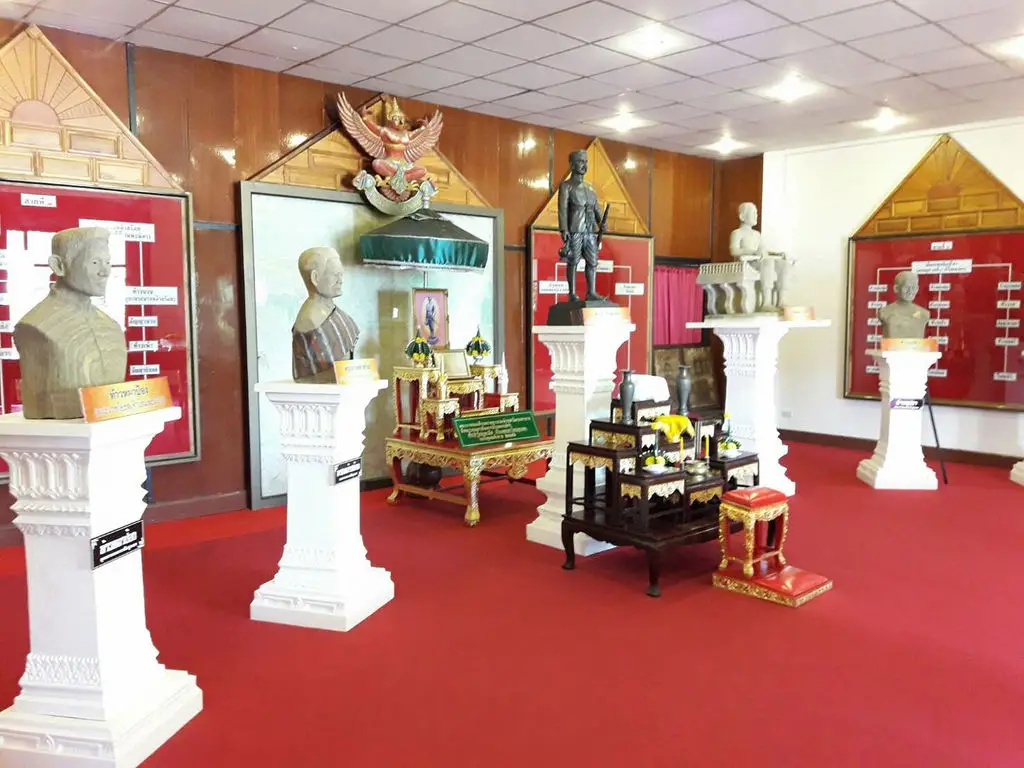
The governors’ room connects visitors with Kalasin’s political and administrative history. It displays models of local rulers beginning with Phraya Chaisunthon, the first governor of Kalasin, together with members of the ruling family and genealogical information. It also connects Kalasin with related historical towns such as Kamalasai, Kut Sim Narai, Phu Laen Chang, and Sahatsakhan. This room helps visitors see that Kalasin’s history is not only about land or monuments. It is also about people, lineage, local authority, and the formation of communities over time.
The Good People of Kalasin room honors individuals who contributed to the province. This section is important because it expands the idea of local heritage beyond objects. People who served the community, supported education, preserved culture, worked for religion, created art, or contributed to public life are also part of Kalasin’s cultural wealth. The room encourages younger generations to see public service and community contribution as valuable forms of local pride.
The Buddhist and religious rooms present sacred objects, amulets, Buddhist items, and religious stories connected with Kalasin. Buddhism has long been central to local life in the province. It shapes temple festivals, merit-making, family ceremonies, community morality, and yearly traditions. By including Buddhist objects and religious displays, the museum helps foreign visitors understand that religion in Kalasin is not separate from daily life. It appears in ceremonies, temple visits, offerings, sermons, and the social rhythm of local communities.
The drug-free province exhibition reflects a more contemporary side of Kalasin’s story. It presents the province’s efforts to address drug problems and create safer communities. Including this room inside a museum shows that local history is not only about the distant past. It also includes social challenges, public policy, collective responsibility, and the effort to build a better community. This makes the museum a place where cultural memory and modern civic life meet.
The room displaying paintings by Prince Narisara Nuwattiwong adds an artistic dimension to the museum. The works include religious and cultural paintings such as scenes from the Ten Great Birth Stories of the Buddha and other Thai subjects influenced by Western artistic composition. This room is suitable for visitors interested in Thai painting, Buddhist art, visual culture, and the relationship between religious storytelling and artistic education.
The rooms on cassava and sugarcane products show another side of Kalasin as an agricultural province. These displays explain cultivation, production, processing, and the economic use of agricultural products. Cassava and sugarcane are important crops connected with local livelihoods. Their presence in the museum shows that Kalasin’s local treasures include not only textiles and religious culture, but also agricultural knowledge, processing industries, and the ability of local communities to create value from their resources.
The local product and souvenir room connects the museum directly with community economy. Visitors can find local textiles, Praewa silk products, traditional clothing, sweets, community products, and souvenirs produced by local groups. This area gives visitors the chance to take home something meaningful while supporting local makers. A souvenir purchased after learning its cultural background often carries more value than an ordinary product bought without context.
Today, the museum also functions as Kalasin Art Museum and a creative cultural space in the old Provincial Hall district. It is used for exhibitions, art events, cultural activities, and creative community programs. This gives the building a dual identity: it remains a local museum while also serving as a contemporary art and cultural venue. For visitors, this means the museum is not frozen in the past. It continues to participate in the cultural life of the city.
For photography, the museum offers several interesting scenes: the façade of the former Provincial Hall, the museum sign, mural and art displays, three-dimensional photo areas, Praewa silk exhibitions, and rooms that tell the story of Kalasin. Visitors should follow the museum’s photography rules, especially in special exhibitions or areas with delicate objects. Respecting the museum’s guidelines helps protect the collections and keeps the atmosphere appropriate for learning.
The museum is also a good destination for families. Children can learn about local culture through visible objects and room displays. Adults can understand the province’s history and buy local souvenirs. Elderly visitors may recognize memories of past ways of life through tools, textiles, religious objects, and household displays. Because the museum covers many subjects in one building, it is suitable for multi-generation travel and educational visits.
Visitors interested in Phu Thai culture should spend extra time in the Phu Thai and Praewa silk rooms. These rooms explain how textile culture is connected to home, family, women’s work, weaving knowledge, costume, and community identity. Praewa silk is easier to appreciate after seeing how it grows out of a broader cultural way of life. This makes the museum a useful starting point before visiting weaving communities or local textile shops in Kalasin.
Visitors interested in history should pay close attention to the governors’ room, the town establishment room, and the displays connected with the ancient city of Fa Daet Song Yang. These rooms link the city center with wider historical sites in the province, including Phra That Ya Khu and Dvaravati-period remains. After visiting the museum, travelers can continue to these sites and understand them with better context.
Mueang Kalasin Museum is therefore highly useful for trip planning. If visitors are interested in silk, they can continue to textile communities. If they are interested in ancient history, they can visit Fa Daet Song Yang and Phra That Ya Khu. If they are interested in dinosaur fossils, they can continue to Sirindhorn Museum. If they are interested in art and city culture, they can explore the old Provincial Hall area and cultural landmarks in Kalasin city. The museum helps connect all these routes into a meaningful journey.
Getting There is convenient because the museum is located in central Kalasin. Travelers by private car can drive into Mueang Kalasin District and head to the former Kalasin Provincial Hall on Kalasin Road. The museum can also be found by searching for Kalasin Art Museum or Mueang Kalasin Museum on map applications. Travelers arriving by interprovincial bus can get off at Kalasin Bus Terminal and continue by local transport, taxi, or songthaew to the old Provincial Hall area.
The best time to visit is shortly after opening or in the early afternoon, when there is enough time to explore the rooms without rushing. A general visit may take 1–2 hours, while visitors who want to read every display, take photographs, and shop for local products should allow more time. Group visits should contact the museum in advance for a briefing or guided arrangement. The museum can be combined easily with Wat Klang Royal Temple, Phraya Chaisunthon Monument, Pong Lang Roundabout, restaurants in the city center, and other nearby attractions.
The main strength of Mueang Kalasin Museum is that it summarizes the identity of the province in one accessible place. Visitors can learn about ancient history, Phu Thai culture, Praewa silk, Buddhism, local art, agricultural products, community wisdom, and modern cultural activities before exploring the wider province. After visiting the museum, travelers will see Kalasin with more context: Praewa silk becomes more than a textile, Pong Lang music becomes part of a larger cultural identity, and historic sites become connected to the city’s long memory.
For local people, the museum is more than a tourist attraction. It is a place that confirms the value of local knowledge and preserves it for younger generations. For travelers, it is a gateway to understanding Kalasin with depth and respect. Anyone who wants to know Kalasin beyond its famous names should begin here, inside the former Provincial Hall where the city’s history, art, faith, textiles, people, and local wisdom are gathered under one roof.
| Name | Mueang Kalasin Museum / Kalasin Art Museum |
| Location | Former Kalasin Provincial Hall, Kalasin Road, Kalasin Subdistrict, Mueang Kalasin District, Kalasin Province |
| Address | Former Kalasin Provincial Hall Building, Kalasin Road, Kalasin Subdistrict, Mueang Kalasin District, Kalasin Province 46000, Thailand |
| Highlights | Kalasin history, Praewa silk, Phu Thai way of life, governors’ room, Buddhist and religious displays, local art, agricultural product rooms, and local souvenir area |
| History | Established as a center for presenting the local treasures of Kalasin inside the former Provincial Hall and developed as a learning space for history, culture, religion, local wisdom, textiles, and art |
| Name Origin | The name reflects the museum’s role as a center for Kalasin’s local treasures, including Praewa silk, Phu Thai culture, city history, important local figures, Buddhist heritage, handicrafts, and community products |
| Distinctive Features | A local museum and city art space housed in the former Provincial Hall, combining a historic building, cultural exhibitions, local wisdom, and creative activities |
| Travel Information | Drive into central Kalasin and head to the former Provincial Hall on Kalasin Road, or take an interprovincial bus to Kalasin Bus Terminal and continue by local transport to the museum |
| Current Status | Open as a cultural learning center and exhibition space for art, history, local lifestyle, religion, textiles, and community wisdom of Kalasin Province |
| Open Days | Tuesday – Sunday; closed on Monday and public holidays |
| Opening Hours | 09.00 – 16.00 |
| Fees | No admission fee |
| Facilities | Multiple exhibition rooms, introductory briefing room, cultural activity area, local product and souvenir area, and briefing or guided arrangements for group visits when coordinated in advance |
| Main Areas / Zones | Introductory briefing room Phu Thai way of life room Praewa silk tribute room / Praewa textile room Cultural visual exhibition room Governors’ room Good People of Kalasin room Buddhist and religious room Drug-free province room Painting room featuring works of Prince Narisara Nuwattiwong Cassava product room Sugarcane product room Local product and souvenir room |
| Caretaker / Managing Organizations | Local government agencies, Kalasin Municipality, and cultural agencies in Kalasin Province |
| Main Contact Number | Kalasin Art Museum: 0-4384-0163 Kalasin Provincial Office: 0-4381-1620 |
| Official Website / Official Page | Kalasin Art Museum, Kalasin Province official website, Thailand Museum Database, and Museum Thailand |
| Nearby Tourist Attractions | 1. Phraya Chaisunthon Monument, about 1 km 2. Wat Klang Royal Temple, about 1 km, Tel. 098-654-5789 3. Pong Lang Roundabout, about 1 km 4. Kut Nam Kin Public Park, about 3 km 5. Fa Daet Song Yang Ancient City And Phra That Ya Khu, about 19 km, Tel. 0-4385-4164, 0-4385-4404 6. Lam Pao Reservoir, about 30 km 7. Sirindhorn Museum, about 35 km, Tel. 0-4387-1014, 0-4387-1393-4, 0-4387-1612-6 |
| Nearby Restaurants | 1. Cafe De' Supak, about 1 km, Tel. 088-552-6796, 081-263-1999 2. Singfarm Coffee Roaster, about 2 km, Tel. 089-944-1854 3. Khao Tom Nit Noi Restaurant, about 3 km, Tel. 084-351-4556 4. Proud Authentic Thai Food, about 4 km, Tel. 093-664-6999, 087-822-2274 5. Tam Yua Yeh, about 4 km, Tel. 063-968-3937 6. Huen Kalasin – Suan Don Tham, about 12 km, Tel. 082-801-8885 |
| Nearby Accommodations | 1. Supak Hotel, about 1 km, Tel. 043-811-315 2. TK Residence Hotel, about 2 km, Tel. 095-338-0515 3. Rimpao Hotel, about 2 km, Tel. 043-813-631 4. Cha-Long Boutiques, about 3 km, Tel. 043-811-789 5. Q Biz Hotel Kalasin, about 5 km, Tel. 088-744-4169 |
Frequently Asked Questions (FAQ)
Q: Where Is Mueang Kalasin Museum Located?
A: It is located inside the former Kalasin Provincial Hall on Kalasin Road, Kalasin Subdistrict, Mueang Kalasin District, Kalasin Province 46000.
Q: What Are The Opening Days And Hours Of Mueang Kalasin Museum?
A: The museum is open Tuesday to Sunday from 09.00 to 16.00 and is closed on Monday and public holidays.
Q: Is There An Admission Fee?
A: No. Admission is free, making it suitable for travelers, students, families, and anyone interested in Kalasin’s history and culture.
Q: What Can Visitors See Inside The Museum?
A: Visitors can see exhibitions about Phu Thai life, Praewa silk, Kalasin governors, Buddhism, local art, important people of Kalasin, agricultural products, local wisdom, and community souvenirs.
Q: Who Should Visit This Museum?
A: It is ideal for cultural travelers, students, families, textile enthusiasts, history lovers, and visitors who want to understand Kalasin before exploring the wider province.
Q: Can Groups Visit The Museum?
A: Yes. Group visits should contact the museum in advance for briefing or guided arrangements.
Q: How Long Should Visitors Spend At The Museum?
A: A general visit takes about 1–2 hours, but visitors who want to read details, take photos, and shop for local products should allow more time.
Q: What Nearby Attractions Can Be Combined With The Museum?
A: Nearby attractions include Phraya Chaisunthon Monument, Wat Klang Royal Temple, Pong Lang Roundabout, Fa Daet Song Yang Ancient City, Phra That Ya Khu, Lam Pao Reservoir, and Sirindhorn Museum.
 Category: ●Art, Culture and Heritage
 Group: ●Museums
Last Update : 4 MonthAgo
 Last Update : 4 MonthAgo
 Click to Access the Navigation Map GPS

 Historical Sites and Monuments(2)
 Landmarks and Memorials(3)
 Art, Craft Centres, Tradition(4)
Museums(3)
 Art Gallery(1)
 Educational Places
 Educational Gardens, Farm(1)
 Places of Worship
 Temple(21)
 Other Sacred Sites(7)
 Suburban Living
 Village, Community(3)
 Nature and Wildlife
 National Parks and Marine Reserves(3)
 Mountain (Doi)(2)
 Dam, Reservoir, Lake(5)
 Waterfalls(4)
 Caves(2)
 River, Canal(3)
 Bays and Beaches(1)
 Other natural attractions(2)
 Entertainment and Agricultural
 Animal camps and shows(1)
 Farms, Parks and Ecotourism(2)
 Travel Articles, Recipes
 Travel Review, Food Review(1)


