
lovethailand home >North Travel Attractions >Lamphun Travel Attractions >Muang Lamphun >Pratu Pa > Wat Chai Chana
TL;DR: Wat Chai Chana is located at 155, Moo 2, Ban Long Duea, Pratu Pa Subdistrict, Mueang Lamphun District, Lamphun 51000, Thailand, open Daily, hours 08:00 – 17:00.
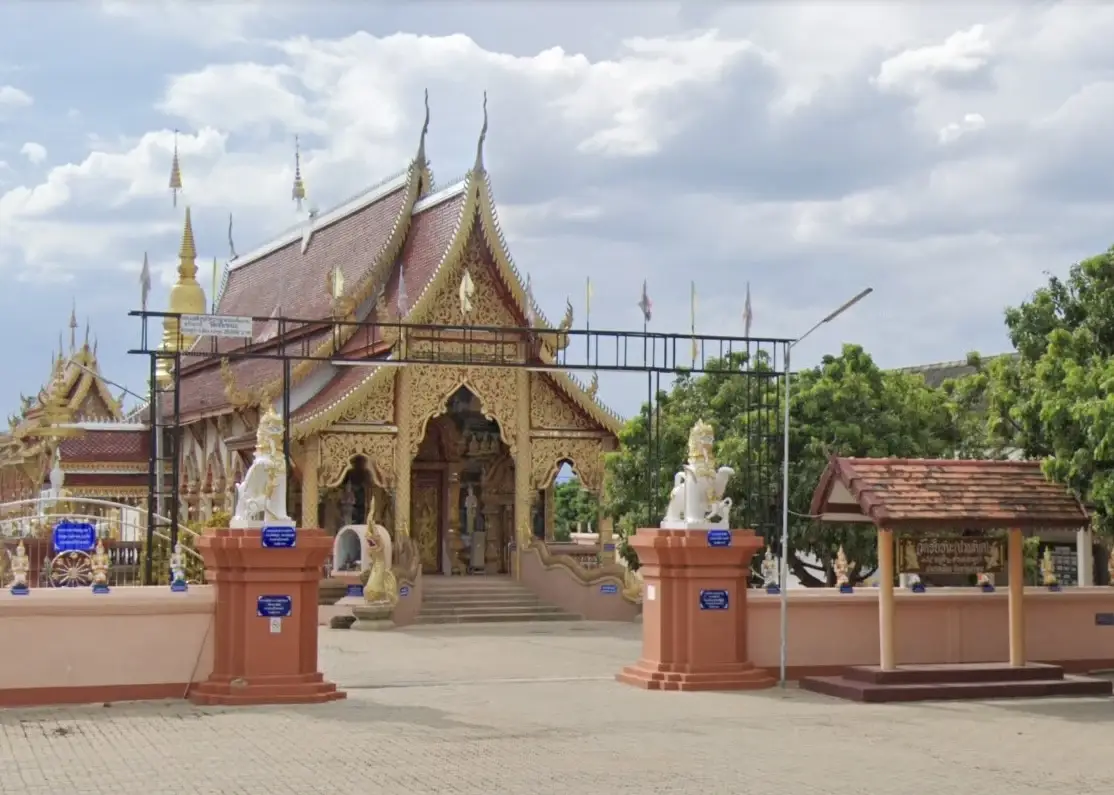
Wat Chai Chana
Open Days: Daily
Opening Hours: 08:00 – 17:00
Wat Chai Chana (Puang Sanuk), Lamphun, Thailand is a historic Buddhist temple located at 155, Moo 2, Ban Long Duea, Pratu Pa Subdistrict, Mueang Lamphun District, Lamphun Province 51000, Northern Thailand. Classified as a community temple belonging to the Maha Nikaya order of Thai Theravada Buddhism, it was originally founded in 1881 CE (2424 BE) and received the name Wat Chai Chana in 1919 CE (2462 BE). The temple holds considerable religious, historical, and cultural importance for Ban Long Duea and its surrounding communities. Its notable sacred landmark is Phra Chedi Si Chai Chana Mongkhon, a golden Buddhist pagoda associated with a traditional water-pouring ceremony that reflects the continuing Buddhist devotion of local residents.
Wat Chai Chana occupies approximately 8 rai and 40 square wah of land. Its temple compound includes an impressive golden pagoda and a beautifully decorated viharn representing the artistic traditions of Northern Thai Buddhism. The buildings and their surroundings demonstrate the development of a community monastery into an important place for Buddhist ceremonies, merit-making activities, and the preservation of local cultural traditions.
The temple's history is especially interesting because its establishment resulted from the collective efforts of local residents. Rather than beginning as a large monastery commissioned through a single construction project, Wat Chai Chana developed gradually through land donations, community labor, and the determination of Buddhist supporters. Its establishment illustrates the important role ordinary villagers played in creating and maintaining religious institutions in traditional Lanna society.
The earliest stage of the temple's development dates to 1881, during the reign of King Chulalongkorn, Rama V of Siam. This period witnessed major changes in government administration, communications, infrastructure, and society. Meanwhile, Northern Thai communities continued to maintain distinctive Lanna religious customs and village traditions. Wat Chai Chana emerged within this historical environment, with local Buddhist faith providing the principal motivation for establishing the monastery.
The original founders included Pho Khun Panya, Pho La, Pho Nuan, and Pho Khammun. These individuals initiated the process of preparing land and establishing a place where the community could conduct Buddhist religious activities. Their contribution was central to the temple's early history, reflecting the commitment of village residents to creating a permanent spiritual and religious center.
The land on which the temple was established was donated by Lung Noi Hin, another important figure in Wat Chai Chana's history. Donating land for a Buddhist temple is regarded as a significant act of merit in Thai Buddhist culture. Such an offering provides space for religious activities and allows the local community to share in the long-term benefits of maintaining a Buddhist institution. The donation therefore marked a decisive step in transforming ordinary land into a religious site.
After receiving the land, the founders and villagers worked together to clear the area and prepare it for construction. This effort required collective labor and cooperation. Preparing the land was an essential part of establishing the monastery because the site needed to be made suitable for future buildings and religious gatherings. The participation of local residents demonstrated that the temple's origins were deeply rooted in community initiative.
Pho Phaya Pantha subsequently developed the prepared site into a functioning Buddhist monastery. His contribution represented another important phase of the temple's development, helping transform the initial community project into a more established religious institution. Through this process, the site acquired a clearer role as a place where Buddhist monks could reside and where local worshippers could participate in religious observances.
Following the development of the monastery, Pho Phaya Pantha invited Phra Panya from Wat Khua Mung in Saraphi District, Chiang Mai Province, to become the head of the monastic establishment. Phra Panya played an important role in organizing the religious life of the newly developed monastery. He was subsequently appointed as its abbot, marking an important stage in the formal administration of Wat Chai Chana.
The connection between Wat Chai Chana and Wat Khua Mung in Saraphi District illustrates the wider network of Buddhist communities in the Lanna region. Inviting a monk from another monastery to lead a newly established religious institution demonstrates how communities could draw upon existing monastic relationships to develop religious practice and administration. These connections were important in maintaining religious continuity across different settlements in Northern Thailand.
In 1919, the monastery officially received the name Wat Chai Chana. The temple had previously been associated with the name Puang Sanuk, which remains part of its historical identity. The names reflect different stages in the development of the monastery. Wat Chai Chana is its official name, while Puang Sanuk preserves a connection with its earlier history and the traditions of the surrounding community.
The sequence of events between 1881 and 1919 illustrates the gradual development of Wat Chai Chana. The monastery began with local initiative, followed by a land donation, collective clearing of the site, the establishment of a religious compound, the appointment of a resident monk, and the eventual recognition of its official name. This process reflects a pattern found in many traditional Northern Thai community temples, where villagers played a decisive role in establishing and sustaining Buddhist institutions.
Pratu Pa Subdistrict, where Wat Chai Chana is located, has historical connections with Lanna settlements and the Yong people. An old channel of the Ping River passes through the area and forms part of its agricultural and environmental landscape. Buddhist monasteries have long played important roles in the surrounding communities, and Wat Chai Chana belongs to a network of temples associated with local religious and cultural life.
Ban Long Duea, the village surrounding Wat Chai Chana, is associated with traditional Northern Thai culture and community life. Studies of the settlement describe a population that includes both Yong people and longstanding local inhabitants. Buddhist beliefs and customs form an important part of the cultural environment. Temples consequently serve as places where community relationships, religious observances, and local traditions can be maintained across generations.
Understanding Wat Chai Chana in the context of Ban Long Duea requires consideration of its relationship with the people who established it. The temple did not develop independently of its surrounding community. Its origins involved named local supporters who donated land, cleared the site, and organized the establishment of a monastery. Pho Khun Panya, Pho La, Pho Nuan, Pho Khammun, Lung Noi Hin, and Pho Phaya Pantha therefore occupy an important place in the historical memory of Wat Chai Chana.
Wat Chai Chana also forms part of Lamphun Province's broader Buddhist heritage. Lamphun is closely associated with the ancient Hariphunchai kingdom, an important Buddhist cultural center that preceded the development of the Lanna kingdom. Although Wat Chai Chana was established much later, during the Rattanakosin period, its origins and community functions reflect the continuing importance of Buddhism in Northern Thai society.
Administratively, Wat Chai Chana is a community-supported Buddhist monastery belonging to the Maha Nikaya order. Maha Nikaya is one of the principal monastic traditions of Thai Theravada Buddhism. The temple's classification reflects its position within the established Thai Sangha system while emphasizing its close relationship with village worshippers and community religious activities.
With a recorded area of 8 rai and 40 square wah, Wat Chai Chana provides space for religious buildings, sacred monuments, and community activities. Photographs published by Pratu Pa Municipality show a golden pagoda, an elaborately decorated viharn, and white boundary walls around an important part of the compound. These architectural elements give the monastery its distinctive visual appearance.
The temple's northern boundary extends approximately 176 meters and adjoins a cemetery and Chai Chana School. This arrangement reflects the close relationship between Buddhist institutions, educational establishments, and facilities associated with community life. The spatial connection between temples and schools is a familiar characteristic of many traditional Thai settlements.
The southern boundary extends approximately 159 meters alongside privately owned land. The eastern boundary extends approximately 102 meters and adjoins a public road, while the western boundary extends approximately 89 meters alongside a public irrigation canal. Together, these boundaries place the monastery within a landscape consisting of residences, roads, community facilities, and traditional water infrastructure.
The public irrigation canal along the temple's western boundary is particularly interesting in relation to the agricultural history of Lanna communities. Traditional irrigation systems have long played important roles in managing water for cultivation and local livelihoods. The presence of such a canal beside the temple illustrates how religious spaces formed part of the wider environmental and agricultural landscape of Northern Thai villages.
Wat Chai Chana received a royal grant of Wisungkhamsima in 1936 CE (2479 BE). Wisungkhamsima refers to the recognized boundary designated for certain formal Buddhist monastic ceremonies. Such a boundary is particularly important for ordination ceremonies and other acts conducted according to Buddhist monastic discipline. Receiving this recognition represented a significant development in the monastery's religious and administrative history.
Phra Chedi Si Chai Chana Mongkhon is one of the temple's most important sacred landmarks. It is closely associated with a local Buddhist water-pouring tradition. Photographs show a prominent golden pagoda standing on a carefully decorated base. Its architectural form includes a substantial lower structure and an ascending arrangement of elements leading toward the pinnacle, creating a striking vertical silhouette.
The importance of a Buddhist pagoda extends beyond its architectural beauty. In Theravada Buddhist culture, pagodas are sacred monuments associated with veneration, remembrance, and devotion. Their presence within temple grounds helps create a spiritual focus for worshippers and provides a setting for religious ceremonies and traditional observances.
The area around Phra Chedi Si Chai Chana Mongkhon includes white boundary walls and decorative architectural details that emphasize the monument's golden appearance. This part of the temple is particularly notable because it brings together the pagoda, its surrounding enclosure, and the nearby viharn in a visually coherent religious setting.
Wat Chai Chana's viharn features tiered roofing and ornamental details associated with Northern Thai Buddhist temple architecture. Photographs published by the local municipality show the use of decorative colors and traditional architectural elements. The roof design and embellishments reflect the importance of craftsmanship in creating buildings intended for Buddhist worship.
In Lanna religious culture, the viharn is an important building traditionally associated with Buddha images, devotional activities, and gatherings of Buddhist worshippers. Its significance therefore combines practical religious use with artistic expression. The decoration and architectural composition of a viharn communicate the respect that Buddhist communities place upon their sacred spaces.
Examining the pagoda and viharn together reveals two complementary aspects of Buddhist temple design. The pagoda emphasizes vertical form and sacred monumentality, while the viharn provides an enclosed architectural space associated with worship and religious gatherings. Their different functions contribute to the overall identity and organization of Wat Chai Chana.
One of the most important traditions associated with Wat Chai Chana is the ceremonial pouring of water over Phra Chedi Si Chai Chana Mongkhon. A documented ceremony took place on June 16, 2024, at Wat Chai Chana (Puang Sanuk), Pratu Pa Subdistrict, Mueang Lamphun District. The event demonstrates the continuing importance of the pagoda as a focus of Buddhist devotion and community cultural activity.
Water-pouring ceremonies associated with Buddhist pagodas form part of the religious and cultural traditions of Lanna. They express reverence toward sacred monuments and symbolize purification, respect, and auspiciousness. Such ceremonies also provide opportunities for community participation, helping preserve shared religious customs and strengthen the relationship between residents and their local monastery.
The June 16, 2024 ceremony was particularly significant because it also included the presentation of an official appointment document naming Phra Khru Bai Dika Arun Rungrot Issaradhammo as acting abbot of Wat Chai Chana. A traditional longevity blessing ceremony was held in connection with the occasion. The event therefore brought together Buddhist ceremonial practice, monastic administration, and Lanna cultural traditions.
The Lanna life-extension or longevity blessing ceremony, commonly known as a Suep Chata ritual, is associated with well-being, auspiciousness, and blessings for a peaceful and prosperous life. Within a Buddhist community setting, such ceremonies can bring monks and laypeople together in collective acts of faith and cultural observance.
In the temple's recent administrative history, Phra Khru Bai Dika Arun Rungrot Issaradhammo was appointed acting abbot in 2024. The 2025 nationwide Kathin project subsequently listed him as the abbot of Wat Chai Chana. His name is therefore associated with the monastery's recent religious leadership and its continuing role in the Buddhist life of the community.
The temple's Kathin ceremony for 2025 was scheduled for October 26 at 9:30 a.m. The event listing recorded five resident monks. Kathin is an important Theravada Buddhist robe-offering ceremony conducted during a prescribed period after the annual rains retreat. During the ceremony, lay Buddhists offer robes and other requisites to eligible monks in accordance with Buddhist monastic practice.
Kathin carries considerable social and cultural importance because it requires cooperation among donors, residents, and the monastic community. Preparing offerings and organizing the ceremony strengthens community relationships while providing support for the Sangha. The annual tradition also contributes to the preservation of local Buddhist identity.
Wat Chai Chana's role in Ban Long Duea extends beyond ceremonies within the monastery itself. The temple provides a place where residents come together for religious observances, cultural activities, and merit-making. Its proximity to Chai Chana School also illustrates the close physical relationship between religious institutions and education within the village.
Ban Long Duea is part of Pratu Pa Subdistrict, where everyday community life remains connected with Buddhist traditions. Religious festivals and temple activities create opportunities for residents of different generations to meet and cooperate. Wat Chai Chana consequently serves as both a spiritual center and an institution contributing to the continuity of local customs.
In Lanna culture, temples have historically played important roles in maintaining religious beliefs, ethical teachings, and customary practices. Pagoda festivals, robe offerings, and other merit-making activities provide opportunities for individuals to express faith through community participation. Wat Chai Chana remains part of this cultural tradition in Pratu Pa Subdistrict.
Wat Chai Chana is particularly suitable for visitors interested in religious and cultural tourism. Its main points of interest include Phra Chedi Si Chai Chana Mongkhon, the traditionally decorated viharn, and the history of its foundation through local community cooperation. The temple provides an opportunity to understand the relationship between Buddhist architecture, historical memory, and village life in Lamphun.
One of the most distinctive features of Wat Chai Chana's historical account is the detailed identification of the people who helped establish the monastery. Pho Khun Panya, Pho La, Pho Nuan, Pho Khammun, Lung Noi Hin, and Pho Phaya Pantha all contributed to its early development. Their roles in preparing land, donating property, and creating the monastery demonstrate how a religious institution can emerge through collective community effort.
Phra Panya, invited from Wat Khua Mung in Saraphi District, Chiang Mai Province, was another important figure in the monastery's formative years. He initially served as head of the religious establishment and was later appointed abbot. His arrival enabled the developing monastery to establish a more organized pattern of religious practice and administration.
Wat Chai Chana and Wat Long Duea are two separate temples, although both are located in Ban Long Duea, Moo 2, Pratu Pa Subdistrict. Wat Chai Chana is registered at number 155 and was initially founded in 1881, while Wat Long Duea is located at number 112 and was established in 1852. Distinguishing between the two monasteries is important when studying local history or planning a visit, as they have different foundation histories and individual religious identities.
Pratu Pa Subdistrict contains several Buddhist temples associated with different communities, including Wat Chai Mongkhon, Wat Chai Chana, Wat Long Duea, Wat Pratu Pa, and Wat Si Suphan. Each monastery contributes to the area's historical and religious landscape. Exploring these sites together offers insight into the development of Buddhist settlements and the diversity of temple traditions in northern Lamphun.
Wat Pratu Pa is another historically important Buddhist monastery, closely connected with the heritage of the Yong community in Lamphun. Its traditional scripture hall is particularly noteworthy for its architectural and artistic value. Scripture halls played important roles in preserving Buddhist manuscripts and religious texts. Visiting Wat Pratu Pa alongside Wat Chai Chana provides an opportunity to compare different expressions of Lanna Buddhist culture.
Wat Long Duea is another monastery within Ban Long Duea village. Established in 1852, it has a historical connection with a monk from Hang Dong District in Chiang Mai Province. The histories of Wat Long Duea and Wat Chai Chana demonstrate longstanding religious connections between communities in Lamphun and Chiang Mai, reflecting broader networks of Buddhist practice within the Lanna region.
Wat Si Suphan is another temple in Pratu Pa Subdistrict with a foundation story connected to local settlement and land development. Its history includes the contribution of Chao Kaew Manut Na Lamphun, who participated in the development of the community and the establishment of a monastery. Comparing its history with Wat Chai Chana highlights the importance of community leaders and local donors in building religious institutions.
A cultural itinerary through Pratu Pa Subdistrict can also connect with the historic center of Lamphun, particularly Wat Phra That Hariphunchai Woramahawihan. This major Buddhist monastery is closely associated with the history of Hariphunchai and is among Lamphun's most important religious landmarks. Visiting it alongside Wat Chai Chana highlights the differences between a major historic urban monastery and a community-supported village temple.
Wat Phra Yuen is another important temple in Mueang Lamphun District, associated with the province's Buddhist history and artistic heritage. Wat San Pa Yang Luang is renowned for its ornate Northern Thai Buddhist architecture and decorative craftsmanship. Combining these temples with Wat Chai Chana creates a more varied cultural journey through Lamphun's religious landscape.
The appeal of Wat Chai Chana lies partly in its continuing connection with everyday community life. Documented Kathin activities and the water-pouring ceremony for Phra Chedi Si Chai Chana Mongkhon demonstrate the monastery's ongoing religious role. The temple is therefore not simply a historical monument but a living religious institution whose traditions remain meaningful to local residents.
Visitors interested in Buddhist architecture will find Phra Chedi Si Chai Chana Mongkhon one of the temple's most memorable features. Its golden form and the nearby viharn reflect the importance of sacred architecture and decorative craftsmanship in Lanna Buddhist culture. These structures also provide opportunities to appreciate the relationship between religious function and architectural beauty.
Preserving Wat Chai Chana is important for both its religious buildings and the history of the community that established it. The temple's recorded founders, land donors, and early religious leaders represent an important part of Ban Long Duea's cultural memory. Their contributions illustrate how local initiative helped create a Buddhist monastery that has continued to serve the community for more than a century.
Visitors should observe respectful conduct because Wat Chai Chana is an active Buddhist religious site. Modest clothing, quiet conversation, and consideration for monks and worshippers are appropriate throughout the compound. Photography should not interrupt ceremonies or disturb people taking part in religious activities. Instructions concerning access to sacred buildings should also be followed.
Paying respect to the pagoda and other sacred spaces is an important aspect of Buddhist temple culture. Visitors can appreciate the architecture and learn about the monastery's history while observing its religious significance. The temple offers an opportunity to understand Buddhist devotion as part of both personal practice and community tradition.
For travelers interested in Lanna ceremonies, the water-pouring tradition at Phra Chedi Si Chai Chana Mongkhon is particularly meaningful. It demonstrates how sacred monuments become central to collective religious activities. Such ceremonies preserve cultural customs and bring residents together through shared expressions of faith.
The Kathin tradition is another example of the monastery's continuing role in modern Buddhist life. The participation of resident monks and lay donors in the annual robe-offering ceremony reflects a religious cycle that connects the temple with supporters in the surrounding community. These observances sustain both monastic practice and social relationships.
From a historical perspective, Wat Chai Chana is especially valuable because of its account of donated land and collective labor. The recorded founders represent the cooperation that made the monastery possible. Preserving their names and contributions allows future generations to understand the temple as a community achievement rather than simply a collection of religious buildings.
The temple's overall significance can be understood through several important milestones: its foundation in 1881, the recognition of its official name in 1919, the granting of Wisungkhamsima in 1936, and the continuing importance of Phra Chedi Si Chai Chana Mongkhon and associated ceremonies. These events illustrate the development of Wat Chai Chana from an early community religious establishment into a longstanding Buddhist institution.
Getting There: Wat Chai Chana is located at 155, Moo 2, Ban Long Duea, Pratu Pa Subdistrict, Mueang Lamphun District, Lamphun Province 51000, Thailand. Visitors traveling from central Lamphun can follow local roads toward Pratu Pa Subdistrict and continue to Ban Long Duea village. Entering Wat Chai Chana (Puang Sanuk) in a navigation application helps distinguish the temple from Wat Long Duea, which is situated in the same village.
Travelers arriving from Chiang Mai can enter Lamphun Province using the main roads connecting the two provinces, then continue toward Pratu Pa Subdistrict and Ban Long Duea. Traveling by private car is convenient for combining a visit to Wat Chai Chana with Wat Long Duea, Wat Pratu Pa, and other Buddhist temples in Lamphun's historic center during the same day.
Wat Chai Chana (Puang Sanuk) is a historic Buddhist monastery founded through the faith and cooperation of Ban Long Duea residents in 1881. Its historical importance is reflected in the donation of its land, the gradual establishment of the monastery, the succession of religious leadership, and the continuing significance of Phra Chedi Si Chai Chana Mongkhon. Through its architecture, pagoda water-pouring ceremony, and Kathin activities, the temple remains part of Lamphun's Buddhist and Lanna cultural heritage, illustrating the longstanding relationship between religion, community, and local history.
| Name | Wat Chai Chana (Puang Sanuk) |
| Category | Community Buddhist Temple, Maha Nikaya Order |
| Address | 155, Moo 2, Ban Long Duea, Pratu Pa Subdistrict, Mueang Lamphun District, Lamphun 51000, Thailand |
| History | Originally established in 1881 CE (2424 BE); officially named Wat Chai Chana in 1919 CE (2462 BE) |
| Historical Name | Puang Sanuk |
| Original Founders | Pho Khun Panya, Pho La, Pho Nuan, and Pho Khammun |
| Land Donor | Lung Noi Hin |
| Monastery Developer | Pho Phaya Pantha |
| Early Abbot | Phra Panya, originally from Wat Khua Mung, Saraphi District, Chiang Mai Province |
| Abbot Listed in the 2025 Religious Activity Register | Phra Khru Bai Dika Arun Rungrot Issaradhammo |
| Land Area | 8 rai and 40 square wah |
| Historical Boundaries | North: approximately 176 m, adjoining a cemetery and Chai Chana School South: approximately 159 m, adjoining private land East: approximately 102 m, adjoining a public road West: approximately 89 m, adjoining a public irrigation canal |
| Wisungkhamsima | Royal consecration boundary granted in 1936 CE (2479 BE) |
| Main Sacred Monument | Phra Chedi Si Chai Chana Mongkhon |
| Important Religious Structures | Golden Pagoda, Viharn, and Decorative Enclosure Walls |
| Main Areas and Zones | Phra Chedi Si Chai Chana Mongkhon Area, Viharn Area, and Religious Activity Spaces |
| Religious Traditions | Water-Pouring Ceremony at Phra Chedi Si Chai Chana Mongkhon and Kathin Robe-Offering Ceremony |
| Notable Events | June 16, 2024: Pagoda Water-Pouring Ceremony and Appointment of an Acting Abbot October 26, 2025: Kathin Merit-Making Event |
| Published Open Days | Daily |
| Published Visiting Hours | 08:00 – 17:00 |
| Municipal Published Contact Numbers | +66 53 500 129, +66 89 950 5957 |
| Nearby and Regional Tourist Attractions | 1. Wat Long Duea, Ban Long Duea, Moo 2 2. Wat Pratu Pa, Pratu Pa Subdistrict 3. Wat Si Suphan, Pratu Pa Subdistrict 4. Wat Chai Mongkhon, Ban Wang Mui 5. Wat Phra That Hariphunchai Woramahawihan, Lamphun Town 6. Wat Phra Yuen, Wiang Yong Subdistrict 7. Wat San Pa Yang Luang, Lamphun Town |
| Restaurants in Mueang Lamphun District | 1. PLU Restaurant, Nai Mueang, Tel. +66 91 556 6669 2. Longan Braised Pork Noodle Shop, Wiang Yong, Tel. +66 89 561 1120 3. Witsawa Chicken Rice, Nai Mueang, Tel. +66 85 031 4439 4. Daokanong Restaurant, Doi Ti Branch, Si Bua Ban, Tel. +66 53 553 942 5. Junpha Local Food and Home Kitchen, Nai Mueang, Tel. +66 95 954 7639 |
| Accommodations in Pratu Pa and Mueang Lamphun | 1. Huan Khum Maung La Poon, Pratu Pa, Tel. +66 95 550 0175 2. Jamadevi Hotel Lamphun, Lamphun Town, Tel. +66 53 512 115 3. Phaya Inn, Lamphun Town, Tel. +66 53 511 777 4. Look at Home Lamphun, Pa Sak, Tel. +66 81 530 5440 5. Kum Chao Jom Kaew, Lamphun Town, Tel. +66 53 560 702 |
| Getting There | From central Lamphun, travel toward Pratu Pa Subdistrict and continue to Ban Long Duea, Moo 2. Use Wat Chai Chana (Puang Sanuk) as the destination name in navigation applications. |
Frequently Asked Questions (FAQ)
Q: Where is Wat Chai Chana (Puang Sanuk) located?
A: Wat Chai Chana is located at 155, Moo 2, Ban Long Duea, Pratu Pa Subdistrict, Mueang Lamphun District, Lamphun Province 51000, Thailand.
Q: When was Wat Chai Chana established?
A: Wat Chai Chana was originally established in 1881 CE (2424 BE) and officially received the name Wat Chai Chana in 1919 CE (2462 BE).
Q: Who founded Wat Chai Chana?
A: The original founders were Pho Khun Panya, Pho La, Pho Nuan, and Pho Khammun. The land was donated by Lung Noi Hin. Pho Phaya Pantha subsequently developed the monastery and invited Phra Panya from Wat Khua Mung in Chiang Mai to lead the religious establishment.
Q: What is the most important sacred landmark at Wat Chai Chana?
A: Phra Chedi Si Chai Chana Mongkhon is one of the temple's main sacred monuments. The golden pagoda is associated with a traditional Buddhist water-pouring ceremony.
Q: Who is the abbot of Wat Chai Chana?
A: Phra Khru Bai Dika Arun Rungrot Issaradhammo was appointed acting abbot in 2024 and was listed as abbot in the temple's 2025 Kathin activity information.
Q: What important religious traditions take place at Wat Chai Chana?
A: Important traditions include the water-pouring ceremony at Phra Chedi Si Chai Chana Mongkhon and the Kathin robe-offering ceremony. Documented events took place in 2024 and 2025, respectively.
Q: Are Wat Chai Chana and Wat Long Duea the same temple?
A: No. They are separate temples in Ban Long Duea village. Wat Chai Chana is located at number 155, Moo 2, while Wat Long Duea is located at number 112, Moo 2.
Q: Which nearby temples can visitors combine with Wat Chai Chana?
A: Visitors can explore Wat Long Duea, Wat Pratu Pa, Wat Si Suphan, Wat Chai Mongkhon, and Wat Phra That Hariphunchai Woramahawihan in the wider Mueang Lamphun area.
 Category: ●Places of Worship
 Group: ●Temple
Last Update : 2 WeekAgo
 Last Update : 2 WeekAgo
 Click to Access the Navigation Map GPS

 Muang Lamphun(141)Mea Ta(30)Ban Hong(45)Li(51)Thung Hua Chang(15)Pa Sang(63)Ban Thi(24)Wiang Nong Long(13)


