
lovethailand home >Northeastern Travel Attractions >Buri Ram Travel Attractions >Muang Buri Ram >Samet > Wat Pa Khao Noi
TL;DR: Wat Pa Khao Noi is located at Samet Subdistrict, Mueang Buri Ram District, Buri Ram Province, open Daily, hours 08.00 – 17.00.
Wat Pa Khao Noi
Open Days: Daily
Opening Hours: 08.00 – 17.00
Wat Pa Khao Noi in Samet Subdistrict, Mueang Buri Ram District, Buri Ram Province, is an important forest meditation temple known for its peaceful natural setting, Buddhist practice atmosphere, and deep association with Luang Pu Suwat Suwajo. Located close to the Khao Kradong volcanic forest park area, the temple is surrounded by shaded woodland and a calm environment that makes it suitable for merit-making, quiet reflection, meditation, and paying homage to sacred Buddhist relics. The most important landmark inside the temple is Phra Borommathat Chedi Si Suwaj Khunanusorn, a monumental reliquary chedi built through the faith and devotion of Luang Pu Suwat’s disciples. It enshrines sacred relics of the Buddha and serves as a memorial to Luang Pu Suwat Suwajo, a respected Dhammayut forest monk in the lineage of Luang Pu Mun Bhuridatto.
Wat Pa Khao Noi offers an atmosphere very different from ordinary city temples. Although it is located only a short distance from Buri Ram city and can be reached conveniently, entering the temple grounds gives visitors a clear sense of forest calm. The temple is not designed around commercial tourism or lively crowds. Its character is quiet, restrained, and contemplative. People usually come here to pay homage at the chedi, make merit, remember Luang Pu Suwat, practice mindfulness, or simply spend time in a peaceful forest temple environment away from the pace of daily life.
The defining identity of Wat Pa Khao Noi is its status as a forest meditation temple in the lineage of Luang Pu Mun Bhuridatto. This tradition emphasizes meditation, discipline, simplicity, mindfulness, and direct inner cultivation. Forest temples of this kind play an important role in Thai Buddhism because they provide space for monks and laypeople to train the mind, develop concentration, and reflect on the teachings of the Buddha. The temple’s location near Khao Kradong and its shaded natural landscape make it especially suitable for this purpose.
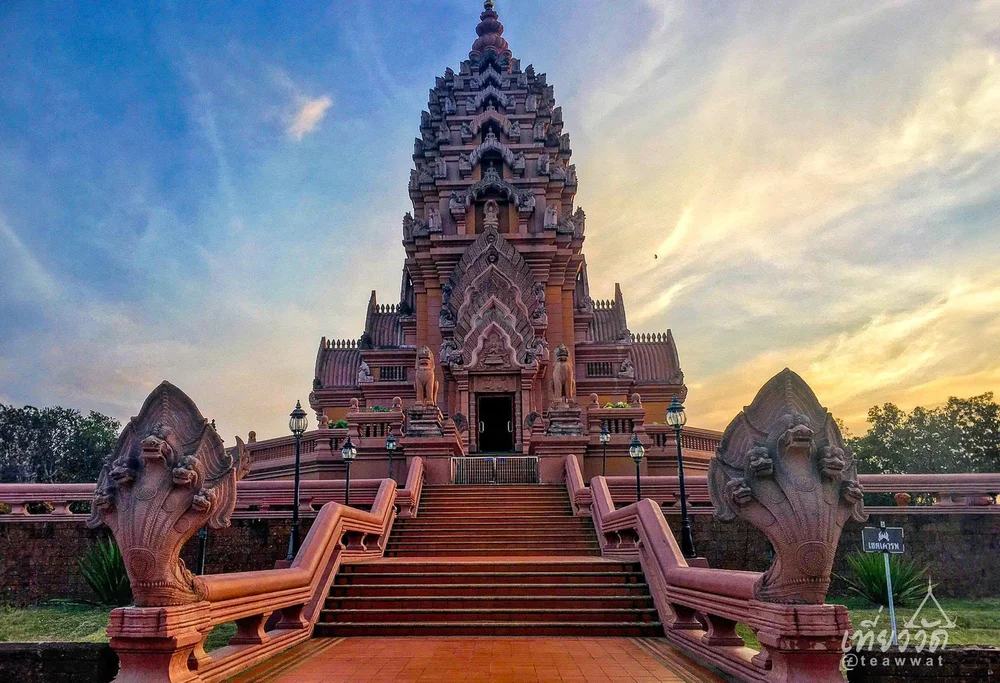
Phra Borommathat Chedi Si Suwaj Khunanusorn is the spiritual center of Wat Pa Khao Noi. The chedi was constructed to enshrine sacred relics of the Buddha and to commemorate Phra Bodhidhammajarn Thera, better known as Luang Pu Suwat Suwajo, the former abbot of Wat Pa Khao Noi and a meditation master deeply respected by Buddhist practitioners. The reddish-brick chedi standing amid the shaded temple grounds creates a strong visual identity and has become one of the most meaningful sacred sites for faith-based travelers visiting Buri Ram Province.
The architecture of Phra Borommathat Chedi Si Suwaj Khunanusorn is especially striking because it draws inspiration from ancient Khmer art and the form of Phanom Rung Stone Castle, one of the most important cultural symbols of Buri Ram. The chedi rises with the dignity of a Khmer-style sanctuary, combining sacred Buddhist meaning with the artistic identity of the lower northeastern region. This design makes the chedi more than a religious monument. It is also a contemporary architectural expression that connects Buddhist devotion with the historical and cultural landscape of Buri Ram.
The interior of the chedi is arranged with several important functions. The lower level is used as a meditation and contemplation area, as well as a space where visitors can learn about the life and teachings of Luang Pu Suwat. This floor invites visitors to calm the mind, sit quietly, and reflect on the path of practice. The upper level enshrines the image of Luang Pu Suwat and his monastic requisites, creating a sacred space for disciples and visitors to pay respect. This arrangement allows the chedi to serve several roles at once: a reliquary, a memorial, a learning space, and a place of meditation.
Luang Pu Suwat Suwajo was a Dhammayut forest monk and a disciple in the lineage of Luang Pu Mun Bhuridatto. He was widely respected as a meditation master whose life reflected perseverance, simplicity, mindfulness, and sincere dedication to Buddhist practice. For many Buddhists, the name Luang Pu Suwat represents the spirit of the Thai forest tradition, where the heart of practice lies in discipline, meditation, and the direct cultivation of wisdom. Wat Pa Khao Noi is therefore not merely a temple connected with his name, but a place that continues to express his intention to create a quiet setting for spiritual training.
Luang Pu Suwat passed away on April 5, 2002, yet his spiritual influence remains alive through Wat Pa Khao Noi and Phra Borommathat Chedi Si Suwaj Khunanusorn. Visitors who come to the chedi do not come only to admire its architecture. They come to remember a revered teacher, to honor his dedication to the Dhamma, and to draw inspiration from the life of a monk who devoted himself to Buddhist practice. The chedi is therefore both a sacred monument and a living symbol of gratitude.
The importance of Wat Pa Khao Noi also lies in its true forest-temple atmosphere. The surrounding trees, natural shade, quiet paths, and sense of stillness create conditions suitable for meditation. Visitors should not rush through the temple merely to take photographs. It is better to spend at least some time walking quietly, listening to the sounds of nature, and allowing the environment to help the mind settle. A forest temple like this turns travel into an inner experience, not only an external visit.
Upon entering the temple, visitors should maintain respectful conduct. Wat Pa Khao Noi is a place of Buddhist practice, not a leisure attraction. Clothing should be modest, speech should be quiet, and behavior should remain restrained. Loud music, disruptive photography, drones, and unnecessary noise are not appropriate. Visitors should not enter monks’ areas or meditation spaces that are not open to the public. This respect preserves the atmosphere of the temple and supports the monks, practitioners, and devotees who come here for spiritual purposes.
Beyond the chedi, the temple includes areas for worship, meditation, monks’ residences, internal walking paths, and shaded natural spaces. Visitors may walk through appropriate public areas, but should avoid disturbing sacred objects, private areas, or meditation zones. A visit to a forest temple should be calm and humble because the main purpose of the place is spiritual training and the preservation of Buddhist values.
Phra Borommathat Chedi Si Suwaj Khunanusorn carries several layers of meaning. First, it is a sacred place where relics of the Buddha are enshrined. Second, it is a memorial to Luang Pu Suwat Suwajo, a revered teacher whose disciples continue to remember his virtue. Third, it is a center of faith where people come to meditate, make merit, and reflect on the qualities of noble Buddhist teachers. These meanings make the chedi important in religious, biographical, and local cultural dimensions.
The chedi’s form, inspired by Phanom Rung Stone Castle, connects Wat Pa Khao Noi closely with the identity of Buri Ram. The province is known for important Khmer historical sites, and Phanom Rung is one of its most recognizable symbols. By drawing on this architectural inspiration, the chedi creates a meaningful bridge between present-day Buddhist faith and the ancient cultural roots of the lower northeastern region.
For travelers from other provinces, Wat Pa Khao Noi can easily be combined with Khao Kradong Forest Park, Wat Phra Phutthabat Khao Kradong, Chang Arena, Buri Ram Castle, and Chang International Circuit. These sites are located within practical driving distance from one another. Starting the day by paying respect at Wat Pa Khao Noi, then continuing to the extinct volcanic landscape of Khao Kradong, gives the trip both spiritual and natural dimensions.
Visitors interested in meditation should come to Wat Pa Khao Noi with clear intention. The temple is not only a place for photographing the chedi. Its quiet atmosphere supports mindfulness, walking meditation, sitting quietly, and reflection on the teachings of the forest masters. Paying homage at the chedi, recalling Luang Pu Suwat’s practice, and spending time in silence can make the visit far more meaningful than a quick sightseeing stop.
Annual activities connected with Wat Pa Khao Noi often relate to the remembrance of Luang Pu Suwat and devotional practice. The period around April 5, the date of his passing, and April 6, the date connected with the opening of Phra Borommathat Chedi Si Suwaj Khunanusorn, is especially meaningful for disciples and devotees. Visitors who come during commemorative events can witness the faith of Luang Pu Suwat’s followers, but should plan carefully and follow temple regulations with particular attention.
Phra Khru Bowon Sila Sophon is the current abbot of Wat Pa Khao Noi. The temple continues to have resident monks and ongoing Buddhist activities. With monastic care and the preservation of Luang Pu Suwat’s intention, Wat Pa Khao Noi remains a living forest meditation temple rather than a mere monument or tourist stop. It continues to serve people who come for merit-making, Dhamma listening, meditation, and remembrance of a respected teacher.
Getting There to Wat Pa Khao Noi from Buri Ram city is convenient. Travel toward Samet Subdistrict and the Khao Kradong area. The distance from the city is about 8–10 km, and the drive takes only a short time. Private cars, rental cars, motorcycles, and hired local vehicles are suitable. Visitors using digital navigation can search for “Wat Pa Khao Noi Buri Ram” or “Phra Borommathat Chedi Si Suwaj Khunanusorn.” The route can easily be combined with Khao Kradong Forest Park because the temple is located very close to that area.
From Buri Ram Railway Station or Buri Ram Bus Terminal, visitors can continue to the temple by hired local vehicle or rental car. A private vehicle is the most practical option for those who want to visit several places in the same day, such as Khao Kradong Forest Park, Wat Phra Phutthabat Khao Kradong, Chang Arena, and Buri Ram Castle. Public transport to the temple and the Khao Kradong area is not as frequent as transport within the city center, so arranging a vehicle in advance gives better control over time and route.
The best time to visit Wat Pa Khao Noi is in the morning or late afternoon, when the weather is more comfortable and the atmosphere is suitable for quiet walking around the chedi. Morning visits feel fresh and peaceful, making them suitable for worship and meditation before starting the day. Late afternoon visits offer softer light on the chedi and can be combined with a trip to Khao Kradong before evening.
Photography should be done respectfully because the chedi is a sacred place of worship. Visitors should avoid inappropriate poses, climbing on platforms or railings, and disturbing people who are praying or meditating. If monks or meditation practitioners are nearby, permission should be requested before taking photographs of individuals. The purpose of photography in a temple should be to preserve the dignity and atmosphere of the place.
Things to prepare before visiting include modest clothing, drinking water, comfortable walking shoes, and small cash for merit-making according to personal faith. Because the temple grounds are shaded and include walking areas, elderly visitors should choose stable footwear. Those who wish to sit quietly or meditate should prepare mentally and avoid loud conversation so that their visit remains consistent with the temple’s forest meditation atmosphere.
Wat Pa Khao Noi is suitable for both half-day and full-day itineraries. For a half-day route, visitors can pay homage at the temple, visit Phra Borommathat Chedi Si Suwaj Khunanusorn, and continue to Khao Kradong Forest Park and Wat Phra Phutthabat Khao Kradong. For a full-day route, Chang Arena, Buri Ram Castle, Chang International Circuit, and restaurants in the city or near the stadium area can be added. This itinerary gives travelers a balanced view of Buri Ram through faith, nature, volcanic landscape, and the modern sports city identity.
Khao Kradong Forest Park is the closest attraction to Wat Pa Khao Noi and should be considered together in the same route. Both places are part of the Khao Kradong volcanic landscape, an extinct volcano area. Visitors can see the volcanic crater, suspension bridge, viewpoints, and Phra Suphattharabophit nearby. Combining Wat Pa Khao Noi with Khao Kradong helps travelers understand both the spiritual and geographical character of Buri Ram.
Chang Arena, Buri Ram Castle, and Chang International Circuit are another group of nearby attractions that can be reached easily from Wat Pa Khao Noi. Many visitors choose this route because travel time between the sites is short and the itinerary reveals several sides of the province. A day can begin with worship and meditation at Wat Pa Khao Noi, continue with nature at Khao Kradong, and end around the sports and leisure district near the football stadium.
For dining, the area near Wat Pa Khao Noi has local restaurants and northeastern Thai food options, especially around Khao Kradong and the route toward Chang Arena. Kuay Tiao Hoi Kha-Bong Pa-on, Song Phi Nong Dinosaur Buriram Restaurant, Ped Yang Ku Mueang Buri Ram Branch, Buri Ram Ped Yang, London Steak Buriram, and Miles Cafe’ Buriram can be combined with the travel route conveniently. Visitors who want more choices can also return to central Buri Ram or the stadium area.
For accommodation, central Buri Ram or the area near Chang Arena is the most convenient base. These areas allow easy access to Wat Pa Khao Noi, Khao Kradong, restaurants, hotels, and other major attractions. Accommodation options range from budget hotels to standard hotels suitable for families and groups. During football matches, motorsport events, festivals, or long holidays, advance booking is recommended.
Wat Pa Khao Noi is suitable for many types of visitors. Elderly travelers can come for worship and quiet time. Families can bring children to learn about Buddhist relics, respectful temple behavior, and the story of Luang Pu Suwat. Those interested in the Thai forest meditation tradition can study the connection between Luang Pu Suwat and the lineage of Luang Pu Mun. General travelers can use the temple as a meaningful starting point before continuing to Khao Kradong and nearby attractions.
Overall, Wat Pa Khao Noi is one of the important Buddhist temples in Buri Ram Province because it combines forest meditation practice, sacred architecture, teacher remembrance, and natural landscape in one place. Phra Borommathat Chedi Si Suwaj Khunanusorn is the heart of the temple. It enshrines relics of the Buddha, honors Luang Pu Suwat Suwajo, and stands as a powerful symbol of faith that connects Buddhism with the cultural identity of the lower northeastern region.
A visit to Wat Pa Khao Noi is therefore more than a stop at a beautiful temple near Buri Ram city. It is a journey into a space of calmness, gratitude, and spiritual reflection. Visitors can remember a revered forest master, admire architecture inspired by Phanom Rung, and experience a forest-temple atmosphere that remains peaceful despite being close to the city. Those who come with respect will find both outer beauty and inner stillness here.
| Name | Wat Pa Khao Noi |
| Location | Samet Subdistrict, Mueang Buri Ram District, Buri Ram Province |
| Coordinates | 14.927278, 103.094861 |
| Temple Type | Private Buddhist Temple Under The Dhammayut Order And A Forest Meditation Temple In The Lineage Of Luang Pu Mun Bhuridatto |
| Highlights | Phra Borommathat Chedi Si Suwaj Khunanusorn, a sacred chedi enshrining relics of the Buddha and commemorating Luang Pu Suwat Suwajo. |
| History | Wat Pa Khao Noi is a forest meditation temple developed according to the intention of Luang Pu Suwat Suwajo, a Dhammayut monk and teacher in the lineage of Luang Pu Mun Bhuridatto, as a place for Buddhist practice and faith. |
| Name Origin | The name is connected with the forested hill landscape near Khao Kradong in Samet Subdistrict, Mueang Buri Ram District. |
| Distinctive Features | A shaded and peaceful forest temple suitable for worship, meditation, mindfulness practice, and paying respect to sacred Buddhist relics. |
| Important Objects Inside The Temple | Phra Borommathat Chedi Si Suwaj Khunanusorn, sacred relics of the Buddha, an image of Luang Pu Suwat Suwajo, Luang Pu Suwat’s monastic requisites, and meditation areas. |
| The Sacred Chedi | Phra Borommathat Chedi Si Suwaj Khunanusorn is inspired by the architecture of Phanom Rung Stone Castle. It rises more than 31 meters and has 2 levels. The lower level is used for meditation and displays the history of Luang Pu Suwat, while the upper level enshrines his image and monastic requisites. |
| Important Related Figure | Phra Bodhidhammajarn Thera, or Luang Pu Suwat Suwajo, a Dhammayut forest monk in the lineage of Luang Pu Mun Bhuridatto. He passed away on April 5, 2002. |
| Travel Information | From Buri Ram city, travel toward Samet Subdistrict and Khao Kradong. The distance is about 8–10 km. Private cars, rental cars, motorcycles, or hired local vehicles are suitable. |
| Current Status | Open as a forest meditation temple for worship, merit-making, paying respect to the sacred chedi, and Buddhist practice. |
| Open Days | Daily |
| Opening Hours | 08.00 – 17.00 |
| Fees | No Admission Fee |
| Facilities | Parking area, worship area, meditation area, shaded spaces, walking paths inside the temple, and the sacred chedi worship area. |
| Main Areas / Zones | Phra Borommathat Chedi Si Suwaj Khunanusorn, Meditation Area, Luang Pu Suwat History Display Area, Image And Monastic Requisites Area, Monastic Area, And Shaded Forest Temple Grounds. |
| Abbot / Caretaker | Phra Khru Bowon Sila Sophon |
| Official Website / Official Page | Wat Pa Khao Noi, Buri Ram Province |
| Nearby Tourist Attractions | 1. Khao Kradong Forest Park, About 1 km 2. Wat Phra Phutthabat Khao Kradong, About 2 km 3. Chang Arena, About 4 km 4. Buri Ram Castle, About 4 km 5. Chang International Circuit, About 5 km 6. King Rama I Monument, About 8 km 7. Buri Ram City Pillar Shrine, About 9 km 8. Buri Ram Night Bazaar, About 9 km |
| Nearby Restaurants | 1. Kuay Tiao Hoi Kha-Bong Pa-on, About 3 km, Tel. 086-345-9789, 086-725-7888 2. Song Phi Nong Dinosaur Buriram Restaurant, About 4 km, Tel. 081-264-4862, 086-258-8850 3. Ped Yang Ku Mueang, Buri Ram Branch, About 5 km, Tel. 061-651-2131 4. Buri Ram Ped Yang, About 5 km, Tel. 080-157-9666 5. London Steak Buriram, About 7 km, Tel. 044-115-213 6. Miles Cafe’ Buriram, About 7 km, Tel. 063-803-9365 |
| Nearby Accommodations | 1. Sky View Resort Buriram, About 4 km, Tel. 061-616-9828 2. Amari Buriram United, About 4 km, Tel. 044-111-444 3. Modena By Fraser Buriram, About 4 km, Tel. 044-118-188 4. Cresco Hotel Buriram, About 5 km, Tel. 044-634-901 5. Fortune Hotel Buriram, About 6 km, Tel. 044-163-800 6. HOP INN Buriram, About 7 km, Tel. 02-080-2222 |
Frequently Asked Questions (FAQ)
Q: Where is Wat Pa Khao Noi located?
A: Wat Pa Khao Noi is located in Samet Subdistrict, Mueang Buri Ram District, Buri Ram Province, near Khao Kradong volcanic forest park. It is about 8–10 km from Buri Ram city.
Q: Why is Wat Pa Khao Noi important?
A: Wat Pa Khao Noi is a forest meditation temple in the lineage of Luang Pu Mun Bhuridatto. It is a peaceful place for Buddhist practice and is home to Phra Borommathat Chedi Si Suwaj Khunanusorn, which enshrines sacred relics of the Buddha and commemorates Luang Pu Suwat Suwajo.
Q: What is special about Phra Borommathat Chedi Si Suwaj Khunanusorn?
A: The chedi is inspired by the architecture of Phanom Rung Stone Castle and rises more than 31 meters. It has 2 levels, with a meditation and Luang Pu Suwat history area below, and an image and monastic requisites of Luang Pu Suwat above.
Q: Who was Luang Pu Suwat Suwajo?
A: Luang Pu Suwat Suwajo was a Dhammayut forest monk in the lineage of Luang Pu Mun Bhuridatto and a respected meditation master. He passed away on April 5, 2002.
Q: What are the opening days and hours of Wat Pa Khao Noi?
A: The temple is open daily from 08.00 to 17.00 for worship, merit-making, and paying respect at the sacred chedi.
Q: Is there an admission fee to visit Wat Pa Khao Noi?
A: No. There is no admission fee. Visitors may make donations according to their faith and should help preserve the temple’s peaceful atmosphere.
Q: What should visitors wear when visiting Wat Pa Khao Noi?
A: Visitors should wear modest clothing, behave calmly, keep their voices low, and avoid disturbing meditation practitioners because Wat Pa Khao Noi is a forest meditation temple.
Q: Which nearby attractions can be visited together with Wat Pa Khao Noi?
A: Nearby attractions include Khao Kradong Forest Park, Wat Phra Phutthabat Khao Kradong, Chang Arena, Buri Ram Castle, Chang International Circuit, the King Rama I Monument, and Buri Ram City Pillar Shrine.
 Category: ●Places of Worship
 Group: ●Temple
Last Update : 4 MonthAgo
 Last Update : 4 MonthAgo
 Click to Access the Navigation Map GPS
Wat Pa Khao Noi Map
Recommend

 Art, Culture and Heritage
 Historical Sites and Monuments(14)
 Landmarks and Memorials(2)
 Art, Craft Centres, Tradition(6)
 Museums(3)
 Educational Places
 Museum for Study(1)
Temple(74)
Museum for Study(1)
Temple(74)
 Other Sacred Sites(5)
 Research and Development
 Royal Project(1)
 Suburban Living
 Village, Community(3)
 Nature and Wildlife
 National Parks and Marine Reserves(2)
 Mountain (Doi)(1)
 Dam, Reservoir, Lake(14)
 River, Canal(1)
 Bays and Beaches(1)
 Other natural attractions(2)
 Entertainment and Agricultural
 Animal camps and shows(1)
 Stadium(2)
 Farms, Parks and Ecotourism(2)
 Waterpark(2)
 Travel Articles, Recipes
 Travel Review, Food Review(1)


