
lovethailand home >Northeastern Travel Attractions >Amnat Charoen Travel Attractions >Senangkha Nikhom >Na Wiang > Phu Kaset
TL;DR: Phu Kaset is located at Nong Hai Subdistrict, Senangkhanikhom District, Amnat Charoen Province, open Daily, hours 09.00 – 16.00.
Phu Kaset
Open Days: Daily
Opening Hours: 09.00 – 16.00
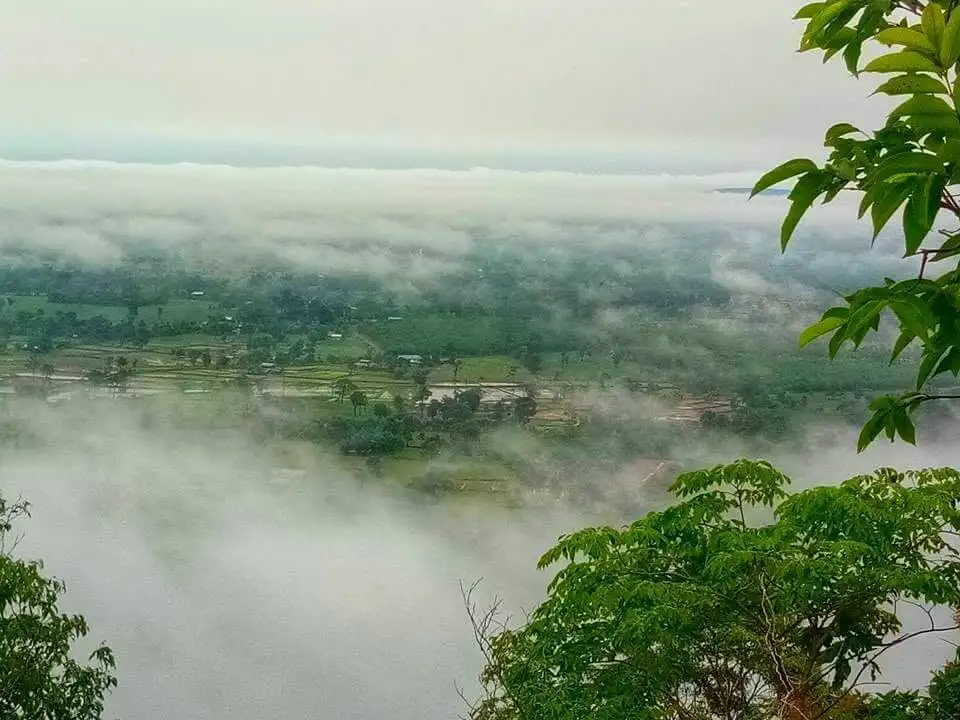
Phu Kaset in Amnat Charoen Province, also known as Wat Tham Hua Nak Phu Kaset, Wat Phu Kaset, and Dan Hin Hua Nak, is a distinctive natural and Buddhist mountain attraction in Nong Hai Subdistrict, Senangkhanikhom District. The site is known for its high mountain landscape, broad stone terraces, steep cliffs, naturally shaped rocks, and Tat Hang Waterfall during the rainy season. It is a suitable destination for travelers who enjoy quiet nature, forest temples, cave temples, rock formations, and less commercial places in northeastern Thailand.
Phu Kaset stands out as a large mountain in the local landscape of Senangkhanikhom District. It is not part of a long mountain range, but appears as a prominent individual mountain with steep layered slopes. This gives the area several points of interest, including open rock platforms, viewpoints, cliff edges, large stone formations, dry forest patches, and rock shapes that local visitors often interpret as different figures. The area known as Dan Hin Hua Nak is one of the most memorable parts of the mountain.
The strength of Phu Kaset lies in the variety of natural features found within one site. Travelers can experience a mountain, stone terraces, seasonal waterfalls, unusual rock shapes, and a Buddhist temple atmosphere in the same visit. The broad rock surface collects and channels rainwater naturally. During the rainy season, water flows over the stone terraces and descends along the mountain slope, creating small streams and waterfalls. Tat Hang Waterfall is especially attractive during this season, while the dry season reveals the strong forms and textures of the rock landscape more clearly.
Phu Kaset also has religious importance because it is home to Wat Tham Hua Nak Phu Kaset, or Wat Phu Kaset. Visitors therefore come not only to enjoy nature but also to experience the calm atmosphere of a forest and cave temple. The temple is surrounded by stone terraces, cliffs, trees, and mountain scenery, creating a peaceful setting for merit-making, Buddhist reflection, and quiet travel. This combination of nature and faith makes Phu Kaset more meaningful than a simple viewpoint.
Dan Hin Hua Nak is a key area for visitors. “Dan Hin” refers to a broad natural rock platform, while “Hua Nak” refers to the head of a naga, a sacred serpent-like being in Thai and northeastern Buddhist culture. Some rock forms appear long, curved, or raised in a way that invites comparison with a naga head. This connection between natural shapes and local belief gives the site both scenic and spiritual value.
The unusual rock shapes at Phu Kaset were created by natural processes over a long period. Weathering, erosion by rainwater, changes in temperature, humidity, wind, and gravity gradually shaped the rocks into cracks, hollows, curves, and distinct forms. Some rocks look like animals, some resemble sacred figures, and others appear like natural sculptures. The beauty of Phu Kaset is therefore not man-made. It is the result of slow natural transformation.
During the transition from the rainy season to the cool season, Phu Kaset has another layer of beauty. Small wildflowers, including silver button flowers, may bloom across parts of the stone terraces and thin soil. These flowers soften the rugged appearance of the rock surface and add color to the mountain scenery. This period is especially suitable for nature photography and for travelers who enjoy quiet walking among seasonal flowers and stone landscapes.
Tat Hang Waterfall is best visited during the rainy season. When water flows from the mountain across the broad stone terraces, it creates a refreshing natural scene. In the dry season, the water level may decrease or disappear according to natural conditions. Travelers who specifically want to see the waterfall should plan their visit during the rainy season or shortly after rainfall, while also being careful because wet stone surfaces can be slippery.
Other points of interest in the Phu Kaset area include Kok Hang Waterfall, Kok Phaeng Waterfall, natural stone sculpture areas, rock-and-forest zones, and wetland-related forest patches in the wider landscape. These features make Phu Kaset more than a single attraction. It is a collection of smaller natural areas that can be explored depending on the season, available time, physical condition, and safety.
The natural stone sculpture area is one of the most visually interesting parts of Phu Kaset. Many stones and rock plates appear like open-air sculptures created by nature. Some visitors may see animal shapes, others may see faces, naga forms, or mythical figures. There is no fixed answer to these interpretations, and that is part of the charm. Each traveler can experience the place differently through observation and imagination.
Phu Kaset is suitable for a half-day or full-day trip from Amnat Charoen town. It is about 25 km from the provincial town and about 4 km from Ban Nong Hai. The route is relatively convenient for private cars, pickup trucks, or rental cars, especially for travelers who want to combine the visit with other attractions in Senangkhanikhom District or Amnat Charoen town on the same day.
Getting There is most convenient from Ban Nong Hai in Nong Hai Subdistrict. From the village, continue for about 4 km to reach the Phu Kaset area. Travelers coming from Amnat Charoen town can drive toward Senangkhanikhom District, continue to Nong Hai Subdistrict, and then follow the local road to Phu Kaset. A private vehicle is recommended because the site is a natural mountain and temple area where public transport may not be convenient.
Visitors should prepare for a mountain and stone-terrace environment. Proper walking shoes with good grip are important. Drinking water, a hat, sun protection, and comfortable outdoor clothing are recommended. During the rainy season, extra care is needed because wet rock surfaces can be slippery and some paths may have running water. During the dry season, visitors should prepare for strong sun because broad rock surfaces can become hot in the daytime.
For travelers interested in Buddhism, Wat Tham Hua Nak Phu Kaset offers a calm place for merit-making and quiet reflection. Because the temple is located in a natural mountain setting, visitors should dress modestly, avoid loud noise, keep the area clean, and refrain from entering meditation or monastic areas without permission. Respectful behavior is important because Phu Kaset is both a tourist attraction and a religious place.
The religious caretaker identified in public information is Phra Khru Palat Niran Panyasuto, connected with Wat Tham Hua Nak Phu Kaset. The presence of resident monks and Buddhist activities confirms that this is a living religious site, not only a natural viewpoint. Travelers should therefore visit with consideration for monks, practitioners, and local worshippers.
There is no admission fee for Phu Kaset according to publicly available tourism information. This makes the site suitable for travelers looking for a low-cost nature and temple experience. Visitors may still prepare money for donations, food, drinks, or transport costs. The absence of an entrance fee does not reduce the value of the place. Phu Kaset has clear natural, spiritual, and local community value.
The best time to visit depends on the travel purpose. Those who want to see Tat Hang Waterfall and seasonal water flowing across the rock terraces should visit during the rainy season or shortly after rainfall. Those who want to walk, photograph rock shapes, see cliffs, and enjoy seasonal wildflowers should consider the late rainy season to early cool season. The cool season is also comfortable for walking and outdoor photography.
Photographers should allow enough time because Phu Kaset offers many visual elements: wide rock terraces, unusual stone forms, steep cliffs, seasonal waterfalls, wildflowers, and temple scenes surrounded by nature. Morning light creates a softer and more peaceful atmosphere, while afternoon light can emphasize shadows and rock textures. Safety is more important than photography, and visitors should avoid cliff edges or unstable rocks.
Families with children or elderly travelers should choose only the safer and easier sections of the site. It is not necessary to explore every part of the mountain. Children should remain under adult supervision, and elderly visitors should avoid steep or uneven stone areas. With proper planning, Phu Kaset can be a rewarding family trip that combines nature, learning, and peace.
Phu Kaset is also suitable for conservation-minded travel. Visitors should not carve or write on rocks, leave rubbish, pick wildflowers, or disturb the natural setting. The rock formations, seasonal flowers, and waterfall areas are natural resources that take a long time to form. Keeping the area clean and peaceful helps protect the identity of the place for future visitors.
For a wider travel route, Phu Kaset can be combined with several attractions in Amnat Charoen Province, such as Phra Mongkhon Ming Mueang and Phuttha Utthayan, Phu Sing-Phu Pha Phueng Forest Park, Wat Tham Saeng Phet, Wat Phu Phanom Di, and Huai Si Tho Reservoir. This creates a varied itinerary covering nature, temples, cave sites, viewpoints, and important Buddhist landmarks.
Restaurants near Phu Kaset are mainly found in Senangkhanikhom District and along the route back to Amnat Charoen town. Travelers should plan meals in advance, especially when traveling with family or a group. Local options include Thai food, northeastern food, cafés, noodle shops, and simple local eateries. For more choices, travelers can return to Amnat Charoen town.
Accommodation options are available in Senangkhanikhom, nearby districts, and Amnat Charoen town. Travelers who want convenience, restaurants, fuel stations, and services may prefer staying in the provincial town and visiting Phu Kaset as a day trip. Those who want to stay closer to local routes should check accommodation in Senangkhanikhom or nearby districts before traveling.
In summary, Phu Kaset in Amnat Charoen Province is a complete nature and Buddhist mountain attraction. Its highlights include a high mountain, broad stone terraces, Tat Hang Waterfall during the rainy season, naturally shaped rocks, steep cliffs, and Wat Tham Hua Nak Phu Kaset. The site is about 4 km from Ban Nong Hai and is suitable for travelers who want to experience a quieter, deeper, and more meaningful side of Amnat Charoen.
| Name | Phu Kaset / Wat Tham Hua Nak Phu Kaset / Wat Phu Kaset / Dan Hin Hua Nak |
| Location | Nong Hai Subdistrict, Senangkhanikhom District, Amnat Charoen Province |
| Address | Nong Hai Subdistrict, Senangkhanikhom District, Amnat Charoen Province 37290 |
| Coordinates / Area Code | 2QXR+57P, Nong Hai Subdistrict, Senangkhanikhom District, Amnat Charoen 37290 |
| Highlights | High mountain, broad stone terraces, Tat Hang Waterfall during the rainy season, naturally shaped rocks, steep cliffs, and Wat Tham Hua Nak Phu Kaset |
| History | A prominent large mountain in Senangkhanikhom District with steep layered slopes and a Buddhist cave-temple site known as Wat Phu Kaset or Dan Hin Hua Nak |
| Name Origin | The name Phu Kaset is connected with the mountain landscape, while Dan Hin Hua Nak refers to rock formations associated with naga-head imagery in local belief |
| Distinctive Features | Large stone terraces collect mountain runoff and create seasonal waterfalls; the area also features wildflowers in the late rainy season, natural stone sculpture zones, rock-and-forest areas, and wetland-related forest patches |
| Travel Information | About 4 km from Ban Nong Hai and about 25 km from Amnat Charoen town; private car or rental car is recommended |
| Current Status | Open as a natural attraction and Buddhist temple area in Nong Hai Subdistrict |
| Open Days | Daily |
| Opening Hours | 09.00 – 16.00 |
| Fees | No admission fee |
| Facilities | Cave-temple area, stone terraces, and natural walking zones; visitors should bring drinking water, sun protection, and proper walking shoes |
| Main Areas / Zones | 1. Dan Hin Hua Nak 2. Broad stone terrace 3. Tat Hang Waterfall 4. Kok Hang Waterfall 5. Kok Phaeng Waterfall 6. Natural stone sculpture area 7. Wat Tham Hua Nak Phu Kaset temple area 8. Cliff and natural viewpoint zones |
| Abbot / Caretaker | Phra Khru Palat Niran Panyasuto |
| Official Website / Official Page | Wat Tham Hin Hua Nak Phu Kaset Facebook Page |
| Nearby Tourist Attractions | 1. Phra Mongkhon Ming Mueang and Phuttha Utthayan, about 25 km 2. Huai Si Tho Reservoir, about 28 km 3. Wat Tham Saeng Phet, about 30 km 4. Wat Phu Phanom Di and Chedi Hin Phan Lan Kon, about 35 km 5. Phu Sing-Phu Pha Phueng Forest Park, about 55 km |
| Nearby Restaurants | 1. Srabai Jai Cafe, about 13 km, Tel. 081-079-6855 2. Cafe Thanai Zaap, about 18 km, Tel. 064-086-2424 3. Krua Phet Nam Ngoen, about 12 km 4. Kuai Tiao Ruea Tang Khong, about 13 km 5. Jungle Cafe Senangkhanikhom Branch, about 14 km |
| Nearby Accommodations | 1. Baan Na Resort Grand, Pathum Ratchawongsa District, about 42 km, Tel. 083-629-8797, 063-989-3454, 080-992-6529 2. Zwa Hotel Amnat Charoen, about 25 km 3. Baan Ing Daan, about 26 km 4. Penphit Hotel, about 26 km 5. Nakarin Hotel, about 27 km |
Frequently Asked Questions (FAQ)
Q: Where is Phu Kaset located?
A: Phu Kaset is located in Nong Hai Subdistrict, Senangkhanikhom District, Amnat Charoen Province. It is also the location of Wat Tham Hua Nak Phu Kaset or Wat Phu Kaset.
Q: What are the opening days and hours of Phu Kaset?
A: Phu Kaset is open daily from 09.00 to 16.00.
Q: Is there an admission fee for Phu Kaset?
A: There is no admission fee. Visitors may enter without paying an entrance charge, but they may prepare money for donations, transport, food, or drinks.
Q: What makes Phu Kaset special?
A: Its highlights include a high mountain, broad stone terraces, Tat Hang Waterfall during the rainy season, naturally shaped rocks, steep cliffs, and Dan Hin Hua Nak.
Q: When is the best time to see Tat Hang Waterfall?
A: The rainy season or shortly after rainfall is the best time to see Tat Hang Waterfall because water flows more clearly across the stone terraces.
Q: How do I get to Phu Kaset?
A: Phu Kaset is about 4 km from Ban Nong Hai and about 25 km from Amnat Charoen town. A private car or rental car is the most convenient option.
Q: Who is Phu Kaset suitable for?
A: It is suitable for travelers who enjoy nature, forest temples, cave temples, stone terraces, cliffs, seasonal waterfalls, and peaceful Buddhist mountain sites.
Q: What should visitors prepare before visiting Phu Kaset?
A: Visitors should wear proper walking shoes, bring drinking water, sun protection, and be extra careful during the rainy season because stone terraces may become slippery.
 Category: ●Nature and Wildlife
 Group: ●Mountain (Doi)
Last Update : 5 MonthAgo
 Last Update : 5 MonthAgo
 Click to Access the Navigation Map GPS
 Art, Culture and Heritage
 Historical Sites and Monuments(1)
 Art, Craft Centres, Tradition(4)
 Museums(1)
 Places of Worship
 Temple(30)
 Other Sacred Sites(8)
 Suburban Living
 Village, Community(4)
 National Parks and Marine Reserves(3)
Mountain (Doi)(6)
National Parks and Marine Reserves(3)
Mountain (Doi)(6)
 Dam, Reservoir, Lake(5)
 Waterfalls(3)
 Caves(2)
 River, Canal(5)
 Other natural attractions(5)
 Entertainment and Agricultural
 Zoos and Aquariums(1)
 Farms, Parks and Ecotourism(4)
 Shopping
 Shopping and Night Market(1)
 Travel Articles, Recipes
 Travel Review, Food Review(3)


