
lovethailand home >Central Travel Attractions >Samut Sakhon Travel Attractions >Muang Samut Sakhon >Maha Chai > Wichian Chodok Fort
TL;DR: Wichian Chodok Fort is located at Maha Chai Subdistrict, Mueang Samut Sakhon District, Samut Sakhon, open Daily, hours 08:00 – 17:00.
Wichian Chodok Fort

Open Days: Daily
Opening Hours: 08:00 – 17:00
Wichian Chodok Fort is one of the most important historic landmarks in Samut Sakhon. Located in Maha Chai Subdistrict, only about 200 metres from the provincial hall, the fort preserves a layer of local history that many visitors overlook when they think of Samut Sakhon only as a seafood city or a busy river port. For travelers who want to understand Maha Chai beyond its markets and food, this old fort offers a direct connection to the military, political, and coastal history of the area.
The fort was built in 1828 during the reign of King Rama III. Its construction was tied to a tense period in regional politics, when Siam was involved in conflict with Vietnam over the case of Chao Anouvong of Vientiane. King Rama III feared that enemy naval forces might attack Siam by sea, so he ordered defensive forts to be built at important river mouths and coastal points. Because the mouth of the Tha Chin River was strategically significant, Samut Sakhon became one of the places chosen for fortification.
The man appointed to oversee the construction was Phraya Choduek Ratchasethi, also known as Thong Chin Krairik. Once the fort was completed, it received the royal name “Wichian Chodok Fort.” The name itself carries historical weight because it reflects both royal authority and the role of the official who supervised the construction. This makes the site more than a surviving military structure. It is also a record of how the Siamese state organized coastal defense in the early Rattanakosin period.
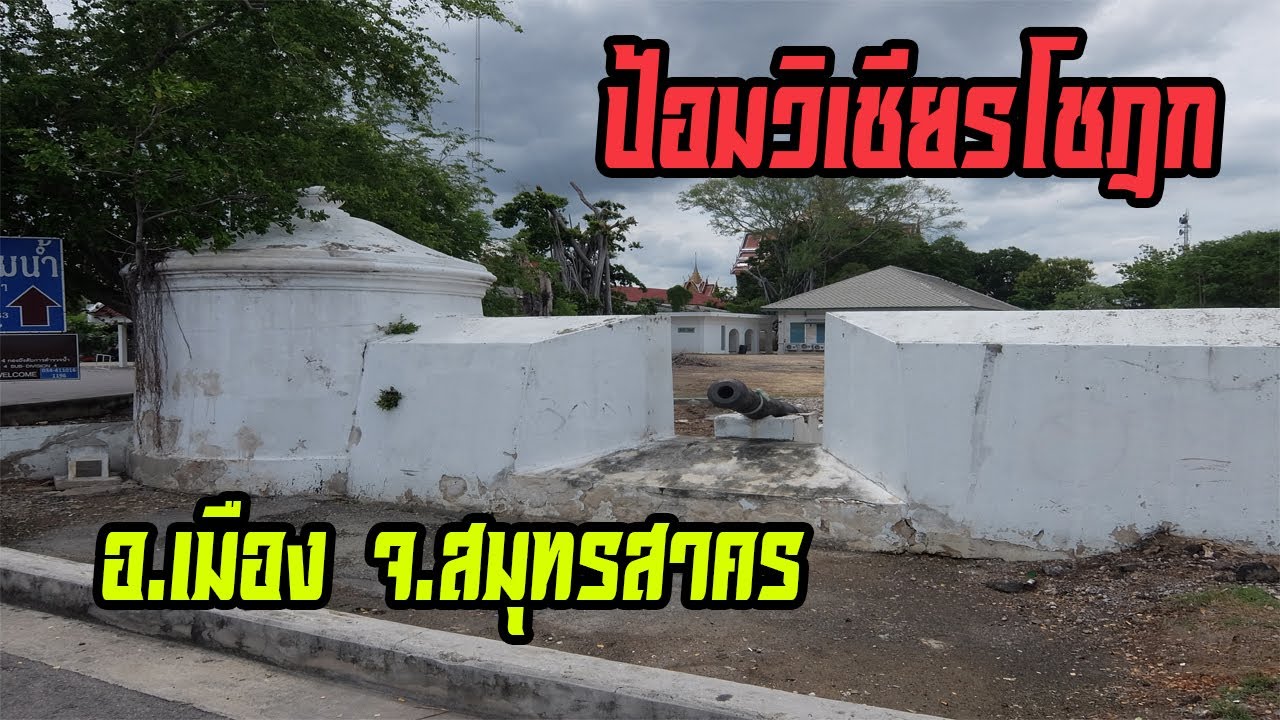
Architecturally, Wichian Chodok Fort was built of brick and mortar. It did not have guard bastions in the later modern sense, but it featured battle towers and wall openings where cannons were positioned to defend against approaching enemies from the river mouth. This design clearly shows that the fort was intended for real defensive use, especially against threats arriving by water. It was practical, strategic, and built to respond to the geography of the Tha Chin estuary.
The location of the fort adds another layer of importance. The Tha Chin River was not only a waterway for trade and daily life, but also a route that needed to be controlled for security reasons. Anyone trying to enter inland areas from the coast would have had to pass this broader zone. That is why the presence of a fort in Maha Chai was not accidental. It reflected the continuing role of the river mouth as a defensive gateway.
There is also evidence that the wider area had defensive importance even before the reign of Rama III. Historical records from the Ayutthaya period mention a fort near the mouth of the Tha Chin River, which suggests that this was a strategically sensitive point for a long time. Wichian Chodok Fort therefore stands within a longer tradition of military vigilance in Samut Sakhon, rather than being an isolated structure built for a single moment in history.
Today, the fort no longer survives in complete form. Only three sides of the fort remain: the northern, southern, and western sides, with the western side facing the Tha Chin River. Part of the original structure was removed over time to make way for circulation and urban development. Even so, the surviving brick walls are enough to preserve the character of the site and to help visitors imagine its original purpose. The weathered surfaces, old masonry, and riverside context still create a strong sense of historical presence.
One of the reasons the site remains appealing is that it is not separated from the life of the city. Inside the fort area, visitors will also find the Samut Sakhon City Pillar Shrine and a shaded public park. This combination makes the place feel active and relevant rather than distant or abandoned. Visitors can appreciate a historic fort, pay respect at a sacred local site, and rest in a green public space all within the same compound. That blend of history, belief, and everyday urban use gives Wichian Chodok Fort a distinctive identity.
For travelers exploring Maha Chai on foot, the fort is especially convenient. It is close to several important points in town, including the city pillar shrine, Mahachai Railway Station, Mahachai Market, the ferry pier to Tha Chalom, and Wat Pom Wichian Chotikaram. Because these places are clustered within the central urban area, Wichian Chodok Fort fits easily into a half-day or full-day walking itinerary. A visit here can be combined with local food, market walks, religious sites, and riverside exploration without needing long transfers.
The fort is also valuable for anyone interested in the broader story of Samut Sakhon. The province is widely known today for fishing, seafood trade, and riverside commerce, but places like this reveal a more complex past. Wichian Chodok Fort shows that Samut Sakhon also had an important role in state security and coastal defense. In that sense, the fort helps explain why Maha Chai mattered not only economically, but politically and militarily as well.
Photographers may find the site quietly rewarding. Its appeal is not based on monumental scale, but on atmosphere. Old brick walls, mature trees, the open park setting, and the surrounding urban texture of Maha Chai all combine to create a scene that feels layered and grounded in time. It is particularly attractive in the morning or late afternoon, when the light brings out the texture of the masonry and the surrounding greenery.
Another reason to visit is that the fort is an officially registered ancient monument. That status confirms its significance beyond local memory. It is recognized as a heritage site tied to the historical defense system of the region. For visitors, this means the place is not simply an old ruin with a story attached, but a documented and protected piece of the historical landscape of Samut Sakhon.
Getting There is straightforward. If you are driving from Bangkok, take Rama II Road into Samut Sakhon and continue toward central Maha Chai. The fort is close to the provincial hall and the city pillar shrine, so it is easy to reach by map navigation. If you prefer public transportation, you can take the Wongwian Yai–Mahachai train to Mahachai Railway Station and walk from there. Because the fort lies within the city centre, it also works well as part of a larger walking route through Maha Chai and onward to the ferry crossing for Tha Chalom.
Wichian Chodok Fort may not be large, but its historical meaning is substantial. It tells the story of early Rattanakosin coastal defense, the strategic role of the Tha Chin River mouth, and the continuing connection between heritage and everyday city life in Maha Chai. For travelers who want a deeper understanding of Samut Sakhon, this fort is one of the most worthwhile places to include in their route.
| Name | Wichian Chodok Fort |
| Location | Maha Chai Subdistrict, Mueang Samut Sakhon District, Samut Sakhon |
| Address | Near the City Pillar Shrine and Samut Sakhon Provincial Hall, Maha Chai, Mueang Samut Sakhon, Samut Sakhon 74000 |
| Coordinates | 13.544907, 100.274157 |
| Highlights | Historic fort from the reign of Rama III, surviving brick fort walls, city-history landmark, city pillar shrine and public park within the compound |
| History | Built in 1828 during the reign of King Rama III to protect the mouth of the Tha Chin River during the conflict with Vietnam related to Chao Anouvong of Vientiane |
| Name Origin | The fort was given the royal name after Phraya Choduek Ratchasethi (Thong Chin Krairik), who supervised its construction |
| Distinctive Features | Brick-and-mortar fortification with battle towers and cannon openings; three sides of the fort remain today |
| Travel Information | Accessible by car via Rama II Road, or by train to Mahachai Railway Station followed by a short walk |
| Current Status | A registered ancient monument and historical attraction in Samut Sakhon, with the City Pillar Shrine and a public park inside the area |
| Open Days | Daily |
| Opening Hours | 08:00 – 17:00 |
| Fees | No admission fee |
| Facilities | Walking paths, shaded public park area, sacred city pillar shrine, easy access to nearby restaurants and the central Maha Chai area |
| Main Areas / Zones | Three surviving fort walls, city pillar shrine area, public park, Tha Chin riverside edge |
| Official Website / Official Page | Tourism Authority of Thailand (TAT), Thailand Tourism Directory |
| Nearby Tourist Attractions | 1) Samut Sakhon City Pillar Shrine – approx. 100 m 2) Mahachai Railway Station – approx. 450 m 3) Mahachai Market – approx. 500 m 4) Mahachai–Tha Chalom Ferry Pier – approx. 700 m 5) Wat Pom Wichian Chotikaram – approx. 900 m |
| Nearby Restaurants | 1) Banjingjo Bakehouse & Roaster – approx. 300 m – Tel. 080-288-5554 2) Tharua Restaurant 2507 – approx. 400 m – Tel. 065-096-4690 3) The White Oven – approx. 800 m – Tel. 092-916-9191 4) Rublom Cafe Mahachai Pier – approx. 400 m 5) Eia Lee Ki Mahachai – approx. 400 m |
| Nearby Accommodations | 1) Rongmai Mahachai Cafe and Stay – approx. 700 m – Tel. 098-008-9980 2) The Seaport Mahachai – approx. 900 m – Tel. 083-436-5434, 034-836-880 3) Orchid Mahachai Hotel – approx. 1 km – Tel. 097-119-4744, 034-425-382, 034-425-383 4) At Samut Sakhon Mahachai – approx. 5 km – Tel. 099-095-4541, 065-464-7459 5) Grand Inter Hotel – approx. 9 km – Tel. 099-949-8889, 084-245-6391 |
Frequently Asked Questions (FAQ)
Q: Where is Wichian Chodok Fort located?
A: It is located in Maha Chai Subdistrict, Mueang Samut Sakhon District, Samut Sakhon, near the provincial hall and the city pillar shrine.
Q: When was Wichian Chodok Fort built?
A: The fort was built in 1828 during the reign of King Rama III.
Q: Why was Wichian Chodok Fort constructed?
A: It was built to protect the mouth of the Tha Chin River during a period of conflict with Vietnam related to Chao Anouvong of Vientiane.
Q: How much of the fort survives today?
A: Three sides of the fort still remain today: the northern, southern, and western sides.
Q: Is there an entrance fee?
A: No. There is no admission fee.
Q: What can I visit near the fort?
A: Nearby places include the Samut Sakhon City Pillar Shrine, Mahachai Railway Station, Mahachai Market, the ferry pier to Tha Chalom, and Wat Pom Wichian Chotikaram.
 Category: ●Art, Culture and Heritage
 Group: ●Landmarks and Memorials
Last Update : 7 MonthAgo
 Last Update : 7 MonthAgo
 Click to Access the Navigation Map GPS
Wichian Chodok Fort Map
Recommend

 Historical Sites and Monuments(3)
Landmarks and Memorials(4)
 Art, Craft Centres, Tradition(2)
 Museums(1)
 Historic Homes and Cities(1)
 Educational Places
 Museum for Study(1)
 Places of Worship
 Temple(31)
 Other Sacred Sites(12)
 Research and Development
 Royal Project(1)
 Suburban Living
 Village, Community(4)
 Local Market(2)
 Floating Market(2)
 Nature and Wildlife
 National Parks and Marine Reserves(1)
 River, Canal(4)
 Bays and Beaches(1)
 Other natural attractions(3)
 Entertainment and Agricultural
 Zoos and Aquariums(1)
 Shopping
 Shopping and Night Market(1)
 Travel Articles, Recipes
 Travel Review, Food Review(1)


