
lovethailand home >North Travel Attractions >Lampang Travel Attractions >Hang Chat >Pong Yang Khok > Wat Pong Yang Khok
TL;DR: Wat Pong Yang Khok is located at Pong Yang Khok Subdistrict, Hang Chat District, Lampang Province, open Daily, hours 07.00 – 17.00.

Wat Pong Yang Khok

Open Days: Daily
Opening Hours: 07.00 – 17.00
Wat Pong Yang Khok in Lampang Province is an ancient temple in Pong Yang Khok Subdistrict, Hang Chat District, known for its deep connection with Queen Chamathewi, Lanna history, and traditional wooden architecture. Its most important highlight is the Phra Mae Chao Chamathewi Viharn, an old wooden Lanna-style assembly hall that houses an ancient castle-like mondop, locally associated with legends dating back to the time of Queen Chamathewi in 1253 BE. For travelers interested in old temples in Lampang, Lanna craftsmanship, and cultural heritage beyond a standard temple visit, this is one of the most meaningful places to include in a heritage route.
Wat Pong Yang Khok is located in an old community area of Hang Chat District, where the atmosphere remains calm and local. The temple grounds include a historic wooden viharn, a chedi, worship areas, and quiet open spaces that reflect the everyday religious life of a northern Thai community. The temple is not only important because of its age, but also because it brings together legend, architecture, local craftsmanship, and community memory in one place.
According to local tradition, Wat Pong Yang Khok is closely linked to Queen Chamathewi, the first ruler of Hariphunchai and one of the most important figures in northern Thai history. The legend tells that when Queen Chamathewi passed through this area, her royal elephant knelt or bowed at this sacred spot. She then ordered a sacred structure to be built as a memorial. Over time, this story became part of the identity of the village, the temple, and the local belief system that has been passed down for generations.
The name “Pong Yang Khok” is often explained through the story of the royal elephant and the resting point of Queen Chamathewi’s procession. The word “Pong” is associated locally with putting something down or stopping at a place, while the later elements of the name are linked to the idea of an elephant kneeling or paying respect. Although the legend may appear in several versions, the shared meaning is clear: this temple is regarded as an old sacred site connected with Queen Chamathewi and the early cultural landscape of Lanna.
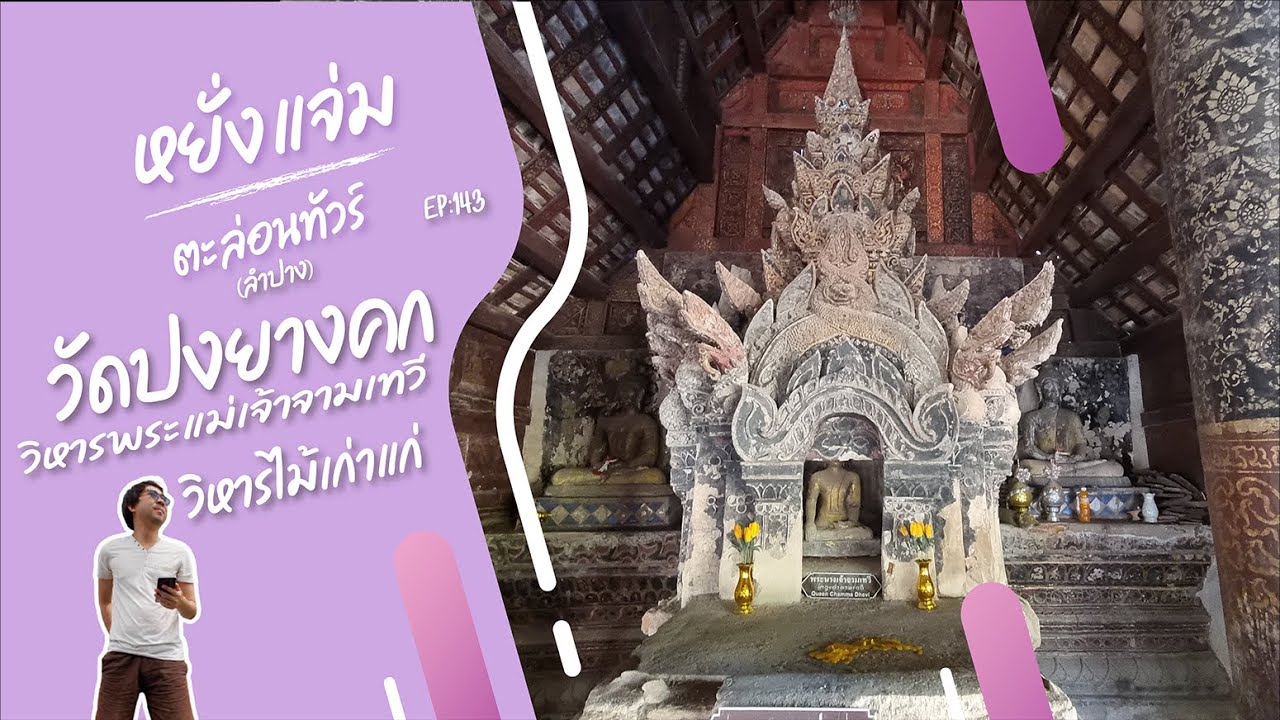
The Phra Mae Chao Chamathewi Viharn is the main reason many visitors come to Wat Pong Yang Khok. This old wooden viharn clearly reflects Lanna architectural character. Its form is modest yet elegant, with tiered roofing, wooden structural elements, and traditional decorative details. Rather than relying on grand scale, the building communicates beauty through proportion, balance, craftsmanship, and the aged surface of wood that has been preserved through time.
Inside the viharn is an old castle-like mondop, also known as a sacred shrine structure or “khong phra chao,” used to enshrine the principal Buddha image and sacred objects. The decorative stucco and Lanna-style motifs reveal the refined craftsmanship of local artisans. The interior space is not merely an architectural display; it is a ritual space where Buddhist devotion, local belief, and the historical memory of the community come together.
The mondop is also connected with the legend of a sacred sign appearing in the natural landscape before a shrine was built over it. This reflects an older northern Thai worldview in which Buddhism, sacred geography, local spirits, and natural signs were often woven together. Wat Pong Yang Khok is therefore more than a temple building; it is a cultural landscape that stores layers of memory from the community.
The beauty of the viharn lies in its age, atmosphere, and authenticity. The old wooden structure, decorative patterns, traces of use, and quiet temple setting give visitors a rare chance to experience Lanna heritage in a living village temple. While walking through the viharn, visitors should take time to observe the tiered roof, wooden columns, painted details, gold patterns, and the mondop inside the hall. These details reveal the aesthetic values of old Lanna artisans.
Wat Pong Yang Khok is also connected with the history of Lampang during the period of Phraya Chai Songkhram, also known as Nan Thip Chang, a significant figure in Lanna history. The construction or restoration period of the Chamathewi Viharn is often associated with the years 2275–2302 BE, linking the site not only to Queen Chamathewi but also to later historical developments in Lampang. This makes the temple a valuable place for understanding the historical relationship between Hang Chat, Lampang, Hariphunchai, and the wider Lanna region.
The Chamathewi Viharn has also been recognized for its heritage value. It is listed as an historic site and has received recognition for conservation, confirming that the wooden viharn is not only important to the local community but also valuable as a wider cultural heritage asset. The preservation of this building demonstrates how local faith, community care, and architectural conservation can work together.
A visit to Wat Pong Yang Khok suits many types of travelers. History lovers can learn about Queen Chamathewi and Lanna legends. Architecture enthusiasts can study an old wooden viharn and a Lanna-style mondop. Photographers can capture the wooden hall, the chedi, and the quiet atmosphere of a northern Thai temple. Visitors who come for merit-making can also pay respect and enjoy the peaceful environment of the temple grounds.
When visiting the Phra Mae Chao Chamathewi Viharn, respectful behavior is important. Visitors should dress modestly, speak quietly, avoid touching old woodwork or decorative elements unnecessarily, and never climb on any part of the structure. Since the viharn is an old wooden building, careful behavior helps preserve it for the community and for future travelers.
The temple is best visited in the morning or late afternoon when the light is softer and the atmosphere is more comfortable. During the rainy season, visitors should bring an umbrella and wear suitable footwear. In the cool season, the area is pleasant for a cultural route linking Wat Pong Yang Khok with nearby attractions such as Wat Phra That Lampang Luang, Wat Lai Hin Luang, and Kad Tung Kwian.
Getting There is straightforward by private car or rental car. From the Hang Chat–Ko Kha road, continue for about 5 km, then turn left into a small road for about 100 meters to reach the temple. Travelers starting from Lampang city can head toward Hang Chat District and continue to Pong Yang Khok Subdistrict. The temple can be combined easily with Wat Phra That Lampang Luang and other historic sites in the same area.
One of the advantages of visiting Wat Pong Yang Khok is that it can be part of a complete cultural route. Travelers can begin at the Chamathewi Viharn, continue to the nearby monument of Pho Chao Thip Chang, visit Wat Phra That Lampang Luang, and then stop at Wat Lai Hin Luang or Kad Tung Kwian. This route gives visitors a clearer picture of Lampang as an old Lanna city with temples, local legends, wood craftsmanship, and community heritage.
For photography, the best approach is to capture the viharn from the front and side in order to show the roof form and wooden structure. After that, visitors can photograph details of the interior, the mondop, and the decorative patterns carefully. Flash photography should be avoided where old artworks are present, and visitors should remain mindful of worshippers and temple activities.
Wat Pong Yang Khok shows that a heritage destination does not need to be large to be deeply valuable. Its importance lies in the depth of its stories, the age of its wooden architecture, and its role as a living place of faith for the local community. Visitors will discover that Lanna art is not found only in large or famous temples, but also in local temples that continue to preserve the memory of ordinary people and their sacred places.
In summary, Wat Pong Yang Khok is one of Lampang’s old temples that deserves a place on a cultural travel itinerary. It offers an intimate and meaningful experience through the Phra Mae Chao Chamathewi Viharn, the old mondop, the legend of Queen Chamathewi, and the quiet atmosphere of a local Lanna temple. It is suitable for families, students, photographers, temple travelers, cultural tourists, and anyone who wants to understand Lampang as a historic northern Thai city.
| Name | Wat Pong Yang Khok |
| Location | Pong Yang Khok Subdistrict, Hang Chat District, Lampang Province |
| Address | Moo 1, Ban Pong Yang Khok, Pong Yang Khok Subdistrict, Hang Chat District, Lampang 52190, Thailand |
| Highlights | Phra Mae Chao Chamathewi Viharn, an old wooden Lanna viharn, and an ancient castle-like mondop inside the hall |
| History | Associated with the legend of Queen Chamathewi in 1253 BE; the Chamathewi Viharn is associated with the period around 2275–2302 BE |
| Name Origin | Linked to the legend of Queen Chamathewi’s royal elephant kneeling or paying respect at this sacred place |
| Distinctive Features | Old Lanna wooden viharn, tiered roof, wooden structure, gold decorative patterns, local craftsmanship, and the sacred mondop |
| Main Areas / Zones | Phra Mae Chao Chamathewi Viharn, the mondop inside the viharn, chedi, worship area, and temple courtyard |
| Travel Information | Take the Hang Chat–Ko Kha road for about 5 km, then turn left for about 100 meters; best reached by private car or rental car |
| Current Status | Open as a Buddhist temple and cultural attraction in Hang Chat District, Lampang Province |
| Open Days | Daily |
| Opening Hours | 07.00 – 17.00 |
| Fees | Free Admission |
| Abbot / Caretaker | Phra Athikan Intha Chanthammo |
| Main Contact Number | 054-217063 |
| Nearby Tourist Attractions | 1. Pho Chao Thip Chang Monument, about 0.02 km 2. Wat Phra That Lampang Luang, about 7 km 3. Wat Lai Hin Luang, about 8 km 4. Wat Selaratana Papphataram, about 9 km 5. Kad Tung Kwian, about 11 km |
| Nearby Restaurants | 1. Som Tam Lod Jed Dom, about 0.3 km 2. Halyn Matcha Cafe, about 0.6 km 3. Bua Kham Noodle, about 0.9 km 4. Krua Mae Pranom, about 4 km, Tel. 080-493-2976 5. Kaeng Hom Lampang Northern Food Garden, about 9 km |
| Nearby Accommodations | 1. The Areaac, about 3 km, Tel. 093-301-0004 2. Satakanta Mansion & Resort, about 6 km, Tel. 086-921-1521 3. Pa Khrai Garden Home, about 9 km, Tel. 065-235-3592 4. Chai Mongkhon Resort, about 10 km, Tel. 082-390-3549 5. Nitta Hotel, about 11 km |
Frequently Asked Questions (FAQ)
Q: Where is Wat Pong Yang Khok located?
A: Wat Pong Yang Khok is located in Pong Yang Khok Subdistrict, Hang Chat District, Lampang Province, northern Thailand.
Q: What is Wat Pong Yang Khok famous for?
A: The temple is famous for the Phra Mae Chao Chamathewi Viharn, an old wooden Lanna-style viharn that houses an ancient castle-like mondop.
Q: How is Wat Pong Yang Khok connected with Queen Chamathewi?
A: Local legend says Queen Chamathewi passed through this area and her royal elephant knelt or paid respect at the sacred site, leading to the temple’s foundation story.
Q: Why is the Chamathewi Viharn important?
A: It is an old wooden Lanna viharn with valuable architectural details, traditional craftsmanship, and a sacred mondop inside the hall.
Q: What are the opening hours of Wat Pong Yang Khok?
A: The temple is open daily from 07.00 to 17.00, and admission is free.
Q: How can travelers get to Wat Pong Yang Khok?
A: Travelers can take the Hang Chat–Ko Kha road for about 5 km, then turn left for about 100 meters to reach the temple. A private car or rental car is recommended.
Q: What nearby attractions can be combined with Wat Pong Yang Khok?
A: Nearby places include Pho Chao Thip Chang Monument, Wat Phra That Lampang Luang, Wat Lai Hin Luang, Wat Selaratana Papphataram, and Kad Tung Kwian.
Q: What should visitors keep in mind when visiting the temple?
A: Visitors should dress modestly, speak quietly, avoid touching old wooden details, and respect worshippers and temple activities.
 Category: ●Places of Worship
 Group: ●Temple
Last Update : 5 MonthAgo
 Last Update : 5 MonthAgo
 Click to Access the Navigation Map GPS
Wat Pong Yang Khok Map
Recommend

 Art, Culture and Heritage
 Historical Sites and Monuments(2)
 Landmarks and Memorials(5)
 Art, Craft Centres, Tradition(10)
 Museums(4)
 Historic Homes and Cities(1)
Temple(86)
 Other Sacred Sites(9)
 Research and Development
 Royal Project(2)
 Suburban Living
 Village, Community(3)
 Local Market(2)
 Nature and Wildlife
 National Parks and Marine Reserves(6)
 Mountain (Doi)(4)
 Dam, Reservoir, Lake(11)
 Waterfalls(15)
 Hot Springs(1)
 Caves(12)
 Flower Field(1)
 River, Canal(1)
 Bays and Beaches(1)
 Other natural attractions(4)
 Entertainment and Agricultural
 Animal camps and shows(1)
 Farms, Parks and Ecotourism(2)
 Outdoor and Adventure Activities(2)
 Shopping
 Shopping and Night Market(2)
 Spas and Wellness
 Spas and Wellness(1)
 Travel Articles, Recipes
 Travel Review, Food Review(1)


