
lovethailand home >North Travel Attractions >Sukhothai Travel Attractions >Si Sat Chana Lai >Si Sat Chana Lai > Wat Chom Chuen
TL;DR: Wat Chom Chuen is located at Si Satchanalai Historical Park, Si Satchanalai Subdistrict, Si Satchanalai District, Sukhothai Province, open Daily, hours 08.00 – 17.00.
Wat Chom Chuen
Open Days: Daily
Opening Hours: 08.00 – 17.00
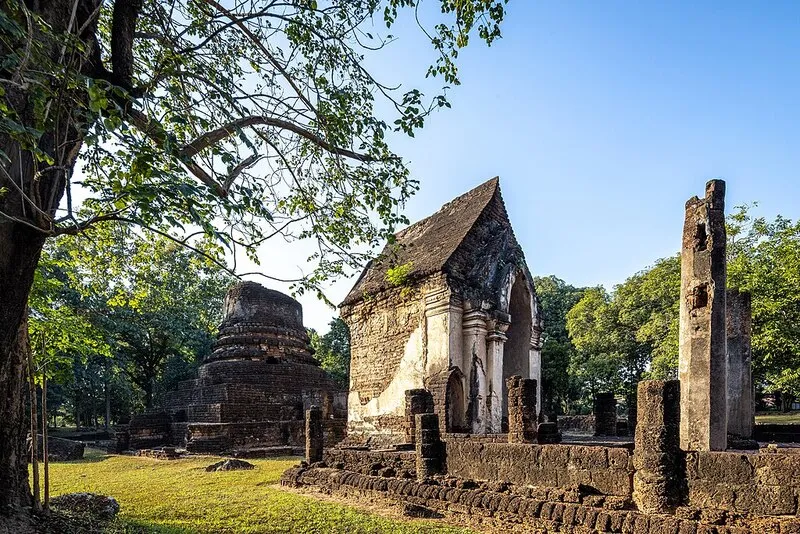
Wat Chom Chuen in Sukhothai Province is an abandoned ancient temple and archaeological site located beside the Yom River, outside the ancient city of Si Satchanalai. Today, it lies within Si Satchanalai Historical Park in Si Satchanalai Subdistrict, Si Satchanalai District, Sukhothai Province. The site is especially important because it preserves evidence of human settlement from the late prehistoric period through the Dvaravati period, Khmer-influenced cultural phase, Sukhothai period, Ayutthaya period, and later historical layers. For travelers, Wat Chom Chuen is not only a quiet ruin with a round stupa, laterite viharn, and mandapa, but also a valuable learning site where archaeology reveals the long human history of the Yom River basin.
Wat Chom Chuen was officially registered as a national ancient monument by the Fine Arts Department, with the announcement published in the Royal Gazette, Volume 52, on 8 March 1935, page 3701. This recognition reflects the site’s historical, archaeological, artistic, and cultural value. Although the temple is now an abandoned monument rather than an active monastery, it remains one of the most meaningful archaeological places in Si Satchanalai because it helps explain how communities developed in this area long before and during the rise of the Sukhothai civilization.
The temple’s riverside location is essential to understanding its importance. In ancient times, the Yom River was more than a natural feature. It was a source of water, a transport route, a settlement corridor, and a cultural axis for communities living in the region. The position of Wat Chom Chuen near the river shows how early communities selected places that were practical for daily life and meaningful for ritual activities. This relationship between settlement, river, and sacred space is one of the reasons the site is so valuable for studying the historical landscape of Si Satchanalai.
Archaeological excavations at Wat Chom Chuen revealed evidence of settlement dating back to the late prehistoric period, around the 9th Buddhist century. Important finds include coarse earthenware fragments shaped by hand and fired at relatively low quality. These simple objects are highly significant because they show that early human communities lived in this area before the development of large Buddhist monuments. They also suggest local production, everyday use, and adaptation to available natural resources.
During the protohistoric period through the Dvaravati period, around the 10th–16th Buddhist centuries, archaeologists found 15 human skeletons. These remains make Wat Chom Chuen especially important as a human archaeological site. Skeletons can provide information about burial practices, health, diet, physical characteristics, and beliefs of people in the past. For visitors, the site helps transform archaeology from an abstract academic subject into a visible story of real people who lived in this landscape centuries ago.
In the Khmer-influenced cultural phase through the early Sukhothai period, around the 17th–18th Buddhist centuries, evidence includes the remains of 3 brick ancient structures, clay pipe fragments, high-fired earthenware, both unglazed and green-glazed wares, and animal bones. These findings suggest that the area had developed more complex forms of architecture, craft production, and community life. The presence of pottery and construction materials also connects the site to the broader technological and cultural development of Si Satchanalai, later famous for its ceramic production.
From the Sukhothai to Ayutthaya periods, around the 19th–21st Buddhist centuries, Wat Chom Chuen developed into a Buddhist religious site with clear architectural components. Its main elements include a round stupa or bell-shaped chedi as the principal monument, a laterite viharn in front of the stupa, and a mandapa connected to the rear of the viharn. Laterite was a major construction material in Sukhothai and Si Satchanalai because it was durable and locally available. The use of laterite gives the monument a strong and dignified character that still remains visible today.
The principal chedi of Wat Chom Chuen is a round stupa set on a square laterite base. The lower base includes niches at the center of all 4 sides and at the corners. This design shows artistic connections with stupa forms found in Sri Lankan and Lanna traditions. The chedi therefore serves not only as the spiritual center of the temple but also as evidence of artistic exchange and adaptation within the Buddhist world of mainland Southeast Asia.
The viharn stands in front of the main chedi and was built of laterite. It consists of 6 bays, with projecting porches at the front and rear. The rear part connects to a mandapa that resembles an enclosed chamber. The mandapa roof was constructed with laterite blocks corbelled inward to form a pointed gable-like structure. This method shows the skill of ancient builders who used heavy laterite blocks to create enclosed sacred spaces with both structural strength and ritual significance.
The mandapa behind the viharn is one of the most interesting parts of the site. On the front sides, there are 2 niches, while the rear niche once housed a Buddha image protected by a naga, though the image has now disappeared. Stucco decoration was also found on the rear pediment of the mandapa. Although many details have been damaged over time, the remaining traces still reveal the refinement of ancient craftsmanship and the religious importance of the building.
One of the most remarkable aspects of Wat Chom Chuen is that it preserves cultural layers from many periods in one place. The laterite Buddhist monuments of the Sukhothai and Ayutthaya periods stand above earlier evidence of human settlement. When visitors walk through the site, they are not simply looking at an abandoned temple. They are standing on land used by many generations of people who lived, made pottery, buried their dead, built religious structures, and reshaped the landscape according to changing beliefs and social conditions.
Finds from the Ayutthaya to Rattanakosin periods include fragments of clay roof tiles, Chinese ceramic wares dating from the Ming to Qing dynasties, and coins such as satang and baht coins mixed within the soil layers. These objects suggest continuing use or activity in and around the area during later periods. They also show connections between local life and wider trade networks, especially through imported ceramics and changing material culture.
The conservation building at the Wat Chom Chuen excavation pit is one of the key features for visitors. It helps present archaeological evidence found in different soil layers and allows people to understand the chronological development of settlement in the area. For students, researchers, and cultural travelers, the excavation building provides a clear link between visible ruins above ground and the hidden human history preserved beneath the soil.
Wat Chom Chuen is therefore a valuable learning site for several fields, including archaeology, art history, anthropology, cultural geography, and heritage conservation. A meaningful visit should begin with observing the temple’s location near the Yom River, then continue to the main chedi, viharn, mandapa, and stucco traces. After that, visitors should spend time at the excavation conservation building to connect the architectural remains with the deeper history of human settlement.
Today, Wat Chom Chuen is an abandoned ancient monument under the care of Si Satchanalai Historical Park, Fine Arts Department. Since it is not an active monastery, it does not have a resident abbot. Site management focuses on conservation, visitor access, safety, and interpretation of archaeological knowledge. Visitors should follow posted guidelines, avoid climbing ancient structures, avoid touching stucco or fragile surfaces, and never remove objects from the site.
Getting There is most convenient by private car. From Sukhothai city, drive north toward Si Satchanalai District, which usually takes about 1 hour depending on traffic. From Sawankhalok District, the journey is shorter. The site can be included in a route covering the old Chaliang area, Wat Phra Si Rattana Mahathat Ratchaworawihan, Wat Chao Chan, Wat Nang Phaya, Wat Chedi Chet Thaeo, and Wat Chang Lom.
The best times to visit are in the morning or late afternoon because much of the site is open-air. Morning light helps reveal the texture of laterite and the shape of the chedi, while late afternoon gives the riverside area a calm and warm atmosphere. Travelers should bring drinking water, a hat, and comfortable walking shoes, especially if planning to visit several monuments within Si Satchanalai Historical Park on the same day.
Wat Chom Chuen fits well into a Si Satchanalai cultural itinerary. A half-day plan can begin at Wat Phra Si Rattana Mahathat Ratchaworawihan, continue to Wat Chom Chuen and its excavation building, and then visit Wat Chao Chan or Wat Nang Phaya. A full-day itinerary can extend to Wat Chedi Chet Thaeo, Wat Chang Lom, and the Sangkhalok kiln conservation sites. This route gives travelers a fuller understanding of religion, architecture, ancient urban planning, and ceramic production in the same historical landscape.
For travelers interested in Sukhothai history, Wat Chom Chuen adds an essential perspective. It shows that Si Satchanalai did not appear suddenly as a major city. Instead, it developed from earlier communities that had lived along the Yom River for centuries. Human skeletons and pottery fragments represent everyday life, while the chedi, viharn, and mandapa represent the later development of Buddhism and sacred architecture. Together, they make Wat Chom Chuen a historical text written in soil layers, laterite, and archaeological remains.
Visitors should dress respectfully and behave carefully even though the site is an abandoned temple. Do not climb the monuments, touch fragile surfaces, write on ruins, or leave rubbish. Responsible travel helps protect the archaeological evidence and allows future generations to study and appreciate the same heritage. The quiet atmosphere of the site is also part of its value, so visitors should move through the area with care and respect.
In summary, Wat Chom Chuen in Sukhothai Province is far more than a ruined temple. It is an important archaeological site that reveals continuous human settlement in Si Satchanalai from the late prehistoric period to the Rattanakosin period. Its highlights include the round chedi, laterite viharn, mandapa, stucco traces, excavation conservation building, human skeletons, pottery fragments, and its relationship with the Yom River. A visit here offers history, archaeology, cultural depth, and a direct encounter with Thailand’s long human past.
| Name | Wat Chom Chuen And Wat Chom Chuen Excavation Conservation Building |
| Location | Si Satchanalai Historical Park, Si Satchanalai Subdistrict, Si Satchanalai District, Sukhothai Province |
| Address | Si Satchanalai Subdistrict, Si Satchanalai District, Sukhothai 64190, Thailand |
| Coordinates | 17.42829, 99.806277 |
| Highlights | Round chedi, laterite viharn, mandapa, excavation conservation building, ancient human skeletons, pottery evidence, and riverside archaeological landscape beside the Yom River |
| History | Evidence ranges from the late prehistoric period around the 9th Buddhist century through the Dvaravati, Khmer-influenced, Sukhothai, Ayutthaya, and Rattanakosin periods |
| Key Evidence | Earthenware fragments, 15 human skeletons, remains of 3 brick structures, ceramic fragments, Chinese wares, coins, round chedi, viharn, and laterite mandapa |
| Name Origin | The name Wat Chom Chuen refers to the abandoned temple and archaeological excavation area by the Yom River in Si Satchanalai |
| Distinctive Features | A multi-period archaeological site showing long-term cultural layers in one location |
| Travel Information | About 1 hour by car from Sukhothai city to Si Satchanalai District, then continue to Si Satchanalai Historical Park and the old Chaliang area |
| Current Status | Abandoned ancient monument and archaeological site under the care of Si Satchanalai Historical Park, Fine Arts Department |
| Open Days | Daily |
| Opening Hours | 08.00 – 17.00 |
| Facilities | Walking paths, excavation conservation building, information signs, parking areas, and visitor facilities within Si Satchanalai Historical Park |
| Main Areas / Zones | Principal chedi, laterite viharn, rear mandapa, niches, stucco traces, and Wat Chom Chuen excavation conservation building |
| Caretaker | Si Satchanalai Historical Park, Fine Arts Department |
| Main Contact Number | 055-950-714, 061-268-6383 |
| Official Website / Official Page | Si Satchanalai Historical Park, Fine Arts Department |
| Nearby Tourist Attractions | 1. Wat Phra Si Rattana Mahathat Ratchaworawihan, about 0.4 km 2. Wat Chao Chan, about 0.5 km 3. Si Satchanalai Historical Park, about 3 km 4. Wat Nang Phaya, about 3 km 5. Wat Chedi Chet Thaeo, about 3 km 6. Wat Chang Lom, about 4 km 7. Sangkhalok Kiln Conservation Site No. 61 And 42, about 6 km |
| Nearby Restaurants | 1. ChomPrang, about 0.8 km, Tel. 063-465-6168, 083-229-9598 2. Thaowali, about 1 km 3. Jeedja Fresh Coffee, about 1 km 4. Kaeng Sak Beer Garden, about 1.5 km 5. Baan Klang Na Si Satchanalai Restaurant, about 4 km 6. Krua Ton Aoy Si Satchanalai, about 8 km, Tel. 087-208-5526, 098-156-9393 |
| Nearby Accommodations | 1. Sisatchanalai Heritage Resort, about 1 km, Tel. 055-615-423, 086-443-2799, 062-869-6988 2. Resort Ban Phra Ruang Phra Prang Si Satchanalai, about 2 km, Tel. 080-509-7345 3. Nong Or Blue House Resort, about 7 km 4. Downhill Resort, about 10 km 5. Chanalai Resort And Hotel, about 12 km, Tel. 055-672-555 |
Frequently Asked Questions (FAQ)
Q: Where is Wat Chom Chuen located?
A: Wat Chom Chuen is located within Si Satchanalai Historical Park in Si Satchanalai Subdistrict, Si Satchanalai District, Sukhothai Province, beside the Yom River outside the ancient city of Si Satchanalai.
Q: Is Wat Chom Chuen still an active monastery?
A: No. Wat Chom Chuen is an abandoned ancient monument under the care of Si Satchanalai Historical Park, Fine Arts Department, and it does not have a resident abbot.
Q: Why is Wat Chom Chuen important?
A: It is important because archaeological evidence shows continuous human settlement from the late prehistoric period to the Rattanakosin period, including human skeletons, pottery, ancient structures, and laterite Buddhist monuments.
Q: What are the main highlights of Wat Chom Chuen?
A: The main highlights are the round chedi, laterite viharn, rear mandapa, niches, stucco traces, and the excavation conservation building.
Q: What are the opening hours of Wat Chom Chuen?
A: The Si Satchanalai Historical Park area is open daily from 08.00 to 17.00.
Q: How long should visitors spend at Wat Chom Chuen?
A: Visitors should allow about 45 minutes to 1 hour for Wat Chom Chuen and the excavation building, or at least half a day if combined with nearby monuments.
Q: How can I travel from Sukhothai city to Wat Chom Chuen?
A: The easiest way is by private car from Sukhothai city to Si Satchanalai District, which usually takes about 1 hour, then continue to Si Satchanalai Historical Park and the old Chaliang area.
Q: What nearby attractions can be visited with Wat Chom Chuen?
A: Nearby attractions include Wat Phra Si Rattana Mahathat Ratchaworawihan, Wat Chao Chan, Wat Nang Phaya, Wat Chedi Chet Thaeo, Wat Chang Lom, and the Sangkhalok kiln conservation sites.
 Category: ●Places of Worship
 Group: ●Temple
Last Update : 5 MonthAgo
 Last Update : 5 MonthAgo
 Click to Access the Navigation Map GPS
Wat Chom Chuen Map
Recommend

 Art, Culture and Heritage
 Historical Sites and Monuments(4)
 Landmarks and Memorials(5)
 Art, Craft Centres, Tradition(11)
 Museums(5)
Temple(40)
Museums(5)
Temple(40)
 Other Sacred Sites(10)
 Suburban Living
 Village, Community(3)
 Nature and Wildlife
 National Parks and Marine Reserves(3)
 Mountain (Doi)(2)
 Dam, Reservoir, Lake(4)
 Waterfalls(8)
 Caves(4)
 River, Canal(2)
 Entertainment and Agricultural
 Farms, Parks and Ecotourism(3)
 Travel Articles, Recipes
 Travel Review, Food Review(1)


