
lovethailand home >North Travel Attractions >Phitsanulok Travel Attractions >Muang Phitsanulok >Tha Thong > Wat Chulamani
TL;DR: Wat Chulamani is located at Tha Thong Subdistrict, Mueang Phitsanulok District, Phitsanulok Province, open Daily, hours 08.00 – 17.00.

Wat Chulamani
Open Days: Daily
Opening Hours: 08.00 – 17.00
Wat Chulamani in Phitsanulok Province is one of the most historically meaningful Buddhist temples along the Nan River. Located in Tha Thong Subdistrict, Mueang Phitsanulok District, this ancient temple is closely connected with Thai royal history, Buddhist devotion, archaeological heritage, and the cultural memory of the old Song Khwae area. For travelers who want to understand Phitsanulok beyond its famous city-center temples, Wat Chulamani offers a quieter yet deeply important perspective on the province’s past.
The temple stands in Ban Wat Chulamani on the eastern bank of the Nan River, around 5 km south of Phitsanulok city along Borom Trailokkanat Road. Its location makes it easy to visit as part of a half-day cultural route together with Wat Phra Si Rattana Mahathat Woramahawihan, Wat Nang Phaya, Wat Ratchaburana, Chan Palace, and Sgt. Maj. Thawee Folk Museum. Although Wat Chulamani is not as crowded as the city’s best-known temple landmarks, it is one of the most rewarding places for travelers interested in ancient architecture, royal Buddhist history, inscriptions, and local community life.
The historical importance of Wat Chulamani is strongly associated with King Borommatrailokkanat of Ayutthaya. In 1464, corresponding to B.E. 2007, the king came to this temple, built a vihara, and entered the monkhood here for 8 months and 15 days. Historical accounts also state that 2,348 royal officials and attendants were ordained with him. This episode shows that Wat Chulamani was not merely a local temple, but a religious site of high prestige, closely linked with royal authority, Buddhist merit, and the political world of the Ayutthaya period.
For foreign visitors, this story is especially valuable because it reveals how Buddhism, kingship, and public life were deeply connected in pre-modern Thailand. A royal ordination was not only a personal religious act; it also expressed moral leadership, Buddhist legitimacy, and the symbolic role of the king as a protector of the faith. Wat Chulamani therefore allows travelers to read Thai history through a real place, not only through dates and names in a textbook.
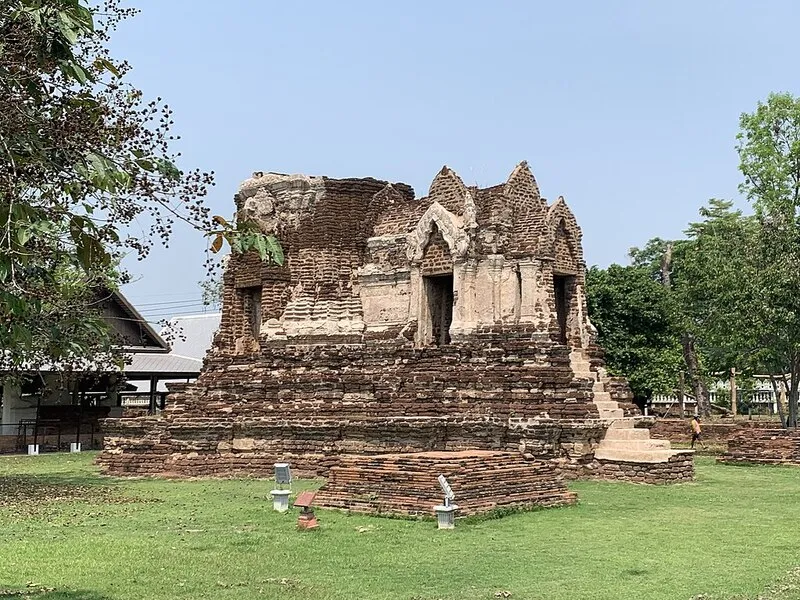
The temple’s most distinctive archaeological feature is its ancient laterite prang. The base measures approximately 11 meters wide and 18 meters long. The front section was built in a three-porched form, and the structure rises on 3 stepped bases with indented corners. Decorative stucco work can still be appreciated in surviving details, especially the swan motifs and ornamental bands. These architectural elements reflect the skill of ancient craftsmen and the refined artistic vocabulary of Buddhist monument construction in the region.
The use of laterite, the layered base, the three-porched plan, and the stucco ornamentation make the prang at Wat Chulamani an important example of historical Thai religious architecture. Its style is often discussed in relation to other ancient prang structures in central and lower northern Thailand, including artistic connections with Lop Buri. Even though time has changed the appearance of the monument, its remaining structure still communicates the grandeur of the old temple and the technical sophistication of ancient builders.
Another major feature inside Wat Chulamani is the mondop housing a replica of the Buddha’s footprint. This sacred element is linked to King Narai the Great of Ayutthaya, who commissioned a replica of the Buddha’s footprint to be enshrined at Wat Chulamani. The temple inscription records important information about this royal act of merit and connects it with the earlier history of King Borommatrailokkanat’s ordination. Because of this, Wat Chulamani is not only an architectural site but also a place where stone, text, faith, and royal history meet.
The Buddha’s footprint has deep symbolic meaning in Buddhist culture. It represents the presence and path of the Buddha, reminding devotees of the way toward wisdom, discipline, and liberation. For Thai Buddhists, paying respect to a Buddha footprint is a meaningful act of reverence. At Wat Chulamani, this sacred symbol is also connected to royal patronage, showing how the temple remained important across different periods of Ayutthaya history.
The Wat Chulamani inscription is another key piece of evidence for understanding the temple. It records the historical background of King Borommatrailokkanat’s religious activity and the later royal command of King Narai the Great to create the Buddha footprint replica. Such inscriptions are crucial because they give historians and visitors a firmer basis for understanding the temple’s past. They turn the site from a beautiful ruin into a documented historical landmark with a clear connection to Thai royal and religious history.
In the past, Wat Chulamani also had a glass wall surrounding its sacred area. This type of boundary was not only architectural but also symbolic. It separated the sacred Buddhist space from the ordinary world and helped organize the temple compound according to religious function. When walking through the temple today, visitors should observe not only the main monument but also the spatial arrangement of the site, as the layout reveals how ancient temples were designed to express reverence, hierarchy, and spiritual order.
Wat Chulamani remains an active Buddhist temple today. It continues to serve the local community of Tha Thong through merit-making, chanting, Buddhist ceremonies, and community activities. The current abbot, Phra Maha Chumphon Paphakaro, plays an important spiritual role in the community. This living function is important: Wat Chulamani is not simply an archaeological ruin separated from daily life. It is still a place of worship, community gathering, cultural memory, and Buddhist practice.
This combination of ancient heritage and living faith gives Wat Chulamani a special character. Visitors can see centuries-old monuments while also observing how the temple continues to function in contemporary Thai society. Local residents come for religious activities, monks continue their daily routines, and travelers arrive to learn about the past. The temple is therefore both a heritage site and a living religious space.
For travelers interested in art history, the laterite prang deserves careful attention. Look at the stepped base, the indented corners, the front porches, the remaining stucco patterns, and the way the monument sits within the temple grounds. These details help explain how ancient Thai builders created sacred architecture that was both symbolic and visually powerful. Even without extensive academic knowledge, visitors can appreciate the balance, proportions, and age of the structure by walking slowly around it.
For travelers interested in Thai history, Wat Chulamani offers an important window into the Ayutthaya period. King Borommatrailokkanat is remembered as a major ruler whose reign shaped the political and administrative development of the kingdom. His ordination at Wat Chulamani gives the temple a historical depth that reaches beyond Phitsanulok itself. The site helps explain how provincial cities, royal power, and Buddhist institutions were linked in the wider history of Thailand.
The atmosphere of Wat Chulamani is calm and unhurried. Compared with busier temples in central Phitsanulok, this site feels more contemplative. The riverside setting, ancient structures, and local community environment make it suitable for quiet cultural travel. Visitors should dress respectfully, avoid loud behavior, and be careful around ancient structures. Climbing on ruins or touching fragile decorative remains should be avoided so that the monument can be preserved for future generations.
Getting There is straightforward from Phitsanulok city. Travel south along Borom Trailokkanat Road for about 5 km toward Tha Thong Subdistrict. The temple is located on the eastern side of the Nan River. Travelers can reach it by private car, rental car, local taxi, or ride-hailing service. If you are staying in central Phitsanulok, the journey is short and easy to combine with other cultural attractions in the city.
The best time to visit is in the morning or late afternoon, when the weather is more comfortable for walking around the temple grounds. The temple is open daily from 08.00 to 17.00. A visit of at least 45 minutes to 1 hour is recommended for those who want to see the prang, the Buddha footprint mondop, the inscription area, and the wider temple environment without rushing.
Wat Chulamani is also suitable for family travel and educational visits. It gives younger visitors a chance to learn about King Borommatrailokkanat, King Narai the Great, Buddhist symbols, ancient inscriptions, and traditional architecture from a real location. This type of learning is more vivid than reading history alone because the structures, setting, and atmosphere help make the past tangible.
In the broader context of Phitsanulok travel, Wat Chulamani adds depth to the city’s cultural itinerary. Many visitors know Phitsanulok for the revered Phra Buddha Chinnarat at Wat Phra Si Rattana Mahathat, but the province has many additional layers of history. Wat Chulamani shows another side of the old city: a riverside temple connected to royal ordination, Ayutthaya inscriptions, ancient laterite architecture, and a community that still maintains its spiritual identity.
For photography, the temple offers meaningful compositions rather than dramatic tourist scenes. The laterite prang, the mondop, the texture of old materials, and the quiet temple grounds are ideal for cultural and documentary-style images. Visitors should photograph respectfully and avoid disturbing monks, worshippers, or ceremonies. The most memorable images from Wat Chulamani are often those that capture its stillness, age, and historical depth.
Wat Chulamani is therefore a highly worthwhile stop for anyone who wants to understand Phitsanulok through history, faith, art, and local life. It is a temple where royal Buddhist history, ancient architecture, inscriptions, riverside settlement, and present-day community worship come together in one place. For foreign travelers seeking a more meaningful cultural experience in Thailand, Wat Chulamani is a quiet but important destination that deserves attention.
| Name | Wat Chulamani |
| Location | Tha Thong Subdistrict, Mueang Phitsanulok District, Phitsanulok Province |
| Address | 50/3 Moo 2, along the Nan River, Tha Thong Subdistrict, Mueang Phitsanulok District, Phitsanulok 65000 |
| Coordinates | Latitude 16.787964, Longitude 100.216656 |
| Highlights | Ancient laterite prang, Buddha footprint mondop, Wat Chulamani inscription, and the royal ordination site of King Borommatrailokkanat |
| History | An ancient temple linked with the Sukhothai–Ayutthaya historical period. King Borommatrailokkanat was ordained here in B.E. 2007 for 8 months and 15 days. |
| Name Origin | The temple name is closely connected with Ban Wat Chulamani, an old community in Tha Thong whose identity has long centered on the temple. |
| Distinctive Features | The ancient prang has a base of approximately 11 meters by 18 meters, laterite construction, a three-porched front section, 3 stepped bases, and surviving stucco ornamentation. |
| Key Evidence | Wat Chulamani inscription, laterite prang, and the Buddha footprint replica commissioned during the reign of King Narai the Great |
| Travel Information | From central Phitsanulok, travel south along Borom Trailokkanat Road for about 5 km. The temple is on the eastern bank of the Nan River. |
| Current Status | Active Buddhist temple and historical attraction open to visitors during regular visiting hours |
| Open Days | Daily |
| Opening Hours | 08.00 – 17.00 |
| Facilities | Parking area, temple grounds, worship areas, religious buildings, and walking areas around the ancient monuments |
| Main Areas / Zones | Wat Chulamani prang, Buddha footprint mondop, inscription area, temple halls, and Buddhist activity areas |
| Abbot / Caretaker | Phra Maha Chumphon Paphakaro |
| Official Website / Official Page | Wat Chulamani - Wat Chulamanee official page |
| Nearby Tourist Attractions | 1. Sgt. Maj. Thawee Folk Museum, about 5 km 2. Wat Phra Si Rattana Mahathat Woramahawihan, about 6 km 3. Wat Nang Phaya, about 6 km 4. Wat Ratchaburana, about 6 km 5. Chan Palace, about 7 km |
| Nearby Restaurants | 1. Mayucha @ Wat Chulamani Phitsanulok, about 0.3 km, Tel. 061-424-7956 2. Krua Pa Nid, Borom Trailokkanat Road, about 4 km, Tel. 081-370-1609 3. Cafe Ban Pa, Borom Trailokkanat Road, about 4 km, Tel. 081-474-9797 4. Rad Na Empire, Borom Trailokkanat Road, about 5 km, Tel. 064-354-2469 5. Rim Nan Hanging-Leg Noodles, about 6 km |
| Nearby Accommodations | 1. Phitsanulok United, about 1.6 km, Tel. 055-218-800 2. B2 Phitsanulok Boutique & Budget Hotel, about 2.3 km, Tel. 052-009-161, 088-263-2897, Call Center 1328 3. Nature Park Resort, about 3 km 4. Iron Resort & Hotel, about 3.1 km, Tel. 099-369-2226, 081-888-1314 5. B2 Phitsanulok Premier Hotel, about 3.5 km, Tel. 052-009-161, 088-263-2897, Call Center 1328 |
Frequently Asked Questions (FAQ)
Q: Where is Wat Chulamani located?
A: Wat Chulamani is located in Tha Thong Subdistrict, Mueang Phitsanulok District, Phitsanulok Province, on the eastern bank of the Nan River about 5 km south of the city center.
Q: Why is Wat Chulamani historically important?
A: The temple is associated with King Borommatrailokkanat, who was ordained here in B.E. 2007 for 8 months and 15 days, with 2,348 royal attendants also entering the monkhood.
Q: What are the main highlights of Wat Chulamani?
A: The main highlights are the ancient laterite prang, the Buddha footprint mondop, the Wat Chulamani inscription, and the calm riverside temple atmosphere.
Q: What are the opening hours of Wat Chulamani?
A: Wat Chulamani is open daily from 08.00 to 17.00.
Q: Who is the abbot of Wat Chulamani?
A: The abbot of Wat Chulamani is Phra Maha Chumphon Paphakaro.
Q: How much time should visitors spend at Wat Chulamani?
A: A visit of about 45 minutes to 1 hour is recommended for seeing the prang, the Buddha footprint mondop, the inscription area, and the wider temple grounds.
Q: Is Wat Chulamani suitable for foreign travelers?
A: Yes. It is especially suitable for travelers interested in Thai history, Buddhist culture, ancient architecture, inscriptions, and quieter cultural sites in Phitsanulok.
Q: What nearby attractions can be visited with Wat Chulamani?
A: Nearby attractions include Wat Phra Si Rattana Mahathat Woramahawihan, Wat Nang Phaya, Wat Ratchaburana, Chan Palace, and Sgt. Maj. Thawee Folk Museum.
 Category: ●Places of Worship
 Group: ●Temple
Last Update : 5 MonthAgo
 Last Update : 5 MonthAgo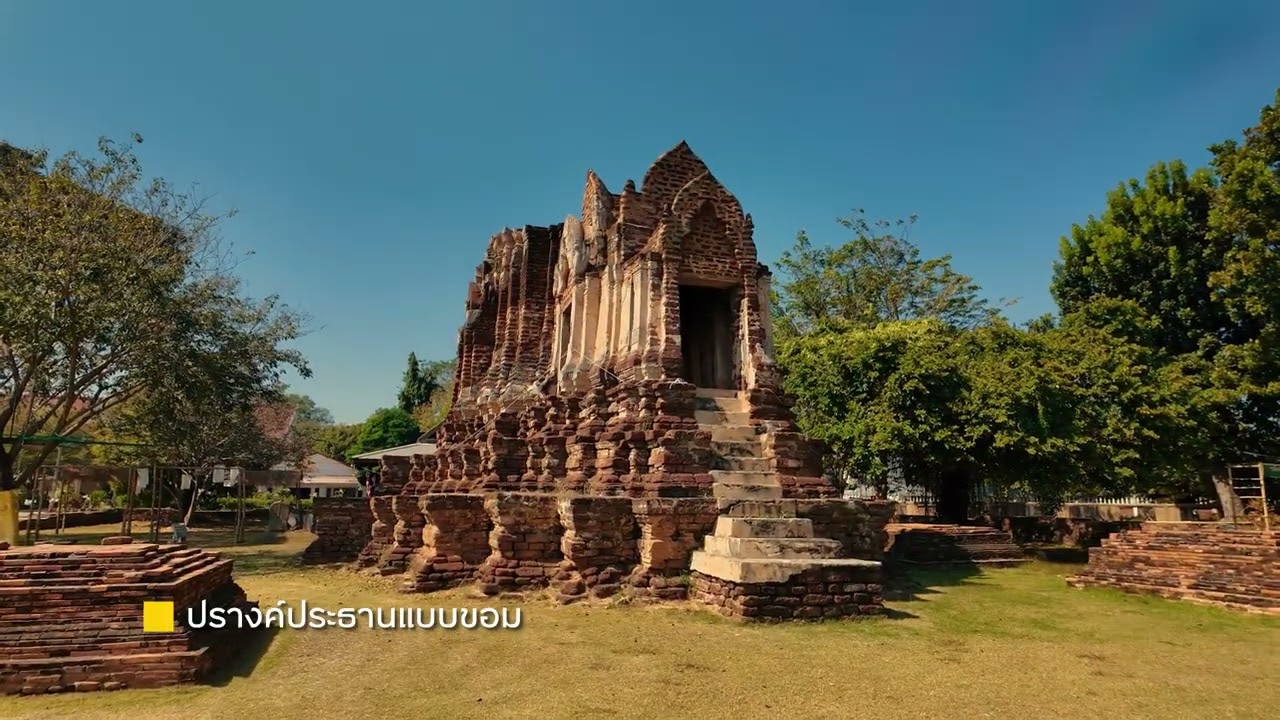
 Click to Access the Navigation Map GPS
Wat Chulamani Map
Recommend

 Art, Culture and Heritage
 Historical Sites and Monuments(1)
 Landmarks and Memorials(2)
 Art, Craft Centres, Tradition(3)
 Museums(3)
 Educational Places
 Educational Gardens, Farm(1)
Temple(29)
Educational Gardens, Farm(1)
Temple(29)
 Mosque(1)
 Other Sacred Sites(3)
 Research and Development
 Royal Project(1)
 Suburban Living
 Village, Community(1)
 Nature and Wildlife
 National Parks and Marine Reserves(7)
 Mountain (Doi)(4)
 Dam, Reservoir, Lake(5)
 Waterfalls(19)
 Caves(3)
 River, Canal(9)
 Other natural attractions(1)
 Entertainment and Agricultural
 Farms, Parks and Ecotourism(2)
 Outdoor and Adventure Activities(1)
 Travel Articles, Recipes
 Travel Review, Food Review(1)


