
lovethailand home >Central Travel Attractions >Pathum Thani Travel Attractions >Klong Luang >Khlong Nueng > Bangkok University (Rangsit Campus)
TL;DR: Bangkok University (Rangsit Campus) is located at 9/1 Moo 5, Phahonyothin Road, Khlong Nueng, Khlong Luang, Pathum Thani 12120, Thailand, open Daily for Student Admissions, including public holidays, hours 08:30 – 17:00 for Student Admissions.
Bangkok University (Rangsit Campus)
Open Days: Daily for Student Admissions, including public holidays
Opening Hours: 08:30 – 17:00 for Student Admissions
Campus Visit Enquiries: Monday – Friday, 09:00 – 16:30
Library Hours: Monday – Saturday, 08:00 – 20:00
Bangkok University, Rangsit Campus (Bangkok University Main Campus) is the principal campus of Bangkok University, a private higher education institution located at 9/1 Moo 5, Phahonyothin Road, Khlong Nueng Subdistrict, Khlong Luang District, Pathum Thani Province, Thailand. Bangkok University was founded on December 25, 1962, under the name Thai Technical College. It became Bangkok College in 1965 and received university status in 1984. The Rangsit Campus opened in 1986 and is now officially known as the Main Campus. The university is recognized for its emphasis on creativity, entrepreneurship, practical learning, and professional education across communication arts, film, design, business, digital technology, engineering, hospitality, and international studies. One of its most recognizable landmarks is the BU Diamond complex, a contemporary architectural development known for its striking geometric forms and distinctive appearance.
Bangkok University's Main Campus is situated along Phahonyothin Road in one of Pathum Thani's important educational districts. The surrounding area connects Bangkok with Rangsit, Khlong Luang, and other parts of central Thailand. Its location provides access for students traveling from Bangkok, Pathum Thani, Ayutthaya, and neighboring provinces. The wider district also contains other universities, research institutions, residential communities, and commercial activities, making it an important center for education and urban development north of Bangkok.
The campus includes modern academic buildings, specialized laboratories, a library, student activity facilities, sporting areas, landscaped open spaces, and communal environments designed for collaborative learning. Its physical environment reflects an educational philosophy that encourages creativity and learning through practical experience. Connected buildings, pedestrian routes, meeting spaces, and recreation areas support everyday student life, from attending classes and completing assignments to participating in club activities and collaborative projects.
The history of Bangkok University is closely linked to Thailand's economic and social development during the early 1960s. As private enterprise, trade, industry, and service businesses expanded, the country increasingly needed graduates with professional knowledge in management, accounting, hospitality, and modern business operations. The university's founders recognized the importance of developing a private higher education institution capable of producing graduates with both academic qualifications and practical professional skills.
Bangkok University was founded by Surat Osathanugrah and Pongtip Osathanugrah, who sought to establish a private educational institution serving the needs of Thailand's developing economy. Dr. Charoen Kanthawongs became its first president. The institution was established on December 25, 1962, although the name Bangkok University was adopted only after subsequent institutional development.
The original institution was called Thai Technical College. Its initial academic fields included business administration, hotel administration, and accounting, reflecting the importance of trained personnel for the private sector. The founders placed considerable emphasis on knowledge that students could apply directly in their professional lives, particularly in administration, financial management, service operations, and organizational development.
In 1965, Thai Technical College became Bangkok College. This change formed part of the institution's expanding academic and administrative development. In 1971, the college established a mass communication department that later developed into the School of Communication Arts. This was a significant milestone in the evolution of media education in Thailand and contributed to the institution's long-term identity in communication and creative industries.
The growth of communication arts education occurred alongside changes in the Thai media industry. Radio, television, newspapers, advertising, and commercial communications created opportunities for new professional fields. Bangkok University became associated with the education of media producers, communicators, and creative professionals. Over time, these subjects evolved to include digital platforms, streaming media, interactive content, branding, and new forms of audience engagement.
The School of Humanities was established in 1981, followed by the School of Law in 1983. Bangkok College gained university status in 1984 and became Bangkok University. The same period also saw the development of international education, reflecting the growing importance of cross-border communication and international professional opportunities.
The Graduate School was established in 1985, extending the university's educational mission beyond undergraduate studies. In 1986, Bangkok University opened its Rangsit Campus in Pathum Thani Province. This development took place during a period when Rangsit and Khlong Luang were becoming increasingly important educational and suburban districts. The new campus provided room for additional academic buildings, laboratories, student facilities, and future institutional expansion.
The opening of the Rangsit Campus represented a major milestone. It allowed Bangkok University to develop a larger educational environment with facilities suited to a growing range of academic disciplines. Unlike a campus constrained by the density of central Bangkok, the Rangsit location offered opportunities to organize teaching facilities, outdoor spaces, and student activities within a more extensive university setting.
In 1987, the university established its School of Science, which later developed into the School of Science and Technology. The School of Fine and Applied Arts was established in 1988, while the School of Engineering followed in 1993. During this period, Bangkok University also developed its university theatre activities, which became an important part of its performing arts education and cultural history.
A significant example of the university's technological achievements occurred in 1999, when a team of engineering students won the championship and Best Performance awards at the international Robocon competition in Japan. The achievement represented an important success for Thailand and demonstrated the practical application of engineering knowledge, robotics, programming, mechanical design, and teamwork.
Bangkok University subsequently developed its identity as a Creative University. This approach places emphasis on imagination, innovation, entrepreneurship, practical learning, and interaction with industry professionals. It also influences the design of university spaces, teaching methods, and educational projects. The intention is to encourage students to develop original ideas and transform them into meaningful professional or entrepreneurial outcomes.
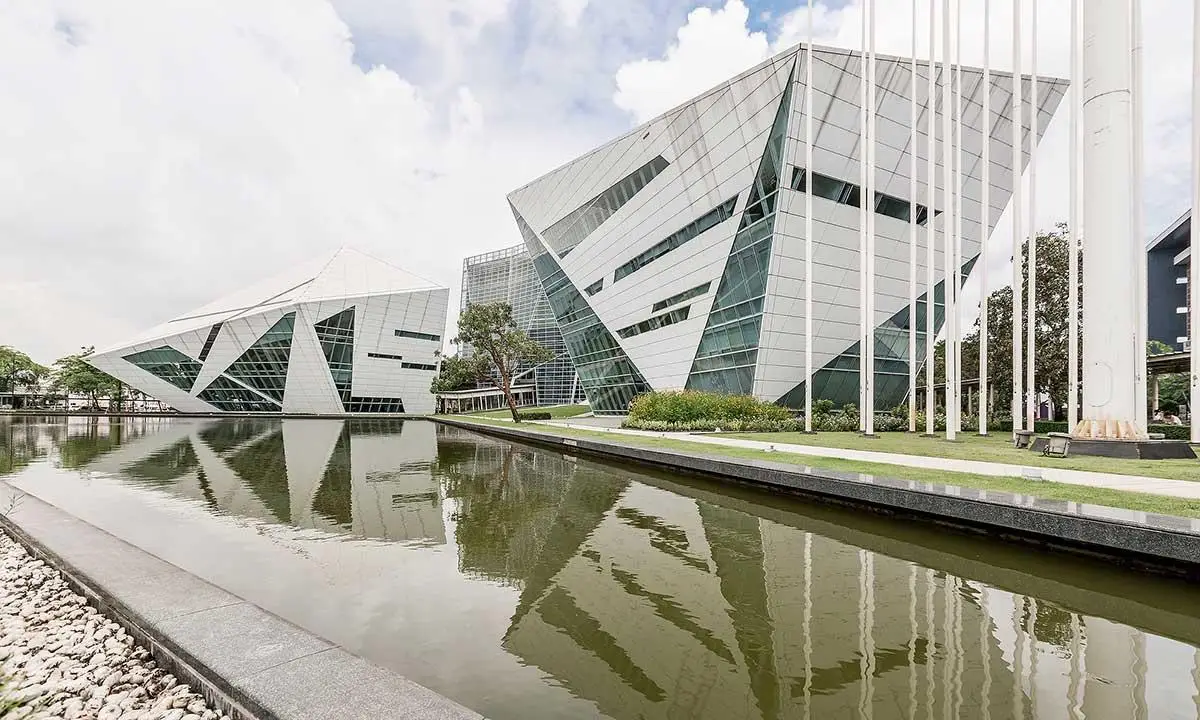
One of the strongest architectural expressions of this philosophy is the BU Diamond complex, commonly known in Thai as Tuek Phet, or the Diamond Building. Its distinctive appearance is characterized by angular surfaces, geometric lines, sloping planes, and glass facades. The building's design differs from conventional rectangular academic structures and creates a memorable visual identity near the entrance to the campus.
The BU Diamond complex also demonstrates how architecture can contribute to an educational environment. Rather than serving only as a functional structure, its design encourages students and visitors to consider the relationship between visual creativity, engineering, technology, and the built environment. The architecture provides a practical example of how an imaginative concept can be transformed into a physical structure.
Landscaped areas surrounding the Diamond Building create open views of its distinctive forms. Lawns, walkways, reflective surfaces, and water features contribute to the visual character of the location. These features have made the building a recognizable subject for architectural photography and a popular visual symbol of the university. Visitors interested in photography should observe campus regulations, especially when planning commercial photography or filming.
Another important campus facility is the Surat Osathanugrah Library, located in Building C6. The library provides academic resources, reading areas, collaborative workspaces, discussion facilities, and spaces supporting research and independent study. Its role extends beyond the traditional provision of books, reflecting the contemporary importance of libraries as places for teamwork, information exchange, and self-directed learning.
Published regular library hours are Monday through Saturday, from 08:00 to 20:00. Certain services require students to use their university identification cards for reservations or access. The library environment is designed to accommodate different learning activities, from individual research to group discussions and project development.
The Main Campus also provides collaborative learning environments such as Imagine Lounge, Common Lounge, and the International Center. These facilities support meetings, group assignments, creative projects, and communication between students from different academic disciplines. Collaborative spaces are especially relevant to the university's educational philosophy because they encourage the exchange of knowledge and the development of interdisciplinary ideas.
The Student Activity Center, commonly known as SAC, provides facilities for student organizations and activities outside the classroom. It supports clubs, music rehearsal, performances, photography-related activities, meetings, and other student projects. The center contributes to university life by allowing students to pursue personal interests, develop leadership skills, organize events, and gain experience in managing practical responsibilities.
Bangkok University has also developed a history of artistic education and creative exhibitions, including activities associated with Bangkok University Gallery, commonly abbreviated as BUG. Exhibitions and related events allow students and artists to present their work, communicate ideas, and interact with audiences beyond their own classrooms. These experiences are valuable to students preparing for careers in art, design, media, and other creative fields.
Practical facilities in hospitality and tourism education include environments associated with Tourism Tower. Such facilities support learning in hotel management, food and beverage services, tourism operations, and aviation-related business. Simulated professional settings help students practice service standards, communication, operational procedures, teamwork, and problem-solving skills relevant to the hospitality industry.
Sporting and recreational facilities form another component of the campus. These include football fields, tennis courts, multipurpose sporting areas, and facilities associated with the Suthee Buranathanit Sports Center. Student sporting activities can include basketball, badminton, volleyball, futsal, football, and other recreational pursuits. These spaces support physical well-being, teamwork, and social interaction beyond academic commitments.
Campus culture includes student orientation, student clubs, exhibitions, artistic productions, sporting competitions, volunteer projects, and graduation ceremonies. These activities connect students, academic staff, university employees, and alumni. They also provide students with opportunities to practice communication, organizational planning, and leadership. Event dates and arrangements follow the university's published schedules.
The Wai Khru ceremony, an important expression of respect toward teachers in Thai educational culture, represents the value placed on education and the relationship between students and their instructors. Student orientation activities serve a different but complementary purpose, helping new students understand university life, become familiar with academic systems, and build friendships within their new learning environment.
Student exhibitions and creative presentations are particularly relevant to Bangkok University's reputation in communication arts, film, design, and digital media. Student projects may include short films, performances, exhibitions, advertising campaigns, digital content, multimedia productions, and technological prototypes. Producing such work requires students to develop ideas, organize resources, collaborate with colleagues, and respond to feedback from audiences or professional reviewers.
Bangkok University's academic strengths reflect its emphasis on creativity, professional education, and entrepreneurship. Its communication arts disciplines cover media production, performance, branding, advertising, digital communication, and event management. Film and digital media programs provide opportunities to develop skills in audiovisual production, storytelling, digital content creation, and technologies used within the contemporary entertainment industry.
Business-related education includes marketing, finance, management, international business, logistics, digital marketing, and entrepreneurship. These fields respond to the demands of organizations operating in an increasingly interconnected digital economy. Students develop knowledge relating to consumer behavior, business planning, organizational strategy, finance, product development, and the management of commercial operations.
Information technology and innovation programs address subjects such as computer science, artificial intelligence, data science, cybersecurity, gaming, and intelligent digital systems. These subjects require both theoretical understanding and practical technical competence. Software development, systems design, programming, and technological problem-solving are essential elements of education in these fields.
Engineering education includes subjects related to electrical engineering, computer engineering and robotics, artificial intelligence, data science, intelligent systems, and unmanned aircraft technology. Students in these areas develop analytical and technical skills through design projects, experimentation, system development, and testing. Engineering education also emphasizes teamwork and the ability to translate scientific principles into practical applications.
The School of Humanities and Tourism Management provides education in languages, hospitality, hotel management, airline business, tourism, cruise operations, and culinary arts. These subjects are directly connected to Thailand's tourism and service industries. Education in these fields emphasizes communication, cultural awareness, professional standards, customer service, and the ability to manage experiences in domestic and international contexts.
Bangkok University International College offers English-language and internationally oriented programs in fields associated with business, communication, technology, design, tourism, and entrepreneurship. Studying in an international academic environment provides opportunities to develop English-language communication skills, work with people from different cultural backgrounds, and gain experience relevant to the global employment market.
Graduate education at Bangkok University includes programs in business administration, innovation, communication, tourism management, information technology, engineering, law, and other academic areas. Admission requirements and study arrangements differ among programs. Graduate education allows professionals and researchers to pursue advanced knowledge, develop specialized expertise, and undertake projects connected with academic or professional challenges.
The university's presence also contributes to the surrounding communities of Khlong Luang and Rangsit. Students, employees, and visitors support demand for accommodation, restaurants, transport, retail, and local services. Academic events, exhibitions, creative projects, and cooperation with businesses further connect the university with the economic and social development of Pathum Thani Province.
For visitors interested in architecture and educational tourism, Bangkok University's Main Campus offers an opportunity to explore an important example of a contemporary Thai university environment. The BU Diamond building is particularly noteworthy for its architecture, while university events, exhibitions, and open-house activities allow visitors to learn more about the institution's creative and academic programs. Entry to laboratories, classrooms, and specialized facilities is subject to university regulations and may require prior authorization.
Getting There by private car is convenient via Phahonyothin Road toward Rangsit and Khlong Luang. The campus lies near major transport routes connecting northern Bangkok with Pathum Thani and the Thammasat University Rangsit area. Drivers should check the relevant campus entrance and parking arrangements before arriving, particularly when attending large events or visiting a particular faculty building.
Public transport options include buses serving Phahonyothin Road, including routes 39, 356, 510, and 520 as listed in the university's transport guidance. Public vans also operate from locations such as Victory Monument and Mo Chit toward the Rangsit area. Passengers should confirm the destination and route before boarding because services may have different stopping points or route patterns.
Travelers using the BTS Green Line can alight at Yaek Kor Por Aor Station and continue by bus routes 39 or 520. Those using the SRT Red Line can travel to Rangsit Station, take Exit 3, and continue using the Rangsit–Jarusorn local minibus routes 1116 or 6188 identified in the university's official transport information. Allowing additional travel time during peak hours is advisable.
Prospective students may visit the Admissions Office on the second floor of Building A8. The office announces daily services from 08:30 to 17:00, including public holidays. General campus visit enquiries can be arranged through Student Admissions from Monday to Friday, 09:00 to 16:30. Visitors are advised to explain the purpose of their visit and check arrangements in advance, since administrative opening hours do not automatically grant access to all university buildings.
Bangkok University's Rangsit Campus has become an important part of the history of private higher education in Thailand. From the founding of Thai Technical College in 1962 to the creation of Bangkok University and the opening of its Rangsit Campus in 1986, the institution has continually adapted its educational approach to changes in business, society, technology, and the creative economy. Its BU Diamond architecture, Surat Osathanugrah Library, student activity facilities, and specialized learning spaces collectively express an educational philosophy that seeks to develop knowledge, creativity, practical skills, and entrepreneurial thinking.
| University Name | Bangkok University, Rangsit Campus (Bangkok University Main Campus) |
| Institution Type | Private University, Main Campus |
| Address | 9/1 Moo 5, Phahonyothin Road, Khlong Nueng, Khlong Luang, Pathum Thani 12120, Thailand |
| Institution Founded | December 25, 1962, as Thai Technical College |
| Renamed Bangkok College | 1965 |
| University Status Granted | 1984 |
| Rangsit Campus Opened | 1986 |
| Institutional Anniversary | 64th Anniversary on December 25, 2026 |
| Rangsit Campus Age In 2026 | 40 Years |
| Founders | Surat Osathanugrah and Pongtip Osathanugrah |
| First President | Dr. Charoen Kanthawongs |
| Educational Identity | Creative University, emphasizing creative thinking, practical learning, and entrepreneurship |
| Iconic Building | BU Diamond Building |
| Important Campus Facilities | BU Diamond, Surat Osathanugrah Library (Building C6), Student Activity Center (SAC), Imagine Lounge, Common Lounge, International Center, Tourism Tower, Suthee Buranathanit Sports Center, and Creative Exhibition Spaces |
| Major Academic Fields | Communication Arts, Film, Digital Media, Design, Business, Entrepreneurship, Information Technology, Engineering, Tourism, Hospitality, and International Studies |
| University Activities | Student Orientation, Clubs, Creative Exhibitions, Sports, Open-House Events, and Graduation Ceremonies |
| Admissions Open Days | Daily, Including Public Holidays |
| Admissions Opening Hours | 08:30 – 17:00, Building A8, Second Floor |
| Campus Visit Enquiries | Monday – Friday, 09:00 – 16:30 |
| Surat Osathanugrah Library | Building C6; Monday – Saturday, 08:00 – 20:00 |
| Facilities | Library, Classrooms, Laboratories, Collaborative Workspaces, Student Activity Areas, Sports Facilities, Recreation Areas, and On-Campus Food Services |
| Getting There | By car via Phahonyothin Road; bus routes 39, 356, 510, and 520; or SRT Red Line to Rangsit Station followed by local minibus services |
| Places Of Interest In Khlong Luang And Rangsit | National Geological Museum, National Science Museum, Supreme Artist Hall, Wat Phra Dhammakaya, and Future Park Rangsit |
| University Telephone | +66 2 407 3888 |
| Admissions Telephone | +66 2 407 3888, Extensions 2411–2417 |
| General Enquiries Email | info@bu.ac.th |
| Admissions Email | admission@bu.ac.th |
| Official Website | https://www.bu.ac.th/ |
| Current Status | Operating as Bangkok University's Main Campus in Pathum Thani Province |
Bangkok University Academic Programs And Fields Of Study — Academic Year 2026 (B.E. 2569)
| School / Academic Unit | Published Programs And Fields Of Study |
| School Of Business Administration | Bachelor's Degree 1. Marketing 2. Finance 3. Management 4. International Business Management 5. Logistics and Supply Chain Management 6. Digital Marketing 7. Financial and Investment Planning 8. International Business Management with a Chinese Business Focus Graduate Study1. Master of Business Administration (MBA) |
| School Of Accounting | Bachelor's Degree 1. Accountancy |
| School Of Communication Arts | Bachelor's Degree 1. Performing Arts 2. Communication and New Media 3. Radio, Television and Streaming Media Production 4. Event Production, Exhibition and Convention Management 5. Creative Content Production and Digital Experiences 6. Global Influencer Creation and Branding Graduate Study1. Brand Management and Strategic Communication 2. Data-Driven Marketing and Communication 3. Ph.D. in Communication Arts, Brand Management and Strategic Communication |
| School Of Digital Media And Cinematic Arts | Bachelor's Degree 1. Film 2. Digital Media 3. Virtual Production and Immersive Experience Design |
| School Of Information Technology And Innovation | Bachelor's Degree 1. Computer Science 2. Intelligent Information Technology and Applied Artificial Intelligence 3. Games and Intelligent Interactive Technology 4. Computer Science with a Data Science and Cybersecurity Focus Master's Degree1. Information Technology and Data Science |
| School Of Engineering | Bachelor's Degree 1. Electrical Engineering 2. Artificial Intelligence Engineering and Data Science 3. Unmanned Aircraft Systems and Technology Engineering 4. Computer and Robotics Engineering 5. Intelligent Systems and Digital Innovation Engineering International Graduate Programs1. Master of Engineering in Electrical and Computer Engineering 2. Doctor of Engineering in Electrical and Computer Engineering |
| School Of Humanities And Tourism Management | Bachelor's Degree 1. English 2. Hotel Management 3. Airline Business Management 4. Tourism and Cruise Management 5. Culinary Arts and Restaurant Service Management International Programs1. International Tourism and Hospitality Management 2. Culinary Arts and Design Graduate Study1. Tourism and Hospitality Management Innovation |
| School Of Architecture | Bachelor's Degree 1. Architecture (Five-Year Program) 2. Interior Architecture Master's Degree1. Architecture |
| School Of Law | Bachelor's Degree 1. Bachelor of Laws Master's Degree1. Master of Laws |
| School Of Entrepreneurship And Management | Bachelor's Degree 1. Entrepreneurship Master's Degree1. Entrepreneurship and Startup Business |
| Bangkok University International College | Bachelor's Degree / International Programs 1. Computer Science 2. Business Administration 3. Business Administration (Bilingual Program) 4. AI Engineering and Entrepreneurship 5. Marketing 6. Entrepreneurship 7. Media and Communication 8. Business English 9. Creative Communication Design 10. Innovative Media Production 11. International Tourism and Hospitality Management 12. Culinary Arts and Design |
Frequently Asked Questions (FAQ)
Q: Where is Bangkok University Rangsit Campus located?
A: Bangkok University's Main Campus is located at 9/1 Moo 5, Phahonyothin Road, Khlong Nueng, Khlong Luang, Pathum Thani 12120, Thailand.
Q: What are Bangkok University Main Campus opening days and hours?
A: The Admissions Office operates daily, including public holidays, from 08:30 to 17:00. Campus visit enquiries are handled Monday through Friday from 09:00 to 16:30, while the Surat Osathanugrah Library normally opens Monday through Saturday from 08:00 to 20:00. Individual campus facilities have their own schedules.
Q: When was Bangkok University founded?
A: Bangkok University was founded on December 25, 1962, as Thai Technical College, became Bangkok College in 1965, and gained university status in 1984.
Q: When did Bangkok University open its Rangsit Campus?
A: The Rangsit Campus opened in 1986 and reached its 40th anniversary in 2026.
Q: Who founded Bangkok University?
A: Bangkok University was founded by Surat Osathanugrah and Pongtip Osathanugrah. Dr. Charoen Kanthawongs served as its first president.
Q: What is the BU Diamond Building?
A: BU Diamond is a landmark architectural complex at Bangkok University's Main Campus, notable for its contemporary geometric design and diamond-like forms.
Q: How can I reach Bangkok University Rangsit Campus by train?
A: Take the BTS Green Line to Yaek Kor Por Aor Station and continue by bus 39 or 520, or take the SRT Red Line to Rangsit Station and transfer to the Rangsit–Jarusorn local minibus service.
Q: Can members of the public visit Bangkok University Main Campus?
A: General visitors can contact Student Admissions regarding campus visits Monday through Friday, from 09:00 to 16:30, at +66 2 407 3888, extension 2411. Access to specialized facilities and restricted areas is subject to university regulations.
 Category: ●University
 Group: ●Private University
Last Update : 2 DayAgo
 Last Update : 2 DayAgo

 Click to Access the Navigation Map GPS
Bangkok University (Rangsit Campus) Map
Recommend

 Art, Culture and Heritage
 Historical Sites and Monuments(2)
 Landmarks and Memorials(1)
 Art, Craft Centres, Tradition(2)
 Museums(11)
 Art Gallery(1)
 Educational Places
 Museum for Study(1)
 Library(1)
 Training Center(1)
 Public university(2)
 Rajamangala University of Technology(1)
 Rajabhat University(1)
Private University(7)
 Places of Worship
 Temple(44)
 Mosque(1)
 Other Sacred Sites(1)
 Research and Development
 Royal Project(1)
 Suburban Living
 Local Market(2)
 Floating Market(3)
 Nature and Wildlife
 River, Canal(1)
 Entertainment and Agricultural
 Animal camps and shows(1)
 Stadium(2)
 Amusement Park(1)
 Waterpark(1)
 Travel Articles, Recipes
 Travel Review, Food Review(1)


