
lovethailand home >North Travel Attractions >Kamphaeng Phet Travel Attractions >Muang Kamphaeng Phet >Nakhon Chum > Wat Phra Borommathat
TL;DR: Wat Phra Borommathat is located at Nakhon Chum Subdistrict, Mueang Kamphaeng Phet District, Kamphaeng Phet Province, open Daily, hours Open For Worship Throughout The Day.
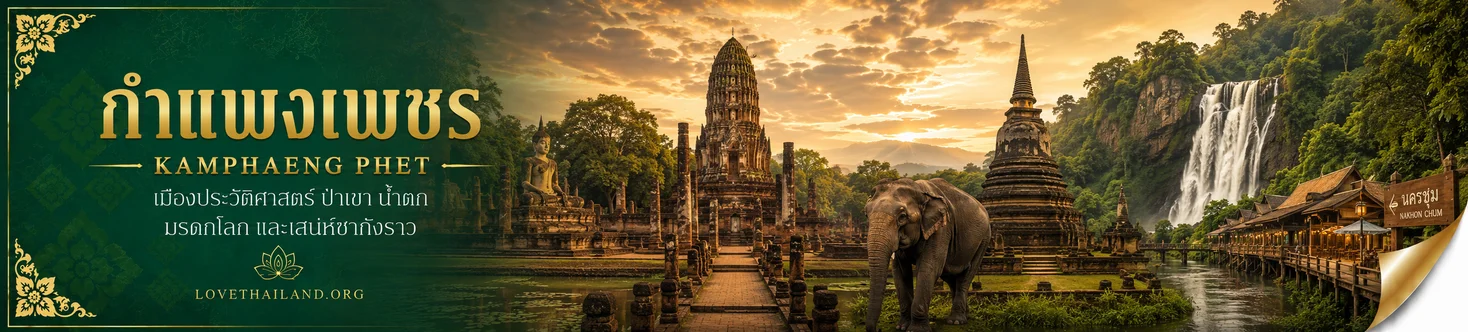
Wat Phra Borommathat

Open Days: Daily
Opening Hours: Open For Worship Throughout The Day
Wat Phra Borommathat in Kamphaeng Phet Province, also known as Wat Phra Borommathat Nakhon Chum or Wat Phra Borommathat Chediyaram, is one of the most important Buddhist temples and historical landmarks in Nakhon Chum Subdistrict, Mueang Kamphaeng Phet District. The temple is a third-class royal monastery and a major spiritual center of the old Nakhon Chum community. Its most striking feature is the large golden Phra Borommathat Chedi, whose history is connected with 3 original lotus-bud-shaped stupas built on the same base during the Sukhothai period. Today, the chedi displays strong Burmese architectural influence from later restoration, making it one of the most distinctive sacred monuments in Kamphaeng Phet.
This temple is ideal for travelers who want to understand Kamphaeng Phet through both faith and history. Nakhon Chum is an old settlement on the western side of the Ping River and has long been connected with the Sukhothai cultural sphere, river trade, Buddhist devotion, and local community life. A visit to Wat Phra Borommathat is therefore not only a temple visit. It is also an introduction to Nakhon Chum as a living historic community, where temples, markets, old houses, local food, and riverside memory continue to shape the identity of the area.
The historical importance of Wat Phra Borommathat begins with its status as the principal temple of Nakhon Chum. The temple stands in a location closely connected with the old town and the Ping River, making it suitable as a religious and community center. For generations, it has served as a place of worship, merit-making, Buddhist ceremonies, and local gatherings. Its history is especially associated with King Lithai, or Phra Maha Thammaracha I of Sukhothai, who played a major role in supporting Buddhism and sacred monuments in the Sukhothai period.
According to the temple’s historical tradition, the original sacred monument consisted of 3 lotus-bud-shaped stupas standing on the same base. These stupas were associated with King Lithai and were built to commemorate major figures in the Sukhothai royal lineage, including King Si Inthrathit and King Ramkhamhaeng. The central stupa enshrined 9 relics of the Buddha. This makes the temple much more than a local religious site. It is part of the wider sacred geography of Sukhothai Buddhism and royal religious patronage.
The idea of 3 lotus-bud-shaped stupas on one base is significant in both artistic and religious terms. The lotus-bud stupa is one of the most recognizable forms of Sukhothai architecture. Its shape reflects Buddhist symbolism and the refined aesthetic of the period. Although the original appearance of the monument changed through later restoration, the memory of the 3 original stupas remains central to the temple’s identity and explains why Wat Phra Borommathat is regarded as a key historical temple of Nakhon Chum.
The Buddha relics enshrined at the temple are the heart of its sacred status. For Buddhist visitors, paying respect to relics of the Buddha is an act of devotion and remembrance of the Buddha’s teachings. Many worshippers come to the temple to make merit, pray, and circumambulate the chedi. The temple’s spiritual power comes not only from the beauty of the golden monument, but also from the belief that the relics connect worshippers directly with the Buddha.
The temple is also connected with the sacred Bodhi tree tradition. The Bodhi tree is one of the most important symbols in Buddhism because it is associated with the Buddha’s enlightenment. The presence of a Sri Maha Bodhi tree at the temple gives the site an additional layer of meaning. Visitors often pay respect to both the chedi and the Bodhi tree because together they symbolize relic worship, enlightenment, and the continuity of Buddhism in Nakhon Chum.
Wat Phra Borommathat became visually distinctive during the Rattanakosin period, especially through restoration associated with the reign of King Rama V. During this restoration, Burmese craftsmen are said to have been involved in repairing and reshaping the chedi. As a result, the monument today has a strong Burmese-style appearance, with a tall golden form that differs from the original Sukhothai lotus-bud stupas. This transformation makes the temple especially interesting because it preserves layers of history in a single monument.
The mixture of Sukhothai origin and Burmese-influenced restoration is one of the temple’s greatest charms. The historical foundation belongs to Sukhothai and the sacred tradition of King Lithai, while the present form reflects later restoration and cross-cultural artistic influence. Rather than reducing the temple’s authenticity, this layered history increases its value. Wat Phra Borommathat shows how sacred monuments in Thailand often change over time through devotion, restoration, craftsmanship, and local belief.
The golden Phra Borommathat Chedi is the strongest visual focus of the temple. Its golden surface shines prominently in the temple courtyard and creates a powerful atmosphere of reverence. Visitors can view the chedi from different angles around the temple grounds. The front view, where the chedi stands together with the worship area and surrounding temple space, is especially impressive. It is also a popular photography point, but visitors should remember that this is an active sacred space used by monks and worshippers.
The temple remains an active religious site. Local people come here for daily worship, merit-making, chanting, offerings, and important Buddhist ceremonies. On major Buddhist holy days such as Makha Bucha, Visakha Bucha, Asalha Bucha, and the Buddhist Lent period, the temple becomes an important gathering place for the community. Candlelight circumambulation and merit-making activities show that Wat Phra Borommathat is not only a historical attraction, but also a living center of Buddhist practice.
One of the important annual traditions associated with the temple is the ceremony to pay homage to Phra Borommathat around the full moon of the third lunar month. This tradition reflects the long-standing faith of the people of Kamphaeng Phet and Nakhon Chum. Worshippers come to make merit, pray, and take part in religious activities for good fortune and spiritual benefit. Such annual traditions help keep the temple alive as a cultural and religious center.
Today, Wat Phra Borommathat is a royal monastery with an important role in the Buddhist administration of Kamphaeng Phet Province. Its current abbot is Phra Methee Wachiraphusit, Dr., who was appointed abbot of Wat Phra Borommathat Royal Monastery in 2025. As a royal monastery, the temple continues to play a role in religious education, community ceremonies, monastic administration, and provincial Buddhist life.
The area around the temple is closely connected with Nakhon Chum’s community life. Visitors can combine the temple with a walk through the old town, local markets, traditional food spots, and nearby heritage sites. Wat Phra Borommathat is close to Nakhon Chum Retro Market, Wat Sawang Arom, Baan Hang Rama V, and Khlong Suan Mak. This makes the temple an excellent starting point for exploring the cultural landscape of Nakhon Chum.
Compared with the ancient monuments inside Kamphaeng Phet Historical Park, Wat Phra Borommathat has a different atmosphere. The historical park presents preserved laterite ruins and ancient city remains, while this temple is still active and filled with religious life. Monks, worshippers, ceremonies, and local visitors give the temple a living character. Visiting both areas allows travelers to understand Kamphaeng Phet through archaeological history and living Buddhist practice.
For architecture lovers, the temple is a fascinating case study. It shows how a sacred monument can evolve from Sukhothai-style lotus-bud stupas into a Burmese-influenced golden chedi through later restoration. This transformation demonstrates that religious monuments are not static objects. They change through time, restoration, craftsmanship, community faith, and changing artistic preferences. Wat Phra Borommathat is therefore a valuable example of living architectural heritage.
For travelers interested in Sukhothai history, the temple is important because of its connection with King Lithai. He was one of the most important Buddhist kings of the Sukhothai period, known for religious patronage, Buddhist learning, and the creation of sacred monuments. The stories of the relics, the Bodhi tree, and the original 3 stupas make this temple part of a larger network of Sukhothai Buddhist sacred sites.
In terms of spiritual experience, Wat Phra Borommathat is suitable for worshippers, history lovers, and travelers seeking a calm place to reflect. Walking around the chedi, sitting quietly in the temple grounds, or joining Buddhist ceremonies can help visitors experience the temple beyond its physical beauty. The site carries a quiet sense of devotion that reflects centuries of faith.
Photography is best in the morning or late afternoon when the light is softer and the golden chedi appears especially warm. Good angles include the full chedi with the temple courtyard and religious elements in the foreground. During ceremonies, visitors should photograph respectfully, avoid blocking worshippers, and avoid intrusive close-ups of monks or devotees without permission.
Visitors should dress politely, speak softly, keep the temple clean, and avoid climbing onto restricted areas. Because the temple is an active religious space, travel behavior should be guided by respect. If making offerings or donations, visitors should use areas provided by the temple. Respectful conduct helps preserve both the sacred atmosphere and the relationship between visitors and the local community.
Getting to Wat Phra Borommathat is easy from Kamphaeng Phet town. Travelers can cross the Ping River to Nakhon Chum and continue to the temple by private car, rental car, hired vehicle, or local transport. The temple is located in a community area with restaurants, local markets, and accommodations nearby, making it convenient for a half-day or full-day cultural route.
Getting There from other provinces is also straightforward. Travelers can follow the main highway to Kamphaeng Phet town, then continue across the Ping River to Nakhon Chum Subdistrict. Those arriving by interprovincial bus can get off at Kamphaeng Phet Bus Terminal and continue by hired vehicle or local transport. The temple’s location is practical for travelers without a private car because it is not far from the town center.
A recommended cultural route begins at Wat Phra Borommathat for worship, then continues to Nakhon Chum Retro Market, Wat Sawang Arom, Baan Hang Rama V, and Khlong Suan Mak. Travelers can then cross back toward Kamphaeng Phet town to visit Kamphaeng Phet National Museum and Kamphaeng Phet Historical Park. This itinerary gives a complete experience of faith, community, local food, heritage houses, and ancient monuments.
For families, the temple offers an accessible way to teach children about Buddhist relics, Bodhi trees, Sukhothai history, and restoration. The golden chedi is visually memorable, while the temple’s stories are clear enough for younger visitors to understand. Learning from a real place makes history more tangible than reading from a textbook.
For foreign travelers, Wat Phra Borommathat is a helpful introduction to Thai Buddhism. It presents several important elements in one place: a relic stupa, Bodhi tree, active worship, Buddhist ceremonies, and community faith. With a guide or explanation, visitors can understand why relics and stupas are central to Buddhist devotion in Thailand.
In summary, Wat Phra Borommathat in Kamphaeng Phet is an essential temple for anyone visiting Nakhon Chum. It is a royal monastery, an ancient sacred site, a center of local faith, and a historical monument connected with King Lithai, the original 3 lotus-bud stupas, Buddha relics, the Bodhi tree, and later Burmese-influenced restoration. Visitors will find history, architecture, faith, and community life brought together in one meaningful temple.
| Name | Wat Phra Borommathat Royal Monastery / Wat Phra Borommathat Nakhon Chum / Wat Phra Borommathat Chediyaram |
| Location | Nakhon Chum Subdistrict, Mueang Kamphaeng Phet District, Kamphaeng Phet Province |
| Address | 15 Moo 3, Nakhon Chum Subdistrict, Mueang Kamphaeng Phet District, Kamphaeng Phet 62000, Thailand |
| Highlights | Golden Phra Borommathat Chedi, 9 Buddha relics, King Lithai history, Sri Maha Bodhi tree, and a monument combining Sukhothai origins with Burmese architectural influence |
| History | Established with ancient Nakhon Chum during the Sukhothai period. The temple is associated with King Lithai and originally had 3 lotus-bud-shaped stupas on one base. It was later restored during the Rama V period with Burmese architectural influence. |
| Name Origin | The name Phra Borommathat refers to the Buddha relics enshrined in the chedi, while Nakhon Chum reflects its role as the principal temple of the old Nakhon Chum community. |
| Distinctive Features | A tall golden Burmese-influenced chedi built upon a historical Sukhothai foundation connected with 3 original lotus-bud stupas and Buddha relic worship |
| Important Sacred Objects | Phra Borommathat Chedi, Buddha relics, Sri Maha Bodhi tree, worship courtyard, and royal monastery elements |
| Traditions / Rituals | Annual homage ceremony to Phra Borommathat around the full moon of the third lunar month, candlelight circumambulation on Buddhist holy days, merit-making, and community Buddhist ceremonies |
| Travel Information | From Kamphaeng Phet town, cross the Ping River to Nakhon Chum Subdistrict and continue to Wat Phra Borommathat. Private car, rental car, hired vehicle, or local transport can be used conveniently. |
| Current Status | A third-class royal monastery and active Buddhist temple with regular religious ceremonies |
| Open Days | Daily |
| Opening Hours | Open for worship throughout the day |
| Fees | Free admission |
| Abbot / Caretaker | Phra Methee Wachiraphusit, Dr., Abbot of Wat Phra Borommathat Royal Monastery |
| Main Contact Number | 055 799 384 |
| Nearby Tourist Attractions | 1. Nakhon Chum Retro Market, about 1 km 2. Wat Sawang Arom, about 1 km 3. Baan Hang Rama V / Baan Pha Pho, about 1 km 4. Khlong Suan Mak, about 1 km 5. Kamphaeng Phet National Museum, about 4 km 6. Kamphaeng Phet Historical Park, about 5 km |
| Nearby Restaurants | 1. Krua Khun Krit, opposite Wat Phra Borommathat Nakhon Chum, about 0.3 km, Tel. 082-780-5129 2. Pad Thai Hor Khai Na Rong Phak, about 1 km 3. Khao Tom Pu Thong Kamphaeng Phet, about 2 km 4. Krua Mae Somchit, about 3 km, Tel. 086-549-1097, 055-721-064, 081-533-8192 5. Thammarat Phochana, about 4 km, Tel. 055-714-247, 088-228-5449 6. Kamphaeng Phet Phochana, about 4 km, Tel. 055-713-035 |
| Nearby Accommodations | 1. Techno Riverview Resort, about 1 km 2. La Riva Boutique Hotel, about 2 km 3. Navarat Heritage Hotel, about 2 km, Tel. 055-711-211, 055-711-219, 081-533-5799 4. P. Paradise Hotel, about 3 km, Tel. 055-741-888, 092-034-3747 5. Chakungrao Riverview Hotel, about 4 km, Tel. 055-714-900-4 6. Grand The Room Hotel, about 4 km |
Frequently Asked Questions (FAQ)
Q: Where is Wat Phra Borommathat in Kamphaeng Phet located?
A: Wat Phra Borommathat Royal Monastery is located at 15 Moo 3, Nakhon Chum Subdistrict, Mueang Kamphaeng Phet District, Kamphaeng Phet Province.
Q: Why is Wat Phra Borommathat Nakhon Chum important?
A: It is an ancient royal monastery, a principal temple of Nakhon Chum, and a sacred site associated with King Lithai, Buddha relics, and Sukhothai-period religious history.
Q: What is the main highlight of the temple?
A: The main highlight is the golden Phra Borommathat Chedi, which has historical roots in 3 Sukhothai lotus-bud stupas and later Burmese-influenced restoration.
Q: Is there an entrance fee?
A: No. Visitors can enter the temple without an admission fee.
Q: Who is the current abbot of Wat Phra Borommathat?
A: The current abbot is Phra Methee Wachiraphusit, Dr., Abbot of Wat Phra Borommathat Royal Monastery.
Q: What annual tradition is associated with the temple?
A: The temple has an annual ceremony to pay homage to Phra Borommathat around the full moon of the third lunar month, along with Buddhist holy day ceremonies.
Q: What nearby places can be visited with this temple?
A: Nearby places include Nakhon Chum Retro Market, Wat Sawang Arom, Baan Hang Rama V, Khlong Suan Mak, Kamphaeng Phet National Museum, and Kamphaeng Phet Historical Park.
Q: How can travelers get to Wat Phra Borommathat Nakhon Chum?
A: From Kamphaeng Phet town, cross the Ping River to Nakhon Chum Subdistrict and continue to the temple by private car, rental car, hired vehicle, or local transport.
 Category: ●Places of Worship
 Group: ●Temple
Last Update : 5 MonthAgo
 Last Update : 5 MonthAgo
 Click to Access the Navigation Map GPS
Wat Phra Borommathat Map
Recommend

 Art, Culture and Heritage
 Historical Sites and Monuments(4)
 Landmarks and Memorials(1)
 Art, Craft Centres, Tradition(4)
 Museums(4)
 Historic Homes and Cities(1)
Temple(25)
 Other Sacred Sites(8)
 Research and Development
 Royal Project(2)
 Suburban Living
 Village, Community(2)
 Local Market(2)
 Nature and Wildlife
 National Parks and Marine Reserves(4)
 Mountain (Doi)(2)
 Dam, Reservoir, Lake(4)
 Waterfalls(4)
 Hot Springs(1)
 River, Canal(3)
 Bays and Beaches(2)
 Other natural attractions(1)
 Entertainment and Agricultural
 Farms, Parks and Ecotourism(5)
 Waterpark(1)
 Shopping
 Shopping and Night Market(1)
 Travel Articles, Recipes
 Travel Review, Food Review(1)


