
lovethailand home >North Travel Attractions >Kamphaeng Phet Travel Attractions >Muang Kamphaeng Phet >Nong Pling > Wat Phra Si Iriyabot
TL;DR: Wat Phra Si Iriyabot is located at Kamphaeng Phet Historical Park, Aranyik Zone, Nong Pling Subdistrict, Mueang Kamphaeng Phet District, Kamphaeng Phet Province, open Daily, hours 08.30 – 16.30.
Wat Phra Si Iriyabot
Open Days: Daily
Opening Hours: 08.30 – 16.30
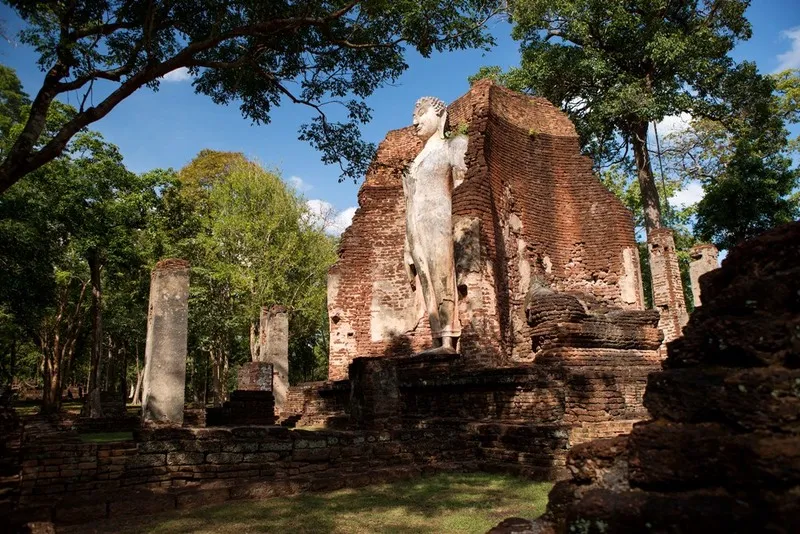
Wat Phra Si Iriyabot, also widely known as Wat Phra Yuen, is one of the most important historical Buddhist monuments in Kamphaeng Phet Historical Park. Located in the Aranyik forest-monastery zone north of the ancient city, in Nong Pling Subdistrict, Mueang Kamphaeng Phet District, this ancient temple is a remarkable place for visitors who want to understand Sukhothai-period Buddhist art, Kamphaeng Phet craftsmanship, laterite architecture, and the spiritual landscape of an old Thai city. The temple’s most distinctive feature is its large four-sided mondop that once enshrined Buddha images in 4 postures: walking, sitting, standing, and reclining. Today, the standing Buddha remains the most visible and best-preserved figure, giving the temple its popular name, Wat Phra Yuen, or the Temple of the Standing Buddha.
This temple is especially valuable for travelers who want to see more than beautiful ruins. Wat Phra Si Iriyabot reflects a complete religious idea expressed through architecture, sculpture, and spatial planning. Its four Buddha postures symbolize different aspects of the Buddha’s life and teaching. Its laterite structures reveal the construction techniques of Kamphaeng Phet. Its position in the Aranyik zone shows the relationship between the ancient city and forest monasteries. For this reason, the site is not only visually impressive but also intellectually rewarding.
The temple stands outside the ancient city wall, in the northern Aranyik area. This zone was historically associated with forest monasteries, meditation, and religious practice away from the busy urban center. Several important monuments are found in this area, including Wat Chang Rop, Wat Phra Non, Wat Sing, and Wat Phra Si Iriyabot. These temples are generally spacious, peaceful, and strongly associated with laterite construction. The atmosphere is quieter than the central city zone, giving visitors a sense of how Buddhist monastic life once extended beyond the walled city.
Wat Phra Si Iriyabot is believed to have been built around the 20th to 22nd Buddhist centuries, a period when Kamphaeng Phet was closely connected with the Sukhothai cultural sphere. The temple’s art shares characteristics with Sukhothai Buddhist sculpture but also shows local Kamphaeng Phet features. The broad forehead and pointed chin of the standing Buddha are often recognized as distinctive traits of the Kamphaeng Phet school. This makes the temple an important place for understanding how Sukhothai artistic ideals were adapted and developed in a local context.
The temple layout is rectangular and faces east, following common Buddhist planning principles. Visitors enter from the front and move toward the main sacred axis. The boundary walls and architectural remains are largely made of laterite, a reddish-brown local material widely used in Kamphaeng Phet. Laterite gives the site a strong visual identity. Its rough texture, warm color, and weathered surfaces create a solemn atmosphere that differs from brick monuments in other ancient cities.
At the front of the temple are water features and bathing-related structures. These elements are important because they show that ancient temples were not only places of worship, but also carefully planned spaces with water management. Some water pits were created through laterite extraction, and the same material was then used to construct buildings. These features therefore help visitors understand both practical resource use and the ritual importance of cleanliness before entering sacred space.
The large vihara at the front of the temple is another significant structure. It was built on a raised base with 2 levels. The lower base, used as a circumambulatory platform, features decorative laterite elements, while the side edges include low laterite balustrades imitating wooden forms. This detail shows that ancient craftsmen did not use laterite only for strength. They also shaped it to express architectural beauty and to recreate the appearance of wooden construction in a more durable material.
Inside the vihara were monk seating platforms and a Buddha pedestal. Square laterite pillars once supported the roof structure. The vihara served as a ritual and assembly space that led visitors toward the great mondop behind it. Walking from the front vihara to the main mondop allows modern visitors to experience the sacred sequence intended by the ancient builders.
The main highlight is the large four-sided mondop behind the vihara. It stands within an inner boundary wall and has projecting porches on 4 sides. At the center is a massive square core that once supported the roof. Each side of the central core was recessed to enshrine a stucco Buddha image in one of 4 postures. The eastern side held a walking Buddha, the northern side a reclining Buddha, the southern side a seated Buddha, and the western side a standing Buddha. The standing Buddha on the western side is the best-preserved figure today.
The concept of 4 Buddha postures has deep religious meaning. The walking Buddha represents movement, teaching, and the spreading of the Dhamma. The seated Buddha is associated with meditation, enlightenment, and inner stillness. The standing Buddha expresses stability, compassion, and the act of teaching or blessing. The reclining Buddha is connected with rest, the final passing into Parinirvana, and important episodes in Buddhist tradition. Bringing all 4 postures together in one mondop creates a powerful image of the Buddha’s presence in all dimensions of life.
The standing Buddha is a major work of Sukhothai-influenced Kamphaeng Phet art. Its broad forehead, pointed chin, graceful body, and calm expression reflect refined Buddhist ideals. The figure is impressive not only because of its size, but also because it preserves the artistic identity of the region. For students of Thai art history, this image is one of the clearest examples of the Kamphaeng Phet style.
Although the other Buddha images are now damaged, their remains still allow visitors to imagine the original grandeur of the mondop. In the past, a worshipper walking around the structure would have encountered the Buddha in different postures on each side. This movement around the mondop was not simply architectural circulation. It was a devotional experience, combining walking, viewing, reflection, and remembrance of Buddhist teachings.
Another important structure is the small ubosot located near the southern boundary of the temple. It has a low laterite base and slate boundary stones placed around it. This shows that Wat Phra Si Iriyabot was not only a site with a large Buddha mondop, but also a functioning monastery with a designated ordination area. The ubosot helps complete our understanding of the temple’s religious role in the ancient city.
Wat Phra Si Iriyabot was mentioned in royal travel writings by King Rama V and King Rama VI, when he was still Crown Prince. Their descriptions of the monument confirm that the temple was already recognized as an important and impressive historical site more than a century ago. These records also help modern visitors understand how the monument appeared in the past and why it attracted royal attention during journeys to the old city of Kamphaeng Phet.
King Rama V referred to the monument by the local name Wat Phra Yuen and described the great four-sided structure with Buddha images in different postures. King Rama VI also described the four-chambered structure with standing, seated, walking, and reclining Buddha images. These historical descriptions are valuable because they preserve impressions of the temple before further deterioration occurred. They also show that the four-posture mondop has long been the temple’s defining feature.
The use of laterite is essential to the identity of this temple. Kamphaeng Phet is famous for laterite monuments, and Wat Phra Si Iriyabot is one of the best places to see this material used in large-scale architecture. Laterite creates a strong, earthy atmosphere. Over time, its surface becomes weathered, textured, and visually powerful. The reddish-brown structures standing among trees give the Aranyik zone a distinctive sacred character.
From an art-historical perspective, Wat Phra Si Iriyabot demonstrates the relationship between Sukhothai and Kamphaeng Phet. The Buddhist images and architectural ideas reflect Sukhothai influence, but the details belong to the local school. The standing Buddha’s facial features and body proportions help distinguish Kamphaeng Phet craftsmanship from other regional styles. Visitors interested in Thai art can use this temple as a key site for comparing Sukhothai, Kamphaeng Phet, and other historical traditions.
The atmosphere around the temple is calm and shaded. The Aranyik area of Kamphaeng Phet Historical Park contains many trees, making the walk pleasant, especially in the morning or late afternoon. Visitors can take time to read the information signs, walk around the mondop, observe the standing Buddha from different angles, and examine the vihara, water features, boundary walls, and ubosot. A slow visit reveals that every element was carefully placed within the sacred plan of the temple.
A typical visit takes around 30 minutes to 1 hour. Visitors who enjoy photography, historical interpretation, or close observation of architectural details may want to spend longer. The best times to visit are early morning and late afternoon, when the light is softer and the heat is less intense. The late afternoon light can be especially beautiful on the laterite surfaces and the standing Buddha.
For families, the temple offers a practical way to teach children about Buddhist art and history. The idea of 4 postures is easy to understand, and children can see how walking, sitting, standing, and reclining are represented in sacred art. Parents can also point out laterite construction, the layout of the temple, and the relationship between the monument and the surrounding forest-monastery zone.
For foreign travelers, Wat Phra Si Iriyabot is one of the clearest and most memorable monuments in Kamphaeng Phet. The concept of 4 Buddha postures can be explained simply, and the standing Buddha provides a strong visual focus. The site helps international visitors understand that Thai Buddhist art presents the Buddha in many forms, each with a different meaning and spiritual context.
The temple is best visited together with other monuments in the Aranyik zone, such as Wat Sing, Wat Phra Non, Wat Chang Rop, and Wat Awat Yai. Each monument has a different character. Wat Phra Si Iriyabot is known for the four-posture mondop, Wat Phra Non for its reclining Buddha and large layout, and Wat Chang Rop for its elephant-surrounded stupa base. Visiting them together gives travelers a richer understanding of the forest-monastery landscape of ancient Kamphaeng Phet.
Compared with Wat Phra Kaeo and Wat Phra That inside the city wall, Wat Phra Si Iriyabot offers a different atmosphere. The central city monuments reflect urban religious and political space, while the Aranyik temples reflect forest practice, quietness, and monastic separation from the city. Exploring both areas helps visitors understand how ancient Kamphaeng Phet was organized into city and forest zones.
Visitors should follow conservation rules carefully. Do not climb on the ruins, do not touch or scratch the laterite surfaces, do not enter restricted areas, and do not perform activities that could damage the ancient structures. These monuments have survived for hundreds of years and require respect from every visitor. Responsible behavior helps preserve the site for future generations.
In terms of conservation, Wat Phra Si Iriyabot remains highly valuable because several major components are still visible: the standing Buddha, mondop, vihara, boundary walls, water features, and ubosot. Together, they allow historians, archaeologists, students, and visitors to study an ancient temple as a complete spatial system rather than as isolated remains. The site’s preservation depends on both official care and visitor responsibility.
Getting There is convenient by private car, rental car, or hired local transport from Kamphaeng Phet town. The temple is located inside Kamphaeng Phet Historical Park in the Aranyik zone, Nong Pling Subdistrict. From the town center, the drive is short and the route is clearly connected with the historical park. Visitors without a car can hire local transport from town and explore the area on foot or by bicycle within the park.
For a well-planned visit, travelers can begin at the visitor information area of Kamphaeng Phet Historical Park, then explore the Aranyik zone, including Wat Phra Si Iriyabot, Wat Sing, Wat Phra Non, and Wat Chang Rop. After that, they can continue to the city-wall zone to see Wat Phra Kaeo, Wat Phra That, and Kamphaeng Phet National Museum. This route offers a complete view of both the city and forest-monastery landscapes.
Photographers should choose angles that include both the standing Buddha and the structure of the mondop. Medium-distance shots usually work better than very close views because the Buddha and the architectural remains are large. A good photograph should show the relationship between the image, the laterite structure, and the surrounding Aranyik landscape.
At a deeper level, Wat Phra Si Iriyabot reminds visitors that Buddhist practice can be present in every posture of life. Walking, sitting, standing, and reclining are ordinary human actions, but in Buddhist art they become reminders of mindfulness, teaching, meditation, compassion, and liberation. This makes the temple meaningful not only as an archaeological monument, but also as a place for quiet reflection.
In summary, Wat Phra Si Iriyabot is one of the most important monuments in Kamphaeng Phet Historical Park. It preserves the unique idea of a four-posture Buddha mondop, a large standing Buddha in Kamphaeng Phet-style Sukhothai art, laterite architecture, a vihara, an ubosot, water features, and historical associations with royal travel writings. For anyone who wants to understand the artistic and spiritual heart of ancient Kamphaeng Phet, this temple is an essential stop.
| Name | Wat Phra Si Iriyabot / Wat Phra Yuen |
| Location | Kamphaeng Phet Historical Park, Aranyik Zone, Nong Pling Subdistrict, Mueang Kamphaeng Phet District, Kamphaeng Phet Province |
| Address | Nong Pling Subdistrict, Mueang Kamphaeng Phet District, Kamphaeng Phet 62000, Thailand, inside Kamphaeng Phet Historical Park |
| Coordinates | 16.5015, 99.51483 |
| Highlights | Four-sided mondop with Buddha images in 4 postures, large standing Buddha, Kamphaeng Phet-style Sukhothai art, laterite vihara, water features, and forest-monastery atmosphere |
| History | Built around the 20th to 22nd Buddhist centuries in the Aranyik zone of ancient Kamphaeng Phet. The temple was mentioned in royal travel writings by King Rama V and King Rama VI. |
| Name Origin | The name Wat Phra Si Iriyabot refers to the Buddha images in 4 postures: walking, sitting, standing, and reclining. Wat Phra Yuen refers to the prominent standing Buddha that remains most visible today. |
| Distinctive Features | Rectangular east-facing temple plan, front vihara, large four-sided mondop, inner boundary wall, ubosot, water features, and laterite construction typical of Kamphaeng Phet |
| Important Sacred Objects | Standing Buddha in Kamphaeng Phet-style Sukhothai art, four-posture mondop, laterite vihara, ubosot, slate boundary stones, water features, and ancient bathing structure |
| Main Areas / Zones | Front water feature area, vihara, four-posture Buddha mondop, western standing Buddha, southern ubosot, temple boundary wall, and inner boundary wall |
| Travel Information | Travel from Kamphaeng Phet town to Kamphaeng Phet Historical Park, Aranyik Zone, Nong Pling Subdistrict. Private car, rental car, or hired local transport is convenient. The site can be combined with Wat Sing, Wat Phra Non, and Wat Chang Rop. |
| Current Status | An ancient monument inside Kamphaeng Phet Historical Park, open to visitors under the supervision of the Fine Arts Department |
| Open Days | Daily |
| Opening Hours | 08.30 – 16.30 |
| Fees | Thai nationals 10 Baht, foreigners 30 Baht |
| Caretaker | Fine Arts Department, through Kamphaeng Phet Historical Park |
| Main Contact Number | 055 711 921 |
| Nearby Tourist Attractions | 1. Wat Sing, about 0.2 km 2. Wat Phra Non, about 0.8 km 3. Wat Chang Rop, about 1 km 4. Kamphaeng Phet Historical Park Visitor Center, about 2 km 5. Kamphaeng Phet National Museum, about 4 km 6. Wat Phra Kaeo Kamphaeng Phet, about 4 km 7. Wat Phra That Kamphaeng Phet, about 4 km |
| Nearby Restaurants | 1. Pad Thai Hor Khai Na Rong Phak, about 3 km 2. Wara Drip Coffee, about 3 km 3. Kamphaeng Phet Phochana, about 4 km, Tel. 055-713-035 4. Thammarat Phochana, about 4 km, Tel. 055-714-247, 088-228-5449 5. Kuai Tiao Nai Ya, about 5 km, Tel. 089-839-0138 6. Kamphaeng Phet Phochana Je Porn, about 5 km, Tel. 061-554-4261 |
| Nearby Accommodations | 1. La Riva Boutique Hotel, about 4 km 2. Hin Sai Resortel, about 4 km 3. Navarat Heritage Hotel, about 5 km 4. Chakungrao Riverview Hotel, about 5 km, Tel. 055-714-900-4 5. Grand The Room Hotel, about 6 km 6. P. Paradise Hotel, about 6 km |
Frequently Asked Questions (FAQ)
Q: Where is Wat Phra Si Iriyabot located?
A: Wat Phra Si Iriyabot is located inside Kamphaeng Phet Historical Park, in the Aranyik Zone, Nong Pling Subdistrict, Mueang Kamphaeng Phet District, Kamphaeng Phet Province.
Q: Why is it called Wat Phra Si Iriyabot?
A: The name refers to the Buddha images in 4 postures: walking, sitting, standing, and reclining, once enshrined around the four-sided mondop.
Q: Is Wat Phra Si Iriyabot the same as Wat Phra Yuen?
A: Yes. Wat Phra Yuen is the popular local name, referring to the large standing Buddha that remains the most visible feature of the temple.
Q: What are the opening hours?
A: The site is open daily from 08.30 to 16.30.
Q: How much is the entrance fee?
A: Admission to Kamphaeng Phet Historical Park is 10 Baht for Thai nationals and 30 Baht for foreign visitors.
Q: What is the main highlight of Wat Phra Si Iriyabot?
A: The main highlight is the large four-sided mondop and the standing Buddha in Kamphaeng Phet-style Sukhothai art, which remains more complete than the other Buddha images.
Q: How long should visitors spend here?
A: Visitors should spend around 30 minutes to 1 hour to walk around the mondop, read the information signs, and take photos respectfully.
Q: What nearby sites can be visited together with this temple?
A: Nearby sites include Wat Sing, Wat Phra Non, Wat Chang Rop, Wat Phra Kaeo, Wat Phra That, and Kamphaeng Phet National Museum.
 Category: ●Places of Worship
 Group: ●Temple
Last Update : 5 MonthAgo
 Last Update : 5 MonthAgo
 Click to Access the Navigation Map GPS
Wat Phra Si Iriyabot Map
Recommend

 Art, Culture and Heritage
 Historical Sites and Monuments(4)
 Landmarks and Memorials(1)
 Art, Craft Centres, Tradition(4)
 Museums(4)
 Historic Homes and Cities(1)
Temple(25)
Historic Homes and Cities(1)
Temple(25)
 Other Sacred Sites(8)
 Research and Development
 Royal Project(2)
 Suburban Living
 Village, Community(2)
 Local Market(2)
 Nature and Wildlife
 National Parks and Marine Reserves(4)
 Mountain (Doi)(2)
 Dam, Reservoir, Lake(4)
 Waterfalls(4)
 Hot Springs(1)
 River, Canal(3)
 Bays and Beaches(2)
 Other natural attractions(1)
 Entertainment and Agricultural
 Farms, Parks and Ecotourism(5)
 Waterpark(1)
 Shopping
 Shopping and Night Market(1)
 Travel Articles, Recipes
 Travel Review, Food Review(1)


