
lovethailand home >Central Travel Attractions >Bangkok Travel Attractions >Bang Plad >Bang Plad > Wat Awutvikasitaram
TL;DR: Wat Awutvikasitaram is located at Bang Phlat Subdistrict, Bang Phlat District, Bangkok, Thailand, open Daily, hours 08:30 – 17:00.
Wat Awutvikasitaram
Open Days: Daily
Opening Hours: 08:30 – 17:00
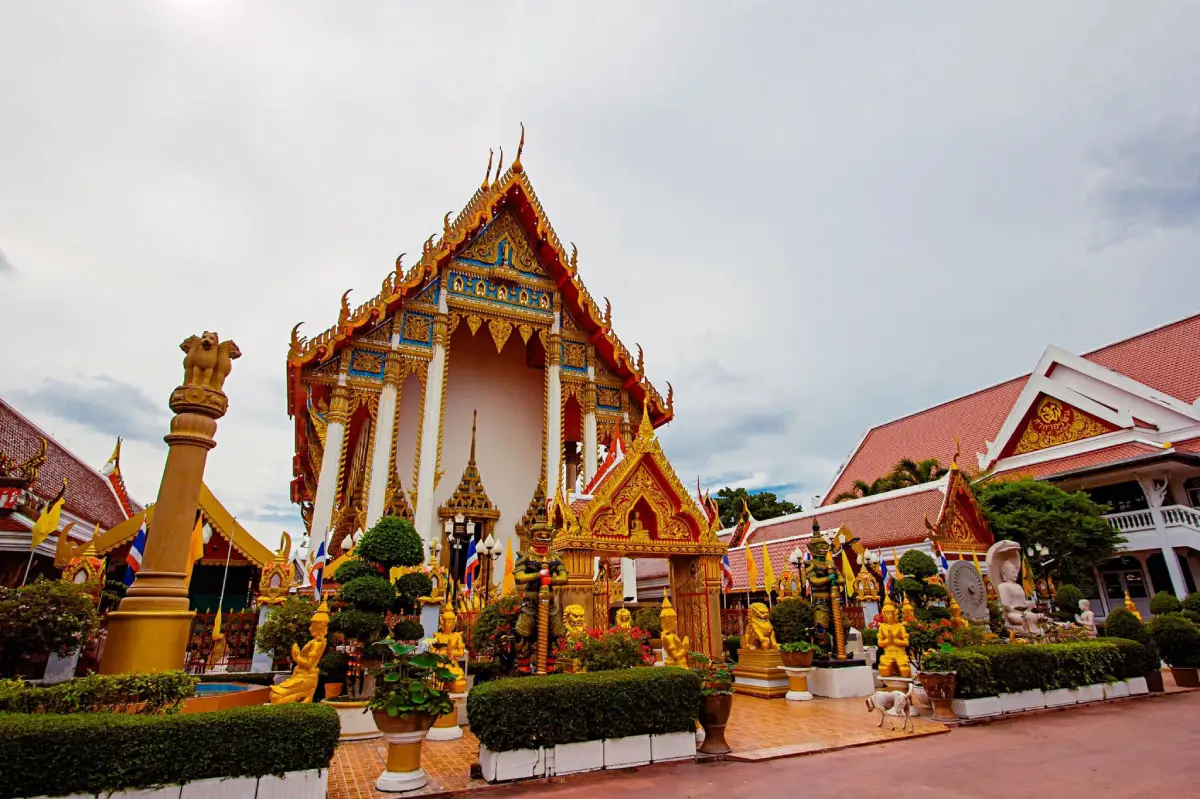
Wat Awut Wikasitaram, commonly shortened to Wat Awut, is a third-class royal monastery of the Dhammayut Nikaya at 436 Soi Charan Sanitwong 72, Bang Phlat, Bangkok 10700. Located close to the Chao Phraya River, the temple is significant for the history of the Bang Phlat community, Buddhist monastic education, its royal-monastery status, and its association with the followers of Khun Mae Bunruen Tongboonterm. Important areas include the ordination hall, a principal Buddha image modeled after Phra Phuttha Chinnarat, an Ashoka pillar monument, a Dharma Wheel, the Khun Mae Bunruen shrine, a monastic Pali and Dhamma school, a bell tower, a drum tower, and a commemorative garden. The current abbot is Phra Phrom Wachara Sutthachan (Thongdee Thitayuko), and the temple remains an active religious institution in 2026.
Information updated: September 13, 2026. Wat Awut Wikasitaram is open and continues to host Buddhist ceremonies, community activities, monastic education, and events organized with public agencies. Recent activities in 2026 include a Visakha Bucha meditation walk and run in May and a major Buddhist ceremony in August. Travelers specifically visiting the Khun Mae Bunruen shrine should note that the shrine follows a shorter daily schedule of 09:00 – 16:00, while the general temple grounds are listed as open from approximately 08:30 – 17:00.
Wat Awut Wikasitaram is especially rewarding for travelers who want to understand how Bangkok temples developed alongside riverside communities. Its history brings together migration after the fall of Ayutthaya, the growth of the old Bang Phlat settlement, major restoration during the reign of King Rama V, the temple's affiliation with the Dhammayut order, its later recognition as a royal monastery, and its continuing role in Buddhist education. It is therefore more than a place for a short prayer stop. The temple offers a compact introduction to the religious and social history of Bangkok's Thonburi side.
The temple's local history reaches back to communities that settled along the Chao Phraya after Ayutthaya fell in 1767. Monks and residents established themselves around the mouth of Khlong Bang Phlat at a time when waterways formed Bangkok's principal transport network. A monastic residence gradually developed in the area, serving people living around the canal and the river.
Local temple history records the development of a temple at the mouth of Khlong Bang Phlat in 1879. It became known as Wat Pak Khlong Bang Phlat, meaning the temple at the mouth of Bang Phlat Canal, and was also called Wat Bang Phlat Nok. A modern temple registry, meanwhile, publishes 1895 as the temple's official establishment year. Both dates appear in records concerning Wat Awut Wikasitaram and represent different stages in the long development of the religious community rather than a reason to discard one strand of its history.
A major transformation took place toward the end of the nineteenth century. Phra Achan Si, Colonel Phraya Awut Phan Phed, also known as Thuam, and other patrons supported extensive restoration. Monks' residences, assembly areas, the ordination hall, and facilities for religious activity were improved. During the reign of King Chulalongkorn, Rama V, the temple also became affiliated with the Dhammayut Nikaya, giving it the monastic identity that it retains today.
The royal name “Wat Awut Wikasitaram” preserves the memory of important patrons. “Awut” refers to Phraya Awut Phan Phed. The Pali-derived word “Wikasit” carries the sense of blossoming or opening and is associated with the name Yaem, the wife of Phraya Awut. “Aram” means monastery or temple. Bangkok's official district information records that the temple received the name Wat Awut Wikasitaram in 1899 during the reign of King Rama V.
The temple received its first formally designated consecrated boundary in 1898 and another in 1968. On April 22, 1996, Wat Awut Wikasitaram was elevated to the status of a third-class royal monastery of the common type. This status reflects the temple's expanded role beyond the immediate neighborhood, particularly in Buddhist education, Sangha affairs, and formal religious ceremonies.
The physical setting still reveals the temple's connection with old riverside Bangkok. The Chao Phraya lies on one side of the area, while modern access is through Soi Charan Sanitwong 72. Visitors arriving from busy Charan Sanitwong Road quickly encounter a quieter religious environment. This contrast between modern urban transport and the historic riverside community is part of what makes Wat Awut Wikasitaram interesting even for travelers who have already visited more famous temples in central Bangkok.
The ordination hall is one of the main religious spaces. Its principal Buddha image follows the revered Phra Phuttha Chinnarat style, one of Thailand's best-known Buddha-image traditions. Standing disciples and Buddha images in different postures are also associated with the principal shrine arrangement. The hall therefore serves both as a functioning sacred space and as a useful place for visitors interested in Thai Buddhist art.
Another recognizable feature is the temple's Ashoka pillar monument together with its Dharma Wheel. These elements refer symbolically to Emperor Ashoka and the historical spread of Buddhism. Visitors should understand them as religious and educational monuments within the temple rather than assume that they are original ancient artifacts brought from India. Their value lies in the Buddhist ideas and history they represent.
The drum tower, bell tower, monks' residences, ceremonial halls, and other working areas reinforce the fact that Wat Awut Wikasitaram is an active monastery rather than a heritage attraction staged exclusively for tourism. Monks live and study here, families attend merit-making ceremonies, funerals and memorial rites take place, and the temple continues to function as part of everyday community life.
A commemorative garden honoring the 48th birthday anniversary of Princess Maha Chakri Sirindhorn adds a quieter landscaped area to the temple grounds. After visiting the ordination hall and the principal shrines, travelers can spend time walking through the grounds rather than treating the temple as a quick photography stop.
Many visitors search for Wat Awut because of Khun Mae Bunruen Tongboonterm, a respected Buddhist lay practitioner whose followers continue to visit the temple. A dedicated shrine provides space for paying respects, chanting, and quiet meditation. Her name is widely associated among followers with Buddhist practice, the Chimphli chant, and the Phra Puttho Noi tradition. The temple therefore attracts visitors interested in devotional culture as well as those interested in architectural or historical tourism.
Visitors to the Khun Mae Bunruen shrine do not need to follow an elaborate ritual. Modest clothing, calm behavior, and respect for people who are chanting or meditating are the most important considerations. If offerings or devotional items are available, travelers should follow the instructions provided by the shrine attendants. This is more reliable than relying on unverified ritual instructions circulated online.
The shrine's operating hours are particularly useful for trip planning. Current place information lists the Khun Mae Bunruen shrine as open daily from 09:00 to 16:00. Travelers whose main purpose is to pay respects to Khun Mae Bunruen should therefore arrive well before 16:00. The wider temple visit can be planned within the general 08:30 to 17:00 opening period.
Wat Awut Wikasitaram also has a substantial educational role. Formal Dhamma and Pali education was developed seriously from around 1987, and the temple was approved as a recognized monastic school on November 20, 1991. This function remains important today. The temple is therefore part of Bangkok's living Buddhist educational network, training monks and novices in scripture, Pali, and monastic studies.
Since 1989, the temple has also served a formal community and institutional role through arrangements allowing its crematorium to be used for Royal Thai Army personnel and their families on the Thonburi side of Bangkok. This is another reason visitors may encounter funerals, memorial services, or other private ceremonies while visiting. Tourists should keep an appropriate distance from ceremonies and avoid photographing mourners without permission.
The current abbot, Phra Phrom Wachara Sutthachan (Thongdee Thitayuko), has responsibilities extending beyond the management of the temple. He previously held the ecclesiastical title Phra Dhamma Wachira Suthi and was elevated to his current title in 2024. In December 2025 he was appointed a member of the Sangha Supreme Council of Thailand. His role links Wat Awut Wikasitaram directly with national-level Buddhist administration as well as monastic education.
The temple's continuing relevance can be seen clearly in 2026. On May 31, 2026, Bang Phlat District organized a Visakha Bucha meditation walk and run at Wat Awut Wikasitaram. On August 24, 2026, the temple hosted a ceremony connected with the construction of the Phra Phuttha Sutthanat Sasada Buddha image, with the current abbot presiding on the monastic side. These recent activities confirm that the monastery remains active in religious and community life.
Most visitors should allow around 1 to 2 hours. This provides enough time to pay respects in the ordination hall, see the Phra Phuttha Chinnarat-style principal image, visit the Ashoka pillar and Dharma Wheel, enter the Khun Mae Bunruen shrine during its opening hours, and walk through the temple grounds without rushing. Travelers with a strong interest in local history or Buddhist practice can comfortably stay longer.
Morning is generally the most comfortable time to visit, particularly during Bangkok's hotter months. It also leaves ample time to visit the Khun Mae Bunruen shrine before it closes. Buddhist holy days and major festival days can be much busier, and religious ceremonies may temporarily limit access to particular areas. Visitors should treat these activities as part of the temple's living religious character and adjust their route quietly rather than interrupt proceedings.
Appropriate temple etiquette is straightforward. Wear clothing that covers the shoulders and knees, keep voices low, remove shoes where instructed, and avoid obstructing monks or worshippers. Ask permission before photographing monks or people engaged in prayer or meditation. Families with children should supervise them carefully inside the ordination hall and other ceremonial spaces.
Wat Awut Wikasitaram is also useful for understanding the historical geography of Bang Phlat. The old name Wat Pak Khlong Bang Phlat identifies the temple with the canal mouth and the water-based settlement pattern that shaped this area long before Charan Sanitwong Road and the MRT became the dominant transport corridors. Walking through the temple today reveals how a historic riverside religious site has been absorbed into dense modern Bangkok while retaining its original community role.
The temple can be combined easily with several nearby religious and historical sites. Wat Thephakon, Wat Bang Phlat, and Wat Thep Nari are all within roughly 1 kilometer. With more time, visitors can continue toward Wat Rachathiwat, Rama VIII Bridge, or the National Museum of Royal Barges. This makes Bang Phlat a practical half-day or full-day cultural route for travelers who want to move beyond Bangkok's most crowded temple circuit.
Food options around Soi Charan Sanitwong 72 include neighborhood kitchens, noodle shops, made-to-order Thai restaurants, Muslim food, and restaurants inside nearby shopping facilities. Accommodation ranges from small local hotels to larger riverside properties. Staying in Bang Phlat can be practical for travelers who want access to Thonburi's historic neighborhoods while remaining connected to central Bangkok by the MRT Blue Line.
Getting There is easiest by the MRT Blue Line. Get off at Bang Phlat MRT Station, use Exit 4, and enter Soi Charan Sanitwong 72. The walk from the station to the temple is approximately 600 meters, or a short local ride can be used. Drivers can approach via Charan Sanitwong Road and turn into Soi Charan Sanitwong 72. Vehicles can enter the temple area, although parking can become busy on Buddhist holy days and during major ceremonies, making the MRT the more predictable option.
Although the temple stands close to the Chao Phraya River, general visitors should plan their trip around the road or MRT network rather than assume that regular Chao Phraya Express Boat services stop directly at the temple. Bang Phlat MRT Station provides a much clearer and more dependable route, especially for international visitors unfamiliar with Bangkok's local river piers.
Wat Awut Wikasitaram is therefore suitable for travelers interested in merit-making, Khun Mae Bunruen, Buddhist art, Bangkok history, monastic education, or lesser-known royal temples accessible by public transport. Its appeal comes from the combination of post-Ayutthaya community history, royal patronage during the Rama V period, a continuing Dhammayut monastic tradition, Buddhist education, and active religious life in present-day Bang Phlat.
| Name | Wat Awut Wikasitaram (Wat Awut) |
| Former Names | Wat Pak Khlong Bang Phlat and Wat Bang Phlat Nok |
| Temple Classification | Third-Class Royal Monastery, Common Type, Dhammayut Nikaya |
| Location | Bang Phlat Subdistrict, Bang Phlat District, Bangkok, Thailand |
| Address | 436 Soi Charan Sanitwong 72, Bang Phlat, Bangkok 10700, Thailand |
| Coordinates | 13.79012, 100.50557 |
| Highlights | Royal monastery near the Chao Phraya River, Bang Phlat community history, Phra Phuttha Chinnarat-style principal Buddha image, Ashoka pillar monument, Dharma Wheel, Khun Mae Bunruen shrine, and monastic school |
| History | The community history is connected with riverside settlement after 1767. Local history records a temple developing at the mouth of Khlong Bang Phlat in 1879, while a modern temple registry lists 1895 as the establishment year. The temple received its present royal name during the reign of King Rama V and was elevated to a third-class royal monastery on April 22, 1996. |
| Name Origin | “Awut” refers to the patron Phraya Awut Phan Phed; “Wikasit” relates in meaning to the name Yaem, his wife; and “Aram” means monastery. |
| Distinctive Features | A historic Bang Phlat community temple that became a royal monastery and continues to function as a center of worship, monastic education, community ceremonies, and devotion connected with Khun Mae Bunruen |
| Main Areas / Zones | Ordination hall, Khun Mae Bunruen shrine, Ashoka pillar monument, Dharma Wheel, monastic school, drum tower, bell tower, and Princess Sirindhorn 48th Birthday Commemorative Garden |
| Principal Buddha Image | A Buddha image modeled after Phra Phuttha Chinnarat |
| Abbot | Phra Phrom Wachara Sutthachan (Thongdee Thitayuko) |
| Current Status | Open and active, with resident monks, monastic education, ceremonies, and documented religious activities continuing in 2026 |
| Open Days | Daily |
| Opening Hours | General temple area: 08:30 – 17:00; Khun Mae Bunruen shrine: 09:00 – 16:00 |
| Admission Fee | No general admission fee |
| Facilities | Parking, restrooms, and wheelchair-accessible entrance information for the Khun Mae Bunruen shrine area |
| Travel Information | Take the MRT Blue Line to Bang Phlat Station, Exit 4, then walk approximately 600 meters through Soi Charan Sanitwong 72. Drivers can access the temple from Charan Sanitwong Road. |
| Main Contact Number | 081-383-9353 |
| Official Page | Facebook: Wat Awut Wikasitaram |
| Nearby Tourist Attractions | 1. Wat Thephakon, approximately 0.6 km 2. Wat Bang Phlat, approximately 0.8 km 3. Wat Thep Nari, approximately 0.8 km 4. Wat Rachathiwat, approximately 1.6 km 5. Rama VIII Bridge, approximately 2.6 km 6. National Museum of Royal Barges, approximately 3.9 km |
| Nearby Restaurants | 1. Krua Khun Pa, Soi Charan Sanitwong 72, approximately 0.2 km, Tel. 080-780-6808 2. MK Restaurants Lotus's Charan Sanitwong, approximately 0.4 km, Tel. 083-099-6168 3. Nai Hui Pork Ball Noodle Shop, approximately 0.4 km 4. Krua Khun Yai, approximately 0.6 km, Tel. 081-116-1011 5. Bang Phlat-Charan Muslim Restaurant, approximately 0.6 km, Tel. 062-970-2333 |
| Nearby Accommodations | 1. Anwari Hotel, approximately 0.2 km, Tel. 02-424-1247 2. H-Banaat Hotel, approximately 1.3 km, Tel. 093-560-1660 3. Riverside Bangkok Hotel, approximately 1.3 km, Tel. 02-883-1588 4. P-Park Hotel Bangkok, approximately 1.8 km, Tel. 095-937-3030 5. BangkokHaus, approximately 2.4 km, Tel. 080-502-4111 |
Frequently Asked Questions (FAQ)
Q: Where is Wat Awut Wikasitaram located?
A: The temple is at 436 Soi Charan Sanitwong 72, Bang Phlat, Bangkok 10700, near the Chao Phraya River and Bang Phlat MRT Station.
Q: What are the opening hours of Wat Awut Wikasitaram?
A: The general temple area is listed as open daily from approximately 08:30 to 17:00. The Khun Mae Bunruen shrine operates daily from 09:00 to 16:00.
Q: How do I get to Wat Awut Wikasitaram by MRT?
A: Take the MRT Blue Line to Bang Phlat Station, use Exit 4, enter Soi Charan Sanitwong 72, and walk approximately 600 meters to the temple.
Q: Is there an admission fee at Wat Awut Wikasitaram?
A: There is no general admission fee for entering the temple and paying respects. Donations and merit-making contributions are voluntary.
Q: Why is Wat Awut associated with Khun Mae Bunruen?
A: The temple has a dedicated shrine to Khun Mae Bunruen Tongboonterm, a respected Buddhist lay practitioner. Followers visit the shrine for prayer, chanting, meditation, and to learn about the devotional tradition associated with her.
Q: Who is the current abbot of Wat Awut Wikasitaram?
A: The current abbot is Phra Phrom Wachara Sutthachan (Thongdee Thitayuko), who is also involved in senior monastic administration and Buddhist education.
Q: What should visitors see inside Wat Awut Wikasitaram?
A: Important areas include the ordination hall and Phra Phuttha Chinnarat-style principal Buddha image, the Khun Mae Bunruen shrine, the Ashoka pillar monument, Dharma Wheel, monastic school, bell tower, drum tower, and commemorative garden.
Q: How much time should I allow for a visit?
A: Around 1 to 2 hours is suitable for a relaxed visit covering the principal shrine, Khun Mae Bunruen shrine, major monuments, and the temple grounds. Allow extra time on Buddhist holy days or during major ceremonies.
 Category: ●Places of Worship
 Group: ●Temple
Last Update : 1 MonthAgo
 Last Update : 1 MonthAgo
 Click to Access the Navigation Map GPS
Wat Awutvikasitaram Map
Recommend

 Phra Nakhon(24)Dusit(17)Khlong San(7)Khlong Toei(3)Jatujak(2)Don Muang(5)Taling Chan(26)Thon Buri(23)Bangkok Noi(31)Bangkok Yai(13)Bang Kapi(5)Bang Kun Tien(15)Bang Khen(3)Bang Kholam(10)Bang Sue(9)Bang Plad(23)Bang Rak(6)Chom Thong(16)Bung Kum(5)Pra Wet(6)Patum Wan(6)Pom Prap Sattru Phai(11)Paya Thai(1)Pra Kanong(4)Pa Sri Charoen(23)Min Buri(7)Yan Na Wa(8)Ratchathewi(4)Rat Burana(6)Lat Krabang(13)Nong Chok(16)Lat Phrao(4)Sathorn(4)Sam Phan Tha Wong(12)Nong Khaem(7)Huai Khwang(3)Suan Luang(7)Din Daeng(2)Lak Si(1)Sai Mai(8)Khan Na Yao(2)Wang Thong Lang(1)Klong Sam Wa(10)Watthana(2)Bang Na(4)Thawi Watthana(3)Bang Khae(5)Thung Khru(4)Bang Bon(3)


