
lovethailand home >Central Travel Attractions >Bangkok Travel Attractions >Bang Khae >Bang Phai > Wat Boonyapradit
TL;DR: Wat Boonyapradit is located at Phutthamonthon Sai 2 Road, Bang Phai Subdistrict, Bang Khae District, Bangkok, open Daily, hours 08.00 – 17.00.
Wat Boonyapradit
Open Days: Daily
Opening Hours: 08.00 – 17.00
Wat Boonyapradit is a third-class royal Buddhist temple of ordinary type located at 9 Moo 2, Phutthamonthon Sai 2 Road, Bang Phai Subdistrict, Bang Khae District, Bangkok 10160. It belongs to the Mahā Nikāya order and is the only royal temple in Bang Khae District. The temple is important as a long-established Buddhist center on the western side of Bangkok, a community temple that developed into a royal temple, and a living religious space connected with merit-making, monastic education, community activities, and the history of Bang Phai and Bang Khae.
For travelers looking for an important temple around Phutthamonthon Sai 2, Wat Boonyapradit is a meaningful place to visit. It is not only a local temple for everyday merit-making, but also a royal temple with a formal religious status in Thai Buddhism. Its status as a third-class royal temple of ordinary type gives it a significance beyond an ordinary neighborhood temple. It is especially valuable for visitors who want to understand Buddhist history and community development in western Bangkok, particularly around Bang Khae, Bang Phai, Phutthamonthon Sai 2, and the area near Khlong Bang Waek.
The temple stands on flat land covering approximately 23 rai and 15 square wah. Its recorded land title deeds include several plots, and the temple area is connected with surrounding communities, schools, residential zones, Phutthamonthon Sai 2 Road, and Khlong Bang Waek on the southern side. This setting gives Wat Boonyapradit the character of an urban community temple that still preserves the atmosphere of older Thonburi-side settlement. Visitors can see that the temple is not simply a ceremonial place; it is a religious and social center that has grown together with the local community.
The former names of Wat Boonyapradit were Wat Mai Boon Nuam and Wat Mai Ta Nuam. These names are important because they preserve the memory of the temple’s founders and the local people who first supported the site. Around 1935, Khun Yom Boon and Khun Yom Nuam Phothinimit donated 10 rai, 3 ngan, and 78 square wah of land for the construction of a temple. They invited Phra Ajarn Sawat from Wat Sala Daeng to reside there and care for the early temple community. This origin reflects a common pattern in Thai temple history: a temple begins through local devotion, then gradually develops into a stable religious institution.
After Phra Ajarn Sawat passed away, Phra Ajarn Harang was invited to reside at the temple in 1938. Wat Boonyapradit was then officially established as a temple in 1939. This period was a key transition from a small Buddhist residence supported by local devotees into a recognized temple with clearer religious and administrative status. As the temple became more established, it gradually became an important Buddhist center for Bang Phai and Bang Khae.
The period of Luang Pho Sin Tisso was another major stage in the temple’s development. He was appointed as the first abbot in 1946 and worked to build and improve several key facilities, including the original ordination hall, sermon hall, chanting hall, monks’ residences, funeral pavilion, and a Dhamma study center. His work helped turn Wat Boonyapradit into a more complete Buddhist institution, serving both monks and laypeople. This period laid the foundation for the temple’s later growth.
In 1956, Phra Ajarn Chamrat Phatthako became the second abbot before leaving the monkhood in 1960. Phra Ajarn Sanit Amaro then became the third abbot in 1960 and played an important role in expanding the temple. He built 40 monks’ rooms and, in 1967, purchased more than 5 rai of additional land. Together with the temple committee and local residents, he also helped cut a soil road to improve access to the temple. This road was important because it connected the temple more directly with the community and made it easier for people to come for worship and merit-making.
The temple’s growth shows that Wat Boonyapradit did not become important overnight. It developed through land donation, monastic leadership, construction of religious buildings, expansion of temple land, access-road development, Buddhist education, and continuous community support. Each generation of monks and lay supporters contributed something different, but together they created a stable religious center with strong roots in the local community.
In 1975, Phra Maha Thuanthong Chinawangso, who had been ordained at Wat Boonyapradit and later studied at Wat Paknam Phasi Charoen, returned to serve as acting abbot. He later became known as Phra Pariyattikit Sophon and, in later ecclesiastical rank, Phra Thep Sitthimethi. His return was significant because he had a direct relationship with the temple. He continued its development during a period when Bang Khae and Phutthamonthon Sai 2 were changing from suburban communities into more urban neighborhoods.
Phra Maha Thuanthong Chinawangso, later Phra Pariyattikit Sophon, played an important role in guiding Wat Boonyapradit toward its elevation as a royal temple in 2004. The temple was elevated according to an announcement by the National Office of Buddhism dated 2 October 2003 and published in the Royal Gazette on 1 January 2004. This was a major turning point: a community temple that had begun with local land donation was formally raised to the status of a third-class royal temple of ordinary type, becoming the only royal temple in Bang Khae District.
The elevation to royal temple status was not only an administrative change. It reflected the temple’s readiness in history, management, religious facilities, monastic life, Buddhist service, and community role. Wat Boonyapradit is therefore a clear example of how a local temple can grow into an important royal Buddhist temple through accumulated devotion, organized development, and long-term cooperation between monks and laypeople.
The current abbot of Wat Boonyapradit is Phra Khru Atthakitjanukul Suphot Thanadhammo. Recent temple activity records and local district information identify him as the leading monk responsible for religious ceremonies, temple administration, and community activities. After the passing of the former abbot Phra Thep Sitthimethi, the temple continued its Buddhist functions without interruption. It remains active with resident monks, Kathin ceremonies, annual events, and youth programs such as summer novice ordination, which helps introduce Buddhist ethics to children and young people in Bang Khae.
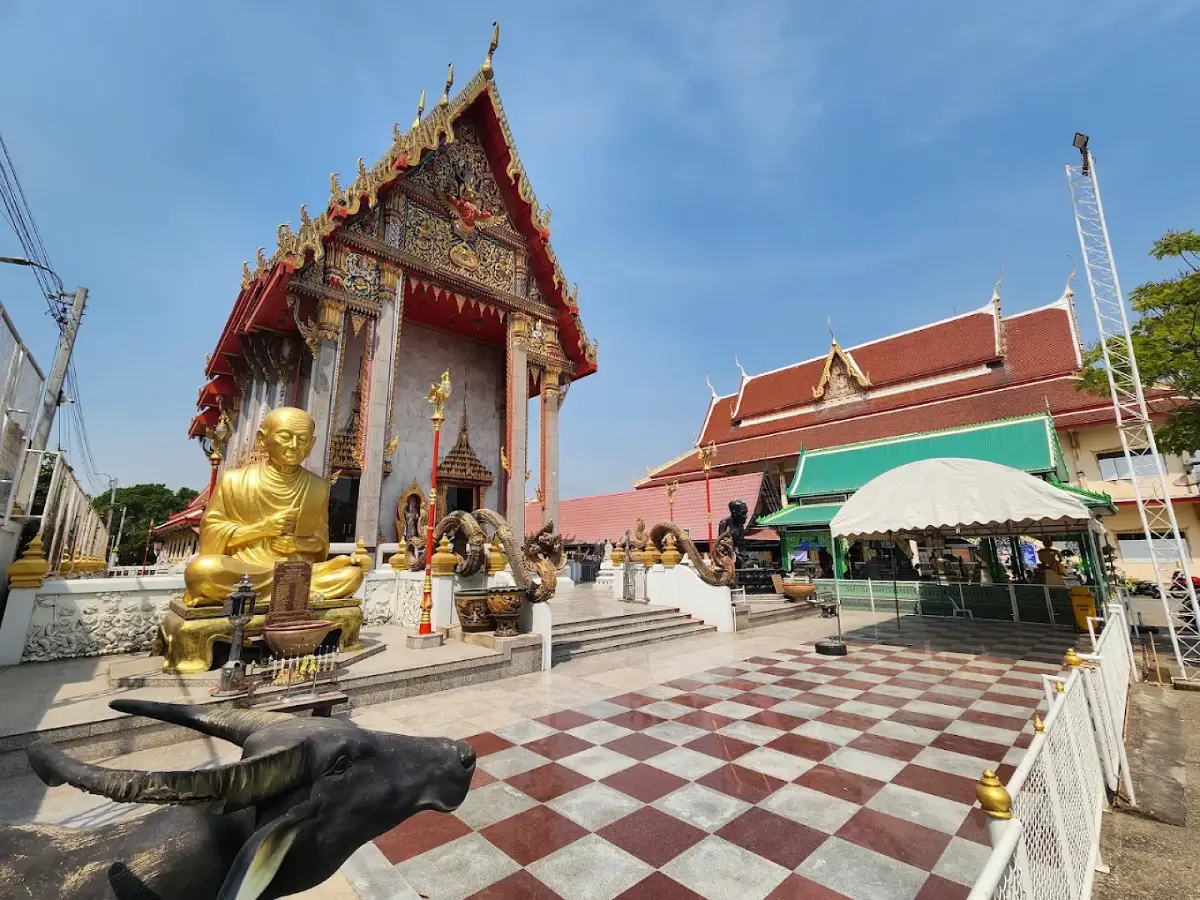
Architecturally, Wat Boonyapradit has important sacred buildings that show different stages of temple development. The former ordination hall, now serving as a vihara, was built in 1954. It is 6 meters wide and 25 meters long. Later renovations added Sukhothai glazed roof tiles, chofa finials, bai raka roof ornaments, traditional stucco door and window arches, a teak gable decorated with lacquer, gold leaf, and mirror work, as well as tiled interior flooring and walls. These details give the old vihara religious and historical value as a record of the temple’s development over time.
The new ordination hall was built during the period of Phra Khru Phiphatthanakowit. Its foundation stone ceremony took place in 1988, presided over by Somdet Phra Phutthakhosachan Fuen Chutintharo, Pali Grade 9, former ecclesiastical governor of the Central Region from Wat Sam Phraya. The building is reinforced concrete, with a marble floor, Sukhothai glazed roof tiles, gilded and mirror-decorated gables and arches, washed-stone exterior surfaces, and interior mural paintings. This ordination hall is one of the most important spaces in the temple because it is used for monastic rites and serves as the main worship area for lay visitors.
The principal sacred object of Wat Boonyapradit is the main Buddha image in the ordination hall in the posture of subduing Mara. Other revered objects associated with the temple’s annual ceremonies include a replica Buddha footprint, Luang Pho Pan, Luang Pho Sot, Luang Pho Sin, and Luang Pho Thuanthong, Phra Thep Sitthimethi. The annual gilding and worship of these sacred objects reflect the devotion of local Buddhists and visitors from nearby districts. The temple is therefore both a place for worship and a space that preserves the memory of important monks who helped develop it.
One of the most interesting aspects of Wat Boonyapradit is the close connection between people and place. The names of Khun Yom Boon, Khun Yom Nuam, Phra Ajarn Sawat, Phra Ajarn Harang, Luang Pho Sin, Phra Ajarn Sanit, Phra Maha Thuanthong, and Phra Khru Atthakitjanukul are not simply a list of names in temple history. Together, they represent generations of monks and laypeople who built, cared for, expanded, and preserved the temple. To understand Wat Boonyapradit properly, visitors should look not only at its buildings and Buddha images, but also at the human devotion behind them.
The temple compound includes several important areas, such as the ordination hall, old vihara, sermon hall, chanting hall, monks’ residences, funeral pavilion, merit-making areas, ceremonial areas, and surrounding community spaces. These areas allow the temple to support many functions: daily chanting, Buddhist holy day observances, ordination ceremonies, almsgiving, funeral rites, Kathin ceremonies, annual festivals, monastic education, and community development activities. Wat Boonyapradit is therefore a living temple, not a static historical site.
The temple’s community role can be seen through activities conducted with Bang Khae District Office and local organizations. These include summer novice ordination projects, annual merit-making events, tree planting and landscape improvement, and activities involving children, youth, and local residents. The temple’s continuing events in 2025 and 2026 confirm that it remains active and continues to serve as a Buddhist center for Bang Khae.
First-time visitors should begin by paying respect to the main Buddha image in the ordination hall or main worship area. They can then walk respectfully around the old vihara and other religious buildings. During the annual temple fair or merit-making period, visitors may have the opportunity to pay respect to the replica Buddha footprint, Luang Pho Pan, Luang Pho Sot, Luang Pho Sin, and Luang Pho Thuanthong. A visit should not be rushed, because the temple’s value is found in its history, architecture, religious atmosphere, and continuing community life.
The atmosphere of Wat Boonyapradit is suitable for quiet worship. Although the temple is located near Phutthamonthon Sai 2 Road, an area with convenient transport and urban activity, the temple compound preserves the order and calm of a working Buddhist temple. Visitors who want to make merit, offer alms, join religious ceremonies, or stop for a quiet moment while traveling around Bang Khae and Thawi Watthana can include this temple easily in their route. Morning and late afternoon are usually the most comfortable times to visit.
Visitors should dress respectfully. Clothing should cover the shoulders and knees. Keep voices low in the ordination hall and ceremonial areas, avoid disturbing monks or worshippers, do not walk across active ritual spaces, and do not climb onto statue bases or sacred platforms. If a funeral or memorial ceremony is taking place, visitors should move quietly and respectfully. Wat Boonyapradit is a shared religious space for monks, local Buddhists, and families using the temple for important life events.
Getting There by Private Car is convenient via Phutthamonthon Sai 2 Road. The temple can be reached from Phet Kasem Road, Borommaratchachonnani Road, Bang Waek Road, Kanchanaphisek Road, Phutthamonthon Sai 1 Road, and Phutthamonthon Sai 3 Road. Visitors coming from Thonburi can approach through Bang Khae or Taling Chan, while visitors from Nakhon Pathom or Phutthamonthon can connect through Borommaratchachonnani Road or nearby western Bangkok routes.
A commonly used navigation point is Soi Phatthanarat, also known as Phutthamonthon Sai 2 Soi 11, which leads toward the temple area. Drivers should use map navigation with the temple name Wat Boonyapradit or the coordinates 13.729, 100.388, especially because Phutthamonthon Sai 2 has many smaller lanes and local communities. Checking the route before departure will help visitors reach the temple more easily.
Visitors using public transport can connect from MRT Lak Song Station, Bang Khae, or other Thonburi-side transport points, then continue by local bus, taxi, or hired local transport toward Phutthamonthon Sai 2 Road. Several public bus routes serve the wider area around Bang Khae and Phutthamonthon Sai 2. Travelers unfamiliar with the area should check current bus routes on the day of travel, as service patterns and stops may change according to traffic and route adjustments.
Wat Boonyapradit can be combined with several nearby attractions. Travelers can visit Khlong Lat Mayom Floating Market, Thonburi Market or Sanam Luang 2, Suan Thawi Wanarom, Utthayan Road, and Phutthamonthon on the same day. This route is suitable for those who want to begin with merit-making, then continue to local markets, food, green spaces, and cultural places on the western side of Bangkok.
From a religious tourism perspective, Wat Boonyapradit is ideal for visitors who want a temple with formal religious status, community history, and continuing local activity. It began with donated land from local supporters, was developed by several generations of monks, contains important worship spaces and sacred objects, and was elevated to become the only royal temple in Bang Khae District. These qualities make it more than a neighborhood temple; it is a place to understand Buddhism, community development, and the expansion of western Bangkok.
Wat Boonyapradit is therefore a meaningful destination for visitors seeking a peaceful Bangkok temple with clear historical depth. A visit introduces the story of Wat Mai Boon Nuam and Wat Mai Ta Nuam, the devotion of Khun Yom Boon and Khun Yom Nuam Phothinimit, the temple’s development through generations of monks, its principal Buddha image and revered sacred objects, and the atmosphere of a royal temple that continues to serve Buddhist and community life in Bang Khae.
| Name | Wat Boonyapradit |
| Temple Type | Third-Class Royal Temple, Ordinary Type |
| Buddhist Order | Mahā Nikāya |
| Location | Phutthamonthon Sai 2 Road, Bang Phai Subdistrict, Bang Khae District, Bangkok |
| Address | 9 Moo 2, Phutthamonthon Sai 2 Road, Bang Phai, Bang Khae, Bangkok 10160, Thailand |
| Navigation Point | 528 Soi Phatthanarat, also known as Phutthamonthon Sai 2 Soi 11, Bang Phai, Bang Khae, Bangkok 10160 |
| Coordinates | 13.729, 100.388 |
| Temple Land Area | 23 rai and 15 square wah |
| Founded As A Temple | 1939 |
| Wisungkhamasima | 3 September 1985 |
| Royal Temple Elevation | Elevated in 2004 according to the National Office of Buddhism announcement dated 2 October 2003 and published in the Royal Gazette on 1 January 2004 |
| Former Names | Wat Mai Boon Nuam and Wat Mai Ta Nuam |
| Original Land Donors | Khun Yom Boon and Khun Yom Nuam Phothinimit donated the first 10 rai, 3 ngan, and 78 square wah around 1935 |
| Highlights | The only royal temple in Bang Khae District, with roots as an old community temple, an important ordination hall, an old vihara, and revered sacred objects worshipped during annual temple events |
| Important Sacred Objects | Main Buddha image in the ordination hall in the posture of subduing Mara, replica Buddha footprint, Luang Pho Pan, Luang Pho Sot, Luang Pho Sin, and Luang Pho Thuanthong, Phra Thep Sitthimethi |
| Main Areas / Zones | Ordination hall, old vihara, sermon hall, chanting hall, monks’ residences, funeral pavilion, merit-making areas, ceremonial areas, and surrounding community spaces |
| Current Status | Open as an active royal Buddhist temple with resident monks, Kathin ceremonies, annual temple events, summer novice ordination programs, and activities with Bang Khae District Office |
| Open Days | Daily |
| Opening Hours | 08.00 – 17.00 |
| Abbot / Caretaker | Phra Khru Atthakitjanukul Suphot Thanadhammo |
| Main Contact Number | 02-413-3042 |
| Travel Information | Accessible by private car via Phutthamonthon Sai 2 Road, with connections from Phet Kasem Road, Borommaratchachonnani Road, Bang Waek Road, Kanchanaphisek Road, Phutthamonthon Sai 1 Road, and Phutthamonthon Sai 3 Road. Public transport users can connect from MRT Lak Song Station or Bang Khae and continue toward Phutthamonthon Sai 2. |
| Facilities | Parking area, restrooms, religious activity areas, funeral pavilion, and spaces for merit-making and community Buddhist activities |
| Nearby Tourist Attractions | 1. Khlong Lat Mayom Floating Market, about 6 km 2. Thonburi Market, Sanam Luang 2, about 7 km 3. Suan Thawi Wanarom, about 7 km 4. Utthayan Road, about 9 km 5. Phutthamonthon, about 11 km |
| Nearby Restaurants | 1. Ayutthaya Boat Noodles, Old Branch, Phutthamonthon Sai 2 Soi 7, about 1 km, Tel. 086-517-1140 2. Yok Niew Coffee, Wat Boonyapradit Area, about 1 km, Tel. 098-262-5422, 095-929-3232 3. Sushi Homu Phutthamonthon Sai 2, about 3 km, Tel. 061-556-6919 4. Phutthachat Phutthamonthon Sai 2, about 4 km, Tel. 02-448-1197, 081-657-7804 5. Choi Roasted Duck Phutthamonthon Sai 2, about 4 km, Tel. 095-264-2226, 086-311-8131 |
| Nearby Accommodations | 1. Icare Residence & Hotel, about 4 km, Tel. 065-991-9989 2. At Yaya, about 5 km, Tel. 081-347-5080 3. Ruan Plaisoi Apartment, about 5 km, Tel. 084-460-9222 4. Penyos Residence, about 6 km, Tel. 087-018-7193 5. The Box Residence, about 9 km, Tel. 085-059-7979 |
Frequently Asked Questions (FAQ)
Q: Where is Wat Boonyapradit located?
A: Wat Boonyapradit is located at 9 Moo 2, Phutthamonthon Sai 2 Road, Bang Phai Subdistrict, Bang Khae District, Bangkok 10160, Thailand.
Q: What type of temple is Wat Boonyapradit?
A: Wat Boonyapradit is a third-class royal Buddhist temple of ordinary type under the Mahā Nikāya order. It is the only royal temple in Bang Khae District.
Q: What is the history of Wat Boonyapradit?
A: The temple began with a land donation by Khun Yom Boon and Khun Yom Nuam Phothinimit around 1935. It was formerly known as Wat Mai Boon Nuam and Wat Mai Ta Nuam, was officially established as a temple in 1939, and was elevated to royal temple status in 2004.
Q: Who is the current abbot of Wat Boonyapradit?
A: The current abbot is Phra Khru Atthakitjanukul Suphot Thanadhammo.
Q: What sacred objects can visitors worship at Wat Boonyapradit?
A: Important sacred objects include the main Buddha image in the ordination hall in the posture of subduing Mara, a replica Buddha footprint, Luang Pho Pan, Luang Pho Sot, Luang Pho Sin, and Luang Pho Thuanthong, Phra Thep Sitthimethi.
Q: What are the opening days and hours of Wat Boonyapradit?
A: Wat Boonyapradit is open daily from 08.00 to 17.00.
Q: Can visitors reach Wat Boonyapradit by public transport?
A: Yes. Visitors can connect from MRT Lak Song Station, Bang Khae, or other Thonburi-side transport points, then continue by local bus, taxi, or hired local transport toward Phutthamonthon Sai 2 Road.
Q: What nearby places can be visited with Wat Boonyapradit?
A: Nearby places include Khlong Lat Mayom Floating Market, Thonburi Market or Sanam Luang 2, Suan Thawi Wanarom, Utthayan Road, and Phutthamonthon.
 Category: ●Places of Worship
 Group: ●Temple
Last Update : 1 MonthAgo
 Last Update : 1 MonthAgo
 Click to Access the Navigation Map GPS
Wat Boonyapradit Map
Recommend

 Phra Nakhon(24)Dusit(17)Khlong San(7)Khlong Toei(3)Jatujak(2)Don Muang(5)Taling Chan(26)Thon Buri(23)Bangkok Noi(31)Bangkok Yai(13)Bang Kapi(5)Bang Kun Tien(15)Bang Khen(3)Bang Kholam(10)Bang Sue(9)Bang Plad(23)Bang Rak(6)Chom Thong(16)Bung Kum(5)Pra Wet(6)Patum Wan(6)Pom Prap Sattru Phai(11)Paya Thai(1)Pra Kanong(4)Pa Sri Charoen(23)Min Buri(7)Yan Na Wa(8)Ratchathewi(4)Rat Burana(6)Lat Krabang(13)Nong Chok(16)Lat Phrao(4)Sathorn(4)Sam Phan Tha Wong(12)Nong Khaem(7)Huai Khwang(3)Suan Luang(7)Din Daeng(2)Lak Si(1)Sai Mai(8)Khan Na Yao(2)Wang Thong Lang(1)Klong Sam Wa(10)Watthana(2)Bang Na(4)Thawi Watthana(3)Bang Khae(5)Thung Khru(4)Bang Bon(3)


