
lovethailand home >North Travel Attractions >Chiang Mai Travel Attractions >Muang Chiang Mai >Chang Phueak > Payap University (Mae Khao Campus)
TL;DR: Payap University (Mae Khao Campus), open Monday–Friday for Administrative Offices Following Their Regular Working, hours 08:00–16:00 for University Units Publishing These Contact Hours; Other Offices.

Payap University (Mae Khao Campus)
Open Days: Monday–Friday for Administrative Offices Following Their Regular Working Schedule
Opening Hours: 08:00–16:00 for University Units Publishing These Contact Hours; Other Offices and Services Follow Their Own Announced Schedules
Payap University, Mae Khao Campus, located at 272 Moo 2, San Phranet Subdistrict, San Sai District, Chiang Mai 50210, Thailand, is the principal campus of Payap University, an institution of particular importance in the history of Thai higher education as the country's first private university. Established on March 21, 1974, as Payap College under the Foundation of the Church of Christ in Thailand, the institution attained university status on July 25, 1984. Today, Payap University is known for its programs in Business Administration, Pharmacy, Law, Nursing, Music, Languages, Information Technology, and International Education. Its guiding philosophy, “Truth–Service,” emphasizes the development of graduates who combine academic knowledge with moral responsibility. Mae Khao Campus contains academic and administrative buildings, the Sirindhorn Learning Resource Center, Henry R. Luce Chapel, meeting and assembly facilities, student residences, and landscaped open spaces. In 2026, Payap University marks 52 years since its original establishment and continues to play an important role in education, research, community service, and intercultural collaboration in northern Thailand and internationally.
One of the most distinctive characteristics of Payap University, Mae Khao Campus, is its historical relationship with Christian education in Thailand and its development into a higher education institution welcoming students from different religious, linguistic, and cultural backgrounds. Admission is not restricted to Christians. Students from the general public may apply according to the academic requirements of each program. The university's educational philosophy focuses on academic competence, professional responsibility, ethical conduct, and meaningful contributions to society. Truth–Service therefore represents an approach to both learning and life rather than simply an institutional slogan.
The name Payap has historical and geographical associations with northern and northwestern Thailand. It appeared in the former administrative name Monthon Payap, which referred to a major region of northern Siam. The university's name thus reflects its connection with northern Thailand and particularly with Chiang Mai, a longstanding center of regional history, culture, religion, and education. The institution's identity combines this regional heritage with a commitment to expanding opportunities for higher education.
Mae Khao Campus occupies a substantial area near the Chiang Mai–Lampang Superhighway, connected with the San Phranet and Nong Pa Khrang communities on the eastern side of Chiang Mai. The surroundings include residential neighborhoods, businesses, restaurants, hotels, shopping facilities, and important transportation routes. Its location allows students and staff to travel from central Chiang Mai, San Sai District, and neighboring communities. Despite the urban development surrounding the university, the campus retains landscaped areas and greenery that contribute to its academic atmosphere.
The landscape of Mae Khao Campus differs from that of universities located entirely within densely built commercial districts. Academic buildings are distributed across spacious grounds containing gardens, trees, and open areas. Henry R. Luce Chapel is among the campus's most recognizable landmarks, with architecture reflecting the university's Christian historical foundations. The combination of educational buildings, religious spaces, and landscaped surroundings creates an environment supporting academic study, student activities, and opportunities for quiet reflection.
Before Payap University was established, Christian educational organizations had already made important contributions to northern Thailand, particularly in general education, nursing, and theological studies. McCormick School of Nursing and Midwifery and McGilvary Theological Seminary were significant institutions associated with the training of professionals and religious personnel. Their educational traditions formed important historical foundations for the establishment of Payap College and continue to influence the university's academic identity.
The Church of Christ in Thailand had pursued the establishment of a Christian higher education institution for more than 50 years. Its intention was to create educational opportunities combining professional knowledge with morality and service to society. However, legal and administrative circumstances delayed the project. When the Thai government introduced legislation in 1969 permitting private organizations to establish higher education institutions, the Church of Christ in Thailand was able to revive its long-standing plan.
In 1970, the Church of Christ in Thailand renewed its efforts to establish a private college by proposing to develop McCormick School of Nursing and Midwifery and McGilvary Theological Seminary into the foundations of a higher education institution. A committee was established to coordinate academic planning, administration, and the government approval process. This approach drew upon existing educational experience and reflected the Church's commitment to continuing its work in professional education and community service.
On March 21, 1974, the Thai government authorized the establishment of Payap College, marking an important development in the country's private higher education system. The institution initially offered bachelor's degrees in seven academic fields and an associate degree in one field. Its first intake comprised 189 students from 15 provinces. The geographical diversity of the first students demonstrated the institution's regional educational mission from the beginning.
The establishment of Payap College was particularly significant because Thai university education had previously been dominated by public institutions. The authorization of private higher education created additional opportunities for students and allowed organizations with established educational experience to contribute to the training of graduates. From the outset, Payap College emphasized the development of knowledgeable, capable, and morally responsible individuals who could contribute to the well-being of society.
During its early development, Payap College gradually expanded its academic programs and improved its buildings, administrative structures, and teaching resources. This development occurred alongside Chiang Mai's growth as a center of commerce, education, healthcare, tourism, and international relations. The increasing demand for specialized professional knowledge encouraged the institution to broaden its academic offerings and prepare graduates for a changing regional economy.
On July 25, 1984, Payap College received official permission to change its institutional status to Payap University, becoming Thailand's first private university. The transition marked a major milestone in the history of Thai higher education because it demonstrated the ability of a privately established college to develop the academic and administrative capacity required of a university. University status also strengthened opportunities for advanced degree programs, research, and collaboration with other institutions.
Two dates are particularly important in Payap University's history. March 21, 1974, commemorates the establishment of Payap College, while July 25, 1984, marks the institution's recognition as a university. In 2026, Payap University celebrates 52 years since the founding of the college and 42 years since obtaining university status. Distinguishing these dates is essential for understanding the institution's historical development accurately.
The development of Mae Khao Campus formed part of the university's efforts to accommodate a growing student population, additional academic programs, and increasingly diverse university activities. Mae Khao became the principal campus, containing administrative offices, teaching buildings, the central learning resources facility, student activity buildings, and residences. At the same time, Kaew Nawarat Campus continued to support academic units connected with the institution's earlier educational traditions.
Payap University has two principal educational locations in Chiang Mai Province: Mae Khao Campus in San Phranet Subdistrict, San Sai District, and Kaew Nawarat Campus at 131 Kaew Nawarat Road, Wat Ket Subdistrict, Mueang Chiang Mai District. The distinction is important for both prospective students and visitors because faculties and colleges are based at different locations. McCormick Faculty of Nursing, McGilvary College of Divinity, and the College of Music are associated with Kaew Nawarat Campus rather than the main Mae Khao site.
Mae Khao Campus functions as an important center for university administration and academic activities. It accommodates the Office of the President, the Office of the Registrar and Educational Services, the Faculty of Pharmacy, Faculty of Business Administration, Faculty of Law, Graduate School, International College, and Interdisciplinary Studies College. It also contains student services and academic resource facilities. Bringing these units together supports cooperation among university departments and provides convenient access to many administrative and educational services.
Payap University's guiding philosophy is “Truth–Service.” It emphasizes the pursuit of truth, personal integrity, ethical conduct, and the use of knowledge to benefit other people. Truth represents a commitment to intellectual honesty, responsible inquiry, and the development of understanding. Service expresses an obligation to care for others and contribute meaningfully to society. Together, the two principles encourage students to view education as preparation for both professional life and responsible citizenship.
This educational philosophy reflects the institution's Christian heritage, particularly its emphasis on love, compassion, and responsibility toward others. Its significance extends beyond religious observance to include professional ethics, respectful communication, and the application of knowledge in ways that support communities. Such values are relevant to students pursuing Nursing, Pharmacy, Law, Business Administration, Education, and other professional disciplines.
The university's official emblem is circular and contains four smaller circles symbolizing Humanity, Science, Art, and Religion. The emblem also includes the university's name and the words Truth–Service. These elements express an educational ideal that integrates different forms of knowledge and emphasizes the development of the whole person. They recognize the importance of understanding society, acquiring academic expertise, appreciating artistic and cultural expression, and cultivating moral responsibility.
The official university colors are sky blue and white. They are familiar symbols of institutional identity among students, employees, and alumni and are used in university activities and communications. The colors help create a shared sense of belonging across faculties, colleges, and generations of students. They also form part of the visual identity associated with Payap University's campus life and traditions.
The university's official flower is Bunnak (Mesua ferrea), known in English as the Ceylon Ironwood or Indian Rose Chestnut. Its white blossoms symbolize purity and goodness, while their fragrance represents a reputation that spreads widely. The flower's umbrella-like form is associated with honor and the value of human life. Bunnak therefore expresses the university's ideal of preparing graduates whose academic achievements are accompanied by good character and moral responsibility.
Students at Payap University are affectionately associated with the identity of “Children of Bunnak.” This name is reflected in activities welcoming new students and building relationships among students, teachers, and staff. Bunnak is therefore more than a botanical symbol. It has become part of the university's shared culture and represents friendship, mutual support, and a sense of belonging to the university community.
One distinctive university tradition is the Bunnak Welcoming Ceremony, an activity welcoming new students into the Payap community. On September 12, 2026, the university organized its annual Bunnak welcoming event at the Saitarntam building on Mae Khao Campus. Activities included the tying of white cotton threads around students' wrists as symbols of pure affection, friendship, and mutual support. The ceremony also featured candle lighting to symbolize the light of wisdom, a traditional northern Thai khantoke meal, and student performances.
The Bunnak Welcoming Ceremony demonstrates how cultural practices involving wrist-tying and welcoming new community members can be incorporated into university life. White cotton threads express goodwill and connection, while the symbolic candle ceremony associates the beginning of university studies with the pursuit of knowledge. These activities help create a sense of shared identity and encourage positive relationships among students from different backgrounds.
Payap University's Wai Khru Teacher Appreciation Ceremony has a distinctive character because it combines the Thai tradition of showing respect to teachers with Christian worship. On July 23, 2026, the university held its annual ceremony at Dr. Boonthong Poocharoen Auditorium. Students prepared ceremonial flower arrangements, participated in competitions recognizing craftsmanship and creativity, joined a worship service, listened to musical performances by the College of Music, expressed gratitude to their teachers, and made commitments concerning their education.
Within Payap University's educational culture, Wai Khru expresses appreciation for those who transmit knowledge and provides an opportunity to reflect on the responsibilities of learning. Christian elements within the ceremony reflect the institution's historical background and its emphasis on moral and spiritual development. The event therefore serves both as a university tradition and as an occasion for reaffirming the values that guide academic life.
Henry R. Luce Chapel is one of the most important landmarks on Mae Khao Campus and a prominent architectural expression of the university's Christian heritage. The building is recognizable for its distinctive roof and cross-topped structure and stands within a landscaped setting. Its appearance reflects the relationship between the university's academic environment and the importance it places on religious and ethical values.
The chapel accommodates Christian worship and selected ceremonial university activities, including occasions associated with graduation and the transition from student life to professional service. The use of a religious building within the academic environment allows students to reflect on personal values, responsibility, and service to others. For those interested in architecture or the history of Christian higher education, the chapel is also an important part of the university's institutional identity.
Patomagarn Building is another important location on Mae Khao Campus because it houses the Office of the President and university administrative meeting facilities. It is associated with institutional management, policy development, and coordination among university departments. In the 2026 academic year, meetings concerning the university's development and institutional strategy were held in facilities at Patomagarn Building.
Panyajarn Building is particularly important for prospective and current students because it accommodates the Office of the Registrar and Educational Services. This unit is responsible for activities including admissions procedures, student registration, academic records, and related documentation. Applicants who need to submit documents or complete in-person enrollment procedures are frequently directed to the registrar's facilities at Mae Khao Campus.
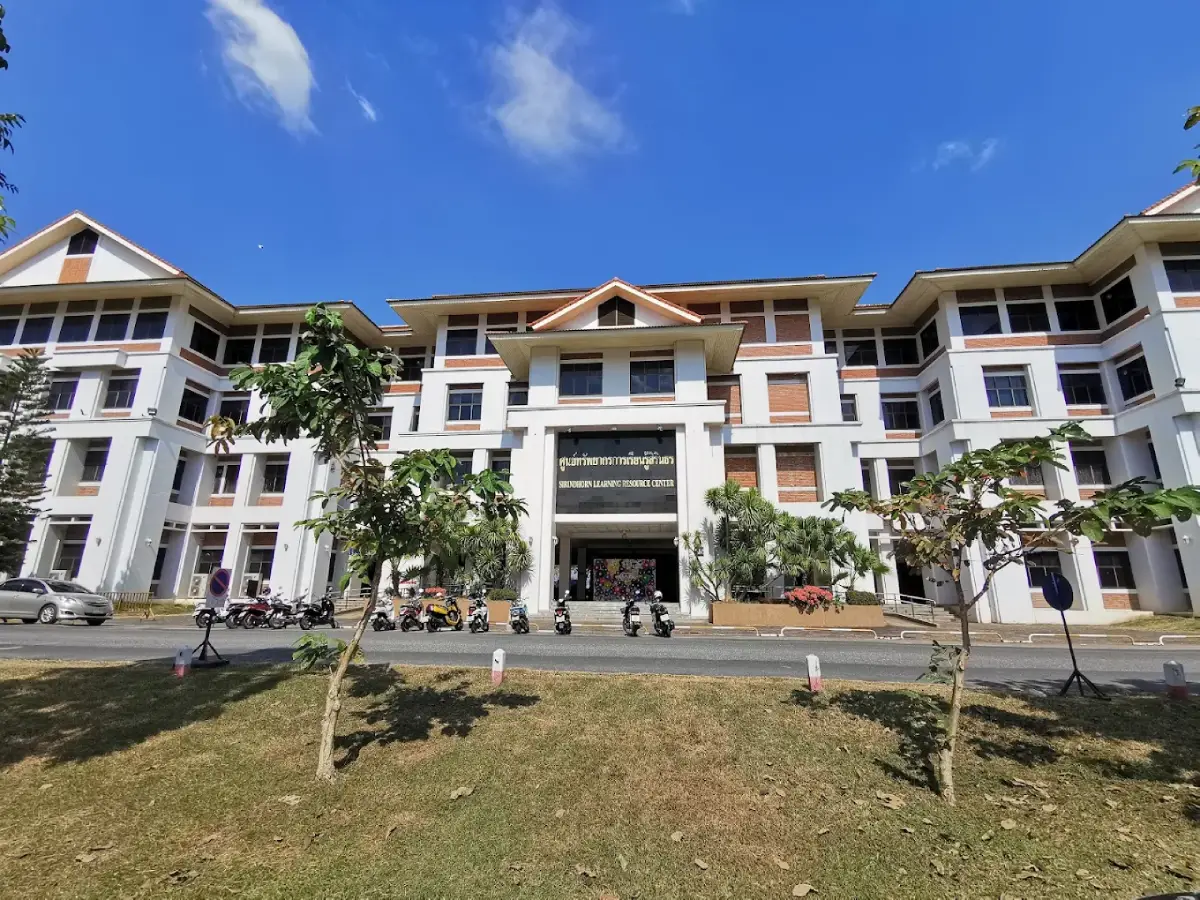
Sirindhorn Learning Resource Center is a principal center for academic information and learning resources. It supports students and staff through research materials, study facilities, and activities connected with teaching and learning. The center is also used for exhibitions and university events. During the 2026 Wai Khru activities, student ceremonial arrangements were displayed and evaluated in its exhibition area, illustrating how the facility supports both academic and cultural life.
Saitarntam Building is associated with large student activities and university gatherings. It hosted the Bunnak Welcoming Ceremony in September 2026, demonstrating its role as a space for student participation and the creation of shared university experiences. Activities in such settings complement formal education by encouraging communication, teamwork, and a sense of community.
Other buildings identified in the university's campus information include Ekasampan, Pantagorn, Nehemiah, Vajanakarn, and Benjaban, together with sporting and recreational areas. These facilities support academic departments, university services, and student activities. Familiarity with their names is particularly useful for students and visitors attending appointments, events, or meetings across the campus.
Payap University also maintains cultural facilities that support education and the preservation of local arts and traditions. Such work is particularly relevant in Chiang Mai, a city with a rich heritage of language, music, craftsmanship, and community customs. Cultural activities help connect higher education with regional traditions while encouraging students from Thailand and other countries to learn from one another.
The university's Bunnak flower is also associated with its campus landscape and environmental learning. Payap maintains a botanical information resource documenting trees and plants found around its grounds, including Bunnak, Phikun, Frangipani, and other species. Recording this information contributes to environmental education and encourages appreciation of the campus's natural resources and landscaped spaces.
Student accommodation is another important part of Mae Khao Campus. The university operates Alpha Women's Dormitory and Omega Men's Dormitory, providing residential options under university accommodation arrangements. On-campus housing is particularly useful for students arriving from other provinces or those wishing to live near teaching facilities. Residential life also creates opportunities to develop independence, personal responsibility, and the ability to live cooperatively with others.
Paradornparp International House is associated with accommodation for international visitors and academic activities. It reflects Payap University's role in welcoming participants in educational and intercultural programs. Facilities supporting visitors from outside Chiang Mai help the university organize academic events and develop international relationships, reinforcing its identity as an institution connected with global educational networks.
Academically, the Faculty of Pharmacy is an important unit based at Mae Khao Campus. Its professional degree program in Pharmaceutical Care combines knowledge of medicines, their appropriate use, health sciences, and professional ethics. The program normally requires six years of study and emphasizes both scientific understanding and the practical responsibilities of pharmacists toward patients and communities.
The Faculty of Business Administration develops knowledge and professional skills in management, entrepreneurship, accounting, marketing, finance, and technology-related business fields. Academic fields published by the university include Innovative Food Business Management, Hotel Management, Management and Entrepreneurship, Digital Marketing, Accountancy, Financial Management and Investment, and Software Engineering. These areas respond to the needs of a modern economy in which business knowledge and technological competence increasingly overlap.
Business education is particularly relevant to Chiang Mai's economy, which contains tourism enterprises, hotels, restaurants, retail businesses, technology services, and many smaller entrepreneurial ventures. Fields such as digital marketing, financial management, and innovative food business development help students understand business planning, customer needs, product development, and the effective use of resources. Learning experiences connected with real business operations can strengthen the transition from university study to professional employment.
The Faculty of Law, also based at Mae Khao Campus, emphasizes legal knowledge together with morality and professional responsibility. Students study legal principles, justice, rights, obligations, and the application of law within society. The university publishes regular and special study arrangements for its Bachelor of Laws program, reflecting options for applicants with different educational and professional backgrounds. Legal education contributes to the development of professionals who understand the importance of fairness, ethical conduct, and the rule of law.
The International College is one of the university's clearest expressions of its international academic identity. It provides Thai-language and international programs in languages, communication, business management, hospitality, information technology, and related disciplines. Learning within an environment that brings Thai and international students together promotes intercultural communication and prepares graduates for workplaces involving people from different linguistic and cultural backgrounds.
Programs in English for Career Development, English Communication, Business Chinese, Japanese Language and Culture, and Thai for Communication for Foreigners demonstrate the university's emphasis on language as a means of connecting people. Language education extends beyond vocabulary and grammar to include cultural understanding, social contexts, and effective communication across national boundaries. Such skills are valuable for careers in education, tourism, business, and international services.
International degree offerings also include International Business Management, Hospitality Industry Management, and Information Technology. These programs help students develop analytical, communication, management, and technical abilities relevant to international professional environments. Their presence is particularly significant in Chiang Mai, which has extensive connections with international tourism, foreign businesses, educational networks, and expatriate communities.
The Interdisciplinary Studies College connects different branches of knowledge to respond to economic and technological change. Digital Business and Financial Technology is one example of a program integrating business administration, digital systems, and financial innovation. Students explore the relationship between technology and business operations in a rapidly changing economic environment, developing knowledge relevant to entrepreneurship and contemporary financial services.
The Graduate School contributes to advanced education at the master's and doctoral levels. Its programs and related academic units support specialized study in business, education, languages, social sciences, and research. Graduate study allows professionals and university graduates to deepen their expertise, develop research skills, and explore questions arising from professional practice and contemporary social challenges.
Payap University publishes Thai-language and international postgraduate programs in areas including Business Administration, Law, Educational Administration, Linguistics, Peace Studies, Teaching English to Speakers of Other Languages, Educational Leadership, and Peacebuilding. These fields reflect the university's commitment to developing advanced knowledge across several dimensions of society, from professional management and educational policy to conflict resolution and cross-cultural communication.
Peace Studies is a particularly distinctive academic field within Payap University's international educational activities. It involves understanding differences in religion, culture, identity, and social perspectives while studying approaches to dialogue, cooperation, and conflict transformation. Such studies are relevant to the development of communities and institutions seeking constructive responses to social tensions. They also connect naturally with the university's commitment to Truth–Service.
Language and linguistics research also relates closely to the diversity of northern Thailand's communities. The university's interest in linguistics contributes to knowledge concerning language analysis, communication, language documentation, and teaching. These fields are valuable in regions where several languages and cultural traditions coexist, including Chiang Mai and neighboring areas with diverse ethnic communities.
Although Mae Khao Campus is the focus of this article, McCormick Faculty of Nursing is essential to understanding the university's history because its predecessor was one of the educational institutions that contributed to the foundation of Payap College. The faculty is associated with Kaew Nawarat Campus and prepares nurses through academic study, clinical skills training, and professional practice in healthcare settings. It emphasizes competence, responsibility, professional ethics, and compassionate care.
McGilvary College of Divinity is another historically important institution connected with the creation of Payap University. Its role involves Christian theological education and the preparation of personnel for service within churches and related organizations. Based at Kaew Nawarat Campus, the college represents the continuing significance of religious education within Payap University's wider academic community.
The College of Music, also associated with Kaew Nawarat Campus, supports professional education in music and performance. The university publishes programs in Music and Dance Performance and Digital Content Creation. Music education develops creative expression, performance abilities, discipline, and collaboration. Students and faculty members also contribute to university ceremonies and cultural events, including musical performances accompanying the Wai Khru and Christian worship ceremonies.
Research and academic services are important university responsibilities supported by offices and units concerned with academic affairs, research, linguistics, innovation, and community engagement. Research contributes to the development of knowledge that can be applied to problems involving business, health, languages, education, culture, and social relationships. These activities complement the university's teaching mission and encourage the application of academic expertise beyond the classroom.
Entrepreneurship education is one area where practical learning is particularly visible. University activities have included student-run simulated business operations that allow participants to develop skills in planning, organization, marketing, and management. Experiences of this kind connect theoretical business knowledge with the challenges encountered in professional practice, preparing students to respond more confidently to real workplace situations.
The university also operates initiatives connected with social impact and social entrepreneurship. Such activities reflect the Truth–Service philosophy by encouraging students and researchers to consider how professional success can contribute to community well-being. Applying knowledge in business and technology to social problems illustrates the relationship between ethical commitments and contemporary academic expertise.
The linguistic and cultural diversity of Mae Khao Campus contributes to an international learning atmosphere. Thai and international students interact through classes, student organizations, and academic exchange activities. These experiences help develop communication skills, respect for differences, and the ability to cooperate with people from varied backgrounds, all of which are valuable in modern professional and social life.
For visitors interested in educational and cultural tourism, Mae Khao Campus offers an opportunity to explore the history of private higher education in Thailand and the development of Christian education in Chiang Mai. Learning about the institution's founding, its emblem, the Truth–Service philosophy, Henry R. Luce Chapel, and its academic buildings provides insight into a distinctive part of Thailand's educational heritage. Formal study visits and access to specific university facilities should be arranged through the appropriate offices.
Payap University is an active educational institution rather than a conventional tourist attraction offering unrestricted access to every building. Teaching, research, administrative work, and religious activities take place throughout the campus. Visitors wishing to attend a service, visit the chapel, use library facilities, arrange an educational tour, or photograph the interior of university buildings should contact the responsible department and observe campus regulations.
The wider area around Mae Khao Campus contains several places of interest, including Wat San Phranet, Wat Nong Pa Khrang, Wat Buak Krok Noi, Wat Buak Krok Luang, and Central Chiang Mai shopping center. Each illustrates a different aspect of life in the eastern part of Chiang Mai. Community temples reflect local Buddhist traditions and neighborhood history, while major commercial facilities represent the economic development of the modern city.
Wat Buak Krok Luang is particularly interesting as a place to learn about Lanna religious art. Its temple hall contains mural paintings illustrating Buddhist stories and Jataka narratives, with influences associated with Shan artistic traditions. Wat Nong Pa Khrang and Wat San Phranet also serve as religious and community centers. Visiting such places offers opportunities to explore the cultural history of Chiang Mai beyond the more frequently visited temples inside the Old City.
The neighborhoods around the campus also provide a variety of restaurants, cafés, and accommodation options. Local food shops, noodle restaurants, international eateries, and hotels can be found in the Nong Pa Khrang, San Phranet, and Central Chiang Mai areas. These services are useful for students, families, conference participants, and visitors who need accommodation or meals near the university.
Prospective students should begin by examining the official program information and admission requirements published by the Office of the Registrar and Educational Services. Payap University provides online applications for Thai and international students. In the 2026 academic year, the university's admissions system also listed opportunities for the second semester, with different academic schedules for Thai-language and international programs. Confirming the appropriate intake and calendar is important before applying.
Applicants interested in professionally regulated fields such as Pharmacy and Nursing should pay particular attention to admission qualifications, required educational backgrounds, and selection procedures. These degrees involve specialized scientific knowledge and practical training. Programs in languages, business, law, and international education have different requirements. Selecting a degree should involve consideration of personal interests, academic preparation, study duration, and professional objectives.
Getting There: Payap University, Mae Khao Campus, is located at 272 Moo 2, San Phranet Subdistrict, San Sai District, Chiang Mai 50210. The Chiang Mai–Lampang Superhighway, Highway 11, is the main road connecting the area with central Chiang Mai and the wider region. Visitors traveling from other parts of Chiang Mai can use major connecting roads or ring roads to reach the university entrance. Those arriving from Lampang can travel along the Chiang Mai–Lampang route toward the eastern side of Chiang Mai before entering the campus.
Visitors arriving at Chiang Mai International Airport, Chiang Mai Railway Station, or the Chiang Mai Arcade Bus Terminal can continue by private vehicle, taxi, or app-based ride-hailing service. Travelers without their own transport should check suitable pick-up and drop-off locations before departure. Searching for “Payap University Mae Khao Campus” in a navigation application helps distinguish the destination from Kaew Nawarat Campus, which is located in a different part of Chiang Mai.
Prospective students and visitors needing registration or admissions services can contact the Office of the Registrar and Educational Services in Panyajarn Building at Mae Khao Campus. The university's main telephone numbers are +66 53 851 478 through +66 53 851 486. The student admissions office can be reached through extensions 240 or 241. Visitors contacting other departments should confirm the relevant extension and building before traveling.
Payap University, Mae Khao Campus, is significant for its contributions to Thai higher education, the development of private universities, and an educational philosophy connecting academic knowledge with morality and public service. Its growth from a private college with an initial enrollment of 189 students into a university offering diverse academic programs and international education illustrates the institution's sustained development over several decades.
As Payap University marks its 52nd anniversary in 2026, it continues to carry forward the educational ideals associated with its founding by the Church of Christ in Thailand. The pursuit of Truth–Service, intercultural understanding, professional knowledge, and social responsibility remains central to its identity. Mae Khao Campus is therefore more than a collection of classrooms and administrative buildings. It is a place of learning, an important part of the history of Thai private higher education, and a community that connects generations of students, staff, and alumni through shared educational values.
| Name | Payap University, Mae Khao Campus |
| Institution Type | Private University Established Under the Foundation of the Church of Christ in Thailand |
| Mae Khao Location | San Phranet Subdistrict, San Sai District, Chiang Mai Province, Thailand |
| Mae Khao Campus Address | 272 Moo 2, San Phranet Subdistrict, San Sai District, Chiang Mai 50210, Thailand |
| Mailing Address | Payap University, Mae Khao Campus, Chiang Mai–Lampang Superhighway Road, Mueang Chiang Mai District, Chiang Mai 50000, Thailand |
| College Establishment Date | March 21, 1974 |
| University Status Date | July 25, 1984 |
| Institutional Age in 2026 | 52 Years Since the Establishment of the College and 42 Years Since University Recognition |
| Historical Significance | Thailand's First Private University, with Historical Foundations in Christian Education in Northern Thailand |
| Founding Organization | Foundation of the Church of Christ in Thailand |
| Historical Predecessor Institutions | McCormick School of Nursing and Midwifery and McGilvary Theological Seminary |
| First Student Intake | 189 Students from 15 Provinces |
| Original Academic Programs | Seven Bachelor's Degree Fields and One Associate Degree Field |
| University President in 2026 | Apicha Insuwan |
| Educational Philosophy | Truth–Service |
| Official Colors | Sky Blue and White |
| Official Flower | Bunnak (Mesua ferrea, Ceylon Ironwood) |
| University Emblem | Circular Emblem Incorporating the Symbols of Humanity, Science, Art, and Religion, with the Words Truth–Service |
| Educational Locations | 1. Mae Khao Campus, San Sai District 2. Kaew Nawarat Campus, 131 Kaew Nawarat Road, Wat Ket Subdistrict, Mueang Chiang Mai District, Chiang Mai 50000 |
| Faculties and Colleges | 1. McCormick Faculty of Nursing 2. Faculty of Pharmacy 3. Faculty of Business Administration 4. Faculty of Law 5. Graduate School 6. McGilvary College of Divinity 7. College of Music 8. International College 9. Interdisciplinary Studies College |
| Academic Strengths | Business Administration, Pharmacy, Law, Nursing, Music, Christian Theology, Foreign Languages, Information Technology, Linguistics, and Peace Studies |
| Important Mae Khao Campus Facilities | 1. Henry R. Luce Chapel 2. Patomagarn Building 3. Panyajarn Building 4. Sirindhorn Learning Resource Center 5. Saitarntam Building 6. Dr. Boonthong Poocharoen Auditorium 7. Ekasampan Building 8. Pantagorn Building 9. Nehemiah Building 10. Vajanakarn Building 11. University Cultural Center 12. Alpha Women's Dormitory and Omega Men's Dormitory |
| Traditions and Important Activities | Bunnak Welcoming Ceremony, Wai Khru and Christian Worship, Freshman Activities, Graduation-Related Worship, Cultural Programs, and Community Service Activities |
| Administrative Office Days | Monday–Friday for Regular Administrative Services |
| Published Contact Hours for University Units | 08:00–16:00 for Units Publishing These Hours; Other Offices Follow Their Own Service Schedules |
| Visitor Access | Access to Classrooms, the Chapel, Meeting Rooms, Library Facilities, and Specialized Areas Is Subject to Campus Regulations and Departmental Arrangements |
| Facilities | Academic Buildings, Library, Conference Rooms, Student Activity Facilities, Chapel, Student Residences, Sports Areas, Food Services, and Designated Parking |
| Getting There | Follow Highway 11, the Chiang Mai–Lampang Superhighway, to Payap University Mae Khao Campus, San Phranet Subdistrict, San Sai District |
| Nearby Attractions and Cultural Places | 1. Wat San Phranet 2. Wat Nong Pa Khrang 3. Wat Buak Krok Noi 4. Wat Buak Krok Luang 5. Central Chiang Mai Shopping Center 6. San Sai Luang Municipal Public Park |
| Nearby Restaurants and Cafés | 1. Payap Coffee, Tel. +66 93 279 9378 2. May Kha Restaurant, Tel. +66 82 572 7820 3. Dang Yen Ta Fo Payap, Tel. +66 90 675 9758 4. Lung Mad Pang Yen, Tel. +66 61 585 2975 5. Mae La-Or Fried Meatballs, Near Payap University |
| Nearby Accommodations | 1. IM Residence Chiangmai, Tel. +66 81 681 2840 2. Brique Hotel Chiang Mai, Tel. +66 52 012 555 3. Nap in Fest Hotel, Tel. +66 53 245 045 4. The Rise Suites Hotel Chiang Mai, Tel. +66 98 661 6422 5. The NicheHome Waterside Living, Tel. +66 81 847 5759 |
| Main Telephone Numbers | +66 53 851 478 to +66 53 851 486 |
| Additional Telephone Number | +66 53 241 255 |
| Student Admissions Office | +66 53 851 478 to +66 53 851 486, Ext. 240 or 241 |
| Official Website | https://www.payap.ac.th/ |
| Online Admissions | https://regapp.payap.ac.th/eAdmission/Home/PYUAdmission |
| Current Status | Active University Providing Academic Programs and Student Admissions in the 2026 Academic Year |
Payap University — Academic Programs and Fields of Study, Academic Year 2026 Payap University provides education at undergraduate, master's, doctoral, and selected certificate levels, with both Thai-language and international programs. The following table brings together programs published in the university's academic information and admissions resources during the 2026 academic period. Faculties and colleges are identified by their principal campus locations. A program that remains listed in an academic catalog is not necessarily open to new students in every semester, and special study plans are not counted as separate degrees solely because their teaching arrangements differ.
| Faculty / College / Campus | Academic Programs and Fields of Study |
| 1. Faculty of Pharmacy Mae Khao Campus | Undergraduate Professional Degree 1. Doctor of Pharmacy Program in Pharmaceutical Care (Six-Year Curriculum) |
| 2. Faculty of Business Administration Mae Khao Campus | Published Undergraduate Fields 1. Innovative Food Business Management 2. Hotel Management 3. Management and Entrepreneurship 4. Digital Marketing 5. Accountancy 6. Financial Management and Investment 7. Software Engineering Master's Degree 1. Master of Business Administration (MBA) Doctoral Degree 1. Doctor of Business Administration (DBA) |
| 3. Faculty of Law Mae Khao Campus | Bachelor's Degree 1. Bachelor of Laws (Regular and Special Study Arrangements) Master's Degree 1. Master of Laws |
| 4. International College Mae Khao Campus | Thai-Language Undergraduate Programs 1. Bachelor of Arts in Business Chinese 2. Bachelor of Arts in Japanese Language and Culture 3. Bachelor of Arts in Thai for Communication for Foreigners 4. Bachelor of Arts in Psychology 5. Bachelor of Communication Arts International Undergraduate Programs 1. Bachelor of Arts in English Communication 2. Bachelor of Arts in English for Career Development 3. Bachelor of Business Administration in International Business Management 4. Bachelor of Business Administration in Hospitality Industry Management 5. Bachelor of Science in Information Technology |
| 5. Interdisciplinary Studies College Mae Khao Campus | Bachelor's Degree 1. Digital Business and Financial Technology |
| 6. Graduate School and Associated Programs Mae Khao Campus / Program-Specific Delivery | Master's Degrees Published in the Central Academic Catalog 1. Master of Education in Educational Administration 2. Master of Arts in Cannabis and Medicinal Plants for Local Development Doctoral Degrees Published in the Central Academic Catalog 1. Doctor of Education in Educational Administration 2. Doctor of Philosophy in Cannabis and Medicinal Plants for Local Development International Graduate Programs Master's Degrees 1. Master of Science in AI Business 2. Master of Arts in Linguistics 3. Master of Arts in Peace Studies 4. Master of Arts in Teaching English to Speakers of Other Languages (TESOL) 5. Master of Arts in Educational Leadership Doctoral Degrees 1. Doctor of Philosophy in Peacebuilding 2. Doctor of Philosophy in Teaching English to Speakers of Other Languages (TESOL) 3. Doctor of Philosophy in Educational Leadership |
| 7. McCormick Faculty of Nursing Kaew Nawarat Campus | Bachelor's Degree 1. Bachelor of Nursing Science Certificate 1. Practical Nursing Certificate Program (Nursing Assistant Program; Admissions Announced for Academic Year 2026) |
| 8. McGilvary College of Divinity Kaew Nawarat Campus | Bachelor's Degree 1. Christian Theology |
| 9. College of Music Kaew Nawarat Campus | Bachelor's Degree 1. Music 2. Dance Performance and Digital Content Creation |
Frequently Asked Questions (FAQ)
Q: Where is Payap University, Mae Khao Campus, located?
A: Mae Khao Campus is located at 272 Moo 2, San Phranet Subdistrict, San Sai District, Chiang Mai 50210, Thailand. It is accessible from the Chiang Mai–Lampang Superhighway.
Q: What are the opening days and hours of Payap University, Mae Khao Campus?
A: University administrative offices generally operate on weekdays, Monday through Friday. A university department publishes contact hours of 08:00–16:00. Office-specific hours, teaching schedules, and access arrangements for campus facilities follow the announcements of the responsible departments.
Q: When was Payap University established?
A: Payap University was originally established as Payap College on March 21, 1974, and received university status on July 25, 1984.
Q: Was Payap University the first private university in Thailand?
A: Yes. Payap University became Thailand's first private university when it was officially recognized as a university on July 25, 1984, following its establishment as Payap College in 1974.
Q: Which faculties and colleges are located at Payap University's Mae Khao Campus?
A: Mae Khao Campus houses the Faculty of Pharmacy, Faculty of Business Administration, Faculty of Law, Graduate School, International College, and Interdisciplinary Studies College, together with central administrative offices. McCormick Faculty of Nursing, McGilvary College of Divinity, and the College of Music are associated with Kaew Nawarat Campus.
Q: What are Payap University's official colors and flower?
A: The official university colors are sky blue and white. Its official flower is Bunnak (Mesua ferrea), symbolizing goodness, honor, and the value of human life.
Q: What are the important landmarks at Mae Khao Campus?
A: Important facilities include Henry R. Luce Chapel, Patomagarn Building, Panyajarn Building, Sirindhorn Learning Resource Center, Saitarntam Building, Dr. Boonthong Poocharoen Auditorium, the Cultural Center, and faculty learning facilities. Access to certain areas requires prior arrangements.
Q: Does Payap University offer international degree programs?
A: Yes. The university publishes international undergraduate and postgraduate programs in subjects including English Communication, English for Career Development, International Business Management, Hospitality Industry Management, Information Technology, Linguistics, Peace Studies, and advanced educational studies. Admissions requirements and intake schedules vary by program.
Q: How can visitors get to Payap University, Mae Khao Campus?
A: Follow Highway 11, the Chiang Mai–Lampang Superhighway, toward Mae Khao Campus in San Phranet Subdistrict, San Sai District. Visitors can use private vehicles or hired transport. When using a navigation application, select Payap University Mae Khao Campus rather than Kaew Nawarat Campus.
 Category: ●University
 Group: ●Private University
Last Update : 1 WeekAgo
 Last Update : 1 WeekAgo
 Click to Access the Navigation Map GPS
Payap University (Mae Khao Campus) Map
Recommend

 Art, Culture and Heritage
 Historical Sites and Monuments(8)
 Landmarks and Memorials(5)
 Royal Palace(2)
 Art, Craft Centres, Tradition(43)
 Museums(24)
 Educational Places
 Museum for Study(2)
 Educational Gardens, Farm(5)
 Training Center(1)
 Public university(3)
 Autonomous Universities(3)
 Rajamangala University of Technology(1)
 Rajabhat University(1)
Private University(5)
 Places of Worship
 Temple(79)
 Mosque(2)
 Other Sacred Sites(17)
 Research and Development
 Royal Project(45)
 Suburban Living
 Village, Community(41)
 Local Market(14)
 Nature and Wildlife
 National Parks and Marine Reserves(18)
 Mountain (Doi)(21)
 Dam, Reservoir, Lake(26)
 Waterfalls(43)
 Hot Springs(12)
 Caves(11)
 River, Canal(6)
 Other natural attractions(14)
 Entertainment and Agricultural
 Zoos and Aquariums(3)
 Animal camps and shows(3)
 Stadium(1)
 Farms, Parks and Ecotourism(19)
 Waterpark(2)
 Theater(1)
 Outdoor and Adventure Activities(10)
 Shopping
 Shopping and Night Market(6)
 Restaurant
 Michelin Star(1)
 Michelin Guide(23)
 Call Customer Service in Tourism
 Call Customer Service in Tourism(1)
 Travel Articles, Recipes
 Travel Review, Food Review(26)
 Food Menu, North Recipes(30)
 Thai Desserts, North Recipes(17)


