
lovethailand home >North Travel Attractions >Chiang Mai Travel Attractions >Hang Dong >San Phak Wan > Wat Latthiwanaram
TL;DR: Wat Latthiwanaram is located at 118 Moo 4, Ban Pa Tan, San Phak Wan Subdistrict, Hang Dong District, Chiang Mai Province, open Daily, hours 08.00 – 17.00.

Wat Latthiwanaram
Open Days: Daily
Opening Hours: 08.00 – 17.00
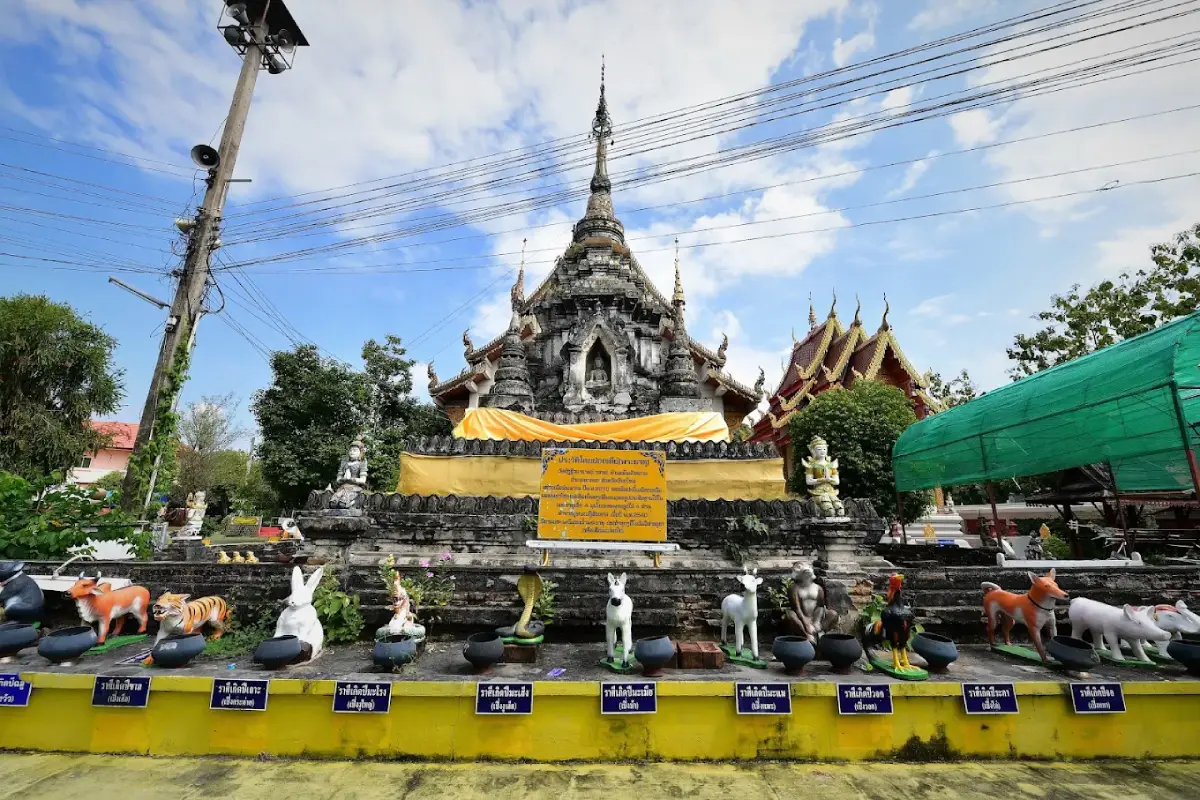
Wat Latthiwanaram, also locally known as Wat Pa Tan, is located at 118 Moo 4, Ban Pa Tan, Chiang Mai–Hot Road, San Phak Wan Subdistrict, Hang Dong District, Chiang Mai Province. It is a private Buddhist temple under the Mahanikaya order, with a temple land area of 6 rai. The temple was built in 1667 and received royal granting of wisungkhamsima on 7 November 2011. Wat Latthiwanaram is an old community temple of Ban Pa Tan, valued for its Buddhist role, historical temple grounds, Lanna-Burmese-influenced Phra That, and close connection with Ban Pa Tan, a village famous for smiling clay sculptures.
San Phak Wan Subdistrict lies in Hang Dong District, not far from Chiang Mai city. The area connects with Chiang Mai–Hang Dong Road, Chiang Mai–Hot Road, the outer ring road, and local roads leading into old communities. It includes community temples, local craft villages, restaurants, accommodations, and family attractions. Wat Latthiwanaram is therefore a meaningful stop for travelers who want to combine a quiet temple visit with Ban Pa Tan’s clay-sculpture community, Kad Farang Village, Baan Tawai Handicraft Village, Grand Canyon Water Park Chiang Mai, Wat Ton Kwen, and other Hang Dong attractions.
Ban Pa Tan is a community whose name is closely connected with the temple’s original landscape. The temple site was once an area with many palm trees, and villagers built a temple there under the name Wat Pa Tan, meaning the temple of the palm grove. Although the temple later received the formal name Wat Latthiwanaram, the older name remains important in local memory and continues to link the temple with the village landscape.
The name Latthiwanaram preserves the meaning of the old palm-grove setting in a more formal religious form. Latthi is associated with palm or palm wood, while wanaram refers to a wooded monastic place or temple. The name therefore still carries the memory of the palm grove while presenting the temple as a peaceful Buddhist sanctuary. This is a good example of how Lanna community temples may change names through time while preserving local landscape memory.
The temple’s establishment in 1667 makes Wat Latthiwanaram one of the old temples in San Phak Wan. This period falls within a historical context in which Chiang Mai and Lanna were strongly influenced by Burmese power. The temple therefore represents more than a village worship site. It preserves traces of Buddhist faith, community settlement, and artistic influence during a complex period of Lanna history.
The royal granting of wisungkhamsima on 7 November 2011 gave Wat Latthiwanaram a formal boundary for monastic acts. This confirms the temple’s continued religious function as an active community temple. Although its historical roots go back centuries, the temple remains a living Buddhist institution where monks, villagers, schools, and local authorities continue to work together.
The most important feature to see at Wat Latthiwanaram is the Phra That, built in a form that combines local Lanna art with Burmese artistic influence. The Phra That has a square form, with four corner elements and arched niches on four sides containing Buddha images. Inside the Phra That are Buddha images associated with the sacred structure. This makes the Phra That important not only as a devotional focus but also as an art-historical feature reflecting the Lanna-Burmese cultural layer of the area.
The Phra That has been restored several times, showing the continuing faith of Ban Pa Tan residents and the local community. For an old temple, restoration is part of its living history. The structure remains meaningful because local people still gather around it, care for it, and use it as the center of important Buddhist traditions.
Other ancient features are also found within the temple grounds. These include old wells with traces of circular brickwork later overbuilt with a square brick rim, and several other brick remains in square and rectangular forms. The ancient remains stand within an almost square temple wall, with gateways at the center of all four sides and a northern entrance featuring a decorative archway. This gives Wat Latthiwanaram value as a historical temple compound, not only as a single Phra That monument.
The abbot of Wat Latthiwanaram is Phra Khru Udom Kittayakon Kittipanyo, who also holds a monastic leadership role in San Phak Wan Subdistrict. In a community temple, the abbot plays an important role in caring for the temple, leading ceremonies, coordinating merit-making, preserving sacred structures, and maintaining cooperation among monks, villagers, schools, and local authorities.
The temple’s contemporary community role is reflected in participation in the Wat Pracha Rat Sang Suk project, a collaborative program involving the municipality, temples, child development centers, and schools in the subdistrict. A memorandum of understanding for this project was signed at Wat Latthiwanaram. This shows that the temple continues to serve as a practical community center, not only as a religious monument.
The key annual tradition of Wat Latthiwanaram is the Phra That bathing ceremony, held on duean 8 peng, the full moon of the eighth lunar month in the Lanna calendar, corresponding to Visakha Bucha. The ceremony allows devotees to pay respect to the Phra That, worship the Buddha, make merit, listen to Dhamma, and preserve Lanna Buddhist tradition. It is both a religious event and a community gathering day for Ban Pa Tan.
Regular Buddhist activities at Wat Latthiwanaram follow the rhythm of Lanna village temple life. These include Buddhist holy day merit-making, alms-giving, sermons, kathin, pha pa, Visakha Bucha, Asalha Bucha, Buddhist Lent, the end of Buddhist Lent, memorial merit-making, and annual Phra That devotion. These activities bring monks, elders, families, young people, and neighbors together around shared Buddhist practice.
Another important part of Wat Latthiwanaram’s identity is its relationship with Ban Pa Tan, a village known for clay sculpture and smiling clay dolls. The community has a long tradition of working with clay, including brickmaking, water jars, vases, and piggy banks. In later years, villagers developed smiling clay sculptures that became the village’s signature craft. This gives the temple a strong cultural setting: visitors can experience both a historic Buddhist site and a living craft village in the same area.
The Din Yim festival of Ban Pa Tan is held around February and highlights the village’s clay-sculpture identity. For travelers, Wat Latthiwanaram and Ban Pa Tan work well together as a cultural route. Visitors can worship at the temple, learn about the old Phra That and temple remains, then continue into the village to see clay-sculpture knowledge and local craft creativity.
Wat Latthiwanaram plays an important role as the spiritual center of Ban Pa Tan. It supports religious practice, preserves historical structures, anchors community identity, and connects Buddhist devotion with local craft heritage. The temple and the village are closely linked: the temple preserves faith and history, while the village preserves clay craft and living local wisdom.
Wat Latthiwanaram is suitable for elderly visitors seeking peaceful worship, families who want children to learn about both temples and crafts, cultural travelers interested in old temple compounds, and visitors who want to understand Hang Dong through local community heritage. Its value lies in age, calm atmosphere, old sacred structures, Phra That devotion, and its connection with Ban Pa Tan’s smiling clay-sculpture identity.
Getting There is convenient by private car, rental car, or hired transport from Chiang Mai city. Take Chiang Mai–Hang Dong Road or Route 108 toward Hang Dong, then continue into San Phak Wan Subdistrict and Ban Pa Tan, Moo 4. Another option is to use the outer ring road and local roads within San Phak Wan. The drive from central Chiang Mai generally takes around 25 to 40 minutes depending on traffic. The temple can be combined with Ban Pa Tan, Kad Farang Village, Baan Tawai Handicraft Village, Wat Ton Kwen, Grand Canyon Water Park Chiang Mai, and Chiang Mai Night Safari.
The best time to visit is in the morning or late afternoon when the weather is more comfortable. Visitors should dress modestly, keep noise low, respect monks’ areas, avoid disturbing worshippers or ceremony participants, and take photos with discretion. If a Phra That bathing ceremony, merit-making event, kathin ceremony, or Din Yim community event is taking place, local participants should be given priority. Wat Latthiwanaram remains an active community temple, so a calm and respectful visit is the best way to experience it.
In summary, Wat Latthiwanaram, or Wat Pa Tan, is a historic community temple of Ban Pa Tan, San Phak Wan Subdistrict, Hang Dong District, Chiang Mai Province. Its value lies in its establishment in 1667, its palm-grove origin, its Lanna-Burmese-influenced Phra That, ancient temple remains, Phra That bathing tradition on duean 8 peng, and its connection with Ban Pa Tan’s smiling clay-sculpture heritage. It is a meaningful stop for travelers who want to understand Chiang Mai through local temples, old sacred sites, and living Lanna craft communities.
| Name | Wat Latthiwanaram / Wat Pa Tan |
| Type | Private Buddhist Temple Under The Mahanikaya Order |
| Location | 118 Moo 4, Ban Pa Tan, San Phak Wan Subdistrict, Hang Dong District, Chiang Mai Province |
| Address | 118 Moo 4, Ban Pa Tan, Chiang Mai–Hot Road, San Phak Wan Subdistrict, Hang Dong District, Chiang Mai 50230, Thailand |
| Highlights | Historic Ban Pa Tan temple built in 1667, featuring a Lanna-Burmese-influenced Phra That, ancient brick remains, old wells, Phra That bathing tradition, and strong connection with Ban Pa Tan’s smiling clay-sculpture community |
| History | Built in 1667 on a former palm-grove site. Villagers first called it Wat Pa Tan before the temple was later renamed Wat Latthiwanaram. |
| Former / Local Name | Wat Pa Tan |
| Name Origin | The temple site was originally a palm grove. The formal name Latthiwanaram preserves the association with palm trees and a peaceful wooded monastic place. |
| Temple Land Area | 6 rai |
| Wisungkhamsima | Received royal granting of wisungkhamsima on 7 November 2011 |
| Community Context | Located in Ban Pa Tan, Moo 4, San Phak Wan Subdistrict, a community known for clay sculpture, smiling clay dolls, and traditional clay craft heritage |
| Main Areas / Zones | Phra That worship area, Buddhist worship area, ancient temple remains, decorative gateway, old wells, temple courtyard, and community religious activity areas |
| Important Structures / Ancient Remains | Square Phra That with Lanna-Burmese influence, four corner elements, four Buddha-image niches, old wells, brick remains, and an almost square old temple wall with gateways on four sides |
| Sacred Objects | Phra That of Wat Latthiwanaram, Buddha images in four niches, and Buddha images enshrined within the Phra That |
| Abbot / Caretaker | Phra Khru Udom Kittayakon Kittipanyo, Abbot of Wat Latthiwanaram and monastic head of San Phak Wan Subdistrict |
| Community Activity | Din Yim festival of Ban Pa Tan in February, clay-sculpture learning, smiling clay dolls, brickmaking, water jars, vases, and traditional village clay crafts |
| Traditions / Merit-Making Events | Phra That bathing ceremony on duean 8 peng, Visakha Bucha, Buddhist holy day merit-making, alms-giving, sermons, kathin, pha pa, Buddhist Lent, the end of Buddhist Lent, and memorial merit-making |
| Community Role | Spiritual center of Ban Pa Tan, preserving Buddhist devotion, ancient temple remains, Phra That worship, and the connection between religion and local clay-craft wisdom |
| Current Status | Active community temple in San Phak Wan Subdistrict, Hang Dong District, Chiang Mai Province |
| Open Days | Daily |
| Opening Hours | 08.00 – 17.00 |
| Contact Number | 089-953-3169 |
| Travel Information | From Chiang Mai city, take Chiang Mai–Hang Dong Road or Route 108 toward Hang Dong, then continue into San Phak Wan Subdistrict and Ban Pa Tan, Moo 4. Another option is the outer ring road and local roads in San Phak Wan. Private car, rental car, and hired transport are the most convenient options. |
| Nearby Tourist Attractions | 1. Ban Pa Tan Din Yim Village, about 1 km 2. Wat Chai Sathit, about 3 km 3. Wat Chimphliwan / Wat Ton Ngio, about 4 km 4. Kad Farang Village, about 5 km 5. Baan Tawai Handicraft Village, about 6 km 6. North Hill Golf Club, about 6 km 7. Grand Canyon Water Park Chiang Mai, about 8 km 8. Wat Ton Kwen / Wat Intharawat, about 9 km |
| Nearby Restaurants | 1. Yark Tum Restaurant Baan Pa Tan, about 1 km, Tel. 082-374-4676 2. Tham Thi Ban Aroi Chang San Phak Wan, about 3 km, Tel. 063-525-2663, 092-816-3431 3. Green Kai San Phak Wan, about 3 km, Tel. 085-031-3446 4. Baan Suan Kitchen San Phak Wan, about 4 km, Tel. 085-147-1077 5. Eat Rice Drink Water San Phak Wan, about 4 km, Tel. 086-658-6871, 066-046-4236 6. Pongsathorn Salapao Savoy Hang Dong Branch, about 5 km, Tel. 097-951-7889 |
| Nearby Accommodations | 1. Hang Dong Hill, about 4 km, Tel. 081-827-2853 2. P&A Thai Lanna Resort, about 4 km, Tel. 089-561-1509 3. Baan Pondchanok Hotel, about 5 km, Tel. 095-673-0586 4. Baan Tawai Lanna Resort, about 6 km, Tel. 063-654-7997 5. North Hill City Resort, about 6 km, Tel. 053-333-111, 093-131-0277 |
Frequently Asked Questions (FAQ)
Q: Where is Wat Latthiwanaram located?
A: Wat Latthiwanaram is located at 118 Moo 4, Ban Pa Tan, Chiang Mai–Hot Road, San Phak Wan Subdistrict, Hang Dong District, Chiang Mai 50230, Thailand.
Q: What is another name for Wat Latthiwanaram?
A: Wat Latthiwanaram is locally known as Wat Pa Tan because the temple site was originally a palm-grove area in Ban Pa Tan.
Q: When was Wat Latthiwanaram established?
A: Wat Latthiwanaram was built in 1667 and received royal granting of wisungkhamsima on 7 November 2011.
Q: What can visitors see at Wat Latthiwanaram?
A: Visitors can see the Lanna-Burmese-influenced Phra That, four corner elements, Buddha-image niches on four sides, old wells, ancient brick remains, and the old temple-wall layout.
Q: What is the important annual tradition of Wat Latthiwanaram?
A: The important annual tradition is the Phra That bathing ceremony on duean 8 peng, the full moon of the eighth Lanna lunar month, corresponding to Visakha Bucha.
Q: How is Wat Latthiwanaram connected with Ban Pa Tan?
A: Wat Latthiwanaram is the spiritual center of Ban Pa Tan, a village known for clay sculpture and smiling clay dolls, making the temple and community craft heritage closely linked.
Q: Who is the abbot of Wat Latthiwanaram?
A: The abbot is Phra Khru Udom Kittayakon Kittipanyo, who is also a monastic leader in San Phak Wan Subdistrict.
Q: What nearby attractions can be combined with Wat Latthiwanaram?
A: Nearby places include Ban Pa Tan Din Yim Village, Wat Chai Sathit, Wat Chimphliwan, Kad Farang Village, Baan Tawai Handicraft Village, North Hill Golf Club, Grand Canyon Water Park Chiang Mai, and Wat Ton Kwen.
 Category: ●Places of Worship
 Group: ●Temple
Last Update : 1 MonthAgo
 Last Update : 1 MonthAgo
 Click to Access the Navigation Map GPS

 Muang Chiang Mai(121)Chom Thong(47)Mae Chaem(25)Chiang Dao(33)Doi Saket(68)Mae Taeng(85)Mae Rim(69)Samoeng(29)Fang(71)Mae Ai(59)Phrao(70)San Pa Tong(103)San Kamphaeng(66)San Sai(73)Hang Dong(73)Hot(32)Doi Tao(22)Omkoi(11)Saraphi(74)Wiang Haeng(15)Chai Prakan(28)Mae Wang(32)Mae On(22)Doi Lo(33)Galyani Vadhana(1)


