
lovethailand home >North Travel Attractions >Chiang Mai Travel Attractions >Saraphi >Nong Faek > Wat Huan Kan
TL;DR: Wat Huan Kan is located at Ban San Pa Sak, Moo 2, Nong Faek Subdistrict, Saraphi District, Chiang Mai Province, open Daily, hours 08.00 – 17.00.

Wat Huan Kan
Open Days: Daily
Opening Hours: 08.00 – 17.00
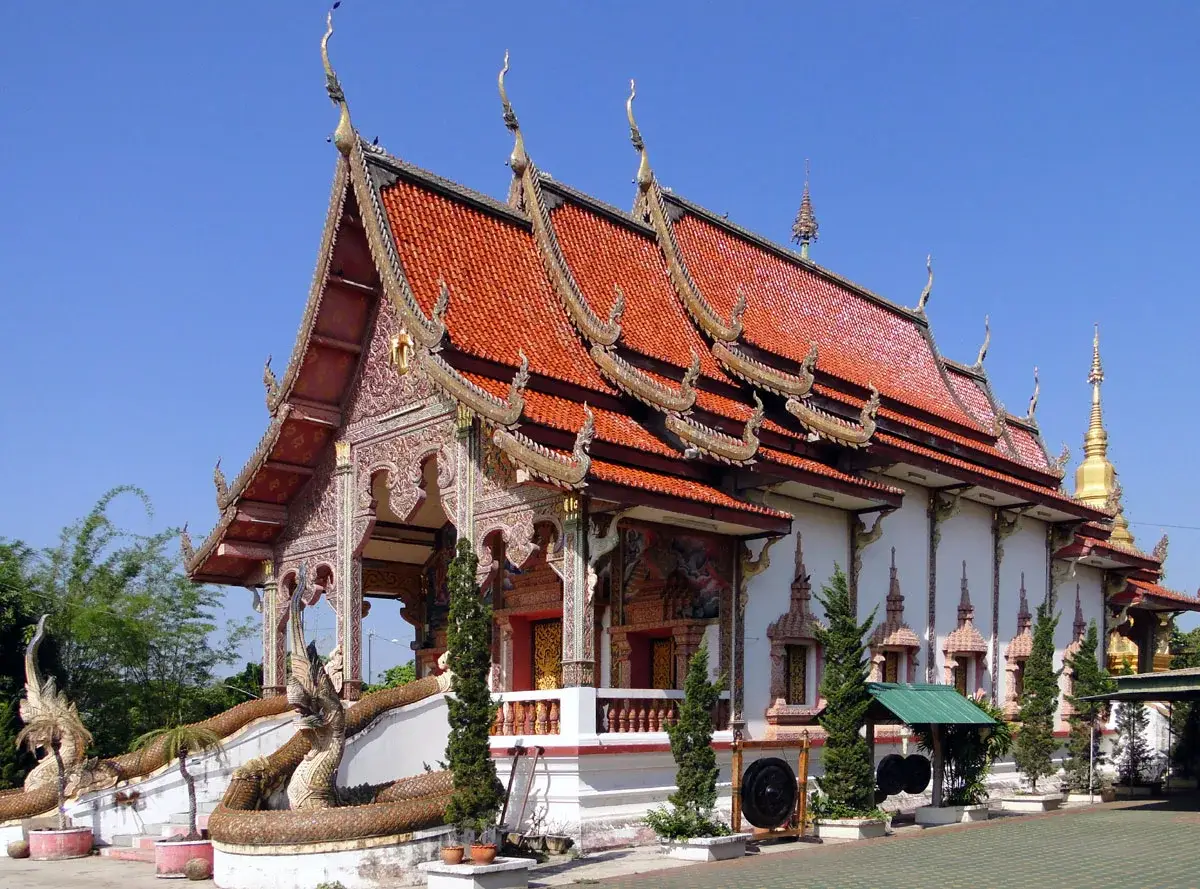
Wat Huan Kan, also connected with the community name Wat San Pa Sak, is a local Buddhist temple under the Mahanikaya monastic order. It is located at No. 83, Moo 2, Ban San Pa Sak, Nong Faek Subdistrict, Saraphi District, Chiang Mai Province 50140. The temple began from a community-led effort in 1929, when local devotees and Khruba La Panyawuttho from Wat Nong Faek came together to clear and prepare the land, practice Dhamma, and establish a temple for the village. The temple later developed with a permanent monks’ residence, viharn, halls, and other monastic facilities. Wat Huan Kan received its Wisungkhamsima on 20 May 1984. Today, it remains an active community temple with Phra Khru Sangharak Rak Sirimethee as abbot and 5 resident monks.
Wat Huan Kan should be understood as a temple created through community faith rather than simply as a village temple. Its origin is tied to a group of elders and devotees in Ban San Pa Sak who donated land, cleared the area, prepared the site, and invited monks to establish a place of Buddhist practice. Important names in the temple’s founding story include Pho Ui Nan Ta Yung, Pho Ui Muen Kan Prachachop, Pho Ui Nan Muen Somboon, Pho Ui Nan Di Ngaokaew, Pho Ui Ma Charoen, Pho Ui La Huan Kap, Pho Ui Nan Kuna Saeng Sawang, and Pho Ui Huean Saeng Fa. These people form the human foundation of the temple’s history.
Ban San Pa Sak is a village whose name reflects the local landscape. San suggests a raised ridge or higher ground, while pa sak refers to teak woodland. The name indicates a settlement shaped by slightly elevated land and local vegetation. In this landscape, Wat Huan Kan became both a Buddhist sanctuary and a community landmark for the village.
In 1929, local devotees and Khruba La Panyawuttho began clearing the area and practicing Dhamma there. Temple history remembers that the early work involved hardship and fearsome surroundings because the site had not yet been properly prepared as a religious place. The continued effort of monks and villagers shows the strength of local faith. With monastic leadership and lay support, the temple gradually took form.
Pho Ui La Huan Kap was an especially important supporter because he donated a significant amount of land. Pho Ui Muen Kan Prachachop, also known as Muen Rin, was another important community figure. The name Huan Kan combines Huan from the family name Huan Kap and Kan from Muen Kan. The temple name therefore preserves gratitude toward the people who helped make the temple possible.
The name Wat Huan Kan has strong community meaning. It is not only a formal temple name but also a memorial to the people whose faith, land, and leadership created the temple. This is typical of many Lanna community temples, where names, buildings, land, and merit-making traditions are closely tied to local benefactors.
After the early clearing in 1929, villagers built a permanent monks’ residence in 1930 so religious ceremonies could begin. In 1938, they built the viharn. In 1945, they built a hall in the area of the present ordination hall. In 1952, they built a southern hall with a smaller monks’ residence to accommodate monks and novices. This sequence shows the temple’s development from a small Dhamma-practice site into a more complete Buddhist monastery.
Temple records identify 1931 as the official construction year and note the former name Wat San Ba Sak or Wat San Pa Sak. The community narrative, however, begins in 1929 with the clearing and practice period. Taken together, these details show both the beginning of community action and the later formal recognition of the temple as a functioning monastery.
The temple land covers 3 rai, 1 ngan, and 61 square wah under land title No. 8868. Its northern and eastern boundaries connect with public roads, while its southern and western boundaries connect with public irrigation channels. This setting reflects the character of a Lanna community temple embedded in village routes and water systems. Irrigation channels are part of agricultural life, linking fields, gardens, households, and temples.
The granting of Wisungkhamsima on 20 May 1984 was an important milestone in the temple’s religious history. A Wisungkhamsima is the formal monastic boundary used for important Sangha rites, especially ordination and ecclesiastical ceremonies. Wat Huan Kan’s boundary measures 12 meters wide and 27 meters long, confirming its formal religious status.
The ordination hall is one of the most important sacred areas of the temple because it is directly connected with the Wisungkhamsima. Visitors should approach it respectfully, speak softly, and avoid disturbing monks or local devotees. It represents the temple’s complete function as a Buddhist monastery.
The viharn is the main devotional space for worship, Dhamma listening, and community ceremonies. Its construction in 1938 marked an important step in the temple’s development from a small monastic residence into a place that could support wider village worship. Visitors should remove shoes where required, speak softly, and pay respect calmly.
The pagoda is another important sacred feature of the temple. In Lanna Buddhism, pagodas symbolize the stability of the religion and serve as places of reverence. Visitors should walk respectfully around such structures and avoid touching, climbing, or leaning on them.
The monks’ residence has special importance in Wat Huan Kan’s history because one of the earliest permanent structures was built in 1930. A temple becomes alive through resident monks who maintain daily chanting, receive alms, guide devotees, and conduct ceremonies. The later construction of additional residential space in 1952 shows the community’s intention to support monks and novices continuously.
The two-storey sermon hall supports Dhamma listening, merit-making, Kathin, robe-offering ceremonies, village meetings, and community activities. In a Lanna community temple, such a hall is a shared religious and social space where villagers gather, cooperate, and continue temple-based traditions across generations.
The temple also once had a school within its compound. This reflects a common role of rural Thai temples as both religious and educational centers. Even though community education has changed through time, this memory shows how Wat Huan Kan contributed not only to Buddhist practice but also to village learning and development.
Wat Huan Kan continues to develop as a place for Buddhist practice and community use. Contemporary accounts mention the restoration of the viharn, a Dhamma-practice hall, Sala Ruam Jai Bun Luea Lon Som Pratthana, and Sala Pan Pon. These additions show that the temple remains active and continues to adapt its space for merit-making, meditation, and community activity.
Phra Khru Sangharak Rak Sirimethee is recorded as the current abbot in the 2025 Kathin activity information. The name Phra Ekkalak Ariyachoto appears in older public temple information. For the present article, the latest activity-based record is used for the current abbot, while the earlier name remains part of the temple’s published history.
The temple has 5 resident monks according to the 2025 Kathin activity information. With monks residing at the temple, Wat Huan Kan can maintain daily chanting, alms-related activities, religious guidance, and ceremonies for local residents. It is therefore not only a historic community temple but also a living Buddhist center.
Important religious activities at Wat Huan Kan include Buddhist holy days, Buddhist Lent, the end of Buddhist Lent, Kathin, robe-offering ceremonies, Songkran, elder-respect customs, Yi Peng, village merit-making, and meditation activities. The 2025 Kathin information confirms the continued presence of organized merit-making at the temple.
During the Lanna New Year, Wat Huan Kan is suitable for merit-making, Buddha-image bathing, elder-respect activities, and community ceremonies. These traditions connect younger generations with elders, families with the temple, and village identity with Buddhism. A visit during the festival season reveals the temple as a living social and religious space.
The main appeal of Wat Huan Kan for visitors is its community-built history, the naming of the temple after important benefactors, the role of Khruba La Panyawuttho from Wat Nong Faek, the chronological development of its monks’ residence, viharn, halls, and monastic facilities, and its calm local atmosphere. It is suitable for visitors interested in Lanna community temples, village Buddhist history, and cultural routes through Nong Faek and Saraphi.
The temple atmosphere is calm and suitable for worship, merit-making, quiet reflection, and respectful exploration. Visitors should allow around 30 to 60 minutes to observe the ordination hall, viharn, pagoda, sermon hall, monks’ residence, and Dhamma-practice areas. Morning or late afternoon is generally the most comfortable time to visit.
Visitors should dress modestly, speak softly, remove shoes before entering sacred buildings, avoid touching Buddha images, pagodas, or sacred objects unnecessarily, and avoid entering the monks’ residential area without permission. If a merit-making event, Kathin, robe-offering ceremony, or village activity is taking place, visitors should allow space for local participants and behave respectfully within the temple grounds.
Getting There is possible by traveling from Chiang Mai city toward Saraphi District, then continuing into Nong Faek Subdistrict and Ban San Pa Sak, Moo 2. Private car, rental car, or local hired transport is the most convenient option. Wat Huan Kan can be combined easily with Wiang Setthi, Wat Ku Daeng, Wat Nong Si Chaeng, Wat Nong Faek, Wat Saraphi, and Wat Pak Kong.
A practical cultural route can begin at Wat Huan Kan and continue to Wiang Setthi, Wat Ku Daeng, Wat Nong Si Chaeng, Wat Nong Faek, Wat Saraphi, and Wat Pak Kong. Travelers who want to extend the route can continue to Wat Chang Khoeng, Wat Mongkhon Wanaram, and the temple routes of Nong Phueng Subdistrict. This route helps visitors understand Saraphi through community temples, old settlements, agricultural landscapes, and Lanna Buddhist faith.
Overall, Wat Huan Kan is valuable for its community history, Buddhist identity, and continuing role in Ban San Pa Sak. It was born from the faith of local elders, land donors, and Khruba La Panyawuttho, developed through successive construction from 1930 onward, received Wisungkhamsima in 1984, and remains active as a community temple with resident monks and ongoing merit-making activities. It is a meaningful destination for visitors interested in the living Lanna temple heritage of Nong Faek and Saraphi.
| Name | Wat Huan Kan |
| Related Names | Wat San Pa Sak / Wat San Ba Sak |
| Location | Ban San Pa Sak, Moo 2, Nong Faek Subdistrict, Saraphi District, Chiang Mai Province |
| Address | No. 83, Moo 2, Ban San Pa Sak, Nong Faek Subdistrict, Saraphi District, Chiang Mai Province 50140, Thailand |
| Temple Type | Local Buddhist temple under the Mahanikaya monastic order |
| Temple Land | 3 rai, 1 ngan, and 61 square wah |
| Land Title | Land title No. 8868 |
| Temple Boundaries | North: public road South: public irrigation channel East: public road West: public irrigation channel |
| Highlights | Community temple of Ban San Pa Sak created through local faith and Khruba La Panyawuttho, with a name honoring the Huan Kap family name and Muen Kan, two key benefactors |
| History | Community clearing and Dhamma practice began in 1929. Temple records identify 1931 as the construction year and record its former name as Wat San Ba Sak or Wat San Pa Sak |
| Name Origin | Huan comes from the family name Huan Kap of Pho Ui La, while Kan comes from Pho Ui Muen Kan Prachachop, both important benefactors of the temple |
| Wisungkhamsima | Granted on 20 May 1984; the boundary measures 12 meters wide and 27 meters long |
| Key Construction Timeline | 1930: first permanent monks’ residence 1938: viharn 1945: hall at the present ordination-hall area 1952: southern hall and small monks’ residence |
| Main Areas / Zones | Monks’ residence, two-storey sermon hall, Lanna-style ordination hall, viharn, pagoda, Dhamma-practice hall, and community activity halls |
| Sacred Features | Ordination hall, viharn, and pagoda inside the temple compound |
| Abbot / Important Monks | Current Abbot: Phra Khru Sangharak Rak Sirimethee Earlier Public Temple Record: Phra Ekkalak Ariyachoto |
| Resident Monks | 5 monks |
| Important Monk In Temple History | Khruba La Panyawuttho from Wat Nong Faek, who helped clear and establish the temple site |
| Open Days | Daily |
| Opening Hours | 08.00 – 17.00 |
| Important Religious Activities | Buddhist holy days, Buddhist Lent, end of Buddhist Lent, Kathin, robe-offering ceremonies, Songkran, elder-respect activities, Yi Peng, Ban San Pa Sak village merit-making, and meditation activities |
| Community Role | Spiritual center of Ban San Pa Sak, used for merit-making, Dhamma listening, meditation, Buddhist ceremonies, and the preservation of Lanna community traditions |
| Travel Information | Travel from Chiang Mai city toward Saraphi District, then continue into Nong Faek Subdistrict and Ban San Pa Sak, Moo 2. Private car, rental car, or local hired transport is the most convenient option |
| Current Status | Active community temple in Nong Faek Subdistrict and a venue for Buddhist worship, Kathin, village merit-making, and community activities |
| Nearby Tourist Attractions | 1. Wiang Setthi, Nong Faek, about 2 km 2. Wat Ku Daeng, Nong Faek, about 2 km 3. Wat Nong Si Chaeng, Nong Faek, about 2 km 4. Wat Nong Faek, Nong Faek, about 3 km 5. Wat Saraphi, Saraphi, about 6 km 6. Wat Pak Kong, Saraphi, about 7 km |
| Nearby Restaurants | 1. Shabu Skewers With Black Sauce Saraphi, about 2 km, Tel. 096-880-8908 2. Jiao Jing Jai Omelette Buffet, Nong Faek, about 3 km, Tel. 091-074-3888 3. Delicious Grilled Pork Saraphi, about 3 km, Tel. 097-007-3989 4. Yak Yum By Mae Kha Pak Jaew, Nong Faek, about 5 km, Tel. 094-851-5997, 099-817-5826 5. Sureerat Made-To-Order Food, Nong Phueng, about 6 km, Tel. 095-450-3692 |
| Nearby Accommodations | 1. 9Roomz, about 8 km, Tel. 095-446-0758, 053-963-829 2. Baan Saraphi, about 9 km, Tel. 053-321-942 3. Ruean Thip Resort, about 10 km, Tel. 098-556-6291 4. Baan Nam Ping Riverside Village, about 11 km, Tel. 053-439040 5. Baan Hom Samunphrai, about 12 km, Tel. 053-817-362, 081-885-1429 |
Frequently Asked Questions (FAQ)
Q: Where is Wat Huan Kan located?
A: Wat Huan Kan is located at No. 83, Moo 2, Ban San Pa Sak, Nong Faek Subdistrict, Saraphi District, Chiang Mai Province 50140. It is a local Buddhist temple under the Mahanikaya monastic order.
Q: When did Wat Huan Kan begin?
A: The community history begins with the clearing and Dhamma-practice effort in 1929, while temple records identify 1931 as the construction year.
Q: What is the origin of the name Huan Kan?
A: The name combines Huan from the family name Huan Kap of Pho Ui La and Kan from Pho Ui Muen Kan Prachachop, both of whom were important benefactors of the temple.
Q: When did Wat Huan Kan receive Wisungkhamsima?
A: Wat Huan Kan received its Wisungkhamsima on 20 May 1984. The boundary measures 12 meters wide and 27 meters long.
Q: What can visitors see at Wat Huan Kan?
A: Visitors can see the monks’ residence, two-storey sermon hall, Lanna-style ordination hall, viharn, pagoda, Dhamma-practice hall, and community activity areas.
Q: Who is the current abbot of Wat Huan Kan?
A: The current abbot of Wat Huan Kan is Phra Khru Sangharak Rak Sirimethee.
Q: What are the opening hours of Wat Huan Kan?
A: Wat Huan Kan is open daily from 08.00 to 17.00.
Q: What nearby places can be visited with Wat Huan Kan?
A: Nearby places include Wiang Setthi, Wat Ku Daeng, Wat Nong Si Chaeng, Wat Nong Faek, Wat Saraphi, and Wat Pak Kong.
 Category: ●Places of Worship
 Group: ●Temple
Last Update : 4 WeekAgo
 Last Update : 4 WeekAgo
 Click to Access the Navigation Map GPS

 Muang Chiang Mai(121)Chom Thong(47)Mae Chaem(25)Chiang Dao(33)Doi Saket(68)Mae Taeng(85)Mae Rim(69)Samoeng(29)Fang(71)Mae Ai(59)Phrao(70)San Pa Tong(103)San Kamphaeng(66)San Sai(73)Hang Dong(73)Hot(32)Doi Tao(22)Omkoi(11)Saraphi(74)Wiang Haeng(15)Chai Prakan(28)Mae Wang(32)Mae On(22)Doi Lo(33)Galyani Vadhana(1)


