
lovethailand home >North Travel Attractions >Chiang Mai Travel Attractions >San Pa Tong >Makhun Wan > Wat Pa Ngio (Makhun Wan)
TL;DR: Wat Pa Ngio (Makhun Wan) is located at Ban Dong Pa Ngio, Mu 7, Makhun Wan Subdistrict, San Pa Tong District, Chiang Mai Province, open Daily, hours 08.00 – 17.00.

Wat Pa Ngio (Makhun Wan)
Open Days: Daily
Opening Hours: 08.00 – 17.00
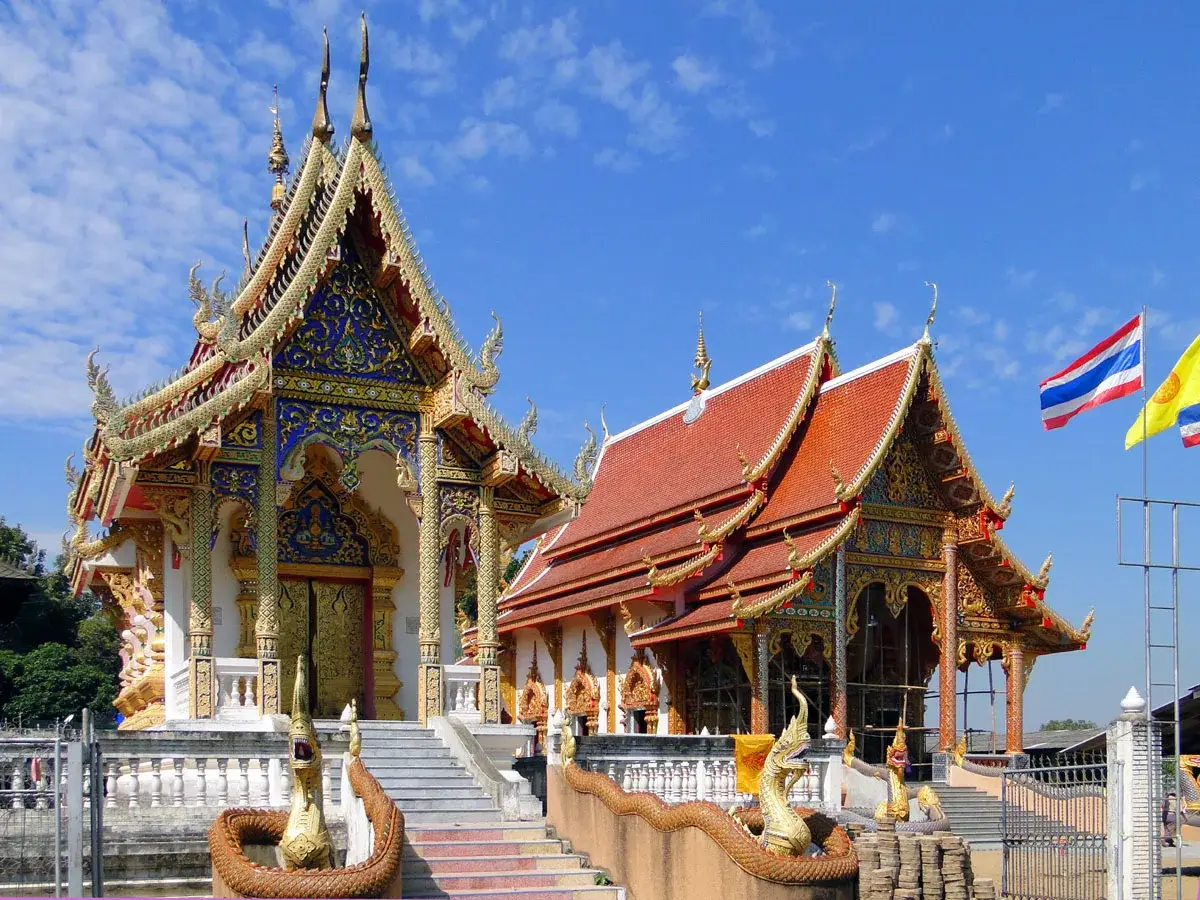
Wat Pa Ngio (Makhun Wan) is a local Buddhist temple under the Mahanikaya order, located at No. 93, Ban Dong Pa Ngio, Mu 7, Makhun Wan Subdistrict, San Pa Tong District, Chiang Mai Province. The temple began to be built in 1921, appeared in the provincial temple register on March 28, 1928, and received its royal monastic boundary in 1997. The temple land covers 1 rai, 3 ngan, and 25 square wah. Wat Pa Ngio is a compact community temple with a clear historical foundation and a strong connection with Ban Dong Pa Ngio, a village known for local culture, creative community tourism, traditional food, and the rural Lanna way of life in San Pa Tong.
The temple name is closely connected with Ban Dong Pa Ngio. The word “dong” suggests a grove or wooded area, while “pa ngio” refers to the ngio tree and the older landscape of the village. The name therefore preserves a memory of the natural environment and local identity. Because the temple shares the name of the village, it functions not only as a religious site but also as a symbol of place, memory, and community belonging.
The temple’s beginning in 1921 reflects the development of Ban Dong Pa Ngio as a settled community with its own spiritual center. In Lanna society, village temples were commonly built through the faith and cooperation of local residents. A temple provided a place for merit-making, worship, Dharma listening, monastic residence, and community gathering. Wat Pa Ngio therefore represents both Buddhist faith and the growth of village life in Makhun Wan.
The temple’s registration on March 28, 1928 gave it a clear place in the provincial temple system. Its royal monastic boundary, granted in 1997, added an important religious dimension. A royal monastic boundary defines the formal area for monastic acts according to Buddhist discipline. Although Wat Pa Ngio is a small community temple, this status supports its religious role within the local Sangha structure.
The temple land is compact, covering 1 rai, 3 ngan, and 25 square wah. Its surroundings connect with residents’ land, private rice fields, and a school. This setting clearly shows the character of a Lanna village temple. The temple is not separated from daily life; it stands within a landscape of homes, farming areas, education, and community movement.
The relationship between the temple and the nearby school is culturally meaningful. In northern Thai communities, temples and schools often work together in moral education, community activities, Buddhist observances, and the transmission of local values. Wat Pa Ngio therefore represents more than a place for worship. It is part of a wider village system where Buddhism, learning, and community life are closely connected.
The confirmed monastic structure at the temple is the monks’ residence. A monks’ residence is essential for a community temple because it supports resident monks in daily practice, chanting, study, and temple care. Its presence allows the temple to remain active in religious life rather than functioning only as a ceremonial site. Through resident monks, the temple continues to support laypeople, merit-making, and village Buddhist activities.
Phra Montri Bhaddarayanano is the abbot of Wat Pa Ngio. The abbot plays an important role in maintaining the temple, guiding religious activities, coordinating with villagers, and preserving the relationship between the temple and Ban Dong Pa Ngio. In a compact village temple, this role is especially important because the temple depends on close cooperation between monks and the local community.
The main appeal of Wat Pa Ngio is its character as a quiet village temple rather than a large tourist attraction. Visitors can experience a calm local atmosphere, observe the temple courtyard, and understand how a small temple continues to serve a real community. Its value lies in its relationship with Ban Dong Pa Ngio, its history, and its role in sustaining Lanna Buddhist life at the village level.
The main things to appreciate at Wat Pa Ngio are the temple atmosphere, the monks’ residence area, the courtyard, and the surrounding village context of school, rice fields, and local homes. The temple should be visited slowly and respectfully. It is best understood as a living place of faith rather than a photo stop.
Visitors should pay respect calmly, make merit if appropriate, dress modestly, keep their voices low, and avoid disturbing monks or local residents. Community temples are sacred spaces for villagers, so respectful conduct is essential. Photography should be done carefully, especially when religious activities are taking place.
Wat Pa Ngio serves Ban Dong Pa Ngio as a center for merit-making, Buddhist observances, and community gathering. It supports the religious life of elders, families, young people, and local residents during Buddhist holy days and annual ceremonies. Activities associated with Lanna community temples include Kathin, pha pa merit-making, Songkran or northern Thai New Year activities, candle offerings for Buddhist Lent, salak phat offerings, and family merit-making ceremonies.
Makhun Wan Subdistrict and San Pa Tong District preserve many Lanna religious traditions. Local events such as Buddha relic bathing ceremonies, Loy Krathong, Songkran, salak phat offerings, and candle offerings for Buddhist Lent connect temples with village life. Wat Pa Ngio belongs to this same cultural rhythm, serving as one of the village temples that help maintain Buddhist traditions in everyday community life.
Ban Dong Pa Ngio also has a contemporary identity as a creative community tourism village. Visitors can learn about local food, old houses, handicrafts, community products, and the cultural stories of the village. Wat Pa Ngio can therefore serve as a starting point for a broader community visit, connecting merit-making with local culture, cuisine, and the creative identity of Dong Pa Ngio.
Wat Pa Ngio can be included in a connected San Pa Tong cultural route. Nearby places include Wat Phra Chao Song Ong, Wat Muang Phi Nong, Wat Makhun Wan, Wat San Sai Mun, Thung Fa Bot Market or Kad Ngua San Pa Tong, Wiang Tha Kan Ancient Town, and Ban Dong Pa Ngio community attractions. This route works well for a half-day or full-day trip combining temple visits, local food, community tourism, and local history.
Getting There is easiest by private car or rental car. From Chiang Mai city, take the Chiang Mai–Hot Road, also known as Highway 108, toward San Pa Tong District. Continue into Makhun Wan Subdistrict and Ban Dong Pa Ngio, Mu 7. Local roads pass through village areas, so drivers should proceed carefully, especially near school times, Buddhist holy days, weekends, and community events.
The best time to visit is in the morning or afternoon before evening. These periods are suitable for worship, quiet walking, and continuing to nearby places. Travelers who want to visit Thung Fa Bot Market should plan according to the market schedule. Those interested in Ban Dong Pa Ngio community tourism should allow additional time for local food, old houses, handicrafts, and community activities.
Wat Pa Ngio is suitable for travelers interested in Lanna village temples, quiet merit-making, local community tourism, and cultural routes in San Pa Tong. It is not a large-scale tourist site, but it offers a meaningful view of Chiang Mai through the relationship between temple, school, homes, rice fields, and community faith.
In summary, Wat Pa Ngio (Makhun Wan) is an important community temple in Ban Dong Pa Ngio, Makhun Wan Subdistrict, San Pa Tong District, Chiang Mai Province. Built beginning in 1921, registered on March 28, 1928, and granted its royal monastic boundary in 1997, the temple has a compact land area of 1 rai, 3 ngan, and 25 square wah. With a monks’ residence and Phra Montri Bhaddarayanano as abbot, the temple remains a meaningful place of worship, community faith, and local Lanna cultural continuity.
| Name | Wat Pa Ngio (Makhun Wan) |
| Location | Ban Dong Pa Ngio, Mu 7, Makhun Wan Subdistrict, San Pa Tong District, Chiang Mai Province |
| Address | No. 93, Ban Dong Pa Ngio, Mu 7, Makhun Wan Subdistrict, San Pa Tong District, Chiang Mai Province |
| Place Type | Local Buddhist temple under the Mahanikaya order |
| Temple Area | 1 rai, 3 ngan, 25 square wah |
| Highlights | A compact village temple of Ban Dong Pa Ngio, connected with local Lanna culture, village tourism, and the rural landscape of Makhun Wan |
| History | Construction began in 1921; the temple appeared in the provincial temple register on March 28, 1928; it received its royal monastic boundary in 1997 |
| Name Origin | The name is connected with Ban Dong Pa Ngio, a village name that reflects the former landscape associated with ngio trees and the local natural environment |
| Distinctive Features | A quiet community temple connected with a school, rice fields, and everyday village life in Ban Dong Pa Ngio |
| Travel Information | From Chiang Mai city, take the Chiang Mai–Hot Road toward San Pa Tong, then continue into Makhun Wan Subdistrict and Ban Dong Pa Ngio, Mu 7; private car or rental car is most convenient |
| Current Status | A community temple in Ban Dong Pa Ngio, open for daily visits and merit-making |
| Open Days | Daily |
| Opening Hours | 08.00 – 17.00 |
| Important Structure | Monks’ residence |
| Abbot / Caretaker | Phra Montri Bhaddarayanano |
| Main Contact Number | 053-829-695 |
| Key Boundaries | North borders local residents’ land; south borders private rice fields; west borders a school and another side borders private rice fields |
| Nearby Tourist Attractions | 1. Ban Dong Pa Ngio Community Tourism Area, about 1 km 2. Wat Phra Chao Song Ong, about 3 km 3. Wat Muang Phi Nong, about 4 km 4. Thung Fa Bot Market / Kad Ngua San Pa Tong, about 6 km 5. Wiang Tha Kan Ancient Town, about 11 km |
| Nearby Restaurants | 1. Nong Fluke Restaurant, about 3 km, Tel. 053-829-528 2. Kap Khao Maton, about 5 km 3. ZAPALiMENE San Pa Tong, about 7 km, Tel. 096-236-9197, 064-874-2594 4. Song Nakhon Restaurant San Pa Tong, about 8 km, Tel. 098-771-7581 5. Charcoal Pork Leg Rice San Pa Tong, about 8 km, Tel. 081-881-5112 |
| Nearby Accommodations | 1. Tai Resort Sanpatong, about 5 km, Tel. 063-096-7000 2. Home Thai Resort, about 8 km, Tel. 063-952-8228 3. P Resort & W Resort, about 9 km, Tel. 064-334-4566 4. Khuangchan Resort, about 10 km, Tel. 089-835-3057 5. Bannoi Himsuan, about 13 km, Tel. 090-329-6108 |
Frequently Asked Questions (FAQ)
Q: Where is Wat Pa Ngio (Makhun Wan) located?
A: Wat Pa Ngio is located at No. 93, Ban Dong Pa Ngio, Mu 7, Makhun Wan Subdistrict, San Pa Tong District, Chiang Mai Province.
Q: When did Wat Pa Ngio begin to be built?
A: Construction of Wat Pa Ngio began in 1921, and the temple appeared in the provincial temple register on March 28, 1928.
Q: When did Wat Pa Ngio receive its royal monastic boundary?
A: Wat Pa Ngio received its royal monastic boundary in 1997.
Q: Who is the abbot of Wat Pa Ngio?
A: Phra Montri Bhaddarayanano is the abbot of Wat Pa Ngio.
Q: What is the main highlight of Wat Pa Ngio?
A: Wat Pa Ngio is a quiet community temple connected with Ban Dong Pa Ngio, a local village known for Lanna culture, community tourism, traditional food, and rural life in San Pa Tong.
Q: What type of traveler is Wat Pa Ngio suitable for?
A: It is suitable for travelers interested in Lanna community temples, quiet merit-making, village culture, and cultural routes in San Pa Tong.
Q: What is the best way to get to Wat Pa Ngio?
A: A private car or rental car is the most convenient option. Take the Chiang Mai–Hot Road toward San Pa Tong, then continue into Makhun Wan Subdistrict and Ban Dong Pa Ngio, Mu 7.
 Category: ●Places of Worship
 Group: ●Temple
Last Update : 1 MonthAgo
 Last Update : 1 MonthAgo
 Click to Access the Navigation Map GPS
Wat Pa Ngio (Makhun Wan) Map
Recommend

 Muang Chiang Mai(121)Chom Thong(47)Mae Chaem(25)Chiang Dao(33)Doi Saket(68)Mae Taeng(85)Mae Rim(69)Samoeng(29)Fang(71)Mae Ai(59)Phrao(70)San Pa Tong(103)San Kamphaeng(66)San Sai(73)Hang Dong(73)Hot(32)Doi Tao(22)Omkoi(11)Saraphi(74)Wiang Haeng(15)Chai Prakan(28)Mae Wang(32)Mae On(22)Doi Lo(33)Galyani Vadhana(1)


