
lovethailand home >North Travel Attractions >Chiang Mai Travel Attractions >San Pa Tong >Makham Luang > Wat Nong Ueng
TL;DR: Wat Nong Ueng is located at Ban Nong Ueng, Mu 5, Makham Luang Subdistrict, San Pa Tong District, Chiang Mai Province, open Daily, hours 08.00 – 17.00.

Wat Nong Ueng
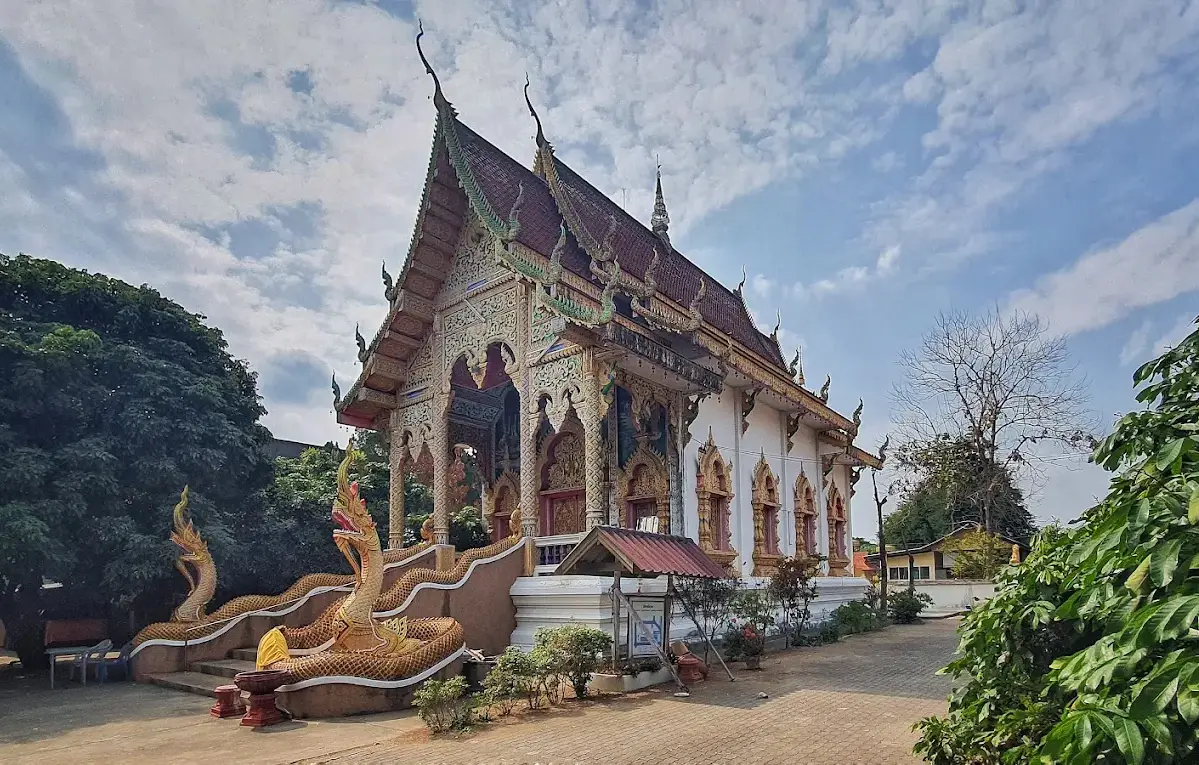
Open Days: Daily
Opening Hours: 08.00 – 17.00
Wat Nong Ueng is a local Buddhist temple under the Mahanikaya order, located at No. 59, Mu 5, Ban Nong Ueng, Makham Luang Subdistrict, San Pa Tong District, Chiang Mai Province. The temple land covers 1 rai, 1 ngan, and 99 square wah under land title deed No. 66914. It also has monastic land measuring 4 rai, 2 ngan, and 73 square wah under land title deed No. 66915. Wat Nong Ueng remains listed among the temples of Makham Luang Subdistrict and continues to serve as an important community religious center. Phra Khru Wapi Chanthophas Chantharansi is identified as the abbot of the temple.
The history of Wat Nong Ueng dates back to around 1867. The original site was a low-lying area where rainwater collected during the rainy season. The standing water formed a small natural pond, attracting frogs and ueng, a local term associated with small amphibians such as the bullfrog or narrow-mouthed frog. Because many of these animals lived in the area, villagers came to call the place Nong Ueng. Later, when the temple and surrounding settlement developed, the name became attached to both the village and the temple.
The name Wat Nong Ueng therefore reflects the local landscape. The word “nong” means a pond or waterlogged lowland, while “ueng” refers to the amphibians that once gathered there in large numbers. The name was not invented as a symbolic label; it grew from the actual environment of the community. This makes the temple name a record of local ecology, village memory, and the relationship between people and place.
During the early period of construction, the acting abbot and local devotees worked together to build temple structures such as monks’ residences, a viharn, and a hall. Local elders remembered the monk who initiated the construction as Khru Ba Wong. Once the temple had resident monks and novices in sufficient number, the community submitted a request through the Sangha hierarchy to establish the temple officially. The temple was named after Ban Nong Ueng, the village in Mu 5 of Makham Luang Subdistrict.
Makham Luang Subdistrict and San Pa Tong District provide important context for understanding Wat Nong Ueng. This area contains many village temples, including Wat Makham Luang, Wat Mongkhon, Wat Phrabat Yang Wit, Wat San Khayom, Wat Saeng Sawang, and other temples in the same cultural landscape. These temples show how Buddhism remains rooted at the village level in Lanna society. Each temple serves its own community while also forming part of a wider network of merit-making, local traditions, and religious life.
The temple boundaries also show its close connection with the village. To the north, the temple borders local residents’ land. To the south, it borders a public road. This location reflects the typical character of a Lanna community temple: it is surrounded by homes, paths, and everyday movement. Wat Nong Ueng is not separated from village life; it is part of the community structure where people gather, make merit, attend ceremonies, and maintain social bonds.
Important structures at Wat Nong Ueng include monks’ residences, a viharn, a sermon hall, an alms pavilion, and a kitchen. These structures support both monastic life and community activities. The monks’ residences allow monks and novices to live at the temple. The viharn serves as the main worship area. The sermon hall is used for Dharma listening and village gatherings. The alms pavilion supports food offerings and merit-making events. The kitchen is essential during temple festivals and community ceremonies.
The viharn is one of the most meaningful areas for visitors. It is the space where local residents pay respect, make merit, and calm the mind. A viharn in a village temple may not be grand in scale, but its value lies in being a sacred space actively used by the community. Worship inside the viharn is therefore a way to encounter the living faith of Ban Nong Ueng.
The sermon hall serves as a central community space. It is used for Buddhist holy days, Dharma listening, merit-making preparations, and religious events. In a Lanna village temple, the sermon hall often functions as both a religious and social center. It is where monks and laypeople meet, where villagers organize temple events, and where local relationships are renewed through shared religious practice.
The alms pavilion and kitchen are practical but highly important parts of the temple. They support food offerings, community cooking, Kathin ceremonies, pha pa merit-making, funeral rites, and annual Buddhist events. In Lanna temple culture, cooking together and preparing food for merit-making are forms of shared generosity. These spaces therefore represent the cooperative spirit of the village.
Phra Khru Wapi Chanthophas Chantharansi is the abbot of Wat Nong Ueng. The abbot plays an important role in maintaining the temple, leading monastic activities, guiding laypeople, coordinating merit-making events, and preserving the relationship between monks and villagers. In a long-established community temple, this role is essential for keeping the temple active and meaningful in everyday life.
Wat Nong Ueng is closely connected with the identity of Ban Nong Ueng. The temple did not develop only as a formal religious institution; it grew from local faith and community cooperation. Its construction involved monks, local leaders, and villagers who wanted a place for worship, Buddhist ceremonies, and monastic residence. Because the temple shares the name of the village, it functions as both a spiritual center and a symbol of local identity.
Temple activities follow the rhythm of Lanna community life. These include Buddhist holy day observances, Dharma listening, Kathin robe-offering ceremonies, pha pa merit-making, Songkran or northern Thai New Year activities, candle offerings for Buddhist Lent, the end of Buddhist Lent, and family merit-making ceremonies. During temple events, monks, elders, families, young people, and volunteers gather to prepare food, arrange the space, and participate in religious rituals.
Recent information about Kathin activities at Wat Nong Ueng also shows that the temple continues to function as a living place of merit-making. Kathin is an important annual ceremony after Buddhist Lent, allowing laypeople to support the monastic community through offerings of robes and other necessities. For a village temple such as Wat Nong Ueng, Kathin reinforces the bond between the temple and its devotees.
The main things to appreciate at Wat Nong Ueng are the atmosphere of a local village temple, the viharn, the sermon hall, the temple courtyard, and the community-use spaces. The temple is best experienced slowly and respectfully. Its value does not come from grandeur, but from its history, its name, its landscape, and its continuing role in the life of Ban Nong Ueng.
Visitors should pay respect at the main worship area inside the viharn. Making merit at Wat Nong Ueng can be understood as more than a personal request for blessings. It is also a way to acknowledge the faith that villagers have preserved for generations. Modest clothing, quiet behavior, and respectful movement through the temple grounds are appropriate throughout the visit.
Wat Nong Ueng is suitable for travelers interested in old community temples, Lanna village culture, and cultural routes in San Pa Tong. It is not a large tourist attraction, but it offers a meaningful local experience for those who want to understand how temples support everyday community life. Travelers who appreciate local names, landscape stories, and village religious traditions will find the temple especially interesting.
Wat Nong Ueng can be included in a connected San Pa Tong route. Nearby places include Wat Saeng Sawang, Wat Makham Luang, Wat Phrabat Yang Wit, Wat Mongkhon, Wat San Khayom, Thung Fa Bot Market or Kad Ngua San Pa Tong, and Wiang Tha Kan Ancient Town. This route works well for a half-day or full-day trip combining temple visits, local food, community culture, and historical heritage.
Getting There is easiest by private car or rental car. From Chiang Mai city, take the Chiang Mai–Hot Road, also known as Highway 108, toward San Pa Tong District. Continue into Makham Luang Subdistrict and Ban Nong Ueng, Mu 5. Local roads lead through the village area, so drivers should proceed carefully, especially on Buddhist holy days, weekends, and temple-event days.
The best time to visit is in the morning or afternoon before evening. These periods are suitable for worship, walking quietly around the temple, and continuing to nearby attractions. Travelers who want to visit Thung Fa Bot Market should plan their travel day according to the market schedule. A private vehicle is the most convenient option for linking temples, restaurants, and cultural sites in San Pa Tong.
Visitors should follow normal Thai temple etiquette. Dress modestly, keep voices low, avoid touching sacred objects without permission, do not disturb monks or local residents, and take photographs respectfully. If visiting during a ceremony or merit-making event, follow the guidance of the temple and local community. Wat Nong Ueng is best appreciated as a living village temple, not merely as a sightseeing stop.
In summary, Wat Nong Ueng is an old community temple in Makham Luang Subdistrict, San Pa Tong District, Chiang Mai. Its history dates to around 1867, and its name comes from a former lowland pond where frogs and ueng once gathered in large numbers. The temple contains monks’ residences, a viharn, a sermon hall, an alms pavilion, and a kitchen. With Phra Khru Wapi Chanthophas Chantharansi as abbot, the temple continues to serve as a spiritual and social center for Ban Nong Ueng. For travelers seeking a quieter and more local side of Chiang Mai, Wat Nong Ueng offers a sincere view of Lanna village faith and community life.
| Name | Wat Nong Ueng |
| Location | Ban Nong Ueng, Mu 5, Makham Luang Subdistrict, San Pa Tong District, Chiang Mai Province |
| Address | No. 59, Mu 5, Makham Luang Subdistrict, San Pa Tong District, Chiang Mai Province |
| Place Type | Local Buddhist temple under the Mahanikaya order |
| Temple Area | Temple land: 1 rai, 1 ngan, 99 square wah; monastic land: 4 rai, 2 ngan, 73 square wah |
| Highlights | An old community temple named after a former pond area where frogs and ueng once gathered, reflecting the link between local ecology, village memory, and faith |
| History | Established around 1867, with Khru Ba Wong remembered locally as an important monk who initiated the temple construction |
| Name Origin | The name comes from a former lowland pond where many frogs and ueng lived; villagers later used Nong Ueng as the name of the village and temple |
| Distinctive Features | A quiet Lanna community temple with religious structures supporting worship, merit-making, and annual village activities |
| Travel Information | From Chiang Mai city, take the Chiang Mai–Hot Road toward San Pa Tong, then continue into Makham Luang Subdistrict and Ban Nong Ueng, Mu 5; private car or rental car is most convenient |
| Current Status | The temple still appears in current temple listings for Makham Luang Subdistrict, San Pa Tong District, Chiang Mai Province, and has recent Kathin activity records |
| Open Days | Daily |
| Opening Hours | 08.00 – 17.00 |
| Important Structures | Monks’ residences, viharn, sermon hall, alms pavilion, and kitchen |
| Abbot / Caretaker | Phra Khru Wapi Chanthophas Chantharansi |
| Key Boundaries | North borders local residents’ land; south borders a public road |
| Nearby Tourist Attractions | 1. Wat Saeng Sawang, about 2 km 2. Wat Makham Luang, about 4 km 3. Wat Phrabat Yang Wit, about 4 km 4. Thung Fa Bot Market / Kad Ngua San Pa Tong, about 5 km 5. Wiang Tha Kan Ancient Town, about 9 km |
| Nearby Restaurants | 1. Klin Kaprao Khao Ho Mok San Pa Tong, about 3 km, Tel. 093-243-8923 2. Delicious Pork Noodles Makham Luang, about 3 km, Tel. 087-195-3342 3. Kap Khao Maton, about 4 km, Tel. 084-615-7789 4. Mae Phrom Makham Luang A La Carte, Noodles and Som Tum, about 4 km, Tel. 089-998-2236 5. Charcoal Pork Leg Rice San Pa Tong, about 6 km, Tel. 081-881-5112 |
| Nearby Accommodations | 1. Tai Resort Sanpatong, about 5 km, Tel. 063-096-7000 2. Home Thai Resort, about 7 km, Tel. 063-952-8228 3. P Resort & W Resort, about 8 km, Tel. 064-334-4566 4. Bannoi Himsuan, about 11 km, Tel. 090-329-6108 5. Kaomai Lanna Resort, about 12 km, Tel. 053-481-201, 086-428-7481 |
Frequently Asked Questions (FAQ)
Q: Where is Wat Nong Ueng located?
A: Wat Nong Ueng is located at No. 59, Mu 5, Ban Nong Ueng, Makham Luang Subdistrict, San Pa Tong District, Chiang Mai Province.
Q: When was Wat Nong Ueng established?
A: Wat Nong Ueng was established around 1867.
Q: What is the origin of the name Wat Nong Ueng?
A: The name comes from a former lowland pond where many frogs and ueng lived. Villagers later used Nong Ueng as the name of the village and temple.
Q: Who is the abbot of Wat Nong Ueng?
A: Phra Khru Wapi Chanthophas Chantharansi is identified as the abbot of Wat Nong Ueng.
Q: What important structures are found at Wat Nong Ueng?
A: Important structures include monks’ residences, a viharn, a sermon hall, an alms pavilion, and a kitchen.
Q: What type of traveler is Wat Nong Ueng suitable for?
A: It is suitable for travelers interested in Lanna community temples, old village temples, merit-making, and cultural routes in San Pa Tong.
Q: What is the best way to get to Wat Nong Ueng?
A: A private car or rental car is the most convenient option. Take the Chiang Mai–Hot Road toward San Pa Tong, then continue into Makham Luang Subdistrict and Ban Nong Ueng, Mu 5.
 Category: ●Places of Worship
 Group: ●Temple
Last Update : 1 MonthAgo
 Last Update : 1 MonthAgo
 Click to Access the Navigation Map GPS

 Muang Chiang Mai(121)Chom Thong(47)Mae Chaem(25)Chiang Dao(33)Doi Saket(68)Mae Taeng(85)Mae Rim(69)Samoeng(29)Fang(71)Mae Ai(59)Phrao(70)San Pa Tong(103)San Kamphaeng(66)San Sai(73)Hang Dong(73)Hot(32)Doi Tao(22)Omkoi(11)Saraphi(74)Wiang Haeng(15)Chai Prakan(28)Mae Wang(32)Mae On(22)Doi Lo(33)Galyani Vadhana(1)


